What goes in a used-car deal jacket: the complete checklist
The documents a used car dealer needs for every sale: federal disclosures, the money paperwork, title forms, BHPH additions, and a 5-minute deal jacket audit.
Switching from another DMS? Compare DealerVLO to DealerCenter, Frazer, or Lot Wizard.
Nobody gets into the car business because they love filing. But when something comes back on a deal — a title question eight months later, a warranty complaint, a lender asking for the odometer statement, your state running a routine audit — the entire conversation comes down to one question: can you produce the paperwork for that deal, right now?
The deal jacket is how you answer yes. One deal, one file, everything in it. This is the checklist I actually use — what belongs in every jacket, what BHPH adds, and the five-minute test that tells you whether your files would survive someone else reading them.
14-day free trial, then $29/mo · Cancel anytime
What a deal jacket is — and the one rule that matters
A deal jacket is the complete record of a single vehicle sale. Folder or digital record, doesn't matter — what matters is the rule: if it touched the deal, it goes in the jacket. Not in a desk drawer, not in a "misc" pile, not in your email. The jacket is the single place where the whole transaction lives.
The reason is boring and important: every document in a car deal exists because someone with authority can ask for it later. The FTC can ask for the Buyers Guide. The state can ask for the title application and the tax math. A lender can ask for the odometer statement. A buyer's lawyer can ask for all of it. You don't get to reconstruct any of this from memory two years later — either the jacket has it or it doesn't.
The federal layer — same on every lot in the country
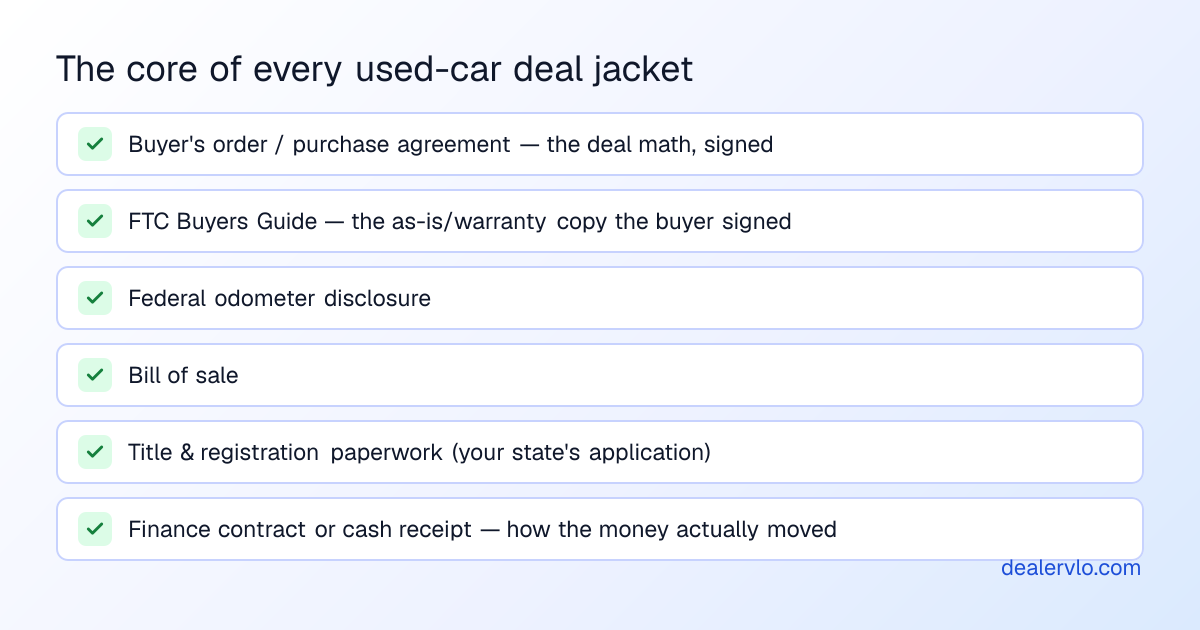
Two documents are in every used-car jacket in America, no matter the state:
The signed FTC Buyers Guide. The window sticker required by the FTC Used Car Rule — as-is or warranty, what's covered, what's not. The part dealers miss: the Buyers Guide isn't done when it comes out of the window. The buyer signs it (or you keep the acknowledged copy per the rule's current form), and that copy goes in the jacket. A Buyers Guide that was displayed but can't be produced later does you very little good in a dispute — the whole point is proving what the buyer was told.
The federal odometer disclosure. Required on most transfers, signed by both sides, mileage stated with the correct status — actual, exceeds mechanical limits, or not actual. If you've read my guide to buying at auction, you know mileage status is also a buying issue; on the selling side, the disclosure in the jacket is what shows you passed along the truth you were given.
Alongside those two, keep your identity and screening record — a copy of the buyer's license and the note that you ran your OFAC/identity checks. It takes a minute at the desk and it's exactly the kind of thing you can't recreate after the fact.
The money layer — what was agreed and how it was paid
This is the part of the jacket that settles arguments, because money is what people argue about.
- The buyer's order / purchase agreement — sale price, trade allowance, fees, tax, the numbers both sides signed. This is the spine of the jacket; everything else should agree with it.
- The bill of sale.
- Trade-in paperwork — the trade's title status, the lienholder's payoff quote in writing with its good-through date and per diem, and later, proof you actually sent the payoff. Trade payoffs are one of the fastest ways a small dealer ends up in a regulator's file; the jacket is your defense that you handled it straight.
- The finance contract or the cash receipt. However the money moved, the jacket shows it. If more than $10,000 of it was cash on a car over $10,000, add your copy of Form 8300 and the buyer's January statement.
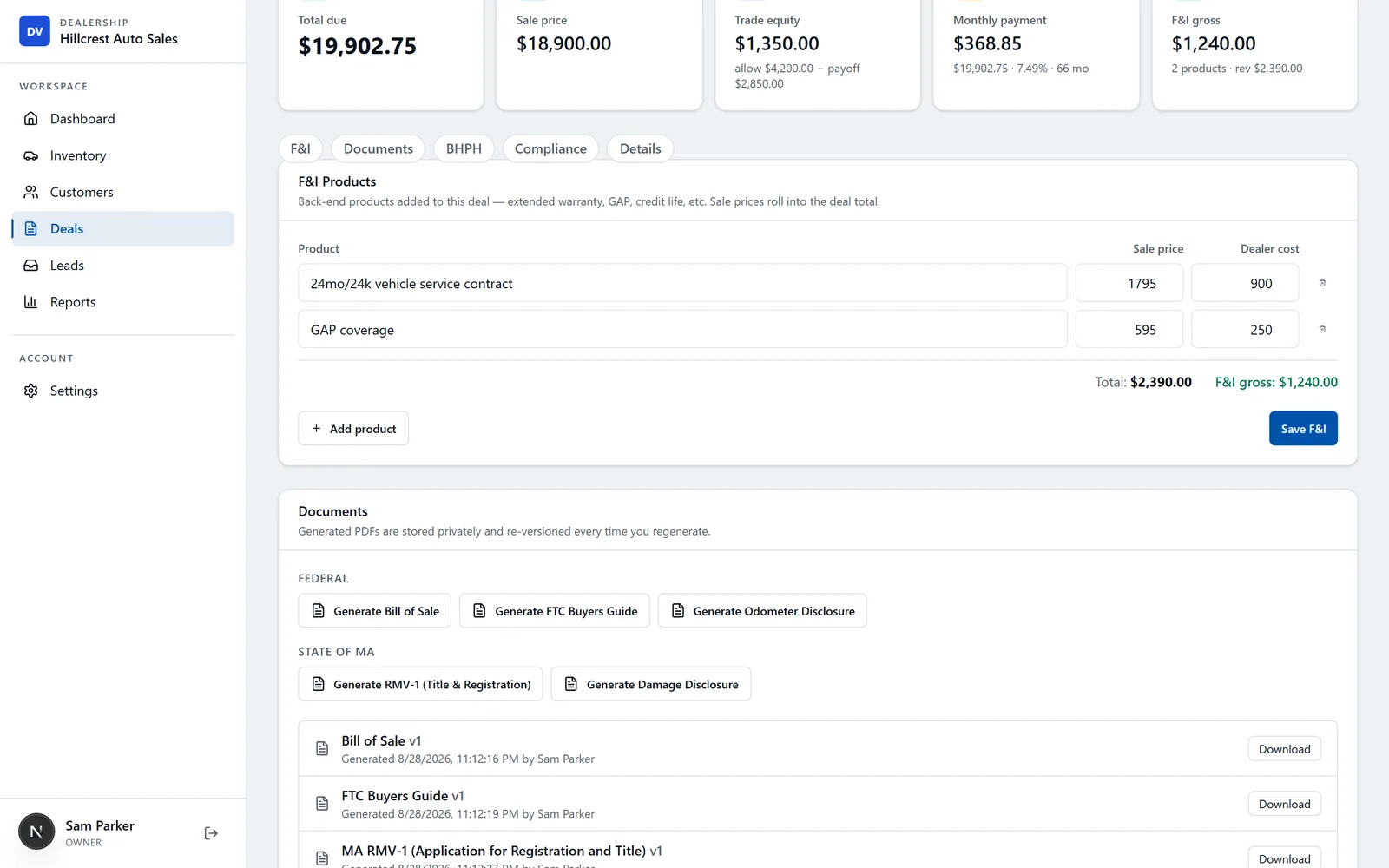
- F&I product contracts — if the deal included a service contract or GAP, the signed product paperwork lives here too, because "what did the customer actually buy" is precisely the question that comes up later.
One habit worth stealing: the numbers on the buyer's order, the state title application, and the finance contract must match. When they're typed three separate times, eventually they won't — and a jacket that disagrees with itself is worse than a thin one, because now it looks like something other than a typo.
The title layer — your state's paperwork
Every state has its own title and registration application — here in Massachusetts it's the RMV-1; your state has its equivalent — plus whatever your state layers on top (damage disclosures, inspection paperwork, temp tag records). I'm not going to pretend to recite fifty states' requirements from memory, and you shouldn't trust any blog post that does. The shape is what's universal: the completed application, anything the buyer signed, and proof of submission all go in the jacket — and if the deal crossed a state line, the out-of-state checklist gets its own layer.
This layer is also where the retyping problem is worst — VIN, buyer, lienholder, and the same tax math, entered again onto an official form where an error means doing it over at the registry. It's the part of the deal I got tired of enough to build software over.
The BHPH addition — the jacket becomes a loan file
If you carry the note yourself, the jacket doesn't close when the car leaves — it stays open for the life of the loan. On top of the retail set:
- The signed note with payment amount, schedule, and terms spelled out.
- The down-payment receipt and the payment schedule.
- Your underwriting record — what income, residence, and references you verified. When a deal defaults, the file that shows you underwrote it honestly is worth a great deal.
- The running payment ledger — every payment, dated. Not a shoebox of receipts: a ledger.
BHPH is where thin jackets hurt the most, because the customer relationship lasts years and the file is the memory.
14-day free trial, then $29/mo · Cancel anytime
Build it in deal order, not after the fact
The failed version of deal-jacket discipline is "we gather it all up on Friday." Paper the deal as it happens and the jacket assembles itself:
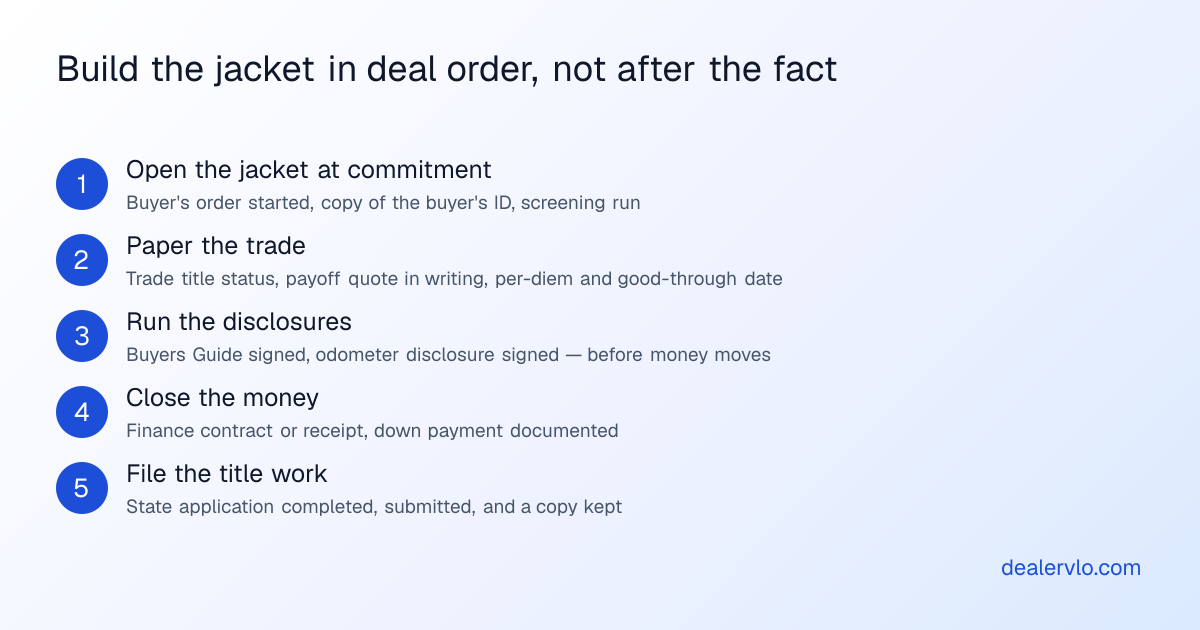
The sequence matters because each step produces its documents naturally — the payoff quote exists while you're appraising the trade, the disclosures get signed while the buyer is at the desk, and nothing depends on anyone's memory. On a small lot where you're the closer, the finance office, and the title clerk all at once, deal-order filing is the only version that survives a busy Saturday.
The 5-minute audit test
Here's the standard I'd hold any lot to, mine included: pull a random deal from last year and try to produce the file, complete, in five minutes.
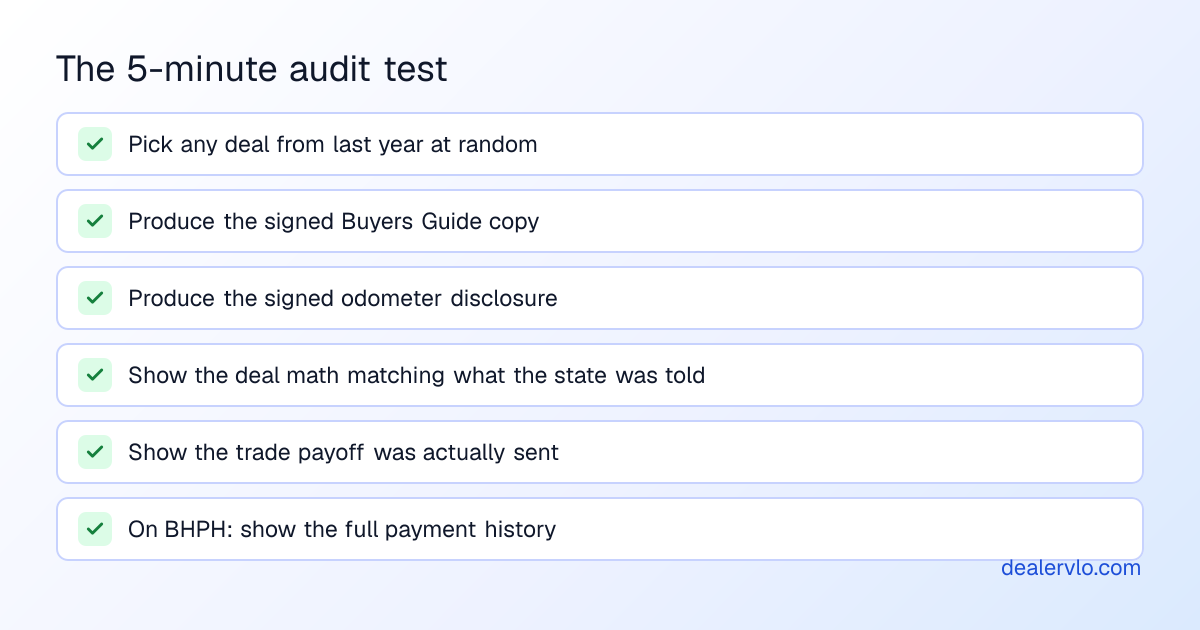
If you pass, your paperwork is an asset — audits are boring, disputes get short, and when you eventually sell the dealership or bring in a partner, your files say "well-run lot." If you fail, you now know exactly which layer is leaking, and it's almost always one of two: the signed federal copies never made it back into the folder, or the trade payoff trail is incomplete.
Every layer above on a single page — tape it to the desk where deals get papered. Enter your email and it opens ready to print; you'll also get the monthly operator letter (unsubscribe anytime).
How long to keep jackets
Retention rules come from more than one direction — your state's dealer regulations, tax records, and the federal rules behind the disclosures — and the honest answer is that the required periods vary. Many dealers keep every jacket at least five to seven years, and BHPH files for the life of the note plus several more. Storage is cheap and regret is not; confirm the specific number with your state dealer association or your accountant, then keep them longer than that.
Frequently asked questions
What is a deal jacket?
The file — physical folder or digital record — holding every document from one vehicle sale: deal math, federal disclosures, title paperwork, payment records, and everything the buyer signed. One deal, one jacket.
What documents does a used car dealer need for every sale?
The core set: buyer's order, signed FTC Buyers Guide, federal odometer disclosure, bill of sale, the state title/registration paperwork, trade payoff proof if there was a trade, the finance contract or cash receipt, ID and screening records, and any F&I product contracts. BHPH adds the full loan file.
How long should a dealer keep deal jackets?
Requirements vary by state and by which rule you ask. Many dealers keep every jacket five to seven years and BHPH files for the life of the loan plus several years — confirm your state's number with your dealer association or accountant.
Is a digital deal jacket acceptable?
For most purposes, yes — and it's far easier to search. Many states still require wet-ink originals on certain title documents, so plenty of dealers run paper for the signed originals and digital for everything else. The real requirement is retrievability years later.
What extra paperwork does a BHPH deal need?
The signed note, payment schedule, down-payment receipt, your underwriting record, and the running payment ledger — kept current for the life of the loan.
Bottom line
The deal jacket is the cheapest insurance in this business: it costs minutes per deal and it's the whole ballgame the day someone official asks about a sale. Use the checklist, build it in deal order, and run the five-minute test on yourself once a quarter.
And if the part you hate is typing the same VIN and buyer onto four documents — that's the exact problem DealerVLO was built to remove. Enter the deal once; the buyer's order math, the federal documents, and your state's title forms all generate from that one record, versioned and stored so the jacket passes the five-minute test by default. It's $29/month flat, with a free 14-day trial — no charge until day 14.
14-day free trial, then $29/mo · Cancel anytime
Structure an in-house note — payment, total interest, and what it collects per month — for any weekly, bi-weekly, or monthly term.
Open the BHPH Payment Calculator