The FTC Safeguards Rule and Your Dealer Software: Where You Store Customer Data Now Matters
Arrange financing and the FTC Safeguards Rule covers your lot — so how you store customer SSNs and licenses is now a liability. What it requires, and what software can't fix.
Most independent dealers I know think about compliance as the stuff on the paperwork — the disclosures, the odometer statement, the Buyers Guide in the window. The one almost nobody thinks about is the quietest and, increasingly, the most dangerous: what happens to the pile of Social Security numbers, driver's licenses, and bank details you collect on every financed deal.
Here's the part that catches lots off guard. If you help customers get financing — and almost every used-car lot does — the FTC considers you a "financial institution," which puts you squarely under the Safeguards Rule. That means how you store that customer data isn't just good practice anymore; it's a federal requirement with real teeth, and the FTC has been enforcing it harder. This isn't legal advice, and I'd point you to the FTC's own guidance and an attorney for your specifics — but every operator should understand the shape of it, because a lot of the exposure comes down to the software you already use.
Why the Rule applies to your lot
The trigger is financing. Under the Gramm-Leach-Bliley Act, a business that arranges credit is a financial institution, and the FTC's Safeguards Rule requires financial institutions to protect the customer information they collect. Arrange one loan through a lender, run one credit app, carry one buy-here-pay-here note, and you're handling exactly the kind of data the Rule is built around.
If you genuinely only do cash deals and never touch a credit application, the analysis is different. But that's not most lots. For most of us, the question isn't whether the Rule applies — it's whether our systems are set up the way it expects.
What the Rule actually expects
Strip out the legalese and the Rule asks you to build a written security program around a handful of technical and organizational safeguards:
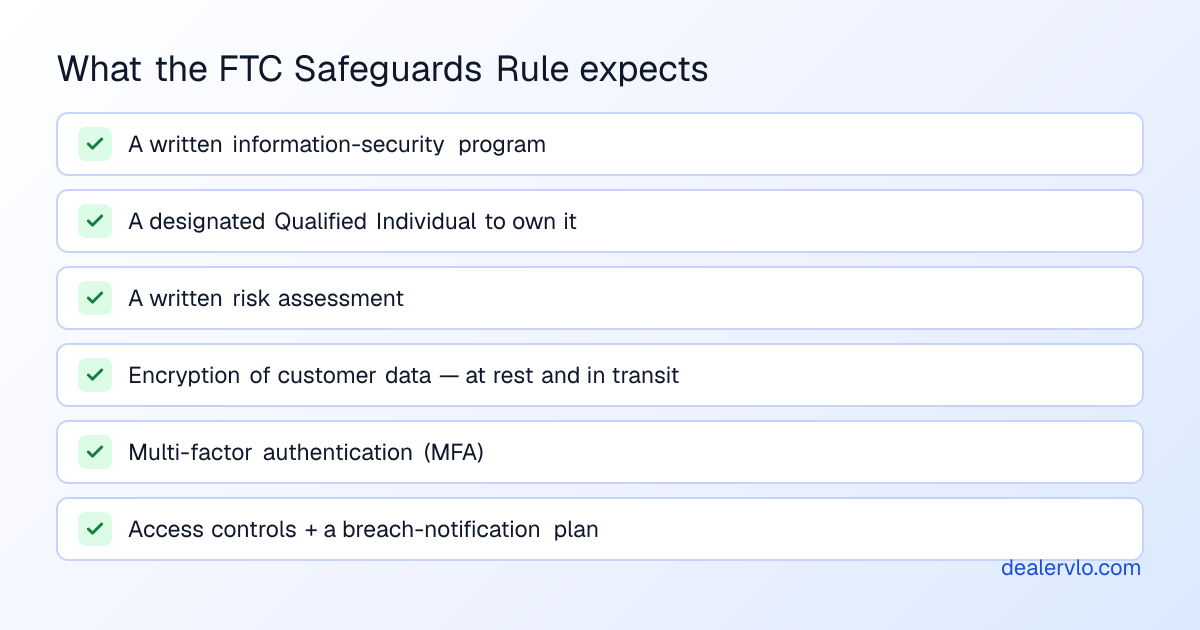
Two of those are pure software questions — encryption of customer data at rest and in transit, and access controls including multi-factor authentication. The rest — a written program, a designated Qualified Individual to own it, a risk assessment — are things you put in place around the software. Hold that split in your head, because it's the whole point of this post: some of these your system either does or doesn't do, and some are on you no matter what you buy.
Add up the real first-year cost of getting licensed in your state.
Open the Dealer License Cost CalculatorWhere a local desktop DMS leaves you exposed
This is the part that should make an operator on legacy software sit up. A lot of the older dealer programs are desktop software — the database lives in a file on one computer in your store, and other machines connect to it over your shop network. That was normal for decades. Under the Safeguards Rule, it's a liability.
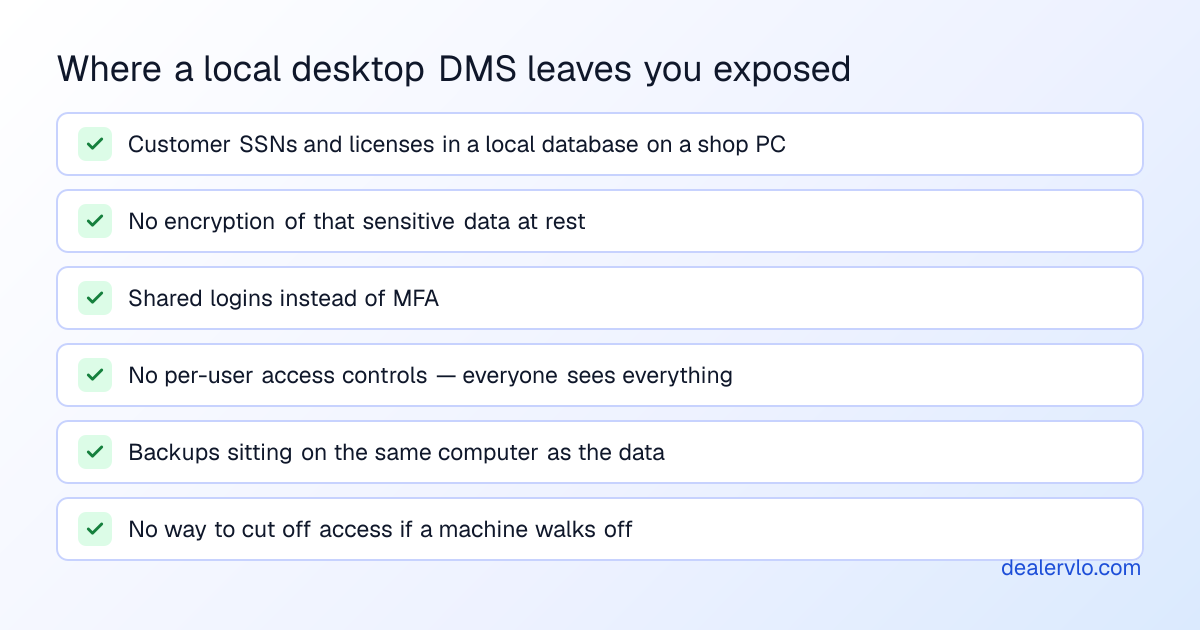
Think about what's actually sitting on that machine: every customer's Social Security number, license, and bank info, often unencrypted, protected by whatever that particular PC happens to have. One shared login the whole store uses. Backups on the same drive. And if that computer is stolen, or an old one gets sold or tossed without being wiped, the data walks out with it. That's not a hypothetical — it's the exact scenario the Rule's encryption and access-control requirements exist to prevent. (To be fair: desktop software can be locked down, and some desktop vendors now offer hosted cloud versions — the exposure is the default local setup, not any one brand.)
This is a big piece of why I think the move from desktop to cloud is more than a convenience upgrade at this point. It changes where your customers' most sensitive data lives and who can get to it.
What software can — and can't — do for you
Here's where I have to be straight with you, because it's where a lot of vendors aren't. No software makes you "Safeguards compliant." Compliance is a program, not a product. What good software does is remove the hardest technical gaps so the rest is manageable.
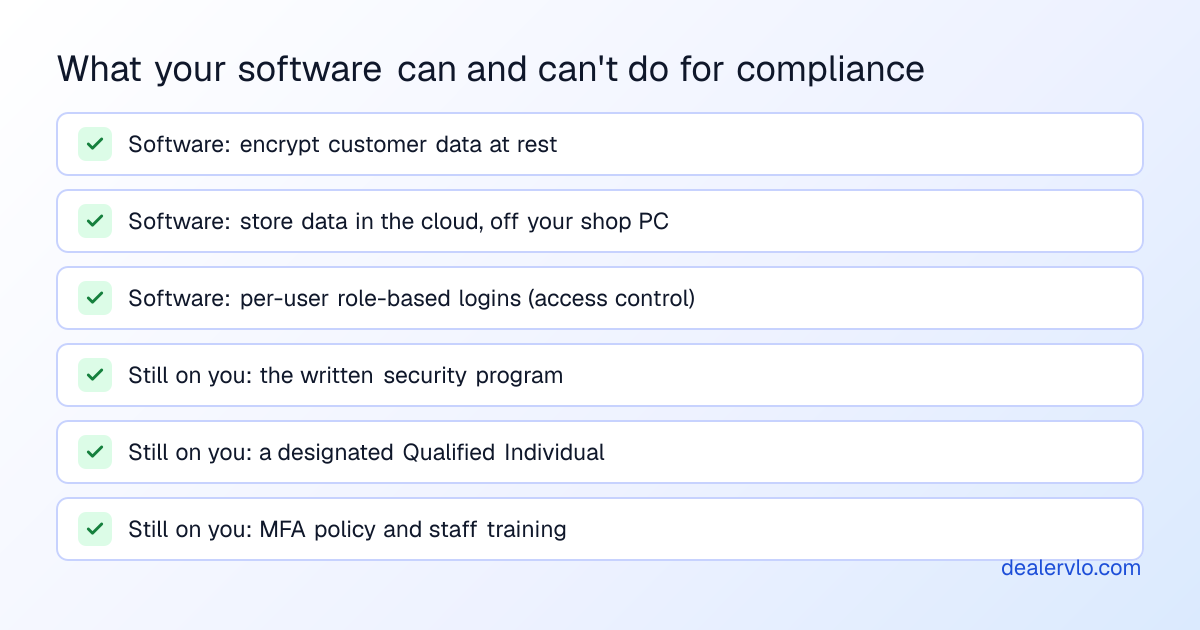
The pieces software can genuinely cover: encrypting sensitive customer data at rest, keeping that data on managed cloud infrastructure instead of a shop PC, and giving every person their own role-based login instead of a shared password. That's real, and it's exactly the technical bar a local desktop file struggles to meet. On my own lot, this is deliberate — DealerVLO encrypts customer driver's-license numbers at rest with AES-256, stores data in the cloud, and every user has their own role-based login, so access is controlled and nothing rides on a shared password.
But — and this is the honest part — the Rule also requires a written information-security program, a designated Qualified Individual responsible for it, multi-factor authentication actually turned on and enforced, a risk assessment, and staff who are trained. No DMS writes your program or trains your people. Software is necessary, not sufficient. Anyone selling you "buy this and you're compliant" is selling you a false sense of security along with it.
Where to start
You don't have to solve all of it this week. Start by knowing where your customers' data actually lives and who can reach it — if the answer is "a file on the front-desk computer that we all log into with the same password," that's your first fix. Then read the FTC's Safeguards Rule guidance, and if you're on a legacy desktop setup, seriously weigh moving that data somewhere encrypted and access-controlled. The move off desktop is usually easier than dealers expect, and it closes the widest gap in one step. For the program side — the written policy, the Qualified Individual, the training — talk to an attorney or a compliance resource that knows auto retail.
Frequently asked questions
Does the FTC Safeguards Rule apply to used car dealers? Yes, if you arrange financing or leasing — the FTC treats you as a financial institution under GLBA, which covers most independent lots including BHPH. The Rule requires a written program to protect the customer financial data you collect. Cash-only with no credit apps is a different analysis, but most lots are covered. Not legal advice — confirm with the FTC's guidance and an attorney.
Does my dealer software need to encrypt customer data? The Rule requires customer information to be encrypted at rest and in transit, so your system needs to support that. A desktop program storing SSNs in an unencrypted local file is the exact gap. Cloud software that encrypts sensitive fields at rest — DealerVLO uses AES-256 on customer license numbers — handles that piece, though it's one requirement of several.
Is cloud-based dealer software more secure than a desktop program? For the Rule's requirements, a well-built cloud system usually starts you closer to compliant — it can encrypt data at rest, keep it off your shop PC, and give each user their own login. Desktop can be secured too, and some vendors offer hosted versions, but the default local install is what most often leaves a lot exposed.
What happens if a dealer doesn't comply with the Safeguards Rule? The FTC can bring enforcement actions and impose significant civil penalties, and enforcement is increasing — but the real risk for a small lot is a breach: leaked SSNs and bank details mean notification obligations, cost, and trust damage with your community. Treat it as protecting customers, not checking a box. Consult the FTC and an attorney for penalty specifics.
Does using DealerVLO make my dealership Safeguards-compliant? No — be skeptical of any software that claims it does. DealerVLO covers technical pieces (encryption at rest, cloud storage, per-user role-based logins), but the Rule also requires a written program, a Qualified Individual, MFA, a risk assessment, and training — things software can't do for you. Good software removes the hardest technical gaps; you own the program around it.
Bottom line
The customer data you collect on every financed deal is a liability the day you collect it, and the FTC Safeguards Rule made that official. Two of its core requirements — encryption and access control — are decided by the software your data lives in, and a local desktop file of unencrypted SSNs is the wrong answer. Fix where the data lives first; it's the widest gap and the fastest to close. Then build the program around it, because no tool does that part for you.
DealerVLO keeps customer data encrypted at rest and in the cloud, with a role-based login for every user — so the technical half of this is handled, and you can focus on the program. Start a free trial and stop keeping your customers' Social Security numbers in a file on the front-desk PC.