How to fill out the RMV-1 in Massachusetts
A field-by-field walkthrough of the Massachusetts RMV-1 (Registration and Title Application) for licensed used car dealers — what goes in every section, who signs what, and the documents you attach. Verified against the official form as of June 2026.
Don't waste another second filling out the Massachusetts RMV-1.
Let DealerVLO fill out every form for you instantly.
Filing these every week? DealerVLO fills the RMV-1 from the deal you already entered, $29/month flat. See pricing
Switching from another DMS? Compare DealerVLO to DealerCenter, Frazer, or Lot Wizard.
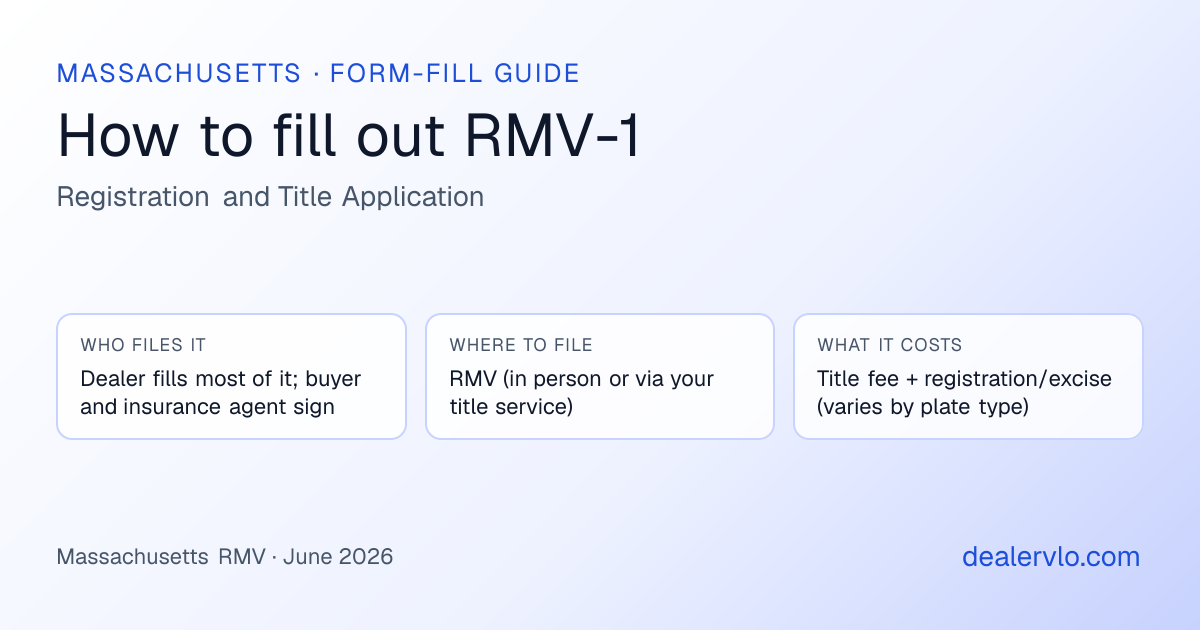
Filling out the MA RMV-1 after a sale:
- What it is
- MA's combined vehicle registration + title application
- Who completes it
- Dealer fills most of it; buyer and insurance agent sign
- Where to file it
- RMV (in person or via your title service)
- Processing time
- Same-day plates; title mailed in ~6–8 weeks
- Cost
- Title fee + registration/excise (varies by plate type)
This guide is informational and does not replace the official Massachusetts instructions. Always confirm the current form and procedure with the Massachusetts RMV before you file.
See the MA RMV-1 filled — from just a VIN
Enter a VIN, the buyer's name, and the price. We decode the vehicle and drop it onto the actual Massachusetts RMV-1 — the same fill DealerVLO produces from a deal. Watermarked preview; nothing is saved.
What the RMV-1 is and why it matters
If you sell cars in Massachusetts, the RMV-1 is the form that actually transfers the vehicle. Until it's completed, stamped by an insurance agent, and filed, your buyer can't title the car, can't register it, and can't legally drive it off your lot. It's the single most important piece of paper in a Massachusetts deal jacket.
The form looks intimidating because it packs owner, vehicle, title, lien, and dealer information onto one page — but each section is short, and as the dealer you only complete part of it. This walkthrough covers every section, shows exactly who is responsible for each field, and flags the errors that send a title application back from the RMV.
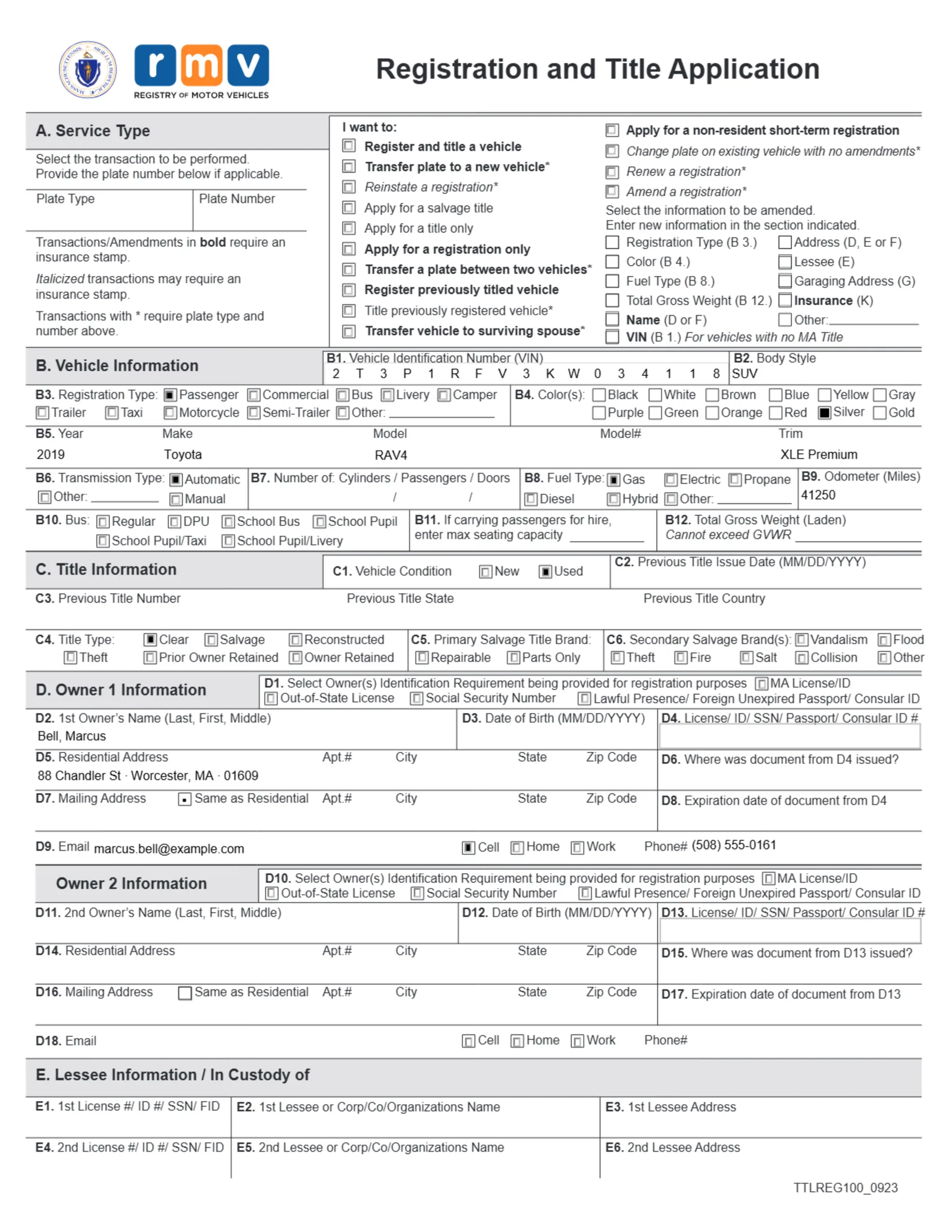
Massachusetts has consolidated the old RMV-1 (registration/title) and RMV-3 forms into a single Registration and Title Application (RTA). Most dealers, insurance agents, and title runners still call it “the RMV-1,” and the published fillable PDF (TTLREG100) carries the same section layout described below. If your form's header reads “Registration and Title Application,” you're in the right place.
Documents to have before you start
Gather these before you complete the RMV-1. A missing attachment is the number-one reason the the Massachusetts RMV bounces a title application back.
- The properly assigned title (or MCO for new vehicles) — Front-and-back complete: prior owner's release, odometer, and your dealer reassignment if the car passed through your inventory.
- Bill of sale — Shows the buyer, the vehicle, and the agreed sale price used for excise tax.
- Active Massachusetts insurance — A licensed MA insurance agent must stamp and sign the RMV-1 confirming the buyer has coverage — the RMV will not process the form without the insurance stamp.
- Proof of the buyer's identity — MA driver's license or ID; the buyer's license number goes on the registration.
- Lienholder details, if financed — Exact legal name and mailing address of the lender so the title prints with the lien recorded.
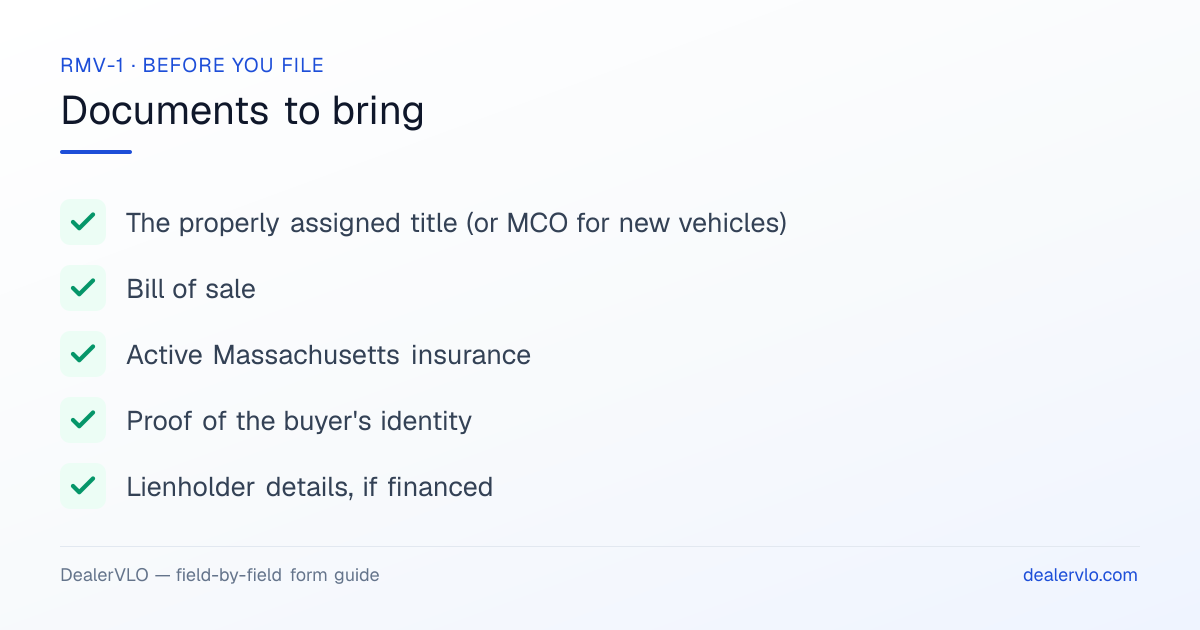
RMV-1, section by section
Section A — Owner / applicant information
This is the buyer (the new owner), not you. Enter the primary owner's full legal name, date of birth, and Massachusetts residential address exactly as they appear on the buyer's license. A co-buyer goes in the Owner 2 fields.
| Field | Who fills it |
|---|---|
Owner 1 full name (Last, First, Middle) From the buyer's license — match it exactly. | You (dealer) |
Owner 1 date of birth | You (dealer) |
Owner 1 Massachusetts address | You (dealer) |
Owner 2 / co-buyer (if any) Only if the deal has a co-buyer. | You (dealer) |
Social Security number Often left blank by the dealer and completed at the counter — it isn't on the deal jacket. | Buyer |
Driver's license number | Buyer |
Section B — Vehicle information
Everything that identifies the car. Most of this decodes straight from the VIN. Double-check the VIN character-for-character against the title and the dash — a single transposed digit is the most common rejection.
| Field | Who fills it |
|---|---|
VIN Verify against the title and the vehicle, not just your records. | You (dealer) |
Year, make, model | You (dealer) |
Body style / type | You (dealer) |
Color Use the RMV's color names, not the manufacturer's marketing name. | You (dealer) |
Cylinders, fuel type, transmission | You (dealer) |
Odometer reading Must match the odometer disclosure on the assigned title. | You (dealer) |
Registration / plate type Passenger, commercial, etc. — confirmed with the buyer. | Buyer |
Section C — Title information
Where the prior title came from. For a used car you sold, you're carrying forward the previous title's number and state, and confirming the vehicle's condition and title type.
| Field | Who fills it |
|---|---|
Previous title number | You (dealer) |
Previous title state | You (dealer) |
Vehicle condition “Used” for a dealer-sold second-hand vehicle. | You (dealer) |
Title type “Clear” by default — change only for salvage/rebuilt/reconstructed titles. | You (dealer) |
Section D — Lienholder information
If the buyer paid cash, leave this blank. If you arranged or assigned financing, record the lender so the lien is printed on the new title and the RMV mails the title to the right place.
| Field | Who fills it |
|---|---|
Lienholder legal name Cash deal? Leave the whole section empty. | You (dealer) |
Lienholder mailing address | You (dealer) |
Date of lien Usually the sale date. | You (dealer) |
Section E — Dealer / seller information
This is you. Your dealership's name and license number identify the selling dealer; the sale date and price drive the excise tax calculation. Be accurate — the price here should match your bill of sale.
| Field | Who fills it |
|---|---|
Dealer name | You (dealer) |
Dealer license number | You (dealer) |
Sale date | You (dealer) |
Sale price Match the bill of sale; this is what excise tax is computed on. | You (dealer) |
Trade-in indicator + allowance Check the trade-in box and enter the allowance when there's a trade on the deal. | You (dealer) |
MA Sales tax & title fee calculator
Free · no signup · updates as you type
Massachusetts collects 6.25% sales/use tax on the sale price less trade-in at registration. This is separate from the annual municipal motor-vehicle excise, which your city or town bills later based on the vehicle's list price and age — not this sale. Title fee $75; registration fees vary by plate type. Informational only; confirm current fees with the MA RMV.
Stop re-keying this onto the RMV-1.
DealerVLO runs this math on every deal and drops it — with the VIN, buyer, and sale price — straight onto the official MA RMV-1, the bill of sale, and the FTC forms. One screen, no re-keying.
14-day free trial — no charge until day 14, then $29/month. Cancel any time.
Section F — Insurance stamp
The RMV will not process the form without proof of active Massachusetts coverage. The buyer's insurance agent stamps and signs this block. You can't complete it yourself — it has to be a licensed MA agent.
| Field | Who fills it |
|---|---|
Insurance company + policy number | Insurance agent |
Agent stamp Required — the form is rejected without it. | Insurance agent |
Agent signature + date | Insurance agent |
Section G — Signatures
The form is signed in person. The buyer signs as the new owner; you sign as the selling dealer. Don't pre-sign — both signatures should be wet-ink at the desk when the deal closes.
| Field | Who fills it |
|---|---|
Owner / buyer signature | Buyer |
Dealer signature | You (dealer) |
The RMV-1 is one car's paperwork. A 20-second read on your lot, and the tax-and-fee math for the whole deal — built for dealers, no signup. Free calculators dealers actually use — no signup, no email.
DealerVLO fills the official Massachusetts RMV-1 straight from your deal — VIN-decoded vehicle, buyer, co-buyer, and sale price already in place. $29/month, free to try — cancel any time.
Common RMV-1 mistakes that cause rejections
The single most common rejection. The RMV-1 is not valid until a licensed Massachusetts insurance agent stamps Section F. Send the buyer to their agent (or your in-house agent) before filing — a printed RMV-1 with an empty insurance block gets handed right back.
The VIN on the RMV-1, the assigned title, and the vehicle must be identical, and the odometer reading must match the disclosure on the title. Verify all three against each other, not just against your DMS record.
Excise tax is calculated from the price in Section E. If it disagrees with your bill of sale, expect questions and delay. Keep the two documents in sync, and apply the trade-in allowance correctly when there's a trade.
Use the buyer's full legal name exactly as printed on their Massachusetts license — including middle name or suffix. A nickname or dropped middle initial can stall the title.
If the car is financed, the lender's exact legal name and address must be in Section D, or the title prints without the lien recorded — a serious problem for the lender and for you.
Common questions
Is the RMV-1 the same as the Registration and Title Application?+
Yes. Massachusetts merged the old RMV-1 and RMV-3 forms into a single Registration and Title Application (RTA). The industry still calls it “the RMV-1,” and the section layout — owner, vehicle, title, lien, dealer, insurance, signatures — is the same. If your form header says Registration and Title Application, that's the current RMV-1.
Who fills out the RMV-1 — the dealer or the buyer?+
The dealer completes most of it: owner information from the buyer's license, the vehicle details, title and lien information, and the dealer/sale block. The buyer provides their Social Security number, license number, and plate type, and signs at the desk. A licensed Massachusetts insurance agent stamps and signs the insurance section. All three are needed before filing.
Why does the RMV-1 need an insurance stamp?+
Massachusetts requires proof of active insurance before a vehicle can be registered. The RMV will not process the RMV-1 until a licensed MA insurance agent stamps and signs the insurance block confirming coverage. This is the most common reason a form gets rejected, so handle it before you file.
Where do I file the completed RMV-1?+
At the Massachusetts RMV — either in person at a service center or through a title/registration service (a “runner”) that many dealers use to avoid the counter. You'll submit the completed RMV-1 along with the assigned title (or MCO), the bill of sale, and the insurance stamp. Plates are typically issued the same day; the printed title is mailed several weeks later.
How long does it take to get the title back?+
Registration and plates are usually handled the same day the RMV-1 is processed. The physical title is mailed afterward and commonly takes about six to eight weeks. If there's a lienholder, the title is mailed to the lender; on a cash deal it goes to the owner.
Can I fill out the RMV-1 electronically?+
You can complete the official fillable PDF on a computer and print it, which is faster and more legible than writing by hand — but the signatures and the insurance stamp still happen in person on the printed form. Dealer software like DealerVLO populates the official fillable PDF from your deal jacket automatically, so you only hand-add the few fields collected at the counter.
What happens if I make a mistake on the RMV-1?+
Don't scribble over it. A clean, correct form processes faster — cross-outs and white-out invite rejection. If you catch an error, reprint the form with the correction. If you generate the RMV-1 from your deal data, fix the underlying record and re-print so the corrected version is clean and consistent.
Is there software that fills out the RMV-1 automatically?+
Yes. Dealer management software like DealerVLO fills the Massachusetts RMV-1 from the deal you already entered — the VIN-decoded vehicle, buyer, co-buyer, lienholder, and sale price are placed for you instead of hand-writing them. For most states that's the official DMV form itself; where a state issues its form only through its own dealer portal, you get a print-ready worksheet with every value already in place. It's $29/month flat with a 14-day free trial, and the same deal also generates your federal documents (Bill of Sale, FTC Buyers Guide, odometer disclosure) and any other state's title forms.
- How to get a used car dealer license in Massachusetts
- Dealer management software built for Massachusetts dealers
- How to fill out NC MVR-1
- Massachusetts dealer plates
- How Massachusetts car sales tax works on a dealer sale
- How to fill out the MA Damage Disclosure
- MA dealer paperwork checklist
- Dealer license in Boston
- Dealer license in Worcester
- Dealer license in Springfield
- Title application forms in every state
- How much is a dealer's license? Cost in every state
Stop filling out the RMV-1 by hand.
DealerVLO fills the official MA RMV-1 straight from your deal jacket — VIN-decoded vehicle, buyer, co-buyer, lienholder, and sale price already in place. Print, sign, and file in about 90 seconds. $29/month. 14-day free trial, cancel any time.
Curious how it works? See how DealerVLO auto-fills every dealer document — bill of sale, FTC Buyers Guide, odometer disclosure, and state title & registration forms for all 50 states, from one deal.
Bond amounts, fees, and form rules change. Get a short email when your state does. No spam, unsubscribe anytime.