How to get a used car dealer license in Massachusetts
A practical walkthrough of the Class II application — fees, bond, timeline, and what to expect at each step. Verified against the official agency as of May 2026.
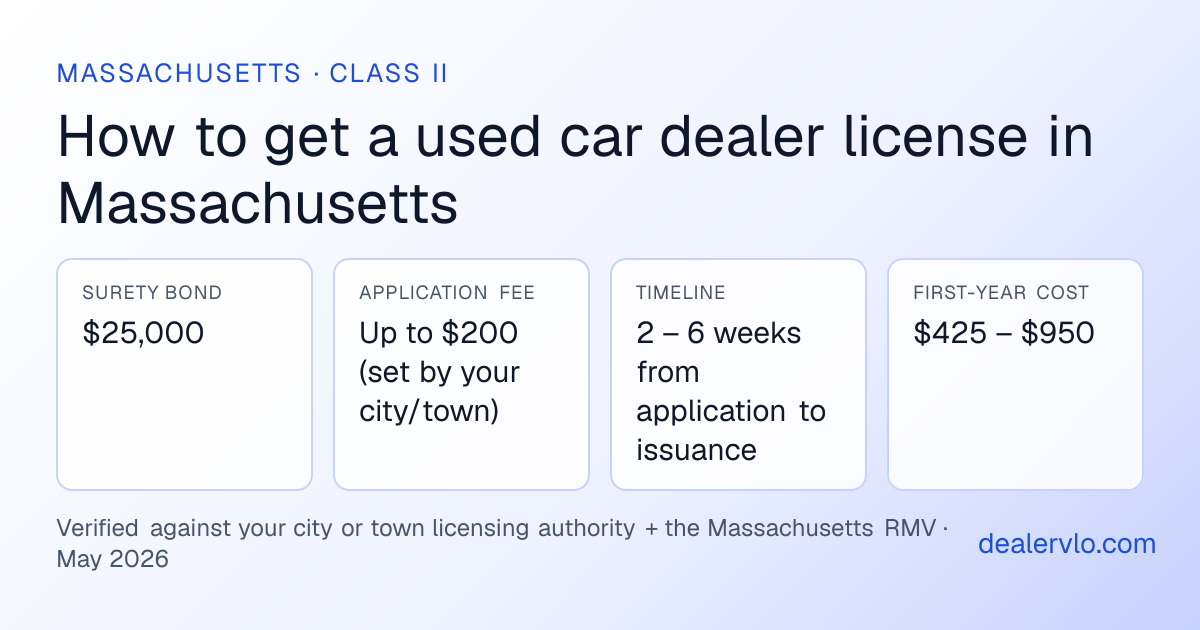
Getting a Class II used-car dealer license in Massachusetts:
- Surety bond required
- $25,000
- Application fee
- Up to $200 (set by your city/town)
- License term
- Annual — expires January 1 every year
- Typical timeline
- 2 – 6 weeks from application to issuance
- Typical first-year cost
- $700 – $1,600
This guide is informational and does not replace official Massachusetts requirements. Always verify with your city or town licensing authority + the Massachusetts RMV before applying.
Two numbers worth knowing before you commit. Free calculators dealers actually use — no signup, no email.
Inventory with VIN auto-decode, the deal jacket, and every MA + federal form your sales need. $29/month, free to try — cancel any time.
Who can apply for a Class II license
A Class II license authorizes the holder to sell used (second-hand) motor vehicles in Massachusetts. Classes I and III cover new-vehicle franchised dealers and junk/salvage dealers respectively, so most independent used-car lots in MA operate under Class II.
In Massachusetts this is also commonly called an auto dealer license, car dealer license, or motor vehicle dealer license — all the same Class II authority to sell used vehicles.
- A fixed business location with proper zoning for vehicle sales (you'll need a Certificate of Occupancy / zoning sign-off from your town)
- Enough lot space to display the vehicles you plan to sell (most towns require a defined number of display spaces)
- Clean criminal background — recent felony convictions can disqualify or require additional review
- No outstanding tax obligations to the Commonwealth (a Department of Revenue tax compliance certificate is commonly required)
- Federal Tax ID (EIN) and a Massachusetts sales tax registration
Step-by-step process
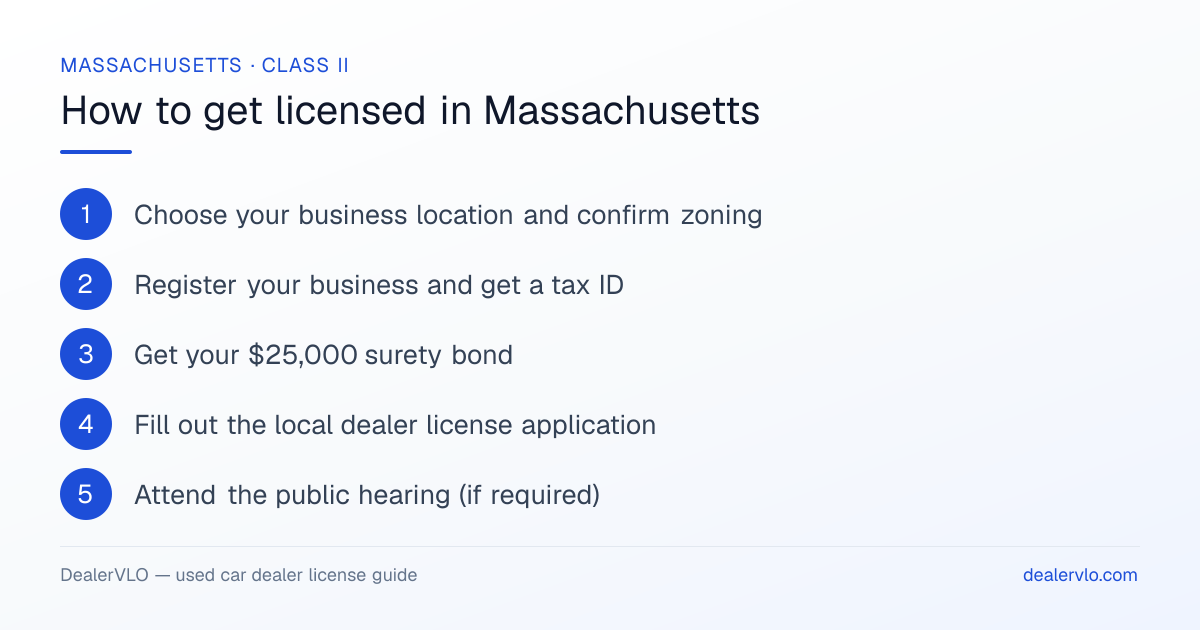
- 1
Choose your business location and confirm zoning
Before anything else, lock in a location. Massachusetts towns have specific zoning rules for motor-vehicle sales (sometimes called 'Auto-1' or 'B-2' zones). Visit your town's building/zoning office, confirm the parcel is zoned for vehicle sales, and get a Certificate of Occupancy or zoning sign-off in writing. Many towns will reject your dealer-license application without this.
- 2
Register your business and get a tax ID
Form your LLC or corporation with the MA Secretary of the Commonwealth (or operate as a DBA). Apply for a Federal Employer Identification Number (EIN) from the IRS — it's free, 10 minutes online. Then register for a Massachusetts sales tax permit through MassTaxConnect. You'll need both numbers on the dealer application.
- 3
Get your $25,000 surety bond
Massachusetts requires a $25,000 surety bond for every Class II dealer — a separate bond for each business name and each city or town where you have a place of business. Shop with at least 2-3 surety bond agents — premiums vary 1-3% of the face value depending on your credit. Plan to pay $250-$750 annually. The bond is paperwork-only; you don't tie up $25k in cash. Your agent will issue a 'bond power' document that goes with the dealer application.
- 4
Fill out the local dealer license application
Each MA city or town issues Class II licenses through its Selectboard, City Council, or Licensing Commission — not the state RMV directly. Get the application form from your town clerk or licensing office. You'll typically submit: the application form, your bond, proof of business registration, Certificate of Occupancy, photo IDs, a plot plan showing the lot layout, and the application fee.
- 5
Attend the public hearing (if required)
Most MA towns hold a public hearing before granting a Class II license. The licensing authority advertises the hearing in the local paper. Be ready to discuss your hours of operation, number of display spaces, lot lighting, signage, and any concerns from abutters. Show up prepared with your business plan and zoning sign-off in hand — well-prepared applicants usually breeze through.
- 6
Receive the license + register with the RMV
Once the town grants the license, register as a dealer with the Massachusetts RMV. You'll get dealer plates: the RMV charges $100 a year for the dealer registration plus $20 per plate, and your city or town adds a $100 excise per plate and access to the RMV's dealer title and registration process. From here you can apply for temporary plates, transfer titles, and file RMV-1 forms for each sale.
Massachusetts dealer license cost — fees breakdown
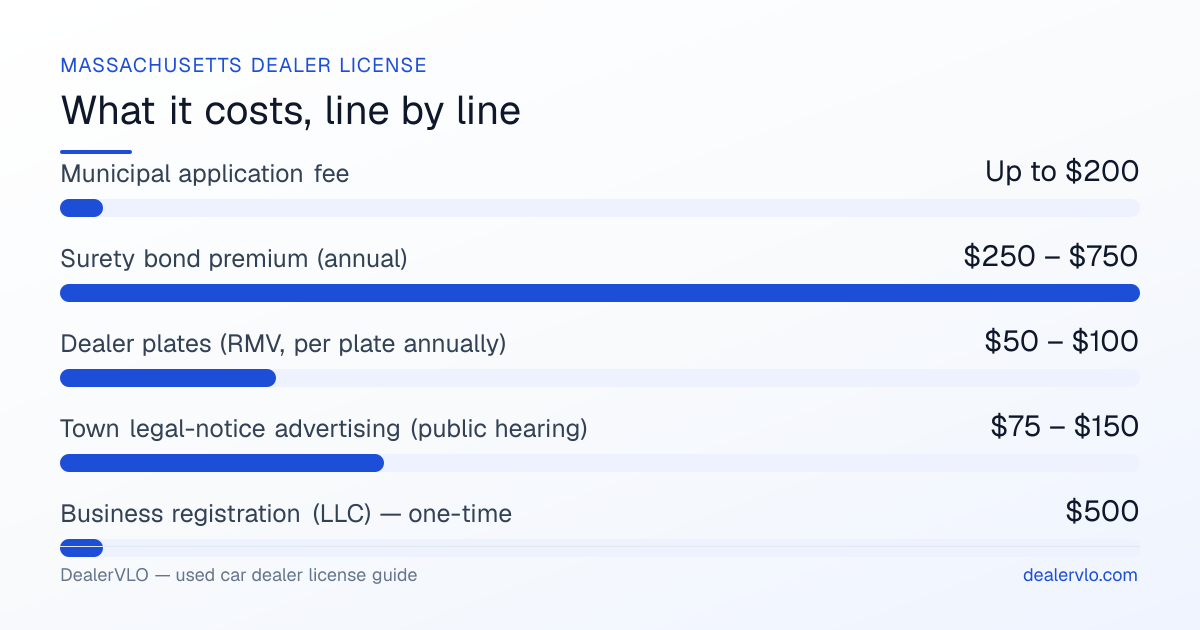
| Item | Amount |
|---|---|
Municipal application fee Set by your town; statutory maximum is $200. Examples: Westfield $200, Northampton $175. | Up to $200 |
Surety bond premium (annual) 1-3% of the $25,000 bond face value, varies by credit | $250 – $750 |
Dealer plates (per plate annually) RMV: $100/yr registration + $20 per plate; local excise $100 per plate. 2-3 plates ≈ $340–$460/yr | $120 + $100/yr registration |
Town legal-notice advertising (public hearing) Paid to the local newspaper, set by their rates | $75 – $150 |
Business registration (LLC) — one-time MA LLC filing fee (separate from the dealer license) | $500 |
EIN (federal) and MA sales tax registration | Free |
The Massachusetts auto dealer bond: $25,000
Massachusetts requires every used-vehicle dealer to post a $25,000 surety bond. The bond protects buyers from misconduct (odometer fraud, undisclosed liens, deceptive trade practices) and the state from unpaid taxes.
You don't pay the full bond amount up front — you pay an annual premium to a surety company, typically 1-3% of the bond's face value. Your actual premium depends on personal credit and business history.
The bond term runs with your license year. When you renew the license each January, the surety renews the bond — your premium re-prices annually. If the surety cancels the bond, your town gives you 10 days to replace it — after that it revokes your dealer license and asks the RMV to pull your dealer plates.
Renewal
Massachusetts Class II licenses expire on January 1 of each year, regardless of when they were originally issued. You must apply for renewal before the expiration date — most towns send a reminder 30-60 days out, but don't rely on it. A late renewal usually requires reapplying from scratch, including the public hearing. Renewal fees are typically the same as the original application fee.
Common questions
How long does it take to get a Massachusetts dealer license?+
Most applicants get from 'start the process' to 'license in hand' in 2-6 weeks. The biggest variable is the town's hearing calendar — some Selectboards meet weekly, others monthly. If your zoning is in order and your bond is ready when you apply, you'll generally be approved at the first hearing.
Do I need a brick-and-mortar location, or can I sell from home?+
Massachusetts requires a fixed business location with appropriate zoning for vehicle sales. You can't operate a Class II dealership from your home unless your residential lot is zoned for commercial vehicle sales (extremely rare). The location must have enough display spaces for the vehicles you plan to sell — exact requirements vary by town.
Can I get a Class II license with a criminal record?+
It depends on the offense, when it occurred, and your town's policy. Recent felony convictions — especially fraud, theft, or motor-vehicle crimes — typically disqualify or require additional review. Older misdemeanors are usually fine. The application includes a CORI (criminal background check) authorization, and your local Selectboard will weigh it.
Is the $25,000 bond a deposit?+
No — you don't deposit $25,000 anywhere. You pay an annual premium (1-3% of $25k, so $250-$750 typically) to a surety company, and they 'back' the bond on your behalf. If a customer or the state successfully files a claim against your bond, the surety pays out, and then you owe the surety. So the bond is more like insurance than a deposit.
What's the difference between Class I, II, and III?+
Class I is for new-vehicle franchised dealers (the Ford dealership, the Honda dealership). Class II is for used (second-hand) motor vehicle dealers — most independent lots. Class III is for junk/salvage dealers selling parts or scrap. Most readers of this guide want a Class II.
Do I need to take a course or pass a test?+
Massachusetts does not require Class II applicants to complete a state-mandated training course or pass a licensing exam — unlike some other states. That said, certain towns may require additional documentation (business plan, financial statements). Check with your local licensing authority.
How much does a Massachusetts dealer license cost?+
Plan for about $700 – $1,600 in the first year. That covers the Up to $200 (set by your city/town) application fee and the $25,000 surety bond — you pay an annual premium of roughly 1-3% of the bond, not the full amount — plus business-formation, facility, and dealer-plate costs. See the full fees breakdown above.
How do I get dealer plates in Massachusetts?+
Dealer plates are separate from the license itself. Once your Class II license is approved, you apply for dealer plates and pay a per-plate fee (listed in the fees breakdown above). You can't obtain dealer plates before the license is issued.
- Massachusetts dealer plates
- How to fill out the RMV-1 (Massachusetts)
- How Massachusetts car sales tax works on a dealer sale
- How to fill out the MA Damage Disclosure
- MA dealer paperwork checklist
- Dealer license in Boston
- Dealer license in Worcester
- Dealer license in Springfield
- Dealer license cost in all 50 states
- License cost calculator (fees + bond by state)
Got your MA dealer license? Run your lot in DealerVLO.
Inventory with VIN auto-decode, deal jacket, federal + state forms (including the MA RMV-1 if you're in MA), and your own dealer website at your custom domain. $29/month. 14-day free trial, cancel any time.
Bond amounts, fees, and form rules change. Get a short email when your state does. No spam, unsubscribe anytime.