How much is a dealer's license?
The short answer: most first-time used car dealers spend $800 to $4,000 all-in for the first year. The long answer depends on your state's application fee and — the biggest variable — its surety bond. Here's the full picture, state by state.
A first-year used car dealer license costs about $800–$4,000 all-in in most states: the state application fee ($75–$1,000), the annual premium on a surety bond (roughly 1–5% of a $10,000–$100,000 bond), plus pre-licensing, fingerprints, and dealer plates. You never pay the full bond amount — only the yearly premium.
A dealership license, car dealer license, and dealer's license are the same thing, so the cost is the same whatever you call it.
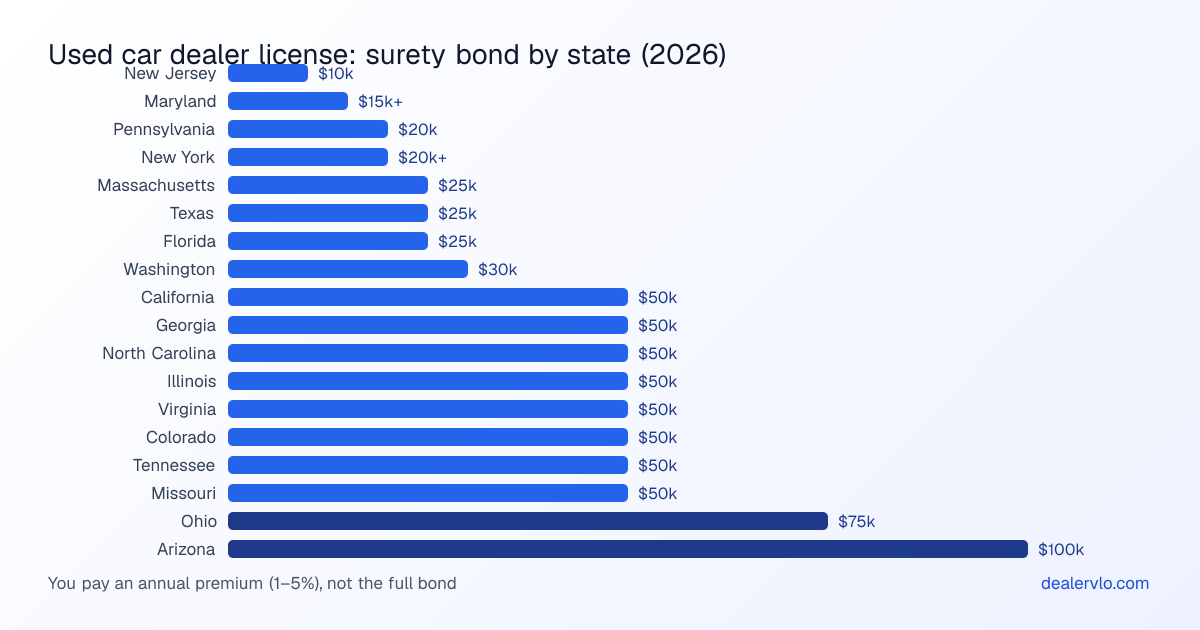
Bond amounts across the 18 states we've verified against state agencies. Remember: you pay a 1–5% annual premium, not the face amount.
Want the full data in one sortable table — fees, bonds, doc-fee caps, and sales-tax rules for all 50 states? See the Dealer Startup Cost Index.
Inventory, deal jacket, and the state + federal paperwork filled from each deal. $29/month, free to try — cancel any time.
How much does it cost to get a dealer license? The four pieces
- The application/license fee — set by the state, from $50 (Ohio) to $1,000 (Illinois). This is the number states publish, and it's usually the smallest piece.
- The surety bond premium — the big variable. States require a bond from $10,000 to $100,000, and you pay roughly 1–5% of it per year based on credit. This is where Arizona ($100,000 bond) costs 10× what New Jersey ($10,000) does.
- Pre-licensing requirements — courses ($50–$400) in states like Ohio, Colorado, Virginia, and Florida; fingerprints and background checks in most.
- The facility — every state requires an established place of business with an office and sign, and most inspect it. Rent isn't a licensing fee, but it gates the license.
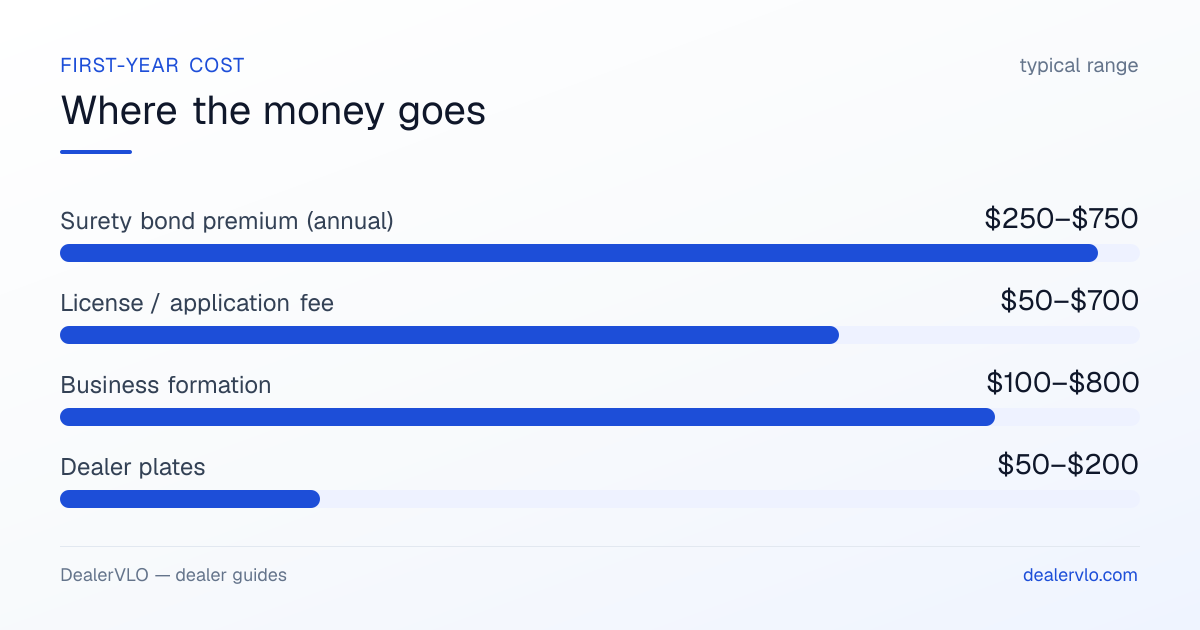
Estimate your state in 30 seconds with the dealer license cost calculator, or see the whole startup budget in how much it costs to open a used car dealership.
Dealer license cost by state: fees and bonds (verified)
These 18 states have full DealerVLO guides with figures verified against the state agency — click through for steps, timelines, and first-year totals.
| State | Application fee | Surety bond | Guide |
|---|---|---|---|
| Massachusetts | Up to $200 | $25,000 | Guide |
| Pennsylvania | $190 | $20,000 | Guide |
| Texas | $700 (2-year) | $50,000 | Guide |
| Florida | $300 initial | $25,000 | Guide |
| Ohio | $50 | $75,000 | Guide |
| California | $175 + fees | $50,000 | Guide |
| New York | $487.50 (2-year) | $20,000+ | Guide |
| Georgia | $170 | $50,000 (raised Jul 2026) | Guide |
| North Carolina | $115.50 | $50,000 | Guide |
| New Jersey | $100 | $10,000 | Guide |
| Illinois | $1,000 / $500 | $50,000 | Guide |
| Virginia | $225 (+$350/yr fund, 3 yrs) | $50,000 | Guide |
| Arizona | $15 + $100 | $100,000 retail / $25,000 wholesale | Guide |
| Washington | $975 | $30,000 | Guide |
| Colorado | $841 | $50,000 | Guide |
| Maryland | $900 (3-year) + $150/tag | $50,000 | Guide |
| Tennessee | $600 | $50,000 | Guide |
| Missouri | $150/yr | $50,000 ($100,000 for written-agreement sales) | Guide |
The other 32 states: published bond requirements
Used-dealer bond amounts as published by surety industry sources (2026). Fee structures vary — confirm with the state agency before budgeting.
Cheapest and most expensive states to get a dealer license
By total first-year cost among the states we've verified. One catch: you must be licensed where your business physically operates, so you can't shop states for a cheaper bond — but if you have a choice of where to set up, it matters.
- New Jersey — $100 fee, $10,000 bond
- Pennsylvania — $190 fee, $20,000 bond
- Michigan — $10,000 bond (lowest bond tier)
- West Virginia — $10,000 bond
- Illinois — up to $1,000 fee, $50,000 bond
- Washington — $975 fee, $30,000 bond
- Arizona — $100,000 retail bond (premium is the driver)
- Ohio — $75,000 bond
The bond face amount drives the yearly cost more than the fee does, because you pay a 1–5% premium on it every year. A low fee with a high bond can still be the pricier license over time.
Dealer license cost FAQ
How much is a dealer's license?
Most first-time used car dealers spend $800 to $4,000 all-in for the first year. The state application fee runs from $50 (Ohio) to nearly $1,000 (Washington, Illinois), and the biggest variable is the surety bond premium — 1-5% annually of a bond that ranges from $10,000 (New Jersey, Michigan) to $100,000 (Arizona retail, Nevada). Pre-licensing courses, fingerprints, business registration, and dealer plates add smaller amounts.
How much does it cost to get a dealer license in my state?
Add your state's application fee to the yearly premium on its surety bond; those two set most of the bill. They swing widely: New Jersey is a $100 fee with a $10,000 bond, while Illinois is up to $1,000 with a $50,000 bond and Arizona requires a $100,000 bond for retail dealers. Find your state in the tables on this page; the 18 states with full DealerVLO guides also have step-by-step licensing instructions and first-year totals.
Is a dealership license the same as a dealer license?
Yes. "Dealer license," "dealership license," and "car dealer license" all describe the same state-issued license to sell vehicles, so the cost is the same whichever name you search. What changes the price is the license class: a retail used-dealer license versus a wholesale one, which several states bond at a lower amount.
Do I pay the full bond amount?
No — this is the most common misunderstanding about dealer license costs. You pay an annual premium of roughly 1-5% of the bond amount, based on your credit. A $25,000 bond typically costs $250-$750 a year; a $50,000 bond roughly $500-$1,500. The full amount is only at stake if a claim is paid against your bond.
What's the cheapest state to get a dealer license?
By total first-year cost, states with low fees AND low bonds are cheapest: New Jersey ($100 fee, $10,000 bond) and Michigan ($10,000 bond) are among the lowest. But you must be licensed in the state where your established place of business actually is — 'shopping' for a cheap state doesn't work, because every state requires an in-state business location it will physically inspect.
What other costs come with the license?
Beyond the fee and bond: pre-licensing courses where required ($50-$400), fingerprints/background checks (~$25-$60 per person), business entity registration, garage liability insurance (required for licensing in some states, like Tennessee's $300,000 minimum), a compliant lot with signage, and dealer plates. See the full startup math in our cost-to-open guide.
How much is a wholesale dealer license versus a retail one?
Wholesale licenses (dealer-to-dealer only, no retail sales) are often cheaper because several states set a lower bond for wholesalers — Arizona, for example, requires a $25,000 wholesale bond versus $100,000 for retail, which cuts the premium sharply. The application fee is usually similar; the savings come from the smaller bond. If you only buy at auction and sell to other dealers, ask your state whether a wholesale class costs less.
Is a used car dealer license worth the cost?
For anyone selling more than the state's casual-sale limit (often 3-5 vehicles a year), yes. Without a license you can't get dealer plates, buy at dealer-only auctions, or legally sell above that limit. The $800-$4,000 first-year cost is typically recovered in the wholesale pricing and auction access a license unlocks — often within a handful of deals.
How much does it cost to renew a dealer license?
Renewal is usually cheaper than the initial license: you pay the state's renewal fee (often lower than the first-time application) plus the next year's bond premium. One-time costs — pre-licensing courses, fingerprints, business setup — don't repeat. Budget roughly the renewal fee plus the 1-5% bond premium each year.
Can I get a dealer license from home?
A few states allow a home-based or reduced-facility license, but most require an established commercial location with an office, a sign, and display space that the state inspects. The facility requirement — not the fee or bond — is what stops the most first-time applicants, so check your state's rules before assuming you can run it from a home address.
Bond amounts, fees, and form rules change. Get a short email when your state does. No spam, unsubscribe anytime.