How to get a used car dealer license in California
A practical walkthrough of the Vehicle Dealer application — fees, bond, timeline, and what to expect at each step. Verified against the official agency as of October 2026.
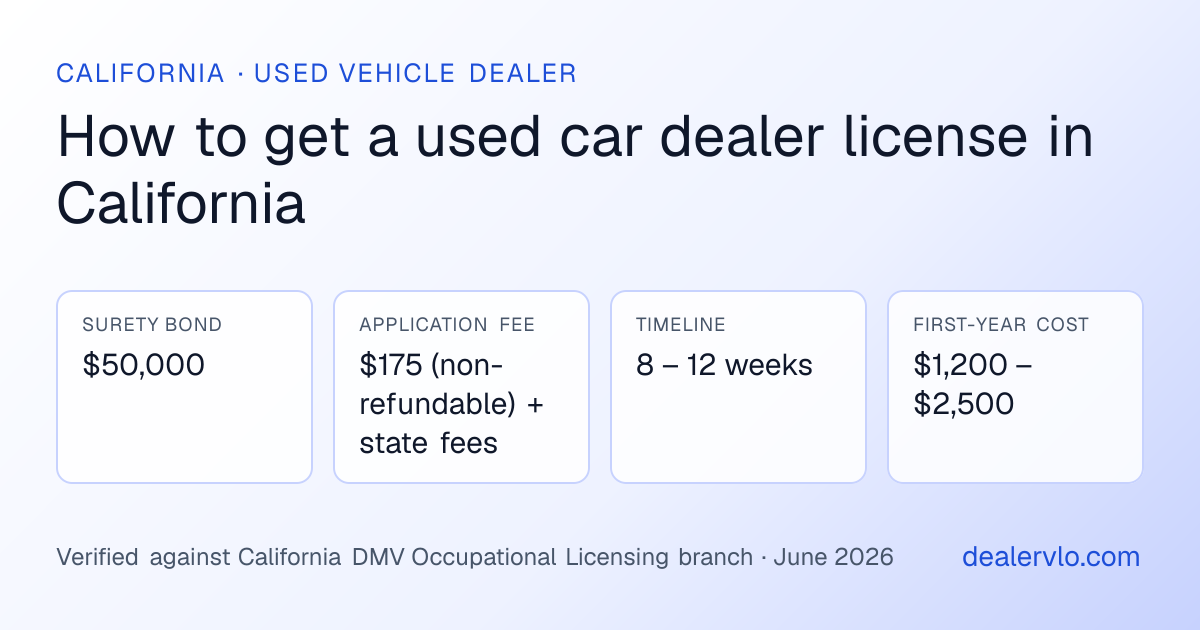
Getting a Vehicle Dealer used-car dealer license in California:
- Surety bond required
- $50,000
- Application fee
- $175 (non-refundable)
- License term
- Renews on a 1- or 2-year term
- Typical timeline
- Up to 120 days (DMV review)
- Typical first-year cost
- $900 – $3,000 (est.)
This guide is informational and does not replace official California requirements. Always verify with the California DMV Occupational Licensing branch before applying.
Two numbers worth knowing before you commit. Free calculators dealers actually use — no signup, no email.
Inventory with VIN auto-decode, the deal jacket, and every CA + federal form your sales need. $29/month, free to try — cancel any time.
Who can apply for a Vehicle Dealer license
In California, a "dealer" is anyone in the business of buying, selling, or taking vehicles in trade for resale, or selling for a commission or profit (Vehicle Code § 285). You can't act as a dealer without a license from the DMV's Occupational Licensing branch (VC § 11700). Used-car dealers apply as either a retail used dealer or a dealer-wholesale only.
In California this is also commonly called an auto dealer license, car dealer license, or motor vehicle dealer license — all the same Vehicle Dealer authority to sell used vehicles.
- A DMV-approved dealer education program of at least 4 hours, finished before you take the test (VC § 11704.5(b))
- A passing score on the DMV written dealer exam, taken with your local Occupational Licensing inspector
- Live Scan fingerprints for every person listed under ownership on the OL 12, with a DOJ background check that clears
- A $50,000 dealer surety bond, or $10,000 if you sell wholesale only and fewer than 25 vehicles a year
- A CDTFA seller's (resale) permit
- An established place of business: a permanent office where your books and records are kept. Retail dealers also need a display area and a permanent sign
Step-by-step process
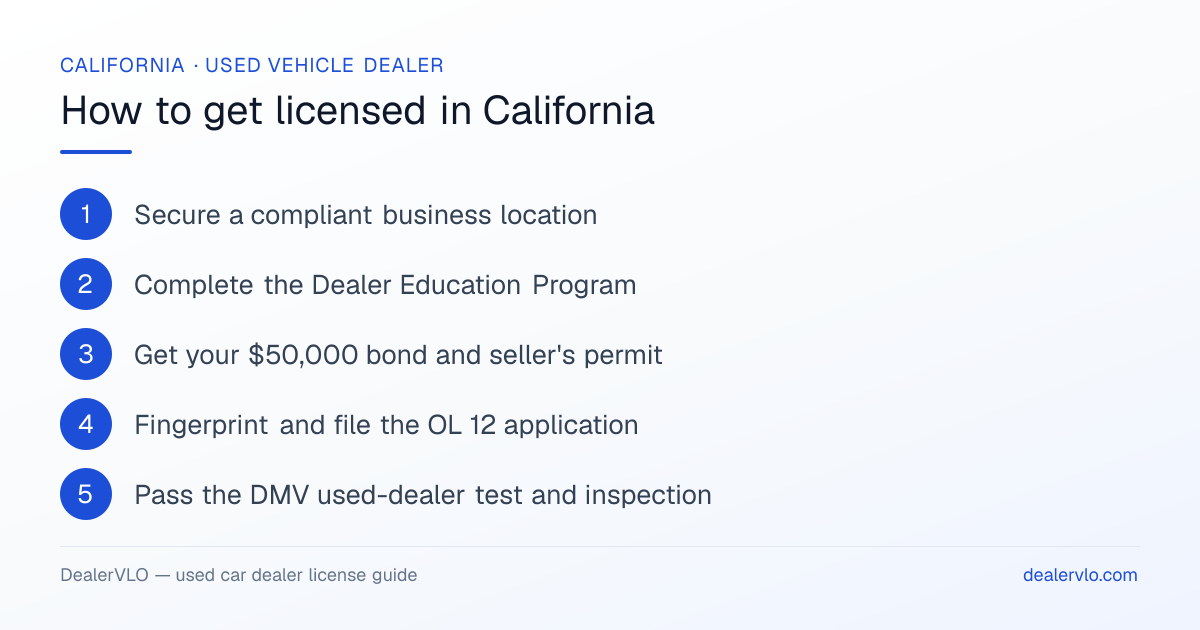
- 1
Pick retail or wholesale-only
Decide whether you'll sell to the public (retail used dealer) or only to other licensed dealers (dealer-wholesale only). It changes your location requirements, your bond, and whether you can ever sell to a consumer. Both use the same Used Dealer application packet (OL 248U).
- 2
Take the dealer education course
Complete a DMV-approved pre-licensing program of at least 4 hours. The DMV lists approved providers on its site; prices are set by each provider. Your Certificate of Completion is valid for one year from the course date, so don't take it too early.
- 3
Set up your place of business
You need an office that isn't temporary or mobile, where your books and records are kept. Retail dealers also need a display area big enough for the vehicles you sell, used only by you, and a permanent sign at least 2 square feet per side, readable from 50 feet. Wholesale-only dealers don't need the display area or the sign.
- 4
Get your bond, seller's permit, and fingerprints
Buy the dealer bond from a surety (you pay an annual premium, not the face amount). Get a CDTFA seller's permit. Each owner listed on the OL 12 gets Live Scan fingerprints with form DMV 8016; the DOJ background check fee is $32, paid at the Live Scan site.
- 5
Apply with the OL 248U forms
Apply through a DMV online account and submit the OL 248U packet: the OL 12 application, OL 21A, bond (OL 25 or OL 25B), OL 53, an OL 29B personal history and ADM 9050 for each owner, your course certificate, seller's permit, Secretary of State Statement of Information if you're a corporation or LLC, and photos of the location. Pay the $175 fee, $1 family support fee, and $16 exam fee.
- 6
Pass the test and the inspection
Once the DMV processes your file, you get an email to schedule a site inspection. The inspector checks your office, books and records, and (for retail) the display area and sign. You take the written exam with your local Occupational Licensing inspector. You get 3 attempts, $16 each, a week apart.
- 7
Get licensed, then order plates if you want them
Once the background check clears and everything passes, the DMV issues your license. Dealer plates are optional: $92 each plus county fees.
Retail vs wholesale-only: which California license do you need?
A retail used dealer can sell to the public. A dealer-wholesale only can't sell any vehicle at retail. You may sell only to other licensed dealers, and every sale is reported to the DMV on the numbered Wholesale Report of Sale (VC § 11713(c)).
Both licenses take the same 4-hour course, the same DMV exam, Live Scan, and the same OL 248U packet. The differences are in the location rules, the bond, and continuing education.
- Bond: $50,000 for retail. $10,000 for a wholesale-only dealer selling fewer than 25 vehicles a year (VC § 11710.1). Auction and dealer-to-dealer sales both count toward the 25.
- Small wholesalers must re-certify the exemption at each renewal on form OL 56. If you sell the 25th vehicle in a year without a $50,000 bond on file, your license is automatically canceled.
- Location: retail needs an office, a display area, and a sign. Wholesale-only needs the office and records, but no display area or sign.
- Continuing education: 4 hours every 2 years to renew. A managerial employee can take it for you. Wholesale-only dealers handling fewer than 50 vehicles a year are exempt (VC § 11704.5(c); form OL 257).
- Autobroker endorsement ($100) is only for retail licenses. It isn't available on a wholesale-only license.
Can you get a California dealer license without a lot?
If you want to sell to the public, no. A retail dealer's principal location needs a display area big enough for the vehicles you sell, used only by you, plus a permanent sign. Extra display areas are allowed within 1,000 feet of your licensed location (13 CCR § 270.08).
A wholesale-only license is the closest thing to a no-lot license. The DMV doesn't inspect a display area or sign for wholesale-only dealers. You still need an established place of business: an office that is actually occupied, either continuously or at regular periods, where your books and records are kept (VC § 320). It can't be temporary, transitory, or mobile (13 CCR § 270.00). The inspector visits it before you're licensed.
The DMV sources we checked don't say whether a home office passes. Ask your local Occupational Licensing office before you sign anything. Check your city's zoning and business-license rules too, since those are separate from the DMV.
Do you need a separate license for in-house (BHPH) financing?
Usually not, if you're selling your own cars on a conditional sale contract. California's Department of Financial Protection and Innovation (DFPI) says automobile sales finance contracts under the Rees-Levering Act are "non-loan" transactions. They aren't covered by the California Financing Law (CFL).
Lending money is different. Under the CFL, anyone in the business of making consumer or commercial loans, or brokering them, generally needs a CFL license from the DFPI. If you plan to make cash loans, or set up a separate company to finance deals, ask the DFPI first.
Rees-Levering itself (Civil Code §§ 2981 et seq.) sets the contract disclosure rules, and it's part of what the dealer education course covers. A contract that breaks its disclosure rules can be unenforceable. Use a compliant contract form from your forms vendor or attorney.
DealerVLO can track the BHPH notes you carry, with a collections panel for payments and past-due accounts.
Using your license at dealer-only auctions
There's no separate "auction license" in the DMV's list of dealer licenses. Buying cars to resell is dealer activity under VC § 285, so the dealer license is what you need. That includes a wholesale-only license.
Each dealer auction is a private business and sets its own registration rules. Ask the auction what it needs from you before your first sale. Common asks are your license, seller's permit, and ID.
Wholesale-only dealers: sales you make through an auction count toward the 25-vehicle limit for the $10,000 bond, and the 50-vehicle continuing education exemption.
Why California dealer applications get delayed or denied
The DMV can take up to 120 days to investigate an application once it has the fee (VC § 11704(b)). These are the hold-ups the DMV's own forms and the Vehicle Code point to:
- Live Scan not cleared. The DMV can't release a license until the DOJ background check passes. Results sent to another agency can't be reused. You have to scan with the DMV's form DMV 8016. Check your status at applicantstatus.doj.ca.gov.
- Incomplete paperwork. Incomplete applications are returned. Forms need original signatures and no whiteout.
- Expired course certificate. It's valid for one year from the course date.
- Failing the exam 3 times. After the third miss you retake the education course and start over.
- Location problems. A temporary or mobile office, a missing display area, or no sign (retail). A temporary sign works only if you show proof a permanent one is on order.
- Background and history. The DMV may refuse a license over a prior revoked dealer license, a crime substantially related to the dealer business, incorrect application information, or business-history irregularities (VC § 11703).
Once you're licensed
Keep the bond at full value. If it lapses or drops, your license is automatically suspended or canceled (VC §§ 11710(c), 11721(b)). Losing your CDTFA seller's permit cancels it too (VC § 11721(f)).
Before you offer or display any used car for sale, pull an NMVTIS report. If the title is branded, put a warning on the vehicle.
Your deal paperwork includes the REG 343 title application, an odometer disclosure, and on eligible retail deals the CARS Act 3-day cancellation disclosure. See our guides to filling out Form REG 343, California dealer plates, the odometer disclosure statement, and the California CARS Act for dealers.
DealerVLO fills the California REG 343 from the deal. It also generates the CARS Act 3-day cancellation disclosure on eligible deals, so your paperwork comes from one record.
Other California forms dealers file
- Form REG 343: California title application
- California certificate of repossession (REG 119)
- California lien release (REG 166)
- California REG 262 transfer and odometer disclosure
Also for California: California dealer plates
Same form in other states: Title applications · Repossession · Lien release · Odometer disclosure
California dealer license cost — fees breakdown
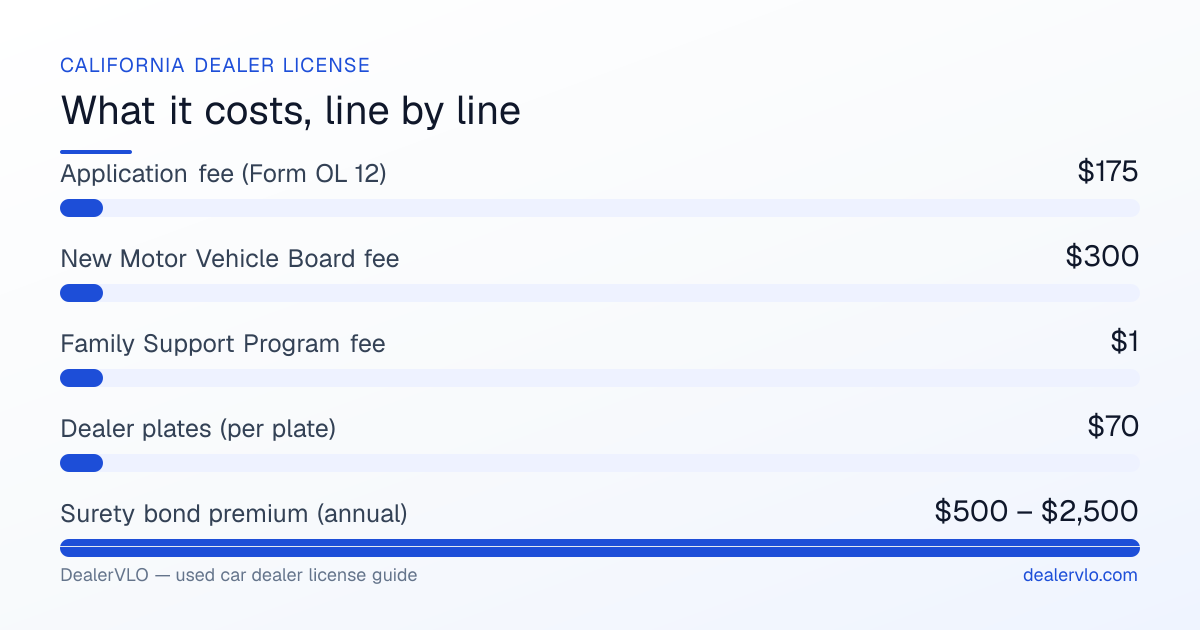
| Item | Amount |
|---|---|
Application fee (OL 12) Non-refundable. | $175 |
Family Support Program fee | $1 |
Examination fee Each retest is another $16. | $16 |
Live Scan DOJ background check Per person, paid at the Live Scan site. The site may add its own rolling fee. | $32 |
Dealer plates (per plate, optional) Plus county fees, which vary by county. Motorcycle plates are $94. | $92 |
Each branch location | $70 |
Autobroker endorsement (retail only) | $100 |
Surety bond premium (annual) Estimate: roughly 1-5% of a $50,000 bond, depending on credit. | $500 – $2,500 |
Dealer education course Set by each DMV-approved provider. | Varies |
The California auto dealer bond: $50,000
California requires every used-vehicle dealer to post a $50,000 surety bond. The bond protects buyers from misconduct (odometer fraud, undisclosed liens, deceptive trade practices) and the state from unpaid taxes.
You don't pay the full bond amount up front — you pay an annual premium to a surety company, typically 1-5% of the bond's face value. Your actual premium depends on personal credit and business history.
The bond is $50,000 (VC § 11710(b)). A wholesale-only dealer selling fewer than 25 vehicles a year can file a $10,000 bond instead (VC § 11710.1) and must re-certify that on form OL 56 at each renewal. Liability has to stay at full value. If the bond drops or lapses, the license is automatically suspended or canceled. The 1-5% premium range is an industry estimate, not a DMV figure.
Renewal
You renew on a 1- or 2-year term with form OL 45 or online. The renewal fee is $125, plus the $1 family support fee and $92 per dealer plate (plus county fees). You can renew up to 90 days before expiration. Every 2 years you need proof of 4 hours of continuing education. A managerial employee can complete it for you. Wholesale-only dealers handling fewer than 50 vehicles a year can claim an exemption on form OL 257.
Common questions
How do I get a dealer license in California?+
Take a DMV-approved dealer education course (at least 4 hours). Set up an office (plus a display area and sign if you'll retail). Get a $50,000 bond and a CDTFA seller's permit, and do Live Scan fingerprints. Apply online with the OL 248U packet and the $175 fee. Then pass the DMV written exam and site inspection. The DMV has up to 120 days to investigate.
How do I get a wholesale dealer license in California?+
Use the same Used Dealer packet (OL 248U), course, and exam as a retail dealer, and apply as dealer-wholesale only. You need an office where your records are kept, but no display area or sign. The bond is $50,000, or $10,000 if you sell fewer than 25 vehicles a year. You can only sell to other licensed dealers.
Can I get a California dealer license without a lot?+
For retail, no. You need a display area and a sign. For wholesale-only, the DMV doesn't require a display area or sign, but you still need an established place of business: a permanent office where your books and records are kept, which the DMV inspects.
How do I get a dealer license for car auctions in California?+
There's no separate auction license on the DMV's dealer license list. A California dealer license, retail or wholesale-only, is what lets you buy and sell for resale. Each auction sets its own registration rules, so ask the auction what documents it wants.
Do I have to take a course and pass a test?+
Yes, for used and wholesale-only dealers. You finish a pre-licensing course of at least 4 hours, then pass the DMV written exam ($16). You get 3 attempts, a week apart. After a third failure you retake the course. The course certificate is good for one year.
Do I need a finance license to do buy here, pay here in California?+
The DFPI says Rees-Levering automobile sales finance contracts are non-loan transactions, not covered by the California Financing Law. If you make loans or broker them, you generally need a CFL license. Ask the DFPI if you're unsure how your setup is classified.
How long does it take to get a California dealer license?+
The DMV has up to 120 days to investigate a complete application (VC § 11704(b)). The usual delays are Live Scan clearance, incomplete forms, and scheduling the site inspection and exam.
How much does a California dealer license cost?+
Plan for about $900 – $3,000 (est.) in the first year. That covers the $175 (non-refundable) application fee and the $50,000 surety bond — you pay an annual premium of roughly 1-5% of the bond, not the full amount — plus business-formation, facility, and dealer-plate costs. See the full fees breakdown above.
How do I get dealer plates in California?+
Dealer plates are separate from the license itself. Once your Vehicle Dealer license is approved, you apply for dealer plates and pay a per-plate fee (listed in the fees breakdown above). You can't obtain dealer plates before the license is issued.
- California DMV: Vehicle Dealer License (requirements, fees, inspection, renewal)
- California DMV: Used Dealer or Dealer Wholesale Only Application Checklist (OL 248B)
- California DMV: Dealer Education Providers
- California DMV: Live Scan Fingerprinting
- California DMV: $50,000 Bond Exemption Application, wholesale-only (OL 56)
- California DMV: Continuing Education Exemption Application, wholesale-only (OL 257)
- California Vehicle Code, Division 5, Chapter 4, Article 1 (§§ 11700–11740)
- California Vehicle Code, Division 1 (§ 285 dealer, § 320 established place of business)
- 13 CCR § 270.00: Place of business
- 13 CCR § 270.08: Display area
- DFPI: About the California Financing Law
- California dealer plates
- How to fill out Form REG 343 (California)
- E-signatures and e-titling for California dealers
- California certificate of repossession (REG 119)
- California lien release (REG 166)
- California REG 262 transfer and odometer disclosure
- California CARS Act dealer compliance
- Dealer license without a lot: state-by-state rules
- Dealer license for car auctions
- Odometer disclosure rules and forms by state
- Dealer license cost in all 50 states
- License cost calculator (fees + bond by state)
Got your CA dealer license? Run your lot in DealerVLO.
Inventory with VIN auto-decode, the deal jacket, your California title paperwork and the federal forms filled from each deal, and your own dealer website at your custom domain. $29/month. 14-day free trial, cancel any time.
Shopping for software first? See what car lot software for a new dealer should cover.