How to get a used car dealer license in New York
A practical walkthrough of the Motor Vehicle Dealer application — fees, bond, timeline, and what to expect at each step. Verified against the official agency as of September 2026.
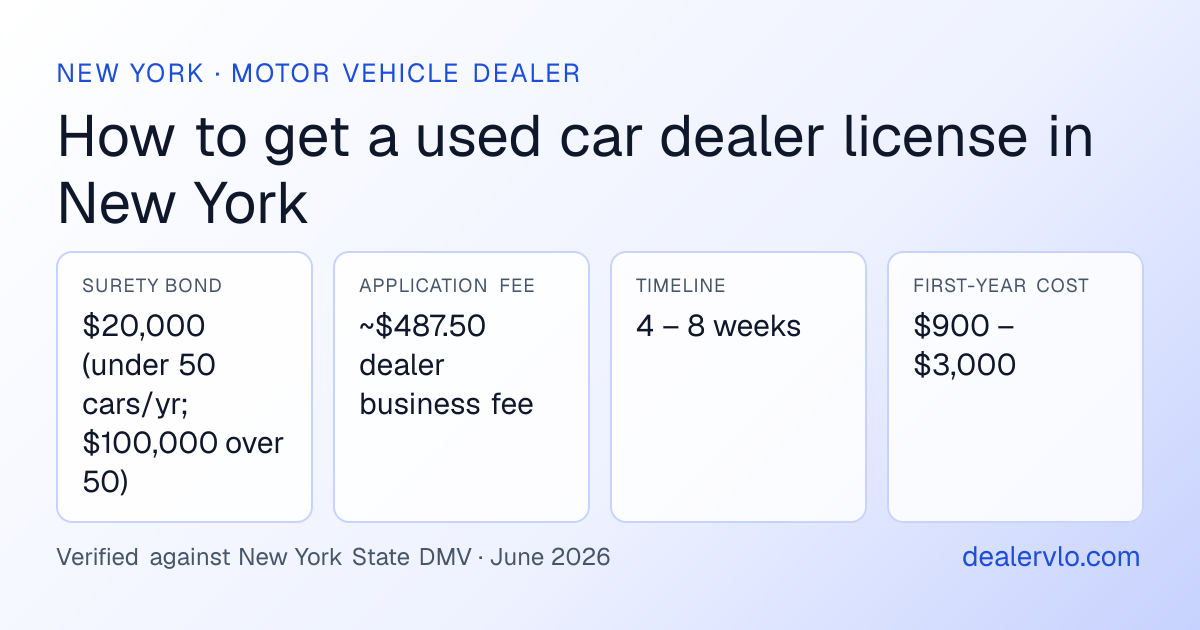
Getting a Motor Vehicle Dealer used-car dealer license in New York:
- Surety bond required
- $20,000 (50 or fewer sales last year; $100,000 above 50)
- Application fee
- $487.50 ($37.50 application + $450 for two years)
- License term
- Two years (biennial)
- Typical timeline
- 4 – 8 weeks
- Typical first-year cost
- $900 – $3,000
This guide is informational and does not replace official New York requirements. Always verify with the New York State DMV before applying.
Two numbers worth knowing before you commit. Free calculators dealers actually use — no signup, no email.
Inventory with VIN auto-decode, the deal jacket, and every NY + federal form your sales need. $29/month, free to try — cancel any time.
Who can apply for a Motor Vehicle Dealer license
New York requires anyone in the business of buying or selling used vehicles to register as a Motor Vehicle Dealer with the DMV under Vehicle and Traffic Law §415. The registration authorizes you to retail used vehicles in New York.
In New York this is also commonly called an auto dealer license, car dealer license, or motor vehicle dealer license — all the same Motor Vehicle Dealer authority to sell used vehicles.
- An established business location with the required display area, office, locked record cabinet, heat/electricity, desk, and a dedicated business phone
- A permanent sign visible from the street reading "REGISTERED (facility number) STATE OF NEW YORK MOTOR VEHICLE DEALER" in 2-inch block letters
- Proper zoning for vehicle sales at the location
- A surety bond — $20,000 if you sold 50 or fewer vehicles in the previous calendar year, $100,000 if you sold more
- A registered business entity and sales-tax registration (Certificate of Authority)
- Clean background; the DMV reviews the principals
Step-by-step process
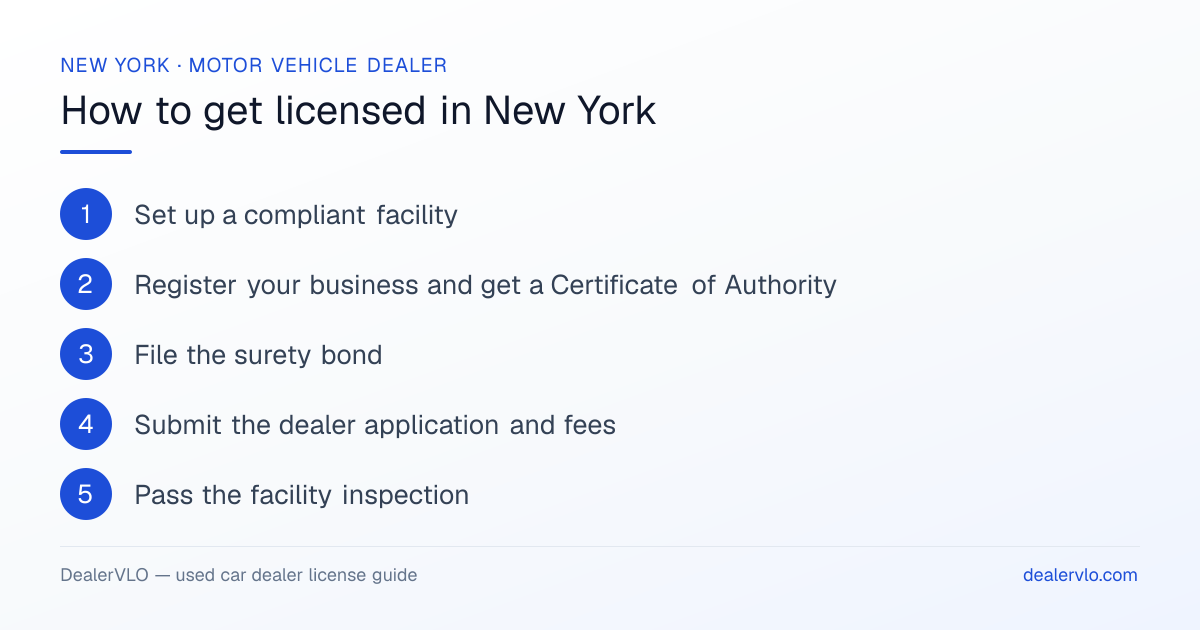
- 1
Set up a compliant facility
Secure a location zoned for vehicle sales with a display area, office, locked filing cabinet, business phone, and the required DMV sign (your facility number in 2-inch block letters, visible from the street). The DMV inspects before issuing the registration.
- 2
Register your business and get a Certificate of Authority
Form your business entity and register for New York sales tax (Certificate of Authority) so you can collect and remit tax on sales. You'll need an EIN from the IRS.
- 3
File the surety bond
Post the required motor vehicle dealer bond before applying — $20,000 if you sold 50 or fewer vehicles in the previous calendar year, $100,000 if more. You pay an annual premium (typically 1-3%), not the full amount. The bond must be filed with the DMV per VTL §415.
- 4
Submit the dealer application and fees
Complete the Original Facility application package and pay the fees — a $37.50 original application fee plus $450 for the two-year registration ($487.50 total). Include your bond, proof of business registration, lease/deed, and facility photos.
- 5
Pass the facility inspection
A DMV representative inspects your location to confirm the signage, display area, office, and records setup meet the requirements. Have everything operational before the inspection.
- 6
Receive your registration and dealer plates
Once approved, the DMV issues your dealer registration and facility number, and you can obtain dealer plates and MV-50 (Retail Certificate of Sale) books for documenting your sales.
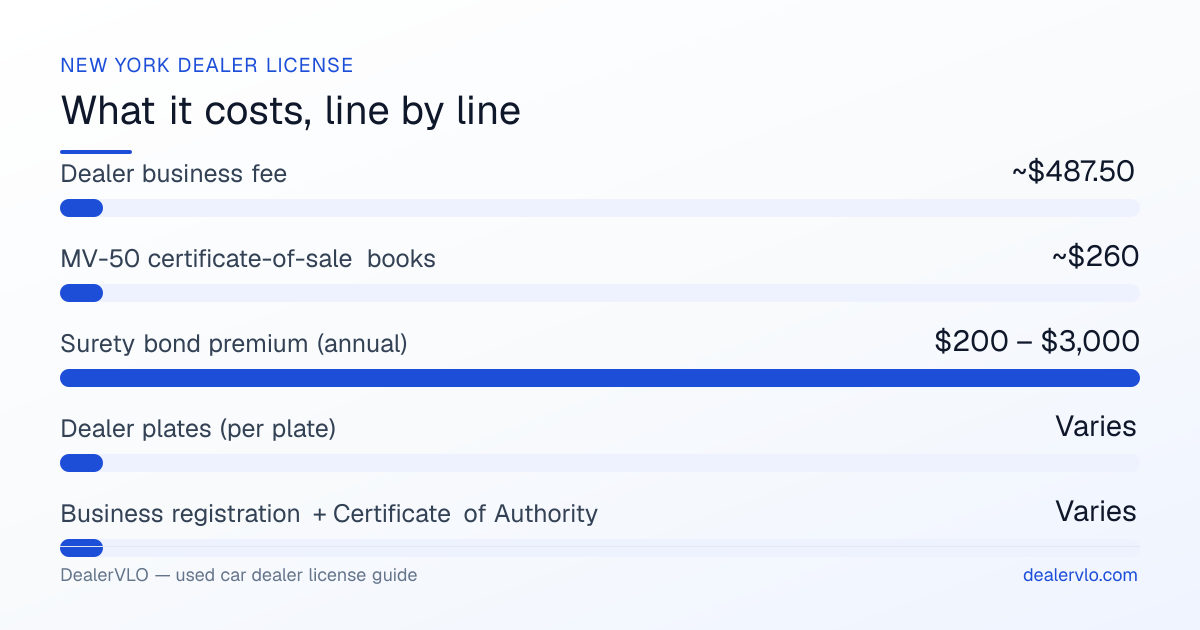
New York dealer license cost — fees breakdown
| Item | Amount |
|---|---|
Application + registration fees $37.50 application + $450 for two years. | $487.50 |
MV-50 certificate-of-sale books Retail MV-50; wholesale MV-50W books are $125. | $250 per book |
Surety bond premium (annual) 1-3% of the bond, by credit and sales volume. | $200 – $3,000 |
Dealer plates Set by statute (VTL §415); obtained after registration. | $20 per set per year |
Business registration + Certificate of Authority Entity filing + free NY sales-tax registration. | Varies |
The New York auto dealer bond: $20,000 (or $100,000)
New York requires every used-vehicle dealer to post a $20,000 (or $100,000) surety bond. The bond protects buyers from misconduct (odometer fraud, undisclosed liens, deceptive trade practices) and the state from unpaid taxes.
You don't pay the full bond amount up front — you pay an annual premium to a surety company, typically 1-3% of the bond's face value. Your actual premium depends on personal credit and business history.
New York scales the bond by volume: $20,000 if you sold 50 or fewer vehicles in the previous calendar year, $100,000 if you sold more. You pay an annual premium, not the full amount. The bond is filed with the DMV before the registration is issued and must stay current.
Renewal
New York motor vehicle dealer registrations run for two years and renew biennially. Keep your bond current, your facility compliant, and your signage in place. The DMV sends a renewal notice; renew before expiration to avoid having to reapply.
Common questions
Do I need a brick-and-mortar location to sell cars in New York?+
Yes. New York requires an established facility with a display area, office, locked record cabinet, business phone, and DMV-specified signage — and it must pass a DMV inspection. You can't register a dealership from a home address that isn't zoned and set up for vehicle sales.
How big does my New York dealer bond need to be?+
It depends on last year's volume: a $20,000 bond if you sold 50 or fewer vehicles in the previous calendar year, and a $100,000 bond if you sold more than 50. You pay an annual premium (typically 1-3% of the bond), not the full amount.
What is the MV-50 I keep hearing about?+
The MV-50 (Retail Certificate of Sale) is the dealer's bill of sale — the proof-of-ownership document a New York dealer gives the buyer, who then uses it (with the MV-82) to register and title the vehicle. Dealers buy MV-50 books from the DMV.
What signage does New York require?+
A permanent sign visible from the street reading "REGISTERED (facility number) STATE OF NEW YORK MOTOR VEHICLE DEALER" in 2-inch block letters. The inspector denies the application if the sign isn't visible.
How long does it take to register as a dealer in New York?+
Most applicants are licensed in about 4 to 8 weeks once the facility is built out and the bond is filed. The biggest variable is scheduling and passing the DMV facility inspection.
How much does a New York dealer license cost?+
Plan for about $900 – $3,000 in the first year. That covers the $487.50 ($37.50 application + $450 for two years) application fee and the $20,000 (50 or fewer sales last year; $100,000 above 50) surety bond — you pay an annual premium of roughly 1-3% of the bond, not the full amount — plus business-formation, facility, and dealer-plate costs. See the full fees breakdown above.
How do I get dealer plates in New York?+
Dealer plates are separate from the license itself. Once your Motor Vehicle Dealer license is approved, you apply for dealer plates and pay a per-plate fee (listed in the fees breakdown above). You can't obtain dealer plates before the license is issued.
Got your NY dealer license? Run your lot in DealerVLO.
Inventory with VIN auto-decode, deal jacket, federal + state forms (including the NY RMV-1 if you're in MA), and your own dealer website at your custom domain. $29/month. 14-day free trial, cancel any time.
Bond amounts, fees, and form rules change. Get a short email when your state does. No spam, unsubscribe anytime.