How to get a used car dealer license in North Carolina
A practical walkthrough of the Motor Vehicle Dealer application — fees, bond, timeline, and what to expect at each step. Verified against the official agency as of October 2026.
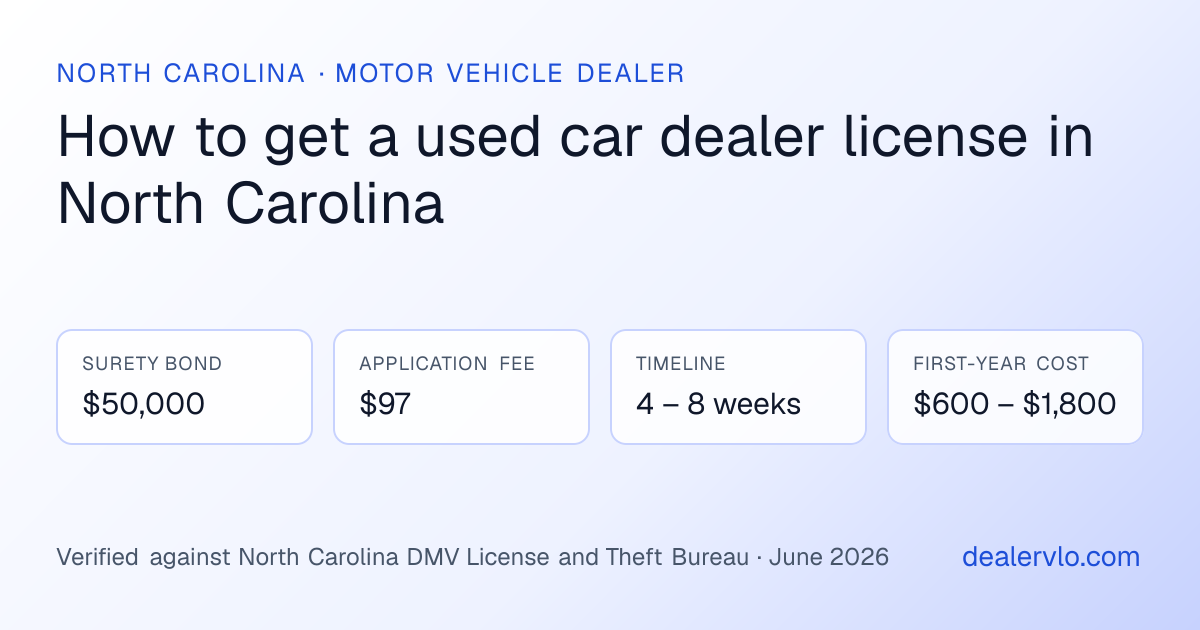
Getting a Motor Vehicle Dealer used-car dealer license in North Carolina:
- Surety bond required
- $50,000
- Application fee
- $115.50 per year ($231 for the 2-year license)
- License term
- 2 years
- Typical timeline
- Varies (no official estimate)
- Typical first-year cost
- $900 – $4,200 (estimate)
This guide is informational and does not replace official North Carolina requirements. Always verify with the NCSHP Investigative Services Unit (Dealer Section) before applying.
Two numbers worth knowing before you commit. Free calculators dealers actually use — no signup, no email.
Inventory with VIN auto-decode, the deal jacket, and every NC + federal form your sales need. $29/month, free to try — cancel any time.
Who can apply for a Motor Vehicle Dealer license
In North Carolina you're a dealer, and need a license, if you buy, sell or exchange five or more vehicles in any 12 consecutive months for profit (G.S. 20-286(11)). Licensing is run by the NC State Highway Patrol's Investigative Services Unit (ISU) Dealer Section, which took over from the DMV License and Theft Bureau. Its Raleigh and Huntersville offices are the only places that issue dealer licenses.
In North Carolina this is also commonly called an auto dealer license, car dealer license, or motor vehicle dealer license — all the same Motor Vehicle Dealer authority to sell used vehicles.
- An established salesroom (retail) or established office (wholesale): at least 96 square feet in a permanent, enclosed building
- For a retail salesroom, a sign with the business's trade name in block letters at least 3 inches tall on a contrasting background
- Written zoning approval from the city or county for the location
- A $50,000 surety or cash bond, plus $25,000 for each additional salesroom
- A 12-hour pre-licensing course approved by the Division, completed within the 12 months before you apply (used dealers)
- Garage liability insurance covering your dealer plates, with NCSHP Dealer Section listed as certificate holder
- An assumed-name filing with the county Register of Deeds if you trade under a name other than your own or your company's
- A passed on-site inspection by an ISU officer before the license is issued
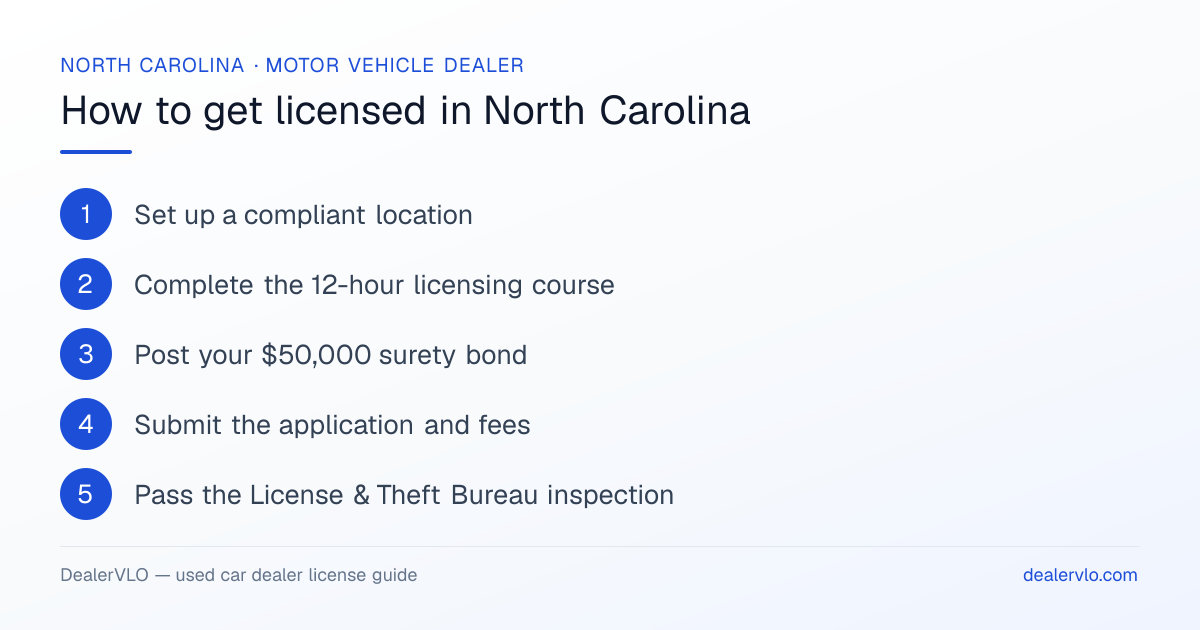
Step-by-step process
- 1
Pick a location that can pass
Find space with at least 96 square feet of office in a permanent, enclosed building. Get written zoning approval before you sign anything long-term. The ISU tells applicants to contact the ISU officer for the county where the dealership will be; the site must be approved before you submit applications to the Dealer Section.
- 2
Form the business and file your names
If you'll operate as a corporation or LLC, file with the NC Secretary of State first (an out-of-state company needs an NC Certificate of Authority). If you trade under any other name, file an assumed name with the Register of Deeds in your county.
- 3
Take the 12-hour pre-licensing course
First-time used motor vehicle dealers need a certificate from a Division-approved 12-hour course dated within the last 12 months (G.S. 20-288(a1)). It goes in your application packet.
- 4
Buy the bond and garage insurance
Get a $50,000 dealer surety bond on form ISU-409, completed by the surety with its power of attorney. Get garage liability insurance and a certificate showing how many dealer plates it covers, with NCSHP Dealer Section, 3129 Mail Service Center, Raleigh NC 27697 as certificate holder.
- 5
Put the sign up and pass the ISU inspection
Hang the trade-name sign (block letters at least 3 inches tall) and have the office ready. An ISU officer must inspect and approve the salesroom or office before any license is issued.
- 6
Submit the packet and fees
Send the notarized ISU-400 application, ISU-405 plate application, ISU-409 bond, notarized ISU-426 sales representative application, course certificate, zoning letter, insurance certificate and company filings. Licenses are issued for two years, so the license fee is $115.50 x 2 = $231, plus plates and $25.50 per year for each sales representative license. Checks go to NC Division of Motor Vehicles.
Which NC dealer license do you need?
Article 12 of Chapter 20 licenses several kinds of dealers. Most independent operators pick between two of them. Both cost $115.50 a year and need the same $50,000 bond.
The main difference is the building. A retail dealer needs an "established salesroom": 96 square feet, a trade-name sign, open to the public at reasonable times. A wholesaler needs an "established office": 96 square feet where the required records are kept. The statute doesn't require a sign for that.
- Dealer (used motor vehicle dealer): sells used vehicles to the public. Needs an established salesroom and the 12-hour course (G.S. 20-286(16), 20-288(a1)).
- Wholesaler: sells or distributes used vehicles to other dealers in North Carolina (G.S. 20-286(17)). Needs an established office and must give the Division a phone number for records questions.
- New motor vehicle dealer: needs a manufacturer or distributor franchise before the license is issued (19A NCAC 03D .0217).
- Sales representative: anyone selling for a dealer needs their own license, $25.50 a year, endorsed by the employing dealer (form ISU-426).
Can you get an NC dealer license without a lot?
Neither the statute nor the ISU's minimum-requirements sheet (ISU-415) lists a vehicle display lot as a licensing requirement. What they require is the building: an established salesroom of at least 96 square feet in a permanent, enclosed building, with the sign, zoning approval and an ISU inspection. G.S. 20-286(6) counts the area next to the premises, or within 500 feet, as part of the salesroom.
That doesn't mean anywhere works. Your city or county zoning has to approve auto sales at the address in writing, and local rules can demand more than the state does. The state's dealer rule (19A NCAC 03D .0216) also says the salesroom must be separate from any living quarters or residence, with its own entrance, and a building on wheels doesn't count as permanent.
A wholesale license is the closest thing to a no-lot license. You still need a 96-square-foot established office in a permanent building where your records are kept, plus the bond and an inspection. You just don't need a public-facing salesroom or the sign. Wholesalers sell to dealers, not the public.
- Tents, temporary stands and other temporary quarters don't qualify (G.S. 20-286(6)).
- The 96-square-foot minimum doesn't apply to locations licensed on or before January 1, 1978.
- Moving later means telling the ISU first. You can't do business at the new address until it's inspected and approved (19A NCAC 03D .0217).
Do you need another license for buy here, pay here?
For most dealers financing their own sales, no separate state finance license shows up in the sources we checked. The NC Commissioner of Banks says its Consumer Finance Act license is for lenders making direct consumer loans of $15,000 or less at rates above Chapter 24's usury limits. Lenders "operating under another lending law (such as the Retail Installment Sales Act)" don't need it.
A dealer selling a car on an installment contract is making a credit sale under the Retail Installment Sales Act (Chapter 25A), not a cash loan. That act caps the finance charge, and for vehicles the cap goes up with age, to 30% a year on vehicles six or more model years old (G.S. 25A-15). G.S. 20-303 also requires every installment sale to be in writing and signed by the buyer, with a statement giving the cash price, down payment, trade-in, finance charge, other charges, balance and payment terms.
If you plan to lend cash, sell your paper in an unusual way, or charge above those caps, call the Commissioner of Banks at (919) 733-3016 or ask a lawyer before you start. Federal rules (Truth in Lending, the FTC Used Car Rule) apply either way.
Once you're carrying notes, DealerVLO's collections panel tracks each BHPH account's payments and balance.
Using your NC dealer license at car auctions
Dealer-only auctions are why a lot of people look into a license. Being licensed lets you buy and sell as a dealer. Each auction sets its own registration requirements, so ask the auction what it needs from you before your first sale. Expect to show your dealer license.
North Carolina's dealer-plate law lets your employees or contractors drive inventory to or from an auction on your dealer plates (G.S. 20-79(d)). The vehicle has to be your inventory, insured, and not used in another business.
Keep in mind the license follows the volume. If you buy at auction and resell five or more vehicles in any 12 months, you're a dealer under G.S. 20-286(11) and need a license, whether or not you have a lot.
Why NC dealer applications get delayed or denied
The ISU says incomplete or illegible forms won't be processed, and only originals are accepted for notarized forms. Most delays come from a missing piece of the packet or a site that isn't ready for inspection. G.S. 20-294 lists the grounds to deny a license. These are the ones that hit new applicants:
- A material misstatement on the application or the dealer-plate application.
- No established salesroom (dealers) or established office (wholesalers) that meets the definition.
- Certain vehicle-related convictions (such as under G.S. 20-106.1 or 20-112) within the five years before you apply, or a felony involving moral turpitude. The Division must weigh factors like how old the offense is and rehabilitation, and you can attach supporting documents.
- A missing zoning letter, course certificate older than 12 months, or a bond whose name and address don't match the application exactly (19A NCAC 03D .0217).
- A denial can be appealed. The application form points to G.S. 20-296 and 20-300 for hearings.
Once you're licensed: your first NC deals
Every retail sale needs the title paperwork. North Carolina's core forms are the MVR-1 title application, the MVR-180 odometer disclosure and the MVR-181 damage disclosure. Dealers must keep records of every vehicle bought and sold for four years, and odometer disclosures for five (19A NCAC 03D .0219).
DealerVLO fills the official NC MVR-1 and MVR-180 from the deal you've already entered, so you're not retyping the buyer, VIN and mileage onto each form.
Our step-by-step guides for each one are linked under "More North Carolina dealer guides" at the bottom of this page:
- MVR-1 title application: who signs where, and what goes with it on a dealer sale
- MVR-180 odometer disclosure: when it's required and how to fill in the mileage
- MVR-181 damage disclosure: the 25% damage rule and what to keep in the deal file
- Dealer plates: how many you can get, who can drive on them, and renewal
Other North Carolina forms dealers file
- Form MVR-1: North Carolina title application
- North Carolina certification of repossession (MVR-3)
- North Carolina lienholder affidavit (MVR-46D)
- North Carolina odometer disclosure (MVR-180)
- North Carolina damage disclosure (MVR-181)
Also for North Carolina: North Carolina dealer plates
Same form in other states: Title applications · Repossession · Lien release · Odometer disclosure · Damage disclosure
North Carolina dealer license cost — fees breakdown
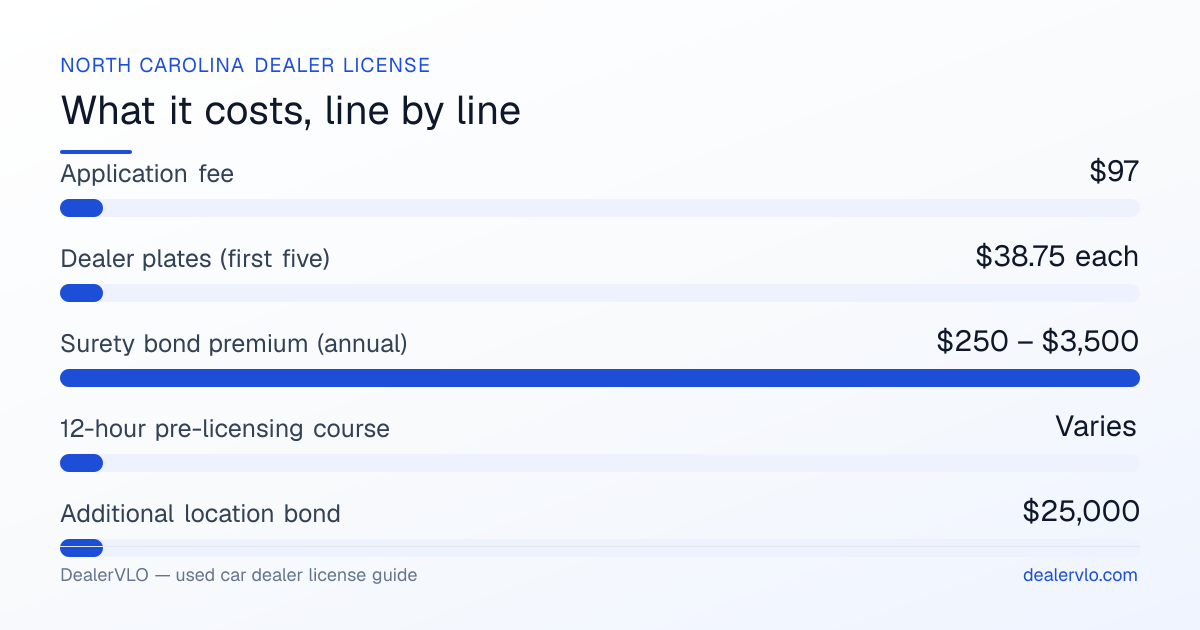
| Item | Amount |
|---|---|
Dealer or wholesale dealer license Issued for 2 years, so $231 at issuance (ISU-400). | $115.50/year |
Dealer plates, first five Plates are issued for 2 years to match the license (ISU-405). | $46.25/plate/year |
Each additional dealer plate Dealer transporter plates are also $23.13. | $23.13/plate/year |
Regional transit tax on plates $17 in Wake, Orange and Durham counties; $1 in Randolph County. | $17 or $1/plate/year |
Sales representative license Form ISU-426, endorsed by the dealer and notarized. | $25.50/person/year |
60-day temporary markers $50 minimum on mail orders. | $25 per set of 25 |
12-hour pre-licensing course Must be a Division-approved course. | Set by provider |
Bond premium (annual) Our estimate at 1–7% of $50,000; your quote depends on credit. | Estimate: $500 – $3,500 |
The North Carolina auto dealer bond: $50,000
North Carolina requires every used-vehicle dealer to post a $50,000 surety bond. The bond protects buyers from misconduct (odometer fraud, undisclosed liens, deceptive trade practices) and the state from unpaid taxes.
You don't pay the full bond amount up front — you pay an annual premium to a surety company, typically 1-7% (industry estimate) of the bond's face value. Your actual premium depends on personal credit and business history.
G.S. 20-288(e) requires a $50,000 corporate surety bond, cash bond or fixed-value equivalent for your first salesroom, plus $25,000 for each additional one. Wholesalers post the same $50,000. The bond is filed on form ISU-409 and covers people harmed by fraud or violations of Articles 12 and 15 of Chapter 20. The surety must give 30 days' written notice to cancel or not renew it. The 1–7% premium range is our estimate, not a state figure.
Renewal
NC dealer licenses now run two years (G.S. 20-288; Session Law 2025-22), with expiration dates staggered rather than one statewide date, so check your Dealer License Certificate for yours. Used dealers must show one 6-hour Division-approved continuing education course for each year of the licensing period. Plates renew with the license and must be replaced every four years. A $15-per-plate late fee starts the first day of the month after expiration. If you don't renew within one month, the license is stamped "Failed to Renew" and you have to file a new application. If you file a renewal before expiration, G.S. 20-295 keeps the license valid for up to 60 days while it's processed.
Common questions
Can you get a dealer license in North Carolina without a lot?+
The state doesn't list a display lot as a requirement. You do need a 96-square-foot established salesroom in a permanent, enclosed building with a trade-name sign, written zoning approval and an ISU inspection. Local zoning can require more. A wholesale license needs a 96-square-foot office but no public salesroom or sign.
Can I run a dealership from my home in North Carolina?+
Not from your living space. The dealer rule (19A NCAC 03D .0216) says the salesroom must be separate from any living quarters or residence and have its own entrance, and zoning has to approve auto sales at the address. A separate, permanent building on the property may work if zoning allows it. Ask your county ISU officer before you spend money on it.
How many cars can I sell in North Carolina without a dealer license?+
Selling five or more vehicles in any 12 consecutive months for profit makes you a dealer under G.S. 20-286(11). Selling cars you bought and actually used yourself or for your family is excluded. Buying to resell is not.
Can I use an NC dealer license to buy at dealer-only auctions?+
Being licensed lets you buy and sell as a dealer, but each auction sets its own registration rules, so check with the auction. Your employees or contractors can drive inventory to and from an auction on your dealer plates under G.S. 20-79(d).
Do I need a separate license to do buy here, pay here in North Carolina?+
Generally no, if you're selling your own cars on installment contracts. The Commissioner of Banks says its Consumer Finance Act license is for direct lenders charging above the usury limits, not businesses operating under the Retail Installment Sales Act. That act caps your finance charge (G.S. 25A-15). If you plan to make cash loans, confirm with the Commissioner of Banks first.
Do I need a course to get a North Carolina dealer license?+
Yes, for used dealers. You need a Division-approved 12-hour pre-licensing course completed within the 12 months before you apply, then one 6-hour continuing education course for each year of the license period at renewal.
How long is a North Carolina dealer license good for?+
Two years. The fee is still quoted per year ($115.50), so you pay $231 for the license term. Expiration dates are staggered, so check your Dealer License Certificate.
Who issues dealer licenses in North Carolina?+
The NC State Highway Patrol's Investigative Services Unit, Dealer Section, which took over from the DMV License and Theft Bureau. Its Raleigh and Huntersville offices are the only places that issue dealer licenses. Site inspections are done by the ISU officer for your county.
How much does a North Carolina dealer license cost?+
Plan for about $900 – $4,200 (estimate) in the first year. That covers the $115.50 per year ($231 for the 2-year license) application fee and the $50,000 surety bond — you pay an annual premium of roughly 1-7% (industry estimate) of the bond, not the full amount — plus business-formation, facility, and dealer-plate costs. See the full fees breakdown above.
How do I get dealer plates in North Carolina?+
Dealer plates are separate from the license itself. Once your Motor Vehicle Dealer license is approved, you apply for dealer plates and pay a per-plate fee (listed in the fees breakdown above). You can't obtain dealer plates before the license is issued.
- NCSHP ISU-415 Minimum Dealer License Requirements (Rev. 02/26)
- NCSHP ISU-400 Application for New Dealer License (Rev. 02/26)
- NCSHP New Dealer Packet (ISU-405 plates, ISU-409 bond, ISU-426, ISU-460)
- NCSHP Dealer Renewal Packet (Rev. 02/26)
- NCSHP Investigative Services Unit
- G.S. 20-286 (definitions: dealer, wholesaler, established salesroom)
- G.S. 20-288 (application, education, bond, 2-year term)
- G.S. 20-294 (grounds for denial)
- G.S. 20-79 (dealer plates)
- G.S. 20-303 (installment sales by dealers)
- G.S. 25A-15 (Retail Installment Sales Act finance charge limits)
- 19A NCAC 03D (dealer rules)
- NC Commissioner of Banks: Consumer Finance Act scope memorandum (Feb. 2023)
- North Carolina dealer plates
- How to fill out Form MVR-1 (North Carolina)
- E-signatures and e-titling for North Carolina dealers
- North Carolina certification of repossession (MVR-3)
- North Carolina lienholder affidavit (MVR-46D)
- North Carolina odometer disclosure (MVR-180)
- North Carolina damage disclosure (MVR-181)
- Dealer license without a lot: state-by-state rules
- Dealer license for car auctions
- Odometer disclosure rules and forms by state
- Dealer license cost in all 50 states
- License cost calculator (fees + bond by state)
Got your NC dealer license? Run your lot in DealerVLO.
Inventory with VIN auto-decode, the deal jacket, your North Carolina title paperwork and the federal forms filled from each deal, and your own dealer website at your custom domain. $29/month. 14-day free trial, cancel any time.
Shopping for software first? See what car lot software for a new dealer should cover.