How to get a used car dealer license in Texas
A practical walkthrough of the General Distinguishing Number (GDN) application — fees, bond, timeline, and what to expect at each step. Verified against the official agency as of October 2026.
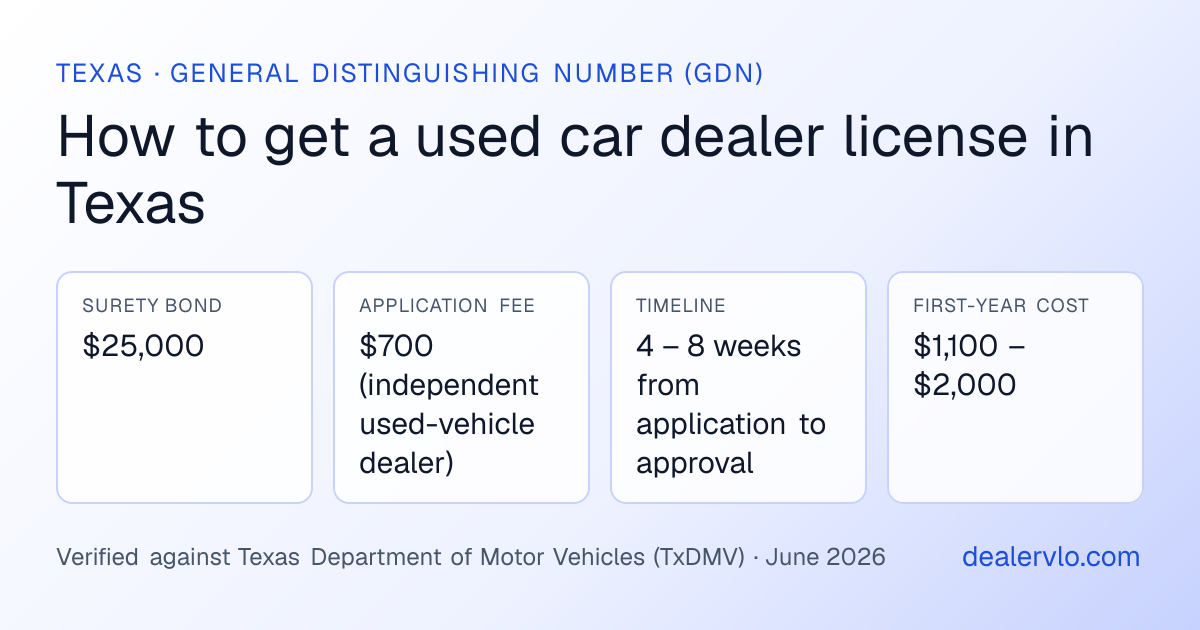
Getting a General Distinguishing Number (GDN) used-car dealer license in Texas:
- Surety bond required
- $50,000
- Application fee
- $700 (original 2-year GDN)
- License term
- 2 years
- Typical timeline
- Varies — TxDMV publishes no fixed processing time
- Typical first-year cost
- About $1,400 – $2,600 (estimate, before rent)
This guide is informational and does not replace official Texas requirements. Always verify with Texas Department of Motor Vehicles (TxDMV) before applying.
Two numbers worth knowing before you commit. Free calculators dealers actually use — no signup, no email.
Inventory with VIN auto-decode, the deal jacket, and every TX + federal form your sales need. $29/month, free to try — cancel any time.
Who can apply for a General Distinguishing Number (GDN) license
In Texas the dealer license is called a General Distinguishing Number (GDN). The Texas Department of Motor Vehicles (TxDMV) issues it. Anyone in the business of buying, selling, or exchanging vehicles — including on consignment — needs one for each location they sell from. Most used-car lots apply for the Independent Motor Vehicle GDN; dealers who only sell to other dealers can apply for the Wholesale Motor Vehicle Dealer GDN instead.
In Texas this is also commonly called an auto dealer license, car dealer license, or motor vehicle dealer license — all the same General Distinguishing Number (GDN) authority to sell used vehicles.
- An established and permanent place of business in Texas — you own the property or hold a written lease that runs at least as long as the 2-year license
- An office of at least 100 sq ft with a 7-foot ceiling, a door that closes, a desk, two chairs, and working internet, in a building with a permanent roof and walls on all sides
- Not in a residence, apartment, hotel, motel, or virtual/subscription office
- Retail dealers: display space for at least five vehicles, reserved for inventory only (wholesale dealers are exempt from this)
- Retail dealers: a permanently mounted sign with your business name in letters at least 6 inches high, visible within 100 feet of the office entrance — banners don't count
- Retail dealers: open at least 4 days a week, at least 4 consecutive hours a day, with hours for all 7 days posted at the entrance — not appointment-only
- A locked room, closet, or bolted-down safe or steel cabinet big enough to hold every metal plate you're issued
- Zoning that allows motor vehicle sales at that address
- A signed $50,000 motor vehicle dealer surety bond covering the 2-year term
- A completed 6-hour TxDMV-approved dealer education course (Independent Motor Vehicle GDN only)
- Fingerprints for every owner, officer, and manager on the application, plus a criminal history review
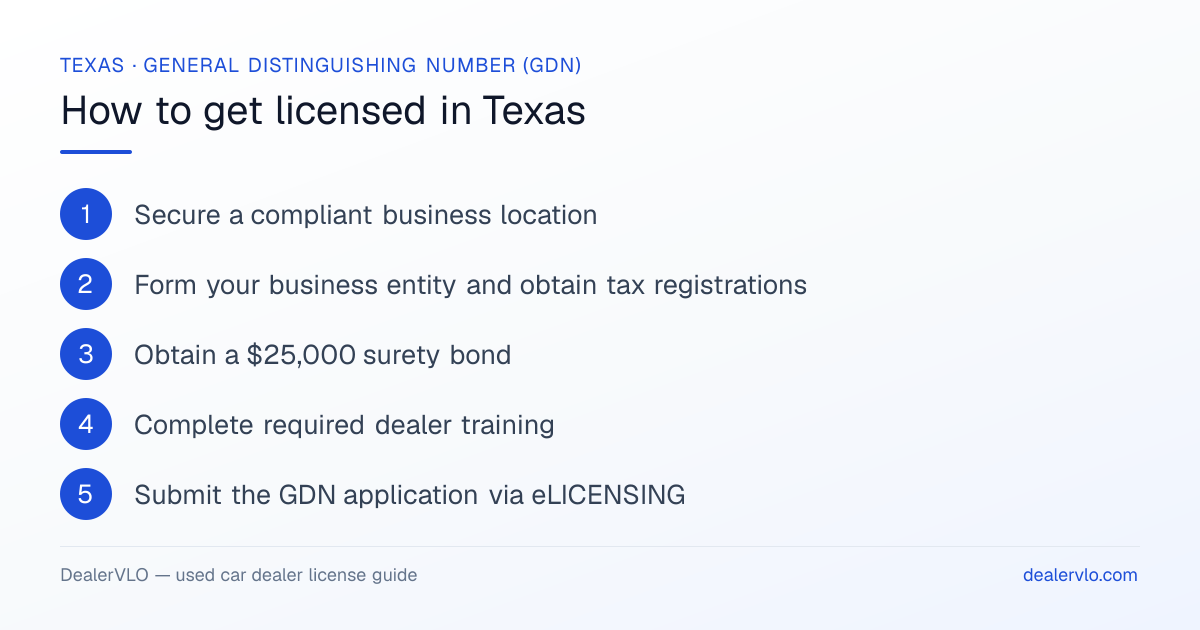
Step-by-step process
- 1
Pick the right GDN type
Each GDN covers one type of dealer. Selling used cars and trucks to the public means the Independent Motor Vehicle GDN. Selling only to other licensed dealers means the Wholesale Motor Vehicle Dealer GDN. Want more than one type? Each one is a separate application. The type you pick decides your premises rules, so settle this before you sign a lease.
- 2
Lock down a location that passes the premises rules
Find a commercial property zoned for vehicle sales. If you lease, the lease must name you as tenant, show the full street address including any suite number, and run for the license term (TxDMV accepts two years, or one year with an option to renew for another). Subleasing needs a notarized statement from the property owner. Then build out what TxDMV checks: the office, the sign, the five-car display space for retail, posted hours, and locked plate storage. You'll photograph all of it for the application.
- 3
Set up the business
Form your LLC or corporation with the Texas Secretary of State, or file a DBA if you're a sole proprietor using an assumed name. The legal name and address must match on every document you upload — mismatches are one of TxDMV's listed reasons for deficiencies. If every owner and manager lives outside Texas, you must add a Texas resident as a bona fide employee who is on site during posted hours.
- 4
Buy the $50,000 surety bond
Independent and wholesale motor vehicle GDNs both need a $50,000 dealer bond. The bond guarantees you pay the drafts and checks you write to buy vehicles and that you deliver good title on the vehicles you sell. It must show your exact business name and physical address, cover the 2-year term, and be signed by you and the bond company, with the power of attorney attached. You pay a yearly premium, not the face amount.
- 5
Take the dealer education course
Independent Motor Vehicle GDN applicants must complete at least six hours of online pre-licensing training from a TxDMV-approved provider. One owner or operating manager takes it, one time. The price is capped at $150 per person. Wholesale, motorcycle, trailer, and salvage applicants are exempt. Upload the completion certificate with your application.
- 6
Apply in eLICENSING
Create an account in TxDMV's eLICENSING portal and complete the application: owners and managers, criminal history, business details, plate request, and the premises photos (sign, building front, display space, office interior, plate storage, posted hours). Attach your bond, lease or deed, IDs, and the Certification of Responsibility signed within 30 days of submitting. Pay the $700 fee from an account held by the business (or its attorney or CPA) — TxDMV withdraws applications paid from anyone else's account.
- 7
Get fingerprinted when TxDMV asks
Every individual listed on the application must be fingerprinted, but don't go until TxDMV emails you that prints are required — it sends instructions with that email. Prints run through the state's vendor (IdentoGO); TxDMV lists the vendor fee as $38.25. Prints taken for another agency or license don't count.
- 8
Get licensed, then set up plates and webDEALER
Once approved, order standard dealer plates ($90 each) and dealer temporary plates ($10 each) through eLICENSING. Since July 1, 2025 (HB 718), paper buyer's tags are gone: you hand the buyer a metal plate at the sale and process title and registration in webDEALER, so complete webDEALER training before your first deal. Within 30 days of your license's active date, notify your county tax office and appraisal district — you'll file a monthly Vehicle Inventory Tax statement there even in months you sell nothing.
Texas GDN types: retail vs wholesale
Texas law splits dealers into categories, and each GDN is issued for one of them. For a used-car business, two matter.
The Independent Motor Vehicle GDN is the standard retail license. It covers used cars, trucks, motor homes, and neighborhood vehicles, lets you sell to anyone, and lets you buy, sell, or rebuild salvage vehicles. It carries the full premises rules: five-car display space, a 6-inch-letter outdoor sign, 4 days a week of posted hours, and the 6-hour education course.
The Wholesale Motor Vehicle Dealer GDN only lets you sell to holders of a Texas GDN or to out-of-state dealers allowed to buy in Texas without paying the motor vehicle sales tax. You cannot sell to a retail buyer. In exchange, the premises rules are lighter, and the education course doesn't apply. You still need the $50,000 bond, an office, fingerprints, and the criminal history review.
- Independent Motor Vehicle — retail and wholesale used cars and trucks; bond required; education course required
- Wholesale Motor Vehicle Dealer — dealer-to-dealer only; bond required; no display space; no education course
- Independent Motorcycle — used motorcycles, scooters, ATVs; bond required
- Travel Trailer and Trailer/Semitrailer — exempt from the bond
- Franchised — new vehicles under a manufacturer agreement; not a used-dealer license
Can you get a Texas dealer license without a lot?
For retail, no. The Independent Motor Vehicle GDN requires display space for at least five vehicles of the type you sell, at your licensed address, reserved for inventory only. It can't be customer parking, employee parking, another dealer's display, or a public right-of-way. A home address doesn't qualify for any GDN — the office can't be in a residence, apartment, hotel, or a virtual office.
For wholesale, you can skip the lot. Texas law exempts wholesale dealers from the display-space rule. But you still need a real office: 100 sq ft, permanent walls and roof, a door, a desk and two chairs, internet, locked plate storage, and a lease that covers the license term. The office can be inside an office building. If an outside sign isn't allowed there, an interior sign by the office door works — 2-inch letters with your name, plus "Purchasers must be Licensed Dealers" in letters at least 1 inch high. Wholesale dealers must be open at least two weekdays a week, two consecutive hours a day, and can't be appointment-only.
Sharing is allowed with limits. Up to four retail dealers, or up to eight wholesale dealers, can be in one building, but retail and wholesale dealers can't share a building. Each dealer needs its own walled office, sign, lease, phone number, and equipment. A retail dealer sharing a lot needs at least five spaces written into the lease for display only, separated by a barrier one person can't easily move.
So the honest answer to "dealer license without a lot" in Texas: a wholesale GDN, with an office, if you only want to sell to other dealers. If you want to sell to the public, you need the lot.
Buy-here-pay-here or in-house financing: you also need an OCCC license
The GDN lets you sell. It doesn't let you finance. Texas's Office of Consumer Credit Commissioner (OCCC) licenses motor vehicle sales finance, and it says both sellers and holders of retail installment contracts need a Motor Vehicle Sales Finance license. That includes dealers that keep their own contracts (buy-here-pay-here) and dealers that write the contract and assign it to a lender or finance company.
Charging interest isn't what triggers it. The OCCC treats a sale as financed whenever the buyer agrees to pay over time, even with no finance charge. TxDMV's own new-dealer page points dealers who offer in-house or third-party financing to the OCCC for this license. Applications run through NMLS, licenses renew each year between November 1 and December 31, and an annual report is due June 30.
In-house financing changes your tax and title deadlines too. A dealer that finances its own sales collects the 6.25% motor vehicle sales tax as payments come in and files seller-financed tax returns with the Texas Comptroller, and TxDMV gives in-house financed sales 45 calendar days for the title and registration filing instead of 20 business days.
If you run notes, DealerVLO tracks buy-here-pay-here accounts with a collections panel for payments and balances. It fills the retail installment contract on the OCCC's model plain-language contract, except on deals with GAP or credit insurance.
Buying at dealer-only auctions with a Texas GDN
A lot of people search for a dealer license so they can buy at dealer-only auctions. A GDN is what gets you in the door, but each auction sets its own registration paperwork, so check with the auction before you plan around it.
Two Texas rules matter here. First, if you buy to resell, you're a dealer once you sell five or more vehicles of the same type in a calendar year, so buying at auction to flip needs a GDN. Second, a wholesale GDN works for auction buying and dealer-to-dealer resale, but it can't sell to the public — if you plan to retail what you buy, get the independent GDN.
Texas also keeps the license active only for working dealers: once you've been licensed 12 months, TxDMV can cancel a GDN that hasn't assigned at least five vehicles in the previous 12 months. A license used only for occasional auction access is at risk.
Why Texas dealer applications get delayed or denied
TxDMV says processing time depends on application volume, how complete the submission is, fingerprint results, and any follow-up review. It publishes a list of common deficiencies. The ones applicants hit most:
- Fee paid from the wrong account — it must come from the applicant's account (or its attorney's or CPA's trust account), or the application is withdrawn and refunded
- Certification of Responsibility unsigned, undated, or signed more than 30 days before TxDMV receives it
- Bond not signed and dated by both parties, wrong business name or address, not a 2-year term, or missing its power of attorney
- Lease missing a signature, the suite number, the term, or (on a shared lot) the five display spaces; lessor who doesn't match county appraisal records without a notarized owner letter
- Premises photos missing or unclear, or a location that fails the sign, office, display, hours, or plate-storage rules
- Expired assumed name or a forfeited Secretary of State entity
- Undisclosed criminal history — you must report every conviction and deferred adjudication, anywhere, no matter how old; failing to disclose can lead to denial. TxDMV weighs how the offense relates to dealing (fraud, theft, forgery, and some vehicle-related felonies count heavily), time since, and rehabilitation. People with a record can ask TxDMV for a criminal history evaluation letter before applying.
- False or misleading information — TxDMV must deny an application that isn't true and must cancel a GDN obtained with false information
Once you're licensed: the paperwork on every deal
Every retail sale ends in a title and registration filing. You process it in webDEALER and collect the 6.25% motor vehicle sales tax for the county tax office, along with the buyer-signed Form 130-U (Application for Texas Title and/or Registration). Deadlines are 20 business days for cash and third-party financed sales and 45 calendar days for in-house financed sales.
Our Texas 130-U guide walks through the form line by line. DealerVLO fills the official Texas VTR-130-U from the deal — buyer, vehicle, price, and trade — so you're not retyping it. Then you submit the transaction in webDEALER.
For plates, our Texas dealer plates guide covers standard, temporary, and buyer plates under HB 718. For mileage, see our odometer disclosure guide for when a written mileage statement is required and how to fill it out.
Other Texas forms dealers file
- Form 130-U: Texas title application
- Texas repossessed vehicle affidavit (VTR-264)
- Texas release of lien (VTR-266)
- Texas limited power of attorney (VTR-271)
- Texas odometer disclosure (VTR-40 retired)
- Texas rebuilt vehicle statement (VTR-61)
Also for Texas: Texas dealer plates
Same form in other states: Title applications · Repossession · Lien release · Power of attorney · Odometer disclosure
Texas dealer license cost — fees breakdown
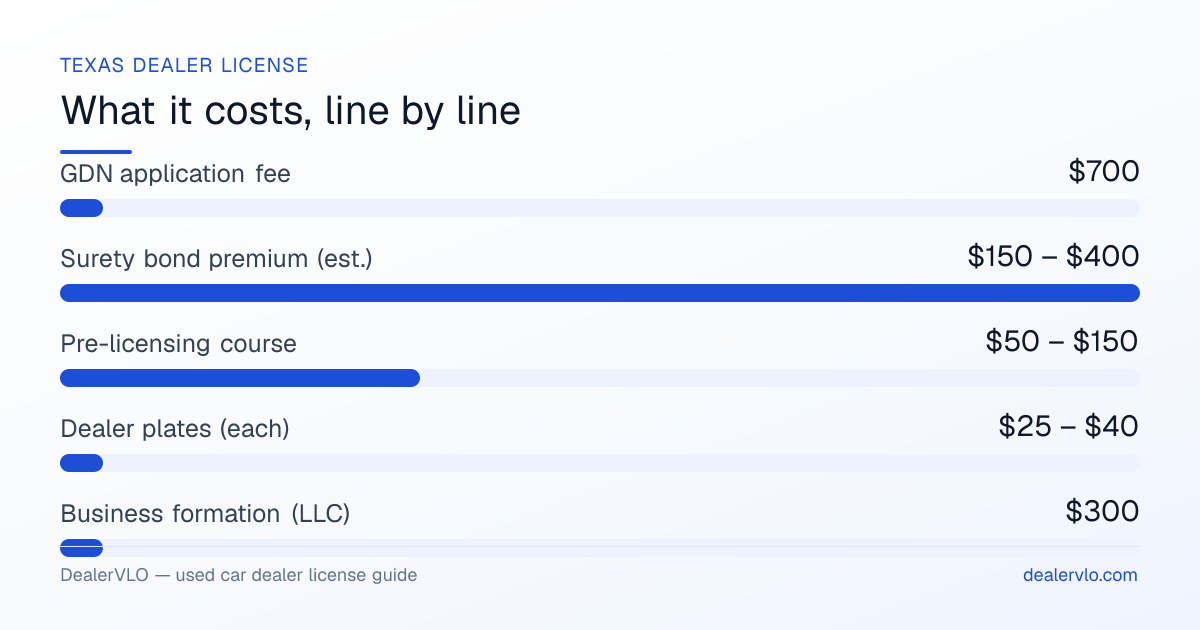
| Item | Amount |
|---|---|
GDN application fee Original 2-year license ($500 first year + $200 second year, set by statute) | $700 |
GDN renewal $200 per year for the 2-year term | $400 |
Surety bond premium (estimate) Market estimate on the $50,000 bond; set by your credit | $500 – $1,500/yr |
Dealer education course TxDMV caps the price; one time, independent motor vehicle GDN only | Up to $150 |
Fingerprints Per person, paid to the vendor (TxDMV-listed fee) | $38.25 |
Standard dealer plate (each) Two-year term matching the license | $90 |
Dealer temporary plate (each) Two-year term; business use only | $10 |
The Texas auto dealer bond: $50,000
Texas requires every used-vehicle dealer to post a $50,000 surety bond. The bond protects buyers from misconduct (odometer fraud, undisclosed liens, deceptive trade practices) and the state from unpaid taxes.
You don't pay the full bond amount up front — you pay an annual premium to a surety company, typically 1–3% (estimate) of the bond's face value. Your actual premium depends on personal credit and business history.
Texas requires a $50,000 surety bond to issue or renew an independent or wholesale motor vehicle GDN; travel trailer and trailer/semitrailer GDNs are exempt. The bond is conditioned on you paying the drafts and checks you write to buy vehicles and delivering good title on what you sell. Someone who wins a judgment against you on either point can collect against it, up to the $50,000 face value. The premium range shown is a market estimate, not a state figure — quotes depend on your credit.
Renewal
The GDN runs 2 years. Renew in eLICENSING before the expiration date — state law requires the renewal to be submitted before the GDN expires. The renewal fee is $200 a year ($400 for the term), and you need a $50,000 bond covering the new term. You must keep meeting every premises rule the whole time you're licensed, and TxDMV can cancel a GDN that hasn't sold or assigned at least five vehicles in the previous 12 months.
Common questions
Can you get a dealer license in Texas without a lot?+
Only a wholesale one. A Wholesale Motor Vehicle Dealer GDN doesn't require display space, but you still need a commercial office (100 sq ft, permanent walls, a lease for the license term) and you can only sell to other licensed dealers. A retail Independent Motor Vehicle GDN requires display space for at least five vehicles at your licensed address.
Can I sell cars from home in Texas?+
Not as a licensed dealer. TxDMV doesn't accept a dealer office in a residence, apartment, hotel, motel, or virtual office, for either retail or wholesale. Without a GDN, you can sell fewer than five vehicles of the same type a year that are titled and registered in your own name.
How many cars can I sell without a dealer license in Texas?+
Fewer than five vehicles of the same type in a calendar year, and only vehicles owned and registered in your own name. Selling or offering more than that without a GDN breaks state law: it's a misdemeanor with a $50 to $5,000 fine (a court can triple it if the violation was willful), plus a civil penalty of $50 to $1,000 per violation, with each day counted separately. After notice, police can also have the vehicles you're offering towed.
How do I get a wholesale dealer license in Texas?+
Apply for the Wholesale Motor Vehicle Dealer GDN in eLICENSING. It's a separate GDN type from the retail independent license. You need the $50,000 bond, an office that meets TxDMV's rules (no display lot required), posted hours of at least two weekdays, two hours a day, and fingerprints. The dealer education course doesn't apply. You can only sell to licensed dealers.
Can I buy at dealer-only auctions with a Texas dealer license?+
A GDN is what dealer-only auctions are built around, but each auction sets its own registration paperwork, so ask the auction what it needs. If you plan to retail what you buy, get the independent GDN — a wholesale GDN can't sell to the public.
Do I need a separate license to finance cars in-house in Texas?+
Yes. The OCCC's Motor Vehicle Sales Finance license is required for dealers that hold their own contracts (buy-here-pay-here) and for dealers that sign retail installment contracts and assign them to a lender. It's required even if you charge no interest, as long as the buyer pays over time.
Do Texas dealers have to use webDEALER?+
Yes, in practice. Since HB 718 took effect July 1, 2025, dealers issue a metal plate at the sale and process title and registration through webDEALER (ePLATE replaced eTAG); TxDMV said dealers without a webDEALER account on that date couldn't complete sales. DealerVLO fills the Texas 130-U from your deal but doesn't connect to webDEALER — you key the transaction there.
How long does it take to get a Texas GDN?+
TxDMV doesn't publish a fixed timeline. It says processing depends on application volume, completeness, fingerprint results, and follow-up review. The fastest path is a complete application: matching names and addresses, every premises photo, a signed bond and certification, and full criminal history disclosure. You can track status with TxDMV's online application status check.
How much does a Texas dealer license cost?+
Plan for about About $1,400 – $2,600 (estimate, before rent) in the first year. That covers the $700 (original 2-year GDN) application fee and the $50,000 surety bond — you pay an annual premium of roughly 1–3% (estimate) of the bond, not the full amount — plus business-formation, facility, and dealer-plate costs. See the full fees breakdown above.
How do I get dealer plates in Texas?+
Dealer plates are separate from the license itself. Once your General Distinguishing Number (GDN) license is approved, you apply for dealer plates and pay a per-plate fee (listed in the fees breakdown above). You can't obtain dealer plates before the license is issued.
- TxDMV — Independent (GDN) license types
- TxDMV — Licensing overview
- TxDMV Form LG100 — Retail GDN Checklist: New Application Requirements (Rev 08/26)
- TxDMV Form LF628 — Dealership Premises Checklist (Rev 08/25)
- TxDMV — Starting Your New Dealership
- TxDMV — Dealer Education Requirements
- TxDMV — Fingerprinting Requirements
- TxDMV — Dealer Criminal History Review Process
- TxDMV — HB 718 metal plate information
- Texas Transportation Code ch. 503 (§§503.001, .007, .008, .021, .024, .032, .033, .034, .038, .094–.096)
- OCCC — Motor Vehicle Sales Finance
- Texas Comptroller — Motor Vehicle Sales and Use Tax
- Texas Comptroller — Motor Vehicle Seller-Financed Sales Tax
- Texas dealer plates
- How to fill out Form 130-U (Texas)
- E-signatures and e-titling for Texas dealers
- How Texas car sales tax works on a dealer sale
- Texas repossessed vehicle affidavit (VTR-264)
- Texas release of lien (VTR-266)
- Texas limited power of attorney (VTR-271)
- Texas odometer disclosure (VTR-40 retired)
- Texas rebuilt vehicle statement (VTR-61)
- Dealer license without a lot: state-by-state rules
- Dealer license for car auctions
- Odometer disclosure rules and forms by state
- Dealer license cost in all 50 states
- License cost calculator (fees + bond by state)
Got your TX dealer license? Run your lot in DealerVLO.
Inventory with VIN auto-decode, the deal jacket, your Texas title paperwork and the federal forms filled from each deal, and your own dealer website at your custom domain. $29/month. 14-day free trial, cancel any time.
Shopping for software first? See what car lot software for a new dealer should cover.