How to get a used car dealer license in Pennsylvania
A practical walkthrough of the Vehicle Dealer License application — fees, bond, timeline, and what to expect at each step. Verified against the official agency as of September 2026.
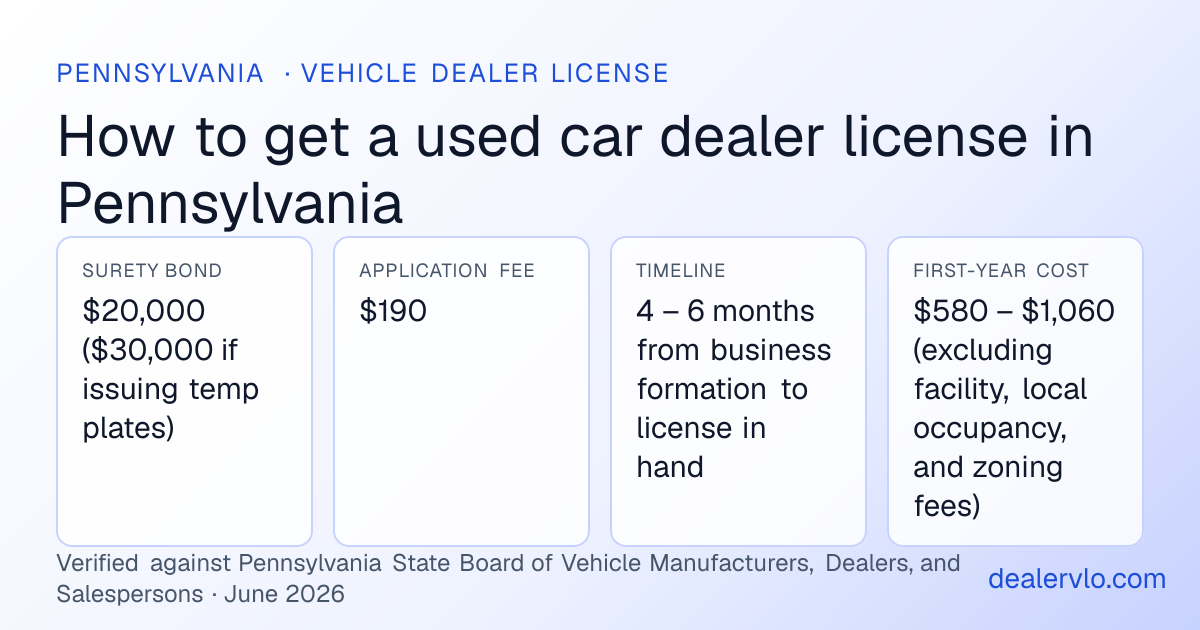
Getting a Vehicle Dealer License used-car dealer license in Pennsylvania:
- Surety bond required
- $20,000 ($30,000 if issuing temp plates)
- Application fee
- $190
- License term
- Two years — expires May 31 of odd-numbered years
- Typical timeline
- 4 – 6 months from business formation to license in hand
- Typical first-year cost
- $580 – $1,060 (excluding facility, local occupancy, and zoning fees)
This guide is informational and does not replace official Pennsylvania requirements. Always verify with Pennsylvania State Board of Vehicle Manufacturers, Dealers, and Salespersons before applying.
Two numbers worth knowing before you commit. Free calculators dealers actually use — no signup, no email.
Inventory with VIN auto-decode, the deal jacket, and every PA + federal form your sales need. $29/month, free to try — cancel any time.
Who can apply for a Vehicle Dealer License license
A Vehicle Dealer License authorizes the holder to buy, sell, and exchange motor vehicles—new, used, or both—in Pennsylvania. The license is issued by the State Board of Vehicle Manufacturers, Dealers, and Salespersons and is required if you sell five or more vehicles in a calendar year. Once licensed by the Board, you can then apply to PennDOT for dealer plates.
In Pennsylvania this is also commonly called an auto dealer license, car dealer license, or motor vehicle dealer license — all the same Vehicle Dealer License authority to sell used vehicles.
- Must register your business entity (sole proprietorship, LLC, corporation, or partnership) with the Pennsylvania Department of State
- A physical facility meeting strict display and office requirements: space to display at least five vehicles with doors open, proper surfacing (asphalt, concrete, gravel, etc.), permanent office with desk, locked file cabinet, and telephone
- Business signage permanently attached and visible to the public, showing your dealership name and hours of operation
- Lease of at least six months or proof of ownership (deed) for your facility location
- Certificate of Occupancy from the Department of Labor and Industry, plus zoning approval from your municipality
- Criminal background checks from Pennsylvania State Police (and any other state you've lived or worked in the past five years) dated within 180 days of application—$22 per person
- Clean criminal history for all owners, partners, and officers; recent felonies can disqualify you
- Liability insurance covering as many vehicles as the number of dealer plates you'll request
- Three character reference letters for each owner or corporate officer, plus a credit reference from your bank
Step-by-step process
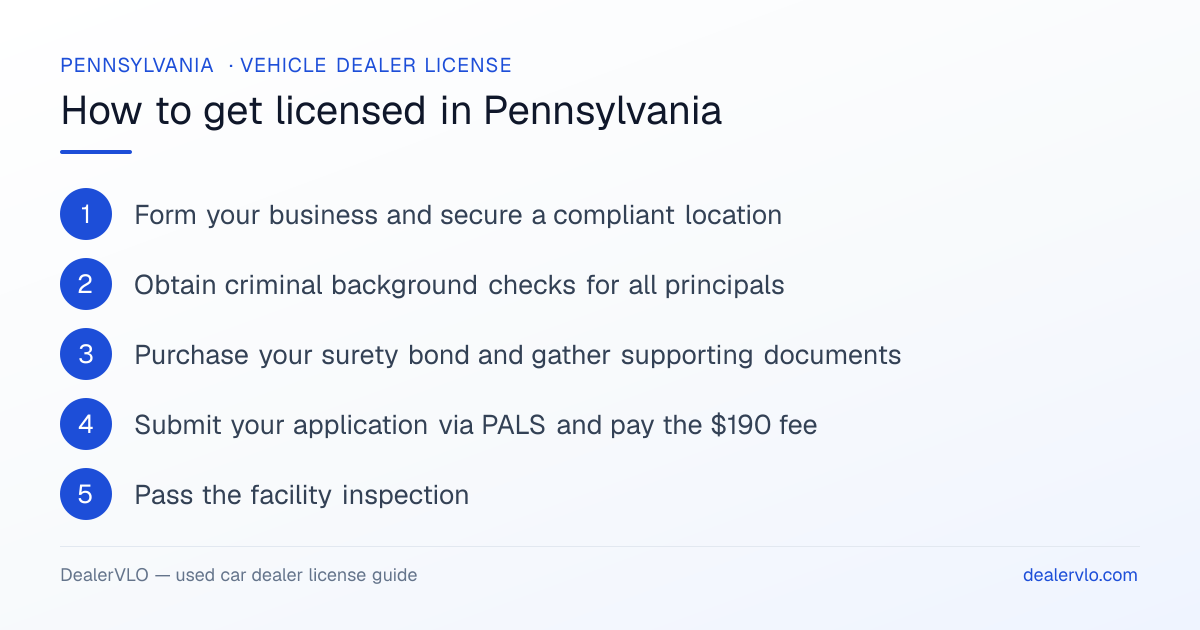
- 1
Form your business and secure a compliant location
Register your business entity with the Pennsylvania Department of State—sole proprietorship, LLC, partnership, or corporation. You'll need an EIN from the IRS. Then lock in a location: lease for at least six months or purchase property. The display area must be large enough to fit at least five vehicles with their doors open, surfaced with asphalt, concrete, gravel, or similar material, and separated from neighboring parking by a barrier (painted lines, ropes, grass, etc.). You need a permanent office adjacent to the display area with a business telephone (landline), desk, and locking file cabinet. Install permanent signage showing your dealership name (as it will appear on your license) and a second sign with your days and hours of operation. Get a Certificate of Occupancy from the Pennsylvania Department of Labor and Industry and confirm your location meets local zoning and land-use rules. All of this must be complete before you submit your application—the Board will inspect the site.
- 2
Obtain criminal background checks for all principals
Every owner, partner, and corporate officer must get an original Pennsylvania State Police criminal history record using Form SP 4-164 ($22 per person). If any principal has lived, worked, or trained in another state during the past five years, you also need a background check from that state. These records must be dated within 180 days of your application date, so time this step carefully. The Board reviews criminal history; recent felonies or certain misdemeanors can block licensure.
- 3
Purchase your surety bond and gather supporting documents
Buy a $20,000 surety bond if you're only selling vehicles, or a $30,000 bond if you plan to issue temporary registration cards and plates. The bond premium typically runs 1–3 percent of the bond amount per year, so budget $200–$600 annually depending on your credit. The bond is filed with PennDOT on Form MV-375 (it backs your dealer registration plates, under 75 Pa.C.S. §1335), and originals are required—no copies accepted. While you wait for the bond, collect the rest of your paperwork: color photographs of your facility (exterior, interior, office, signage, display area), a hand-drawn diagram showing the office, display area, parking, and dimensions, your lease or deed, a telephone bill or letter from your phone company proving the business landline, three notarized character reference letters for each owner or officer, a credit reference letter from your bank, a notarized statement that you owe no money to the Commonwealth, your business formation documents, and proof of liability insurance. If you're selling new vehicles, include your franchise agreement.
- 4
Submit your application via PALS and pay the $190 fee
Create an account at www.pals.pa.gov and complete the Vehicle Dealership Initial License Application online. Pay the $190 application fee by credit card or electronic check. Upload digital copies of your documents where possible, and mail originals (especially the bond, background checks, and notarized statements) to the State Board at P.O. Box 2649, Harrisburg, PA 17105-2649. Double-check that your criminal history records are still within the 180-day window when you hit submit. Once the Board receives your complete application, they'll review it for compliance with statutes and regulations in Chapter 19 of the Pennsylvania Code.
- 5
Pass the facility inspection
After the Board deems your application complete, a Board representative will call to schedule an on-site inspection of your dealership. They'll verify that your display area, office, signage, surfacing, barriers, and accessibility all meet the rules in 49 Pa. Code §19.18. Make sure your location is fully operational—vehicles on display, office furnished, signs installed—before the inspector arrives. If you fail the initial inspection, you'll pay a $45 reinspection fee and fix the deficiencies before a second visit. Once you pass, the Board will issue temporary authorization to operate while your official license is processed.
- 6
Receive your dealer license and apply for dealer plates
Approximately four weeks after passing inspection, your official Vehicle Dealer License and dealer identification number will arrive by mail. Your license is valid for two years and expires on May 31 of the next odd-numbered year (for example, May 31, 2027). With your license in hand, you can now apply to PennDOT for dealer registration plates by submitting Form MV-349 and the required fee ($70 per auto dealer plate or $35 per motorcycle plate, per year) to PennDOT, Bureau of Motor Vehicles, P.O. Box 68283, Harrisburg, PA 17106-8283. Do not apply for dealer plates before you have your Board-issued dealer license—PennDOT will reject the application.
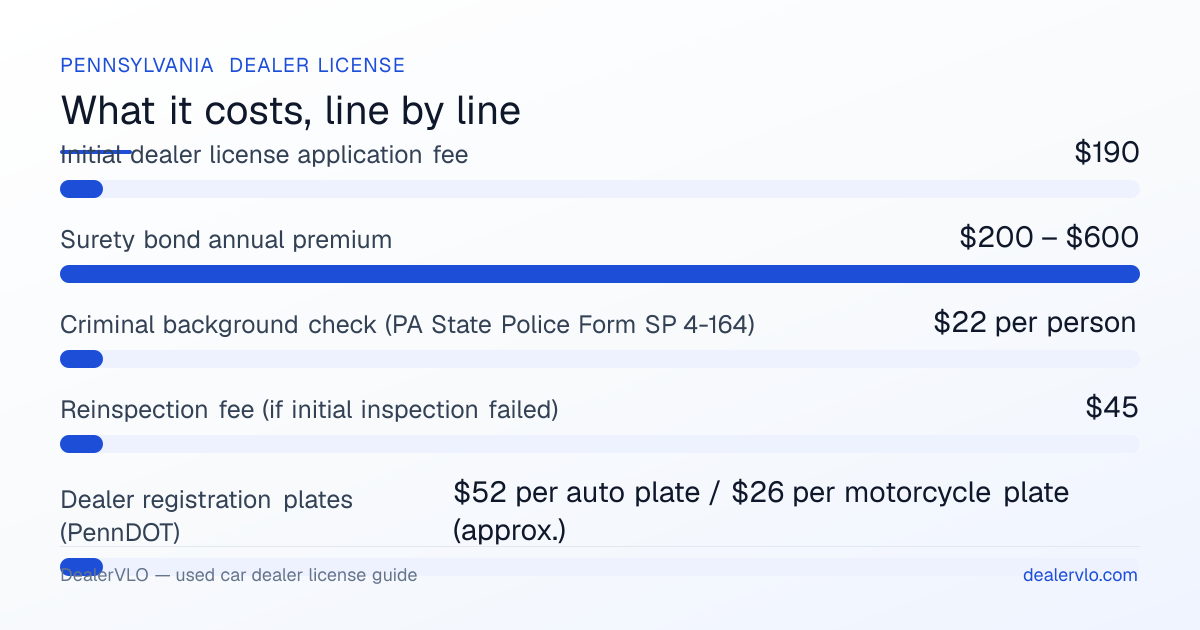
Pennsylvania dealer license cost — fees breakdown
| Item | Amount |
|---|---|
Initial dealer license application fee Biennial license; graduated from $65 in prior years to $190 as of FY 2024–2026. | $190 |
Surety bond annual premium 1–3% of the bond amount ($20,000 or $30,000), depending on personal credit and financials. | $200 – $600 |
Criminal background check (PA State Police Form SP 4-164) Required for every owner, partner, and corporate officer; additional checks if lived/worked in other states in past 5 years. | $22 per person |
Reinspection fee (if initial inspection failed) Only charged if you do not pass the first facility inspection. | $45 |
Dealer registration plates (PennDOT) Applied for separately after you receive your dealer license from the Board. | $70 per auto plate / $35 per motorcycle plate, per year |
Certificate of Occupancy, zoning, and local permits Contact your local Department of Labor and Industry office and municipal zoning authority for exact fees. | Varies by municipality |
The Pennsylvania auto dealer bond: $20,000 for dealers who only sell vehicles; $30,000 for dealers who also issue temporary registration cards and plates
Pennsylvania requires every used-vehicle dealer to post a $20,000 for dealers who only sell vehicles; $30,000 for dealers who also issue temporary registration cards and plates surety bond. The bond protects buyers from misconduct (odometer fraud, undisclosed liens, deceptive trade practices) and the state from unpaid taxes.
You don't pay the full bond amount up front — you pay an annual premium to a surety company, typically 1–3% annually (typically $200–$600 per year for the $20,000 bond, $300–$900 for the $30,000 bond) of the bond's face value. Your actual premium depends on personal credit and business history.
The bond runs concurrently with your two-year license term and must remain in force the entire time you hold your license. It protects consumers and the Commonwealth if you violate vehicle sales laws. Applicants with strong credit and solid financials pay on the low end of the range; weaker credit or thin business history pushes premiums higher. You must submit the original bond document with your application—the Board does not accept photocopies. Renew or replace the bond before it expires to keep your license active.
Renewal
Pennsylvania Vehicle Dealer Licenses expire on May 31 of each odd-numbered year—May 31, 2027, May 31, 2029, and so on. The biennial renewal fee is $274. Renew online through your PALS account before the expiration date; the Board will send a renewal notice roughly 60 days in advance. Make sure your surety bond remains current and that your facility still meets all Chapter 19 requirements. If you move locations or change your business structure, you must notify the Board and may need to submit a new application or amendment. Late renewals can result in penalties or the need to reapply as a new applicant, so mark your calendar and renew early.
Common questions
How long does it take to get a Pennsylvania dealer license?+
Most applicants spend four to six months from business formation to license in hand. Securing and setting up a compliant facility (4–8 weeks), gathering documents and background checks (2–4 weeks), Board review of your application (2–6 weeks), scheduling and passing the inspection (2–4 weeks), and final license issuance (4 weeks) all add up. If you already have a turnkey location and clean background checks, you can compress the timeline to three months. Delays usually come from facility issues, incomplete paperwork, or failing the first inspection.
Can I operate from home or do I need a commercial lot?+
You need a commercial facility that meets strict physical requirements: space to display at least five vehicles with doors open, proper surfacing (asphalt, concrete, gravel, etc.), a permanent office with desk, locked file cabinet, and landline telephone, and permanent signage visible to the public. The display area must be separated from neighboring parking by a barrier and meet local zoning for vehicle sales. Residential driveways and home offices do not satisfy these rules. Lease commercial property for at least six months or purchase a lot, obtain a Certificate of Occupancy, and confirm zoning approval before you apply.
Do I need a separate license if I only sell online or through auctions?+
Yes. Pennsylvania law requires a Vehicle Dealer License if you sell five or more motor vehicles in any calendar year, regardless of whether you sell retail on a lot, online via Craigslist or eBay, or wholesale at auctions. Online and auction-only dealers must still maintain a compliant physical facility, pass the Board's inspection, and carry the surety bond. There is no "online-only" or "wholesale-only" exemption from the facility and licensing rules.
What is the difference between the State Board license and PennDOT dealer plates?+
The State Board of Vehicle Manufacturers, Dealers, and Salespersons issues your Vehicle Dealer License, which is the legal authority to buy and sell vehicles as a business. PennDOT (the Department of Transportation) issues dealer registration plates after you have your Board license. You cannot get dealer plates until you hold a valid dealer license. The two agencies coordinate but handle separate parts of the process: Board for professional licensure and consumer protection, PennDOT for vehicle registration and titling. Always get your Board license first.
How much does the $20,000 bond actually cost me?+
You do not pay $20,000 up front. Instead, you pay a surety company an annual premium—typically 1 to 3 percent of the bond amount. If your credit is strong and your financials are solid, expect to pay $200–$400 per year. Weaker credit or a thin business history can push the premium to $600 or more. The surety company underwrites your risk; if a customer or the state files a valid claim against your bond, the surety pays it and then seeks reimbursement from you. Shop quotes from multiple surety providers to find the best rate.
What happens if I fail the facility inspection?+
The Board will document the deficiencies—inadequate display area, missing signage, improper office setup, zoning issues, or lack of proper surfacing—and you'll have to correct them. Once fixed, you pay a $45 reinspection fee and schedule a second visit. Repeated failures delay your license by weeks or months and cost additional reinspection fees. To avoid this, carefully review 49 Pa. Code Chapter 19, especially §19.18, before you submit your application. Take detailed photos and measurements, and consider consulting with an attorney or an experienced dealer who has passed the inspection successfully.
How much does a Pennsylvania dealer license cost?+
Plan for about $580 – $1,060 (excluding facility, local occupancy, and zoning fees) in the first year. That covers the $190 application fee and the $20,000 ($30,000 if issuing temp plates) surety bond — you pay an annual premium of roughly 1–3% annually (typically $200–$600 per year for the $20,000 bond, $300–$900 for the $30,000 bond) of the bond, not the full amount — plus business-formation, facility, and dealer-plate costs. See the full fees breakdown above.
How do I get dealer plates in Pennsylvania?+
Dealer plates are separate from the license itself. Once your Vehicle Dealer License license is approved, you apply for dealer plates and pay a per-plate fee (listed in the fees breakdown above). You can't obtain dealer plates before the license is issued.
Got your PA dealer license? Run your lot in DealerVLO.
Inventory with VIN auto-decode, deal jacket, federal + state forms (including the PA RMV-1 if you're in MA), and your own dealer website at your custom domain. $29/month. 14-day free trial, cancel any time.
Bond amounts, fees, and form rules change. Get a short email when your state does. No spam, unsubscribe anytime.