How to get a used car dealer license in Tennessee
A practical walkthrough of the Motor Vehicle Dealer application — fees, bond, timeline, and what to expect at each step. Verified against the official agency as of October 2026.
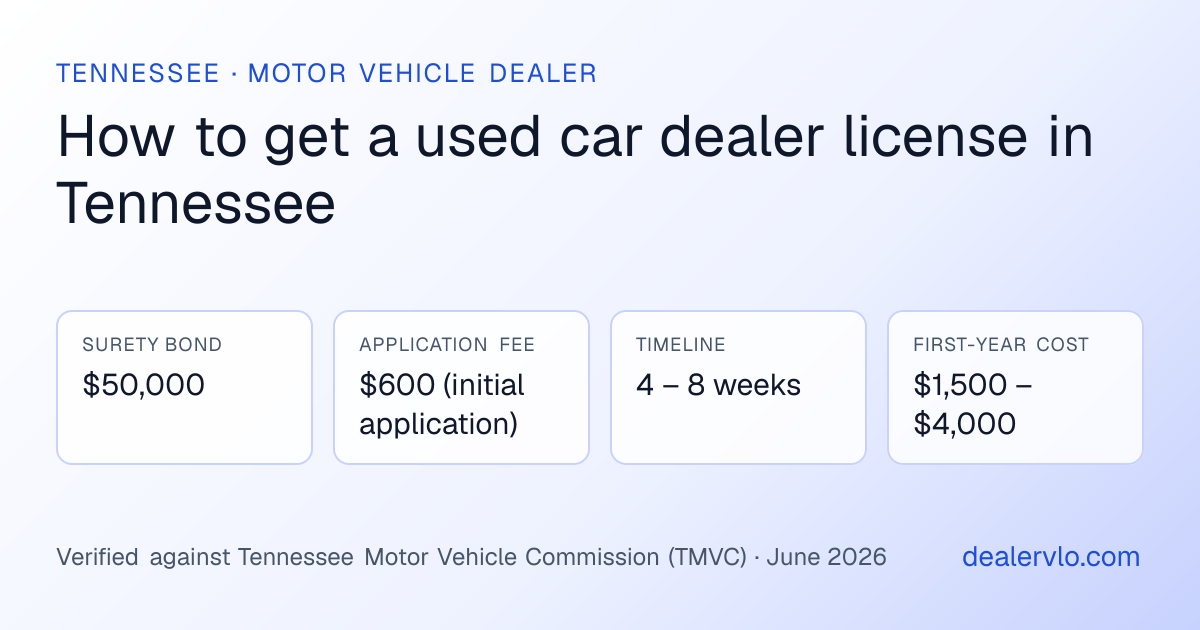
Getting a Motor Vehicle Dealer used-car dealer license in Tennessee:
- Surety bond required
- $50,000 (two-year bond)
- Application fee
- $600 (initial and renewal)
- License term
- 2 years, matched to the bond
- Typical timeline
- Documents due within 90 days of applying; license issued within 14 business days of approval
- Typical first-year cost
- About $1,200 – $2,500 (estimate, before rent, insurance, and CPA fees)
This guide is informational and does not replace official Tennessee requirements. Always verify with the Tennessee Motor Vehicle Commission before applying.
Two numbers worth knowing before you commit. Free calculators dealers actually use — no signup, no email.
Inventory with VIN auto-decode, the deal jacket, and every TN + federal form your sales need. $29/month, free to try — cancel any time.
Who can apply for a Motor Vehicle Dealer license
The Tennessee Motor Vehicle Commission (MVC), part of the Department of Commerce and Insurance, licenses dealers. Anyone who sells, or offers to sell, more than five motor vehicles in a year in Tennessee needs a Motor Vehicle Dealer license. That covers used cars, motorcycles, and RVs. The facility rules are specific, so read them before you sign a lease.
In Tennessee this is also commonly called an auto dealer license, car dealer license, or motor vehicle dealer license — all the same Motor Vehicle Dealer authority to sell used vehicles.
- A permanent facility used only for the vehicle business — not a residence, tent, or temporary stand; modular units must be underpinned
- An office of at least 288 square feet with a restroom, physically separate from any other business (or behind a floor-to-ceiling wall with its own outside entrance)
- A display lot for 15 vehicles, next to the facility and for your use only, on compacted gravel, chert, stone, or similar (not grass, public land, or a residential driveway), plus 3 customer parking spots
- A permanent sign with your business name in letters at least 8 inches high, visible from the road — banners don't count
- Posted hours of at least 3 days and 12 hours a week, between 8 a.m. and 7 p.m., with at least 8 of those hours on weekdays
- A phone number listed in the local directory under the dealership's name, posted on the door, window, or sign
- A written zoning letter stating that auto sales are a permitted use at your address
- A county business tax license (and city license if applicable) and a Sales & Use Tax certificate, in the exact business name
- A CPA-compiled financial statement showing a net worth of at least $10,000, dated within 12 months
- A $50,000 surety bond for two consecutive years and $300,000 per occurrence in garage liability or "any auto" insurance
- A service agreement with a repair garage if you don't have one on site
- At least one licensed motor vehicle salesperson employed at the dealership
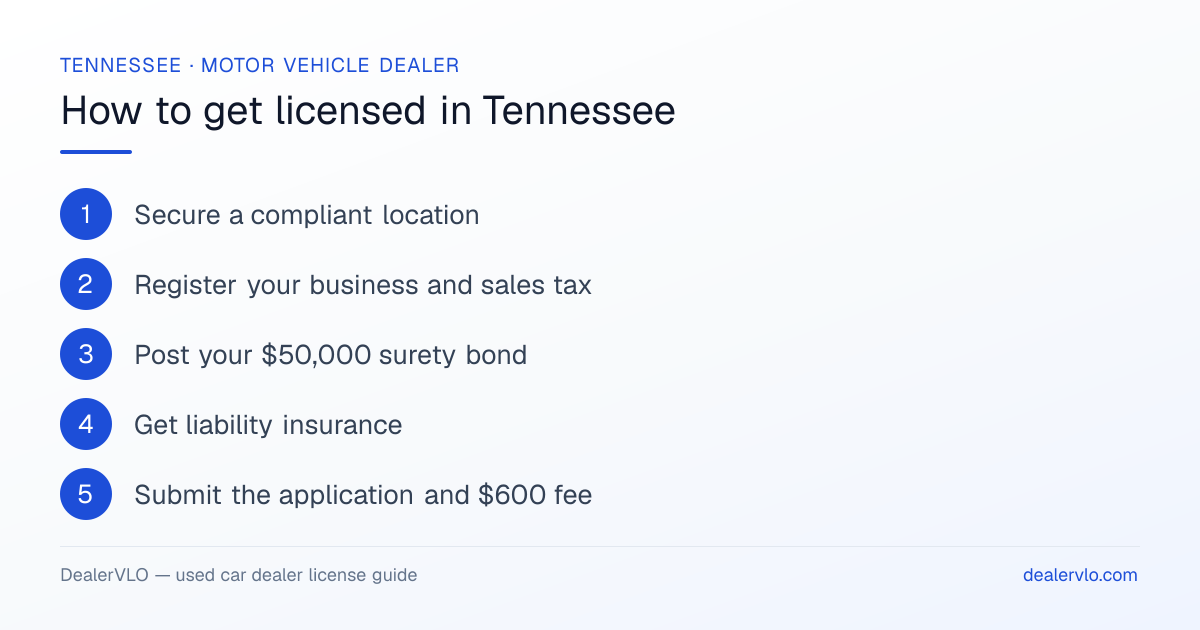
Step-by-step process
- 1
Find a location that meets the facility rule
Rule 0960-01-.21 is where most Tennessee applicants get stuck. You need a permanent building with at least 288 square feet of office space and a restroom, a 15-car display lot on compacted gravel or better, and 3 customer parking spots. No residence, tent, or temporary stand. You can run one other business on the premises only if at least 66% of the space goes to vehicle sales and service and the other business brings in under 33% of the dealership's income, with separate records.
- 2
Get the zoning letter and local licenses
Get written approval from your local zoning authority that names the address and says auto sales are a permitted use. If there's no zoning, get a statement from a county or city official saying so. Then get a Class 2 business tax license from the County Clerk (plus a city license if your city requires one) and a Sales & Use Tax certificate from the Department of Revenue. Both must show the exact name being licensed, including any d/b/a.
- 3
Set up the business and the financial statement
If you're an LLC or corporation, you'll submit the charter or articles, and list every owner of more than 5% with their percentage. You also need a compiled financial statement in the business's name, prepared under GAAP and signed by a CPA on letterhead, showing a net worth of at least $10,000 and dated within 12 months of applying.
- 4
Buy the bond and the insurance
The bond is a $50,000 corporate surety bond on the Commission's form, signed by the principal owners, with a power of attorney letter. It must run two consecutive years, starting in the month you expect the license and ending on the last day of that month two years later. Insurance must be garage liability or "any auto" at $300,000 per occurrence, in the dealership's full name and physical address, for the life of the license.
- 5
Line up a salesperson and a service agreement
A dealership must employ at least one licensed motor vehicle salesperson to do business. The salesperson license costs $50 and requires being 18 or older. If you don't have a repair shop on site, sign a service agreement with a repair garage within a reasonable distance and keep it in place.
- 6
Apply in CORE
Complete the Initial Motor Vehicle Dealer Application in the state's CORE portal and pay the $600 fee. Upload digital photos of the whole display lot, the sign, the posted hours and phone number, the office, and the restroom, plus street-view photos of the full building with every entrance and exit. Report your floor plan lenders. If any owner, officer, or director has a felony conviction, attach the final court order and release paperwork.
- 7
Pass the site inspection and get licensed
Submit every document before the Commission's on-site inspection. Final eligibility comes after the inspection and document review. If your documents aren't complete within 90 days, you start over with new fees, and the rules say 25% of the application fee is forfeited. A re-inspection you cause costs $400. Once approved, the license is issued within 14 business days.
Tennessee dealer license types
The Motor Vehicle Commission licenses motor vehicle dealers, recreational vehicle dealers, motor vehicle auctions, salespeople, manufacturers and their representatives, and dismantlers and recyclers. For a used-car lot, the license is the Motor Vehicle Dealer license. It covers new and used cars, motorcycles, and RVs.
Unlike Texas or Missouri, the Commission's license list has no separate wholesale-only dealer license. A dealer who mostly sells to other dealers goes through the same Motor Vehicle Dealer application and facility rules as a retail lot.
The dealer license and the salesperson license are separate. The dealership can't do business without at least one licensed salesperson on staff.
- Motor Vehicle Dealer: $600, initial and renewal
- RV Dealer: $600, initial and renewal
- Salesperson: $50, must work for a licensed dealer
- Motor Vehicle Auction: $1,200, wholesale between licensed dealers
- Franchised dealers pay an extra $600 per line make
Can you get a Tennessee dealer license without a lot?
No. Rule 0960-01-.21 requires immediate, adjoining access to a display lot for 15 vehicles of your product line that only your dealership uses. It has to be compacted gravel, chert, stone, or similar, and it can't be public land, unimproved land, or a residential driveway. You also need 3 parking spots for customers.
A home-based dealership doesn't work either. The facility can't include a residence, and it has to be used only for the vehicle business, apart from the one-additional-business exception.
Since Tennessee has no wholesale-only license, there's no lighter path for dealers who only sell to other dealers. If you just want to sell a few cars a year, stay at five or fewer, titled in your own name.
Buy-here-pay-here in Tennessee: check financing licensing before your first note
The MVC dealer license covers selling cars. Its dealer requirements don't address financing, apart from making you report your floor plan lenders. Consumer lenders are regulated by the Tennessee Department of Financial Institutions (TDFI), which registers industrial loan and thrift companies through NMLS under T.C.A. 45-5-103.
We couldn't confirm from an official source whether a dealer that writes and keeps its own installment contracts needs TDFI registration. The answer can also change if you sell your contracts to a separate finance company. Ask TDFI licensing directly before you carry paper, and describe exactly how you'll structure it.
Some MVC rules apply either way. Credit advertising has to comply with the federal Truth in Lending Act and Regulation Z, or it violates rule 0960-01-.12. You also have to keep dead deal files, meaning any paperwork from a deal that didn't close after you took a credit application or wrote a buyer's order.
If you run notes, DealerVLO tracks buy-here-pay-here accounts with a payment schedule and a collections panel for payments and balances. The license question and the contract forms are on you.
Buying at dealer-only auctions in Tennessee
This is one place where Tennessee's rules are explicit. The Commission says auto auctions in Tennessee are strictly wholesale, between licensed dealers. Rule 0960-01-.16 bars unlicensed individuals from buying at a licensed auto auction unless an exemption applies. Auctions have to station someone at each entrance to check dealer and salesperson credentials.
A licensed dealer can bring up to five employees to an auction to help evaluate and transport cars. Those employees can't bid, buy, or sell.
So if you want auction access, you need the full Motor Vehicle Dealer license, lot and all. Each auction also sets its own registration paperwork, so check with the auction before you plan around it. Public auto auctions are licensed separately, through the Tennessee Auctioneer Commission.
Why Tennessee dealer applications get delayed or denied
The Commission doesn't inspect until every document is in, and it gives you 90 days to finish. These are the issues that cost applicants time and money:
- Names that don't match: the bond, insurance, business tax license, and sales tax certificate must show the exact licensed name and physical address, including any d/b/a
- A lot that doesn't qualify: under 15 spaces, grass or dirt, shared with another business, or missing the 3 customer spots
- An office under 288 square feet, no restroom, or no permanent wall and separate entrance from a neighboring business
- A sign with letters under 8 inches, a banner, or a sign that advertises another business
- A zoning letter that doesn't name the address or say auto sales are permitted
- A financial statement that isn't CPA-compiled, is older than 12 months, or shows less than $10,000 net worth
- A bond that isn't on the Commission's form, isn't for two consecutive years, or is missing the power of attorney
- Missing documents after 90 days: you restart with new fees, and a re-inspection you cause costs $400
- Criminal history: the Commission can deny an application if any manager, director, or owner of 5% or more could be denied as an individual under T.C.A. 55-17-114
Once you're licensed: the paperwork on every deal
Tennessee dealers collect sales tax at the sale. That's 7% state tax plus the single article tax on the part of the price between $1,600 and $3,200, unless the buyer signs a three-day removal affidavit to take the car out of state. File your Annual Sales Report in CORE: you can't buy dealer plates without it, and reports filed after February 15 carry a $100 late fee. Our Tennessee dealer plates guide covers the plates.
For title work, our Tennessee RV-F1315201 guide walks through the title application, and our Tennessee RV-F1317001 guide covers the odometer statement. DealerVLO fills the official RV-F1315201 and RV-F1317001 from the deal, so you're not retyping the buyer and vehicle. For the federal side, see our odometer disclosure rules.
Two more things the Commission enforces. Before any sale of a car with a rebuilt or salvage title or salvage history, the buyer has to sign the Commission's disclosure form. And temporary tags are limited: the law allows one 60-day temporary plate, and the Commission warns that going past the Department of Revenue's limit risks your license.
Other Tennessee forms dealers file
- Multi-Purpose Application: Tennessee title application
- Tennessee certification of sales under special conditions (RV-F1312101)
- Tennessee power of attorney (RV-F1311401)
- Tennessee odometer disclosure statement (RV-F1317001)
Also for Tennessee: Tennessee dealer plates
Same form in other states: Title applications · Repossession · Power of attorney · Odometer disclosure
Tennessee dealer license cost — fees breakdown
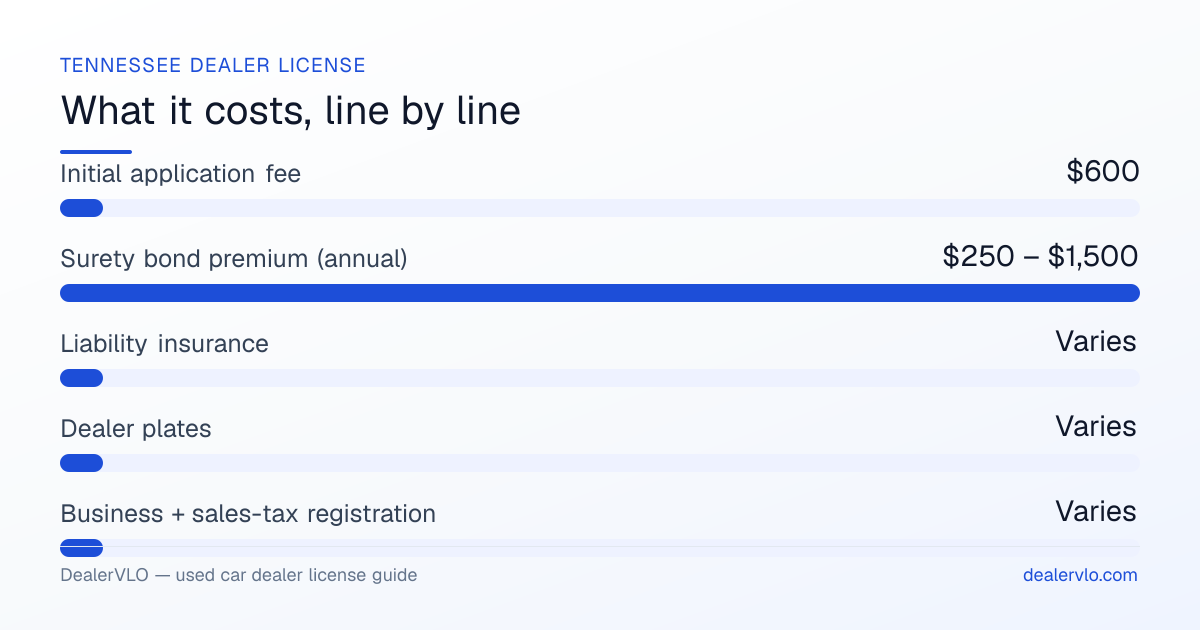
| Item | Amount |
|---|---|
Dealer license application Initial and renewal; plus $600 per line make for franchised dealers | $600 |
Salesperson license At least one is required for the dealership to do business | $50 |
Surety bond premium (estimate) Market estimate on the $50,000 two-year bond; set by your credit | $500 – $1,500/yr |
Re-inspection Only when the applicant's action or inaction makes it necessary | $400 |
Late renewal 50% of the initial fee, charged after the expiration date | $300 |
Dealer relocation Moving the dealership requires a new application | $600 |
CPA-compiled financial statement Must show at least $10,000 net worth | Set by your CPA |
The Tennessee auto dealer bond: $50,000
Tennessee requires every used-vehicle dealer to post a $50,000 surety bond. The bond protects buyers from misconduct (odometer fraud, undisclosed liens, deceptive trade practices) and the state from unpaid taxes.
You don't pay the full bond amount up front — you pay an annual premium to a surety company, typically 1–3% (estimate) of the bond's face value. Your actual premium depends on personal credit and business history.
Tennessee requires a $50,000 corporate surety bond on the Commission's dealer bond form, signed by the principal owners, matching the business name and address, with a power of attorney letter. It runs two consecutive years and must stay in force as long as you're licensed. The surety has to give the Commission 60 days' notice before cancelling. If it's cancelled, you stop doing business until you have new coverage. The premium range shown is a market estimate, not a state figure — quotes depend on your credit.
Renewal
Renew in CORE before the expiration date on your license, with a new two-year bond that starts and ends on the expiration date, current garage liability insurance, and the $600 fee. After the expiration date there's a $300 late fee, and the license isn't renewed until it's paid. Any sales in that gap can bring fines. More than 90 days past expiration, you reapply as a new dealer, meet every initial requirement again, and get a new license number.
Common questions
How do I get a dealer license in Tennessee?+
Set up a facility that meets the Commission's rules (288 sq ft office, restroom, 15-car lot, 3 customer spots, 8-inch-letter sign), get a zoning letter, business tax license, sales tax certificate, and a CPA-compiled financial statement showing $10,000 net worth. Then buy a $50,000 two-year bond and $300,000 garage liability insurance, hire a licensed salesperson, apply in CORE with the $600 fee, and pass the site inspection.
How many cars can you sell in Tennessee without a dealer license?+
Five a year. The Motor Vehicle Commission requires a dealer license for anyone who sells or offers to sell more than five motor vehicles in one year in Tennessee, including RVs and motorcycles.
Can you get a dealer license in Tennessee without a lot?+
No. Every Tennessee dealer needs a display lot for 15 vehicles that only the dealership uses, on compacted gravel or similar, plus 3 customer parking spots. Tennessee has no wholesale-only license that skips the lot, and a residence can't be part of the facility.
Do I need a dealer license to buy at car auctions in Tennessee?+
Yes, for licensed auto auctions. The Commission says Tennessee auto auctions are strictly wholesale between licensed dealers, and its rules bar unlicensed individuals from buying there. A dealer can bring up to five employees, but they can't bid or buy.
What is the net worth requirement for a Tennessee dealer license?+
At least $10,000, shown on a compiled financial statement in the business's name. A CPA has to prepare it under GAAP on letterhead with a license number, dated within 12 months of the application.
Does a Tennessee dealer need a licensed salesperson?+
Yes. The Commission requires every dealership to employ at least one licensed motor vehicle salesperson to do business. The salesperson license costs $50 and is applied for in CORE.
How long does it take to get a Tennessee dealer license?+
You have 90 days after applying to get every document in, or you start over with new fees. The Commission inspects once the file is complete, and it issues licenses within 14 business days of approval. Your setup time — lot, zoning, CPA statement — usually takes longest.
How much does a Tennessee dealer license cost?+
Plan for about About $1,200 – $2,500 (estimate, before rent, insurance, and CPA fees) in the first year. That covers the $600 (initial and renewal) application fee and the $50,000 (two-year bond) surety bond — you pay an annual premium of roughly 1–3% (estimate) of the bond, not the full amount — plus business-formation, facility, and dealer-plate costs. See the full fees breakdown above.
How do I get dealer plates in Tennessee?+
Dealer plates are separate from the license itself. Once your Motor Vehicle Dealer license is approved, you apply for dealer plates and pay a per-plate fee (listed in the fees breakdown above). You can't obtain dealer plates before the license is issued.
- Tennessee MVC — Motor Vehicle/Recreational Dealer license requirements
- Tennessee MVC — Fees
- Tennessee MVC — Renewal, Reinstatement, & Other Resources
- Tennessee MVC — Salesperson license
- Tennessee MVC — Motor Vehicle Auction license
- Tennessee MVC — Forms and Downloads
- Tennessee MVC — News (sales tax, temporary tags)
- Tenn. Comp. R. & Regs. ch. 0960-01, General Rules (rev. June 2026)
- Tennessee Department of Financial Institutions — Industrial Loan & Thrift
- Tennessee dealer plates
- How to fill out the Multi-Purpose Application (Tennessee)
- E-signatures and e-titling for Tennessee dealers
- Tennessee certification of sales under special conditions (RV-F1312101)
- Tennessee power of attorney (RV-F1311401)
- Tennessee odometer disclosure statement (RV-F1317001)
- Dealer license without a lot: state-by-state rules
- Dealer license for car auctions
- Odometer disclosure rules and forms by state
- Dealer license cost in all 50 states
- License cost calculator (fees + bond by state)
Got your TN dealer license? Run your lot in DealerVLO.
Inventory with VIN auto-decode, the deal jacket, your Tennessee title paperwork and the federal forms filled from each deal, and your own dealer website at your custom domain. $29/month. 14-day free trial, cancel any time.
Shopping for software first? See what car lot software for a new dealer should cover.