The Best CRM for Independent Used-Car Dealers in 2026 (an Honest List)
Most 'best CRM' lists rank generic sales software. Here's what a used-car lot actually needs in a CRM in 2026, the real options, and the traps to avoid.
Part of the Choosing dealer software guide: The best DMS for independent used-car dealers in 2026 — an honest list from a dealer
Switching from another DMS? Compare DealerVLO to DealerCenter, Frazer, or Lot Wizard.
Search "best CRM for car dealers" and you'll get lists ranking generic sales software — Teamgate, Capsule, monday — next to a couple of dealer tools, written by people who've never worked a lead on a used-car lot. A CRM for a 20-car independent is a different animal than a CRM for a franchise store or a SaaS sales team, so here's an honest cut: what a used-car lot actually needs in a CRM in 2026, the real options, and the traps that cost small dealers the most.
The short version: for most single-rooftop lots, the best CRM is the one built into the software you already run — no per-user fee, no separate contract, and the lead lands on the deal instead of in a second system. The rest of this explains why, and when a standalone tool is worth it.
14-day free trial, then $29/mo · Cancel anytime
The jobs a dealer CRM actually does
Strip away the feature lists and a CRM has four jobs on a used-car lot. Rank any option by how well it does these, not by the length of its spec sheet.
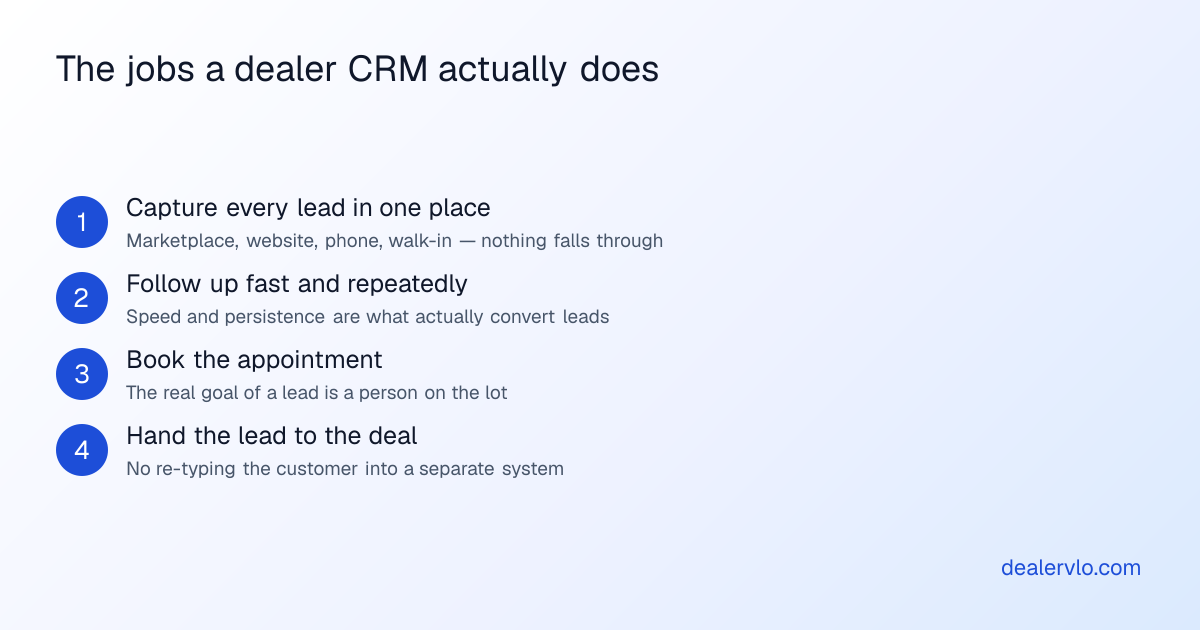
Two of those jobs decide almost everything for a small lot: capturing every lead (most lost deals die in the gap between a lead coming in and someone answering) and following up fast — speed to the first response is the single biggest lever a small store has, which we covered in converting online leads to appointments. A CRM that nails those two beats one with a longer feature list that fumbles them.
The real options, by who they fit
Built-into-the-DMS CRM — best for most single-rooftop lots. When leads, follow-up, and the deal live in one system, you capture the lead, work it, and turn it into a deal without re-typing the customer or paying a second subscription. No per-user fee, no separate login. This is the category most "best CRM" lists skip because there's no standalone product to rank — but it's the right answer for a lot running on modern software. It's the approach DealerVLO takes: the CRM is part of the $29 DMS, not a bolt-on.
Standalone dealer CRM — for a dedicated pipeline or a BDC. Tools built for dealers (AutoRaptor and Selly are the commonly-named independents) give you a focused lead-management workflow and are worth it if you have real lead volume or a person whose whole job is follow-up. The trade-off is another bill and another system to sync back to your deal.
Enterprise CRM — for larger stores. The legacy names (VinSolutions, DealerSocket, Elead) are built for franchise and multi-rooftop operations, typically with per-seat pricing and multi-year contracts. They do a lot, but a 10–50 car lot pays for scale it won't use. If you're weighing one of these against a modern independent tool, our comparison pages lay out the head-to-heads — see DealerVLO vs AutoRaptor and vs DealerSocket.
Turn your ad spend into a cost per car sold and a real ROI — and see how many units the spend has to produce just to break even.
Open the Marketing ROI CalculatorWhat to look for (and the traps)
Across every option, the same handful of things separate a CRM that earns its keep from one that just adds cost.
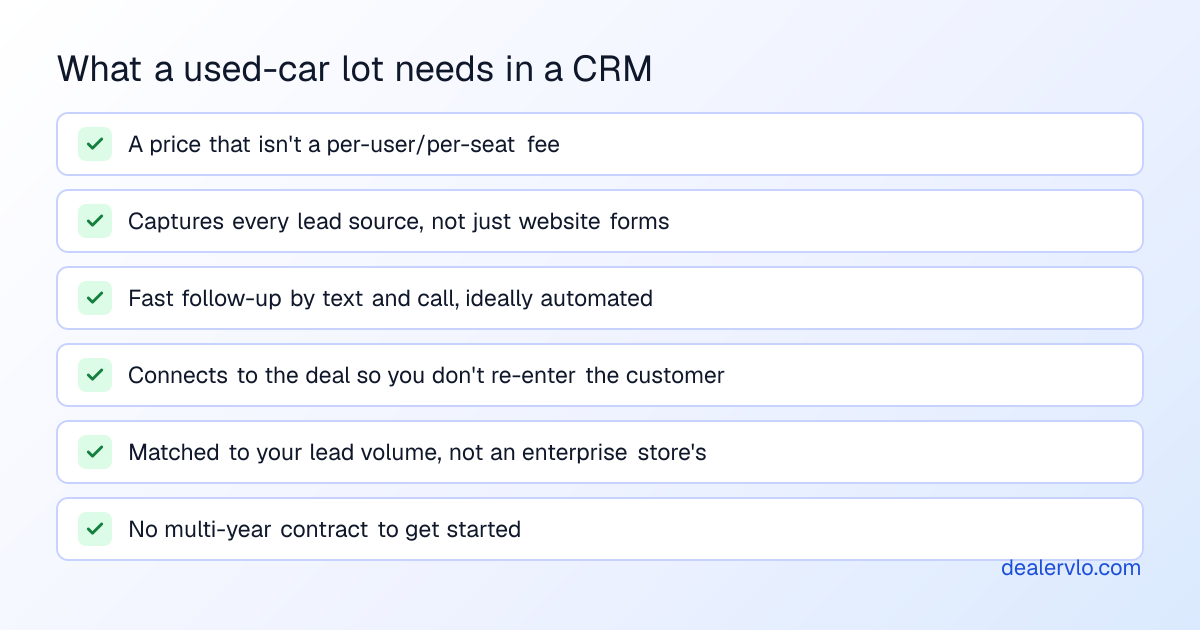
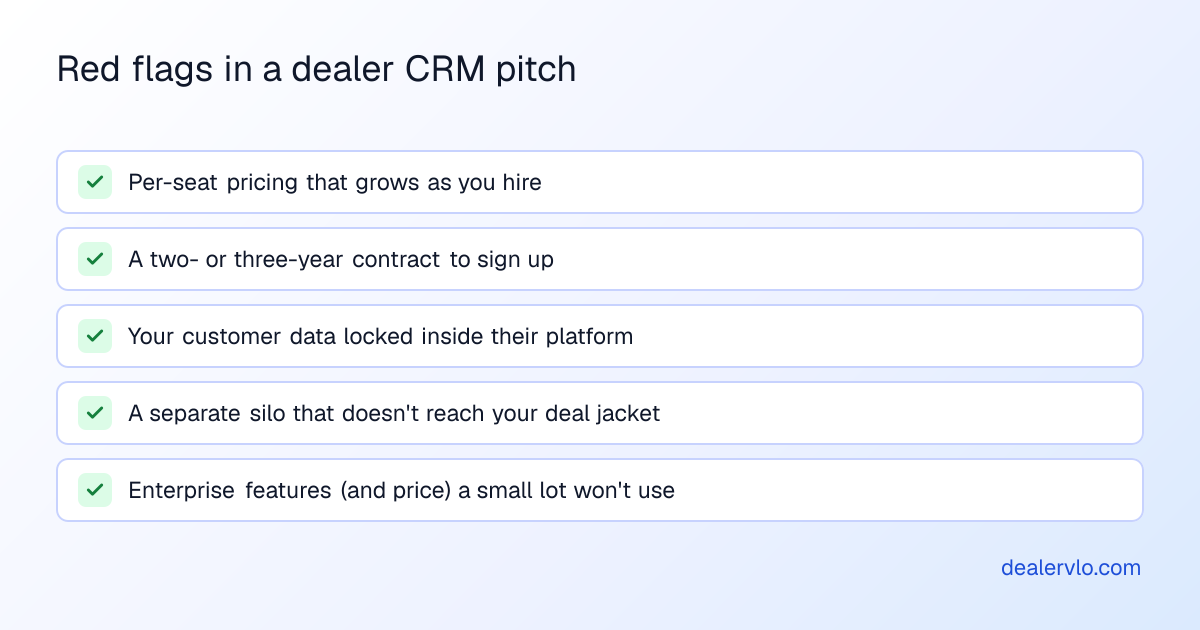
The pricing model matters more than the feature list. On a used-car margin, a per-seat fee taxes you for every person you add, and a multi-year contract locks you in before you know if the tool fits. A flat price — or a CRM included in software you already pay for — keeps the cost predictable. And watch the pitch itself:
14-day free trial, then $29/mo · Cancel anytime
CRM vs DMS — don't buy the wrong thing
A lot of confusion in this category comes from vendors blurring the line. A CRM runs the pipeline before the sale: leads, follow-up, appointments. A DMS runs the transaction: inventory, the deal jacket, tax and title paperwork, BHPH. Some products do both. If you're actually shopping for the system that runs your whole lot, that's a DMS decision — see our best DMS for independent used-car dealers list, which draws the same honest line.
Frequently asked questions
What's the best CRM for an independent used-car dealer? Usually the one built into your DMS — leads and the deal in one place, no per-user fee, no separate contract. Standalone tools (AutoRaptor, Selly) fit a dedicated pipeline; enterprise CRMs (VinSolutions, DealerSocket, Elead) fit larger stores. Judge by fit and pricing model, not brand.
Do I need a separate CRM if my DMS has one? Usually not — a separate CRM is another login, bill, and data silo that has to sync back to the deal anyway. Add one only for a dedicated BDC or high lead volume.
How is a dealer CRM different from a DMS? CRM = the pipeline before the sale; DMS = the transaction (inventory, deal jacket, paperwork, BHPH). If it can't produce a tax-correct deal jacket with your state's forms, it's a CRM, not a DMS.
How much should it cost? Judge the model, not the sticker: avoid per-seat fees and long contracts; a flat price or a CRM included in your DMS keeps it predictable.
Bottom line
Don't buy a CRM by the brand on a generic list. For most independent lots, the CRM built into your DMS covers the jobs that matter — capture every lead, follow up fast, and land it on the deal — without a per-user fee or a separate contract. Reach for a standalone tool only when your lead volume or a dedicated BDC genuinely needs one.
DealerVLO builds the CRM into the deal, so a lead becomes a customer becomes a deal in one system — no per-user fee, no bolt-on. Start a 14-day free trial and run your leads and your deals in the same place.
14-day free trial, then $29/mo · Cancel anytime