Converting online leads into showroom appointments (what actually works)
Internet leads don't buy cars; appointments do. Speed to lead, replies that get answered, the ask that books the visit, and the follow-up most dealers quit.
Part of the Selling & your sales team guide: The In-Person Used-Car Sale: From Test Drive to Close on an Independent Lot
Switching from another DMS? Compare DealerVLO to DealerCenter, Frazer, or Lot Wizard.
An internet lead isn't a customer. It's a person comparison-shopping five dealers from their couch, and the dealer who turns that message into a set appointment wins the deal before anyone talks numbers. At a small lot every lead is expensive — you either paid a marketplace for it or earned it with your own website — so the conversion from click to appointment is the highest-leverage skill in the building.
Here's the system, stripped of the vendor-webinar fluff.
14-day free trial, then $29/mo · Cancel anytime
Speed is most of the battle
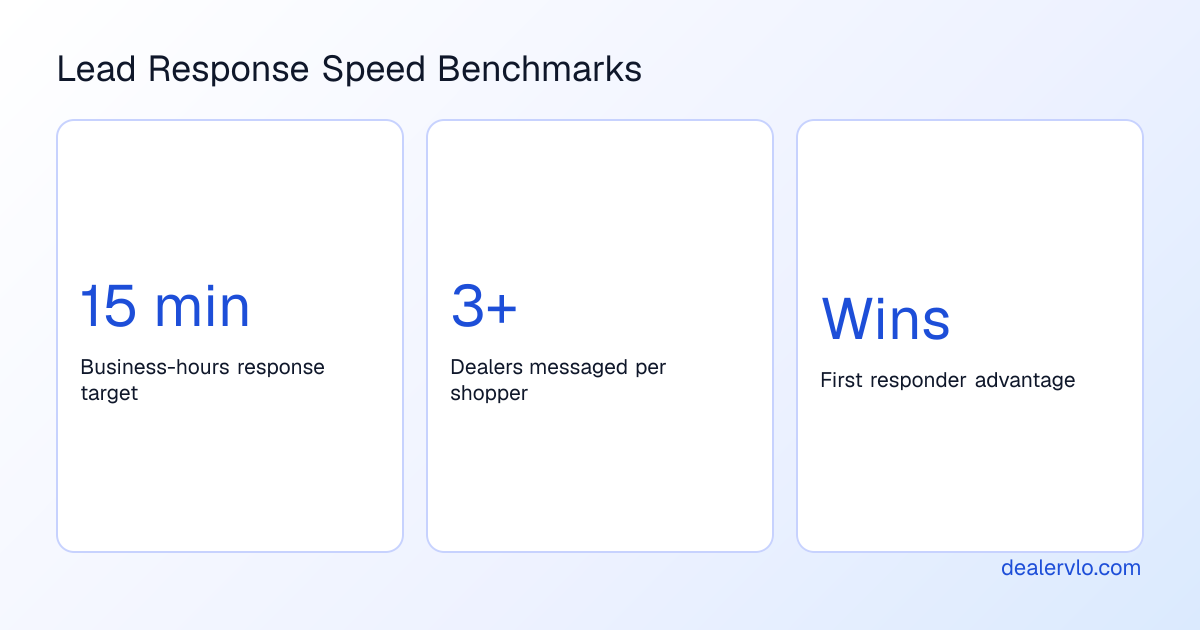
The shopper who messaged you messaged three other dealers in the same sitting. The first real response usually gets the conversation, and response time is measured in minutes, not hours:
- Answer in under 15 minutes during business hours. Not with an auto-responder — with a human answer to their actual question.
- After-hours leads get a same-night acknowledgment ("Got your message about the Equinox — it's still here. I'll call you at 9 tomorrow, or tell me a better time") and a real follow-up when you open.
- If nobody owns lead response at your lot, leads die in the inbox on busy Saturdays — the exact day they're worth most. Assign it like you assign opening the gate.
At a two-person lot this sounds impossible. It isn't — it's a phone notification and the discipline to send two sentences. What's impossible is winning back the shopper who bought elsewhere because you replied Monday.
Answer the question, then ask for the visit
Every lead reply has the same skeleton: answer honestly, add one thing they didn't ask, ask for the appointment with two options.
"Yes — the 2019 CR-V is still available, and the price is $18,950. It's a one-owner with fresh brakes all around. Are you free to come see it this evening, or is tomorrow morning better?"
The parts that matter:
- Answer the actual question first. Dodging "is it available?" or "what's your best price?" with "come on in and we'll talk!" is why shoppers ghost dealers. Transparency isn't a concession, it's the qualifier.
- The either/or ask. "Tonight or tomorrow morning?" books more visits than "would you like to schedule an appointment?" — an open question invites "I'll let you know," which means no.
- One message, one purpose. Don't pitch financing, trade-in, and warranties in the reply. Book the visit. Everything else happens across a desk.
Turn your ad spend into a cost per car sold and a real ROI — and see how many units the spend has to produce just to break even.
Open the Marketing ROI CalculatorMake the appointment feel like an appointment
A vague "come by anytime!" converts like what it is — nothing. A real appointment has a time, a name, and a reason to be kept:
- Confirm with specifics: "You're set for 5:30 tomorrow with me, Chris. I'll have the CR-V pulled up front and cooled off."
- Text a reminder the morning of. Half of no-shows aren't rejections, they're life. The reminder rescues them.
- Have the car ready. The pulled-up, cleaned, cold-A/C car greeting a shopper by appointment closes at a different rate than the one you go hunting for on the back row. The appointment kept its promise — that's your trust deposit before negotiation starts.
14-day free trial, then $29/mo · Cancel anytime
The follow-up cadence (where the buried deals are)
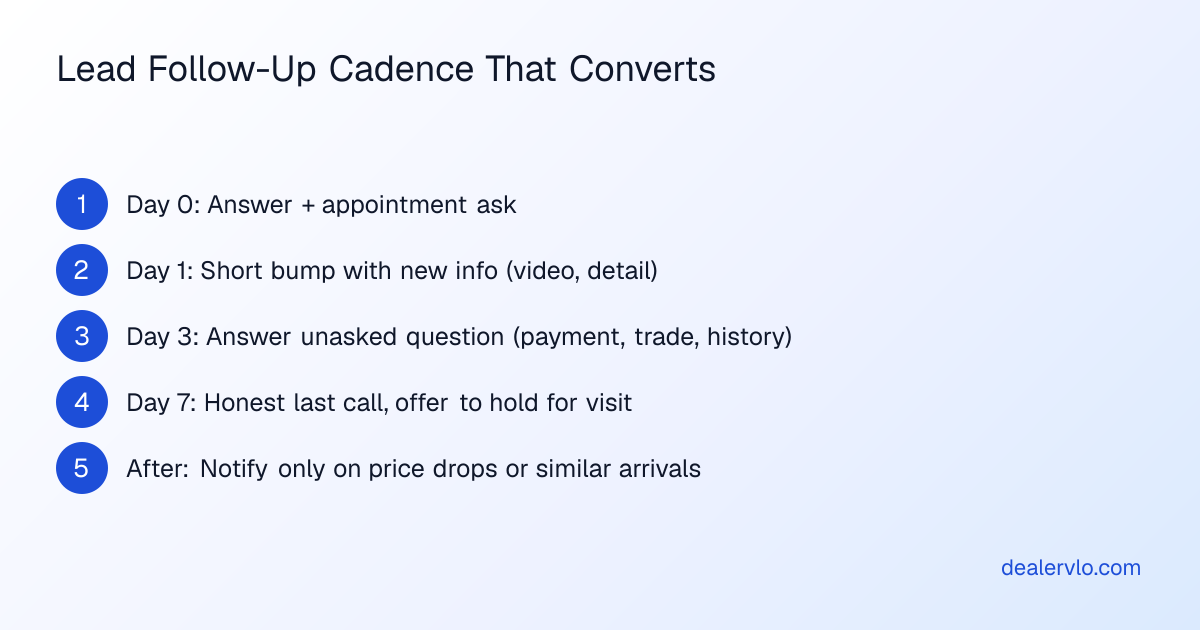
Most shoppers aren't ready the day they message, and most dealerships quit after one attempt. The money is in the boring middle:
- Day 0: answer + appointment ask.
- Day 1: if no reply — one short bump with new information ("took a walkaround video tonight, want me to text it?"), not "just checking in."
- Day 3: answer their unasked question — payment estimate, trade ballpark, the history report link.
- Day 7: the honest last call: "Don't want to pester you — if the timing's off, no problem. It's been getting looks, so tell me if you want me to hold it for a visit."
- Then stop pestering and start notifying: price drops and similar-car arrivals only. That's the message that revives a three-week-old lead, because it's information, not pressure.
Nobody runs this cadence on memory across twenty open leads. This is what a CRM is for — every lead with a next action and a date, and the daily list of who's due. (DealerVLO's leads pipeline does exactly this, tied to the same inventory the shopper asked about; if you use something else, fine — but use something. The follow-ups that don't happen are invisible in your P&L and enormous.)
Your website's job in all this
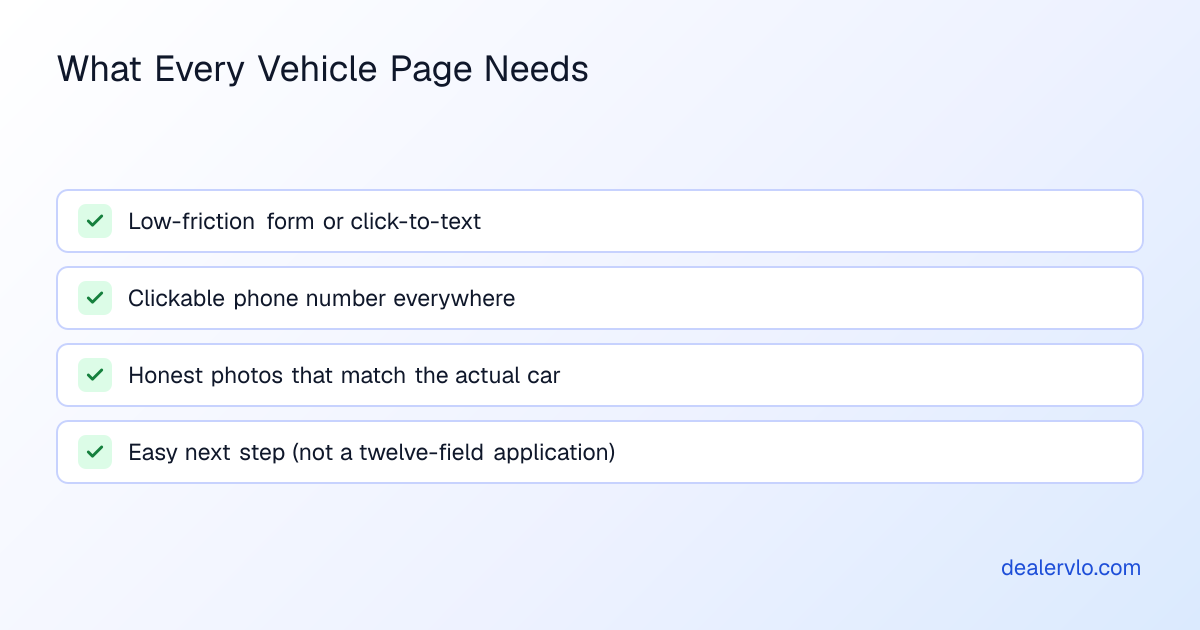
The best lead is one from your own site — no marketplace fee, no competing quotes on the same screen. That means every vehicle page needs a low-friction ask (a short form or a click-to-text, not a twelve-field application), your phone number clickable everywhere, and photos honest enough that the appointment survives the walkaround. Traffic without an easy next step is a brochure; we covered getting that traffic in local SEO for used car dealers.
Measure one ratio
Leads-to-appointments-set, appointments-to-shows, shows-to-sales. Small lots that measure nothing should measure just the first one for a month. If you're setting appointments with fewer than a quarter of your real leads, the fix is almost always earlier in this post than you think — it's speed, or it's answering the question, in that order.
None of this is clever. That's the point: the dealer who answers in ten minutes with a straight answer and an either/or ask beats the dealer with the bigger ad budget, every week, for free.
14-day free trial, then $29/mo · Cancel anytime