How to buy cars that sell fast (the retail-back method)
Fast-turning inventory is bought that way. The retail-back method: start from your market's selling price, subtract recon, fees, holding cost and margin, bid.
Part of the Buying & sourcing inventory guide: How to buy at dealer auctions without getting buried
Switching from another DMS? Compare DealerVLO to DealerCenter, Frazer, or Lot Wizard.
Every dealer has owned the car that wouldn't leave. It sat through three price drops, aged past 90 days, and finally went to the wholesale lane for less than you paid. Here's the uncomfortable truth about that car: it didn't go bad on the lot. You bought a slow car. The sale is won or lost at acquisition, and buying cars that sell fast is a method, not a gift.
14-day free trial, then $29/mo · Cancel anytime
Start from the exit: retail-back buying
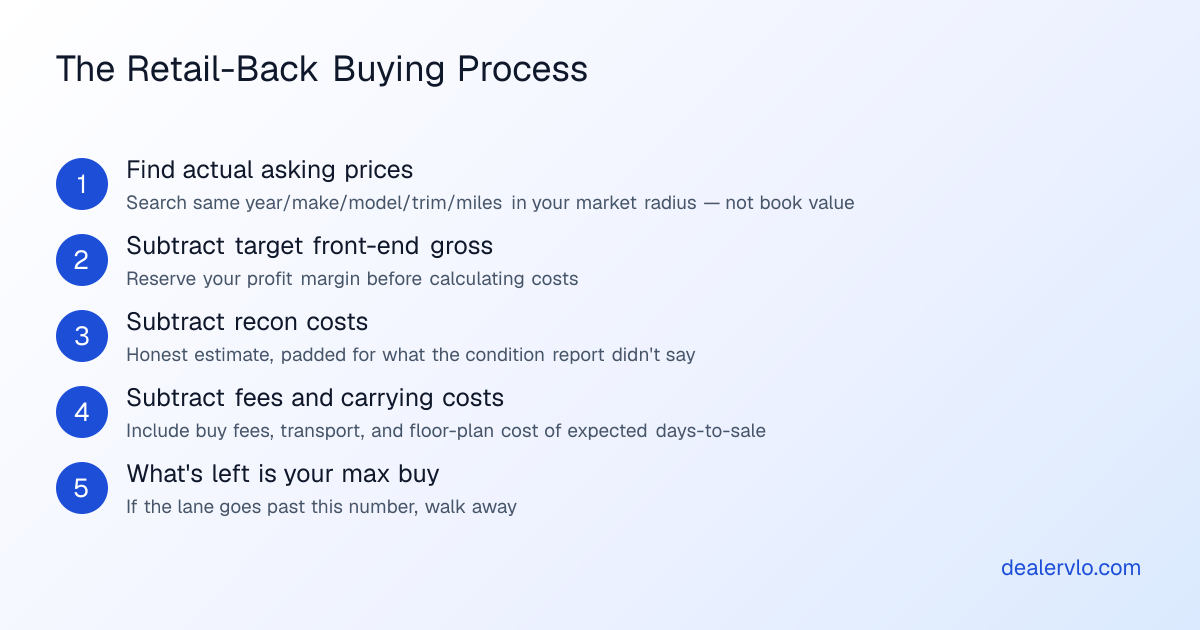
Most slow inventory comes from buying forward: "the car is cheap, I'll figure out the retail later." The fix is to run every buy backward from the exit:
- What does this exact car sell for in my market, right now? Not book value — actual asking prices for the same year/make/model/trim/miles within the radius your buyers shop.
- Subtract your target front-end gross.
- Subtract recon (honest, padded for what the condition report didn't say).
- Subtract buy fees, transport, and the floor-plan cost of your expected days-to-sale.
- What's left is your maximum buy number. If the lane goes past it, that's not your car.
The magic isn't the arithmetic — it's that step 1 forces you to confirm there's a live retail market for the unit before you own it. The car that "was a great deal" with no comparable listings in 100 miles wasn't a deal. It was a mystery, and you paid to solve it.
Market days supply: the one number that predicts turn
For any candidate car, the question is: how many are for sale locally versus how fast do they sell? That ratio — market days supply — is what separates a 30-day car from a 90-day car before you buy it.
- Low supply, steady demand (the only clean AWD wagon in 50 miles): buys itself, holds gross, forgives small mistakes.
- High supply, any demand (the twelfth silver mid-size sedan at the same price point): sells only on price, bleeds gross with every competitor's price drop, and punishes every day it sits.
You don't need enterprise software to approximate this. Search your market like a buyer would: if your customer sees fifteen near-identical choices, you're entering a price war with your own money. If they see two, you have pricing power.
Before you authorize the work: see whether a repair earns back its cost plus the holding days it adds.
Open the Recon ROI CalculatorBuy for your buyer, not for yourself
The fastest-turning cars on my lot are never the ones I'd drive. Know who actually buys from you — price band, body styles, financing profile — and buy for that person relentlessly.
- Your price band is your identity. A $28,000 unit on a lot full of $12,000 cars confuses your walk-in traffic and your website visitors alike. It will sit, not because it's a bad car, but because your buyers didn't come to you for it.
- Your financing shapes your inventory. If your buyers are subprime or BHPH, the car's payment matters more than its price, and the durability-per-dollar of the unit matters more than the trim level.
- Boring sells. The practical commuter with no stories outsells the interesting enthusiast car ten times out of ten at an independent lot. Buy your inventory, not your hobby.
14-day free trial, then $29/mo · Cancel anytime
The condition profile that turns fast
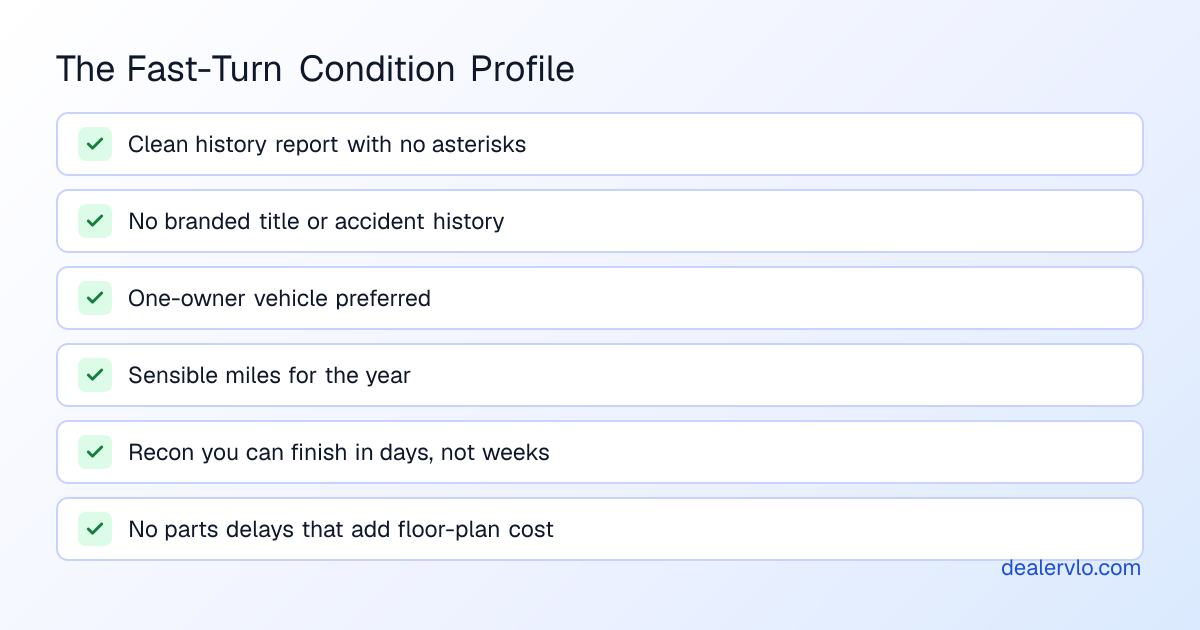
Between two identical cars, the one that sells faster is the one that's decision-easy for a nervous buyer:
- Clean history report, no asterisks. Every asterisk you buy (branded title, accident history, TMU) you will re-explain to every single shopper — that's the discount you got, paid back in days-on-lot.
- One-owner, sensible miles for the year. Not because the car is mechanically better, but because the listing writes itself and the buyer's spouse approves it.
- Recon you can finish in days, not weeks. A car waiting three weeks on a part is a car paying floor-plan interest with no chance of selling. Recon speed is part of the buy decision.
Price it right on day one — which starts at the buy
Fast turn also depends on pricing to market from the first day, and you can only do that if you bought with room to. A car bought right gets priced at market and sells in its first 30 days, when it gets the most views it will ever get. A car bought wrong gets priced on hope, sits through its high-attention window overpriced, and then chases the market down. The listing's best week is its first week — the buy determines whether you can afford to use it.
This is where I'll mention what we built: DealerVLO's AI price suggestion looks up current listings for comparable units around your zip code, shows you the real ones it found, and hands you an asking-price range — so the "what does this actually retail for here" step happens in seconds at the desk, or on your phone in the lane before you bid.
Review your own scoreboard monthly
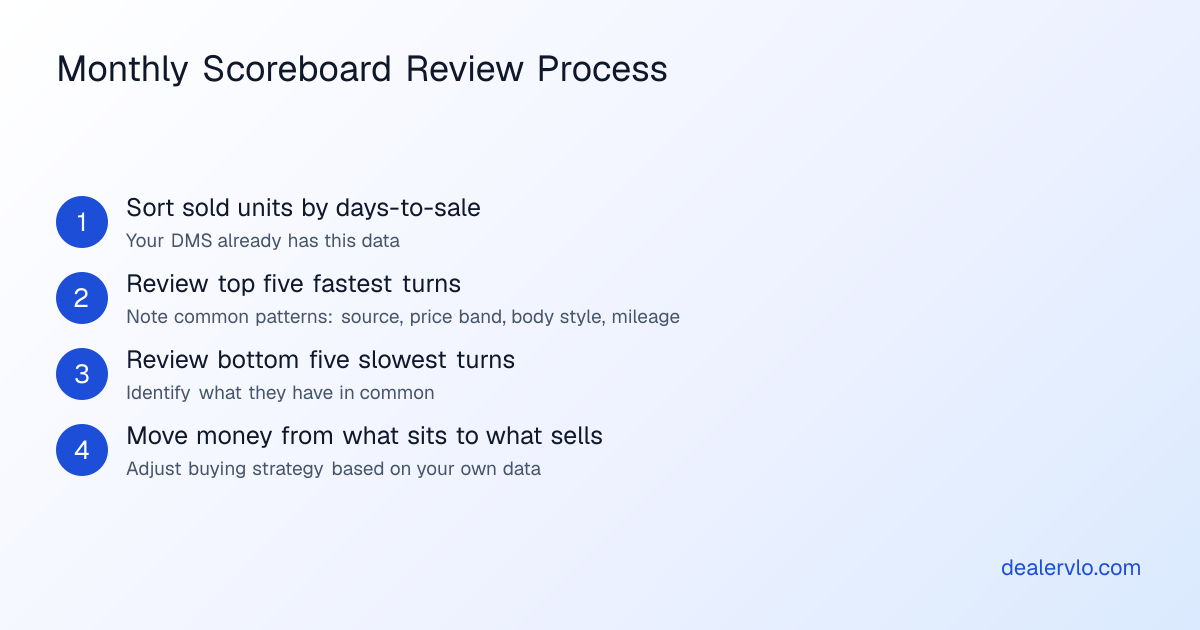
Your DMS already knows your fastest and slowest turns. Once a month, sort sold units by days-to-sale and ask what the top and bottom five have in common — source, price band, body style, mileage bracket. Then move money from what sits toward what sells. Your market will drift over time; the dealers who notice are reading their own data, not the trade press.
Buying fast-turning inventory is the same skill applied twice: know your exit before you enter, and know your buyer better than the dealer in the next lane knows theirs. Get those right and the lot starts to feel different in about sixty days — because everything on it was bought to leave.
14-day free trial, then $29/mo · Cancel anytime