How to buy at dealer auctions without getting buried
A dealer's auction guide: condition reports and run lists, all-in cost math with fees and transport, arbitration rules, and lane discipline that protects gross.
Switching from another DMS? Compare DealerVLO to DealerCenter, Frazer, or Lot Wizard.
The auction is where independent dealers make their money — not on the sale, on the buy. It's also where new dealers lose it fastest, because everything about a sale day is engineered to make you bid one more time. I've bought at lanes and online sales for years, and the difference between the dealers who grind out a living and the ones who quietly disappear isn't secret knowledge. It's discipline about maybe six things.
14-day free trial, then $29/mo · Cancel anytime
Do the work before sale day
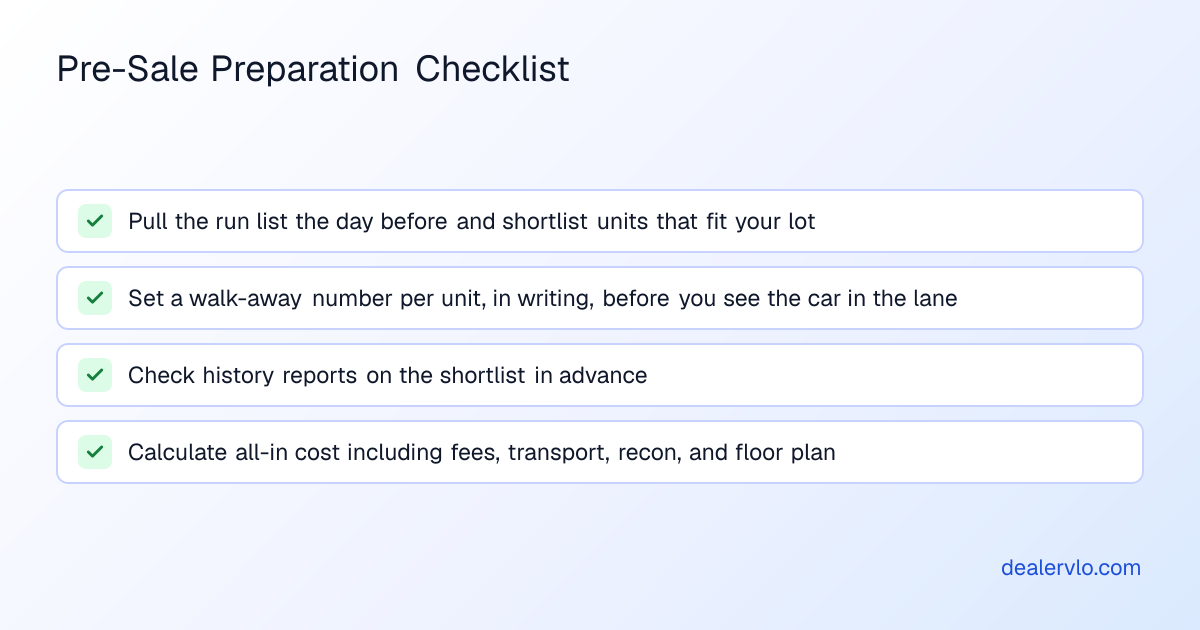
The run list drops before the sale. That's when the buying happens.
- Pull the list the day before and shortlist units that fit your lot — your price band, your buyer, your brands. Sale-day discoveries are how you end up owning something you never planned to retail.
- Set a walk-away number per unit, in writing, before you see the car in the lane. The number comes from your retail-back math (more on that below), not from what the car "feels" worth when the bidding is live.
- Check history reports on the shortlist in advance. A branded title or a frame-damage announcement changes the math completely, and checking during the run means deciding in seconds.
- Note who's selling each car. An off-lease return, a rental defleet, a repo, and a franchise store's aged unit each come with a different likely recon bill. Here's why cars are sold at auction and what each seller's reason tells you.
Read the condition report like a skeptic
Online or in the lane, the condition report (CR) is the seller's story about the car. Learn its dialect:
- Grades are relative, not absolute. A "4.0" from one seller isn't a "4.0" from another. Track which consignors' grades you can trust — fleet/lease accounts tend to grade consistently; some dealer consignments grade generously.
- What's not pictured matters. No photo of the driver's seat bolster, the engine bay, or the touchscreen powered on? Assume there's a reason.
- Announcements are the contract. Whatever's announced (or lit on the block) — miles exempt, structural, TMU — is what you agreed to buy. Everything not announced is where arbitration lives.
The all-in number, not the hammer number
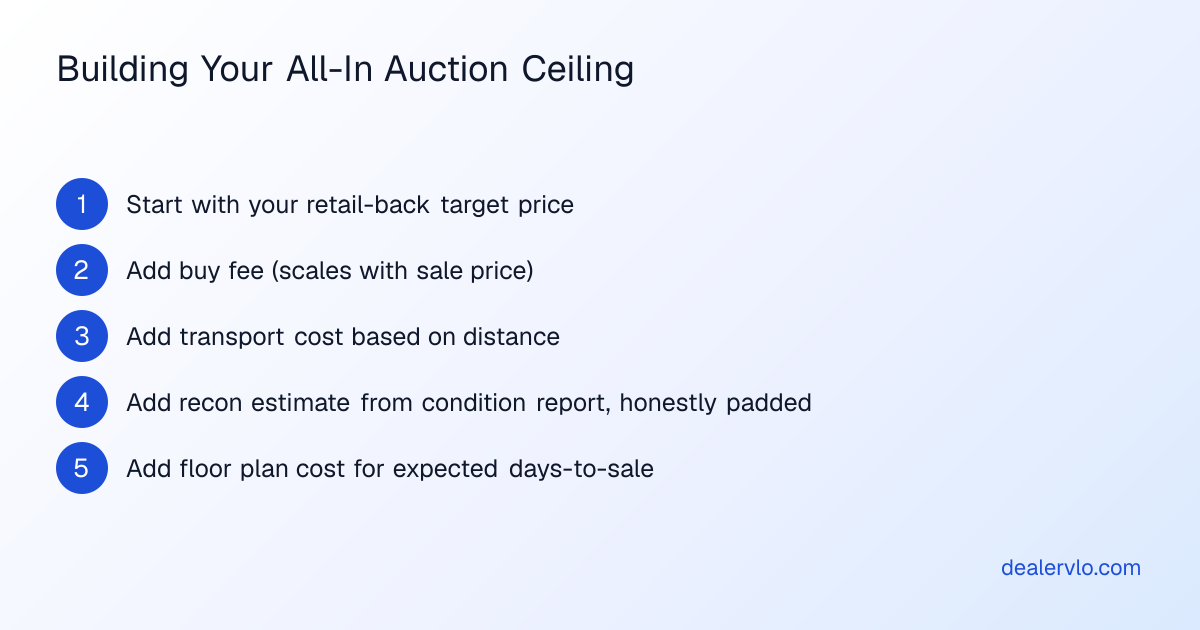
The bid is maybe 85–90% of what the car costs you. Before you raise a hand, know the whole stack:
- Buy fee — scales with the sale price, and it's real money on cheaper units percentage-wise.
- Transport — a car three states away can eat the entire margin that made it look like a deal.
- Recon estimate — from the CR, honestly padded. If the CR admits to two tires and brakes, plan for two tires, brakes, and the thing the CR didn't mention.
- Floor plan cost for your expected days-to-sale — interest and fees accrue from the day you buy, not the day you list. (We broke the math down in how dealer floor plans work.)
My rule: I bid against my all-in ceiling, not the hammer. If the ceiling is $12,000 all-in and fees-plus-transport are $900, my last bid is $11,100 no matter what the guy across the lane does.
Work out the most you can bid at the lane and still hit your target margin.
Open the Auction Profit CalculatorKnow the arbitration rules before you need them
Every auction has an arbitration policy — the window and grounds under which you can un-buy a car with an undisclosed problem. The details vary by auction house and by the light the car ran under, but the pattern is universal: windows are short (measured in days), grounds are specific (undisclosed structural, flood, major mechanical — not cosmetic disappointment), and delay kills claims. Inspect the car the day it lands, drive it, scan it, and file the same day if something material was hidden. Dealers lose arbitration cases by discovering the problem in week two.
14-day free trial, then $29/mo · Cancel anytime
Lane discipline (the "tricks" that actually matter)
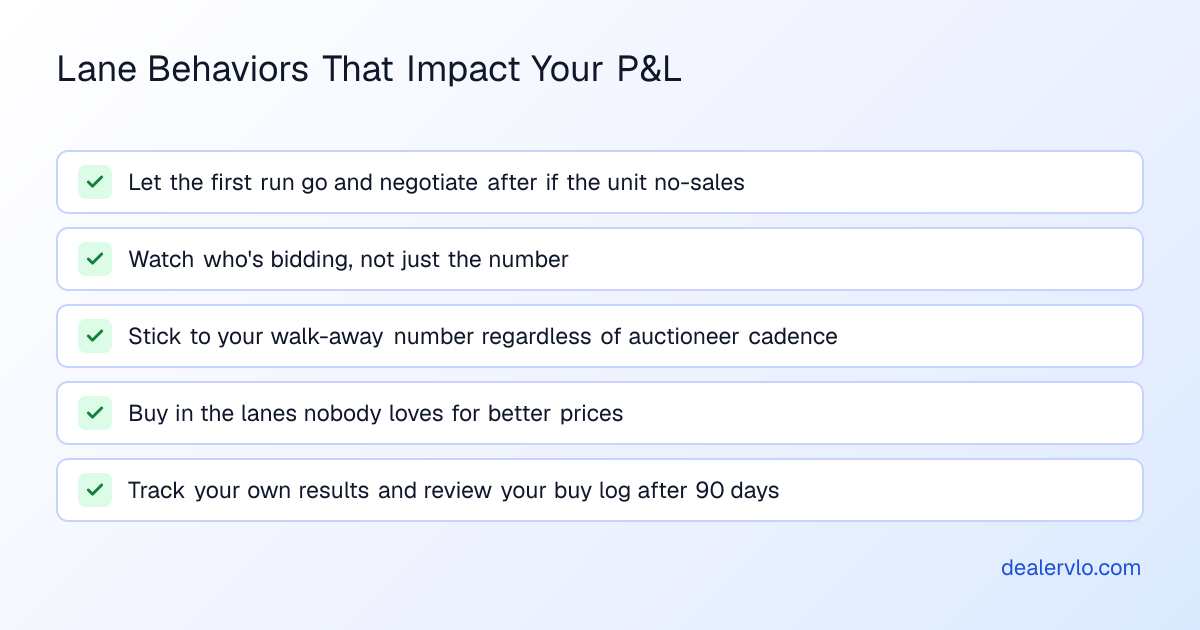
Most "auction tricks" content is noise. The behaviors that actually show up in your P&L:
- Let the first run go. If a unit no-sales, the negotiation often continues after the lane — through the auctioneer's rep or the online "make offer" — where the seller's reserve is suddenly softer.
- Watch who's bidding, not just the number. Two retail-hungry dealers bidding a car past retail-back doesn't make the car worth more. Let them have it; there's another sale next week.
- The auctioneer's job is momentum. "Last call" isn't last call the first three times. Your walk-away number doesn't care about cadence.
- Buy in the lanes nobody loves. The glamour runs get the crowds. The fleet-repo lanes and the last hour of a long sale are where the same car goes cheaper.
- Track your own results. After 90 days, your DMS knows which auction, which consignor, and which vehicle type actually made you money. Buy more of what your data likes, not what the lane applauds.
Online sales: same rules, less adrenaline
Online-only platforms and simulcast remove the crowd energy — good for discipline — but shift all your trust onto the CR and the platform's arbitration process. Start with lower-risk units (newer, cleaner history, consistent graders), learn a platform's grading dialect before you spend real money on it, and treat transport quotes as part of the bid, since every online buy ships.
The honest summary
Auctions reward preparation and punish emotion, week after week, forever. Run list the night before, all-in ceilings in writing, CR skepticism, arbitration same-day, and a buy log you actually review. Do that for a year and you'll out-buy dealers with twice your experience — because most of them are still bidding on feel.
If you want the wider sourcing picture beyond the lanes — trade walk-ins, direct-from-consumer buys, wholesale relationships — we covered it in best practices for buying wholesale vehicles.
14-day free trial, then $29/mo · Cancel anytime