Buying wholesale cars for your lot — the best practices that actually protect your margin
Buying wholesale cars as a dealer: a max bid from your retail exit, condition reports, arbitration windows, all-in cost math, and discipline to protect gross.
Part of the Buying & sourcing inventory guide: How to buy at dealer auctions without getting buried
Switching from another DMS? Compare DealerVLO to DealerCenter, Frazer, or Lot Wizard.
Every dollar of front-end gross is made or lost on the buy. Retail skill can't rescue a car you paid too much for, and no amount of marketing fixes a lot full of the wrong inventory. I buy for my own lot in Massachusetts; these are the practices that separate dealers who grind out consistent gross from the ones who donate money at auction every week.
14-day free trial, then $29/mo · Cancel anytime
Know your exit before you bid
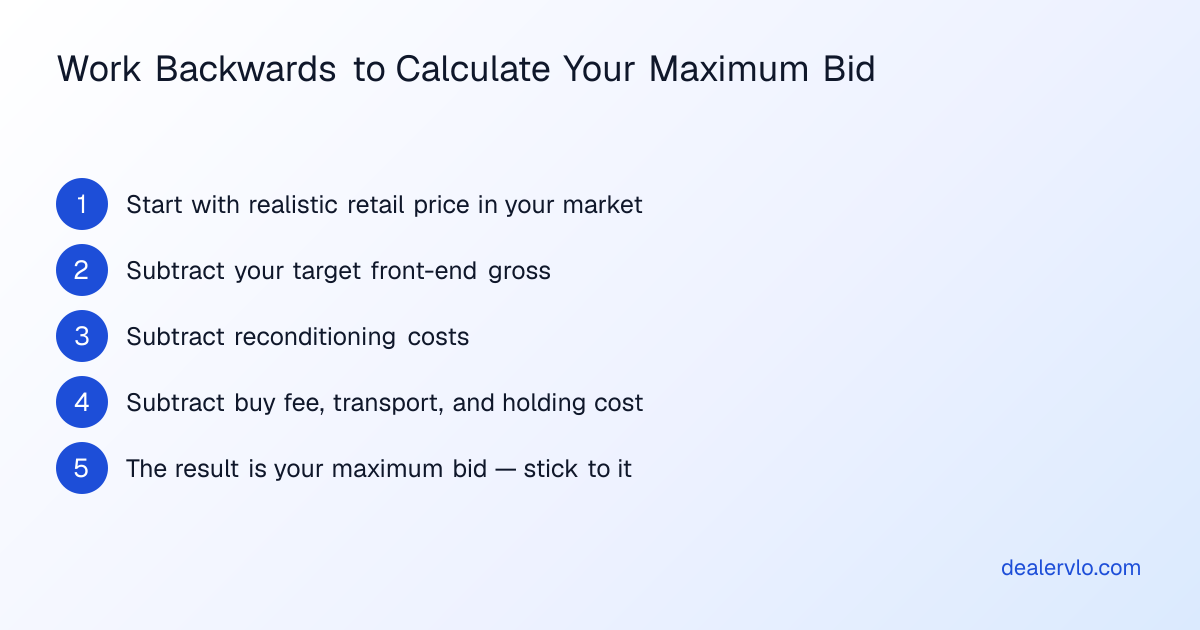
The cardinal rule: you're not buying a car, you're buying a retail outcome. Before any bid, you should know what that exact vehicle — year, trim, miles, color — retails for in your market, how many days similar units sit, and what your target front-end gross is.
Work backwards from there:
Max bid = realistic retail price − target gross − reconditioning − buy fee − transport − expected holding cost
If the bidding passes your number, you're out. The auction will run another lane tomorrow. The dealers who lose are the ones who fall in love with a unit mid-lane and "win" it at retail money.
Price the all-in cost, not the hammer price
The hammer price is maybe 85–90% of what the car actually costs you:
- Buy fee — tiered by sale price at most auctions; a few hundred dollars per unit
- Transport — $200–$500+ depending on distance; more for online buys from out of region
- Reconditioning — budget $500–$1,500 per unit before you bid, based on the condition report, not after the car shows up
- Holding cost — if you're floor-planned, the interest clock starts at purchase. Run the real per-day number — a $10/day unit that sits 60 days quietly ate $600 of your gross
- The pack — whatever fixed per-unit overhead you assign
Then check the whole picture in the profit margin calculator. If the math only works when everything goes right, the math doesn't work.
Read condition reports like a skeptic
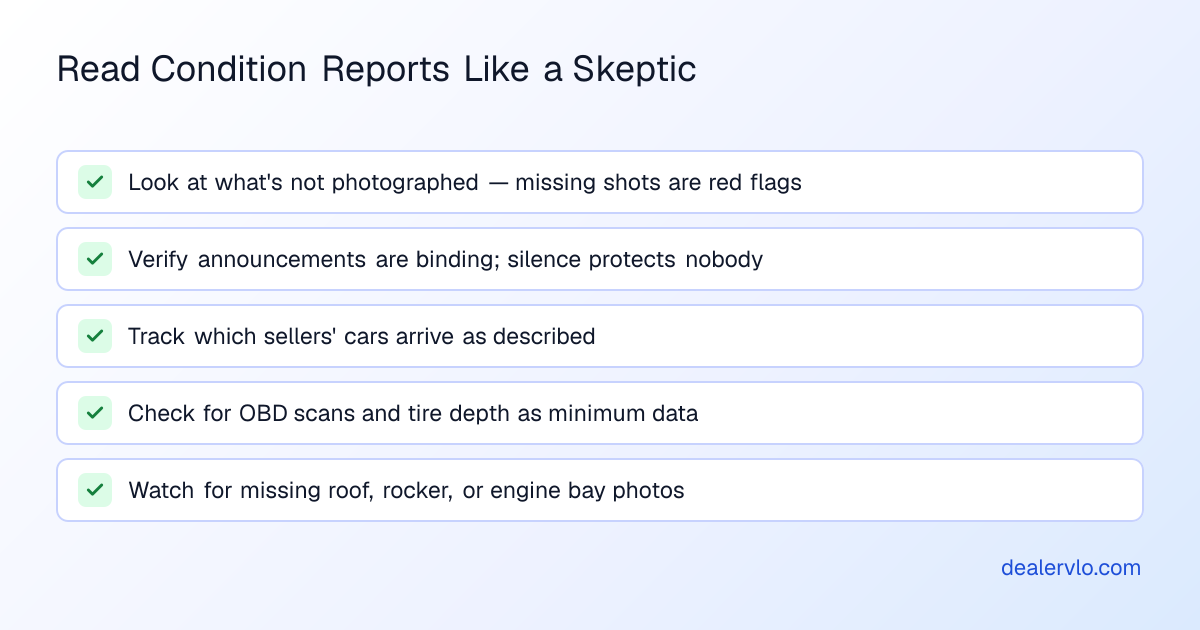
Online wholesale (ACV, Manheim's digital lanes, dealer-to-dealer platforms) lives and dies on the condition report. Treat it as a legal document, not a description:
- Look at what's not photographed. Missing shots of the roof, rocker panels, or engine bay are rarely accidents.
- Announcements are binding; silence is not. "Frame damage announced" protects you; a clean report with no undercarriage photos protects nobody.
- Grade inflation is real. A 4.0 from one seller isn't a 4.0 from another. Track which sellers' cars arrive as described — and stop buying from the ones that don't.
- OBD scans and tire depth are minimum viable data. No scan on a modern unit is a red flag priced accordingly.
Use the arbitration window like a professional
Every auction and platform has an arbitration policy with a clock on it — often measured in days, sometimes hours for certain defects. Best practice is mechanical:
- Inspect and scan the day the car lands, not when you get around to detailing it
- Document everything with photos and the OBD report immediately
- File within the window with the paperwork organized — arbitration favors buyers who show up documented
A missed arbitration window converts the seller's problem into your problem at 100% of the loss.
Dump it at auction now or retail it? Compare the two nets and find the break-even day.
Open the Wholesale vs. Retail CalculatorCheck the title and history before the money moves
Run the VIN before you commit: title brands, odometer discrepancies, prior salvage, flood history, and open liens. A branded title you didn't catch doesn't just kill that deal's margin — in most states it creates a disclosure obligation on your retail sale (Massachusetts dealers, see the damage disclosure guide). Decode the basics free with the VIN decoder, and treat any history-report gap as a discount, not a mystery.
14-day free trial, then $29/mo · Cancel anytime
Buy for your market's velocity, not your taste
Your buy list should come from data: what body styles, price bands, and mileage ranges actually turn on your lot. The discipline points:
- Price band first. If your market moves $8,000–$15,000 sedans and compact SUVs, the $28,000 low-mile truck is someone else's grand slam.
- Velocity beats margin on paper. A unit that turns in 20 days at $1,800 gross beats one that "should" make $3,000 but sits for 90 — especially on a floor plan.
- Fill holes, not preferences. Buy what the lot is missing, not what caught your eye in the lane.
You need the license before the lanes open
Dealer-only auctions and wholesale platforms require an active dealer license — it's the ticket into the room where the inventory is. If you're not licensed yet, that's step zero: our state-by-state dealer license guides cover the bond, fees, and timeline for 18 states.
The checklist
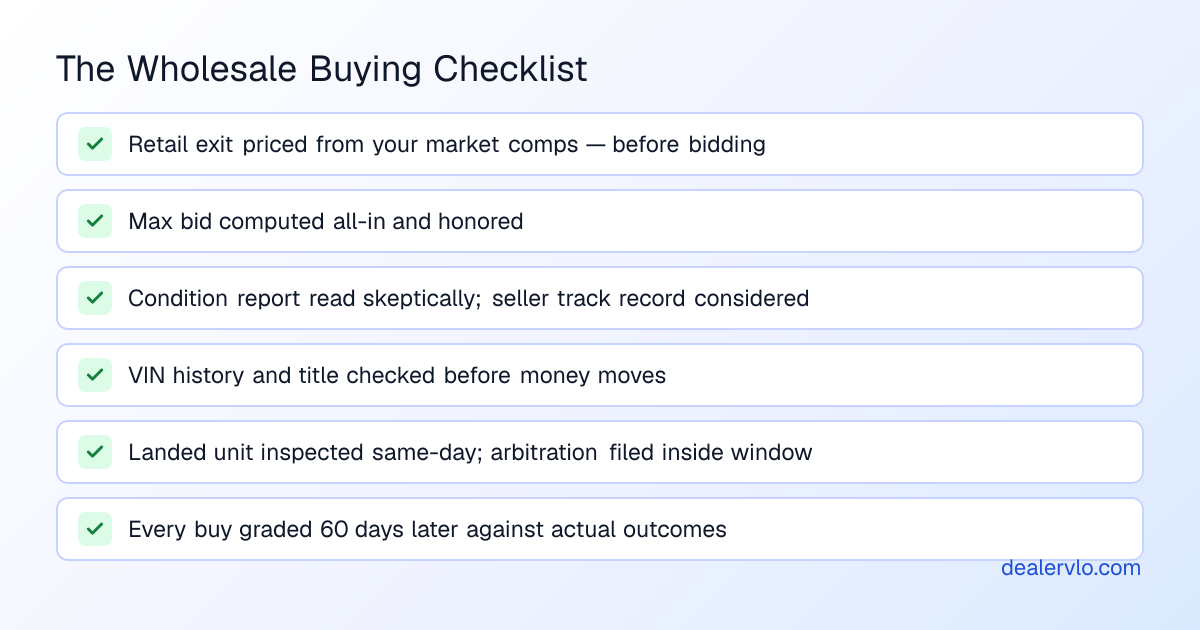
- Retail exit priced from your market comps — before bidding
- Max bid computed all-in (fee, transport, recon, holding) — and honored
- Condition report read skeptically; seller track record considered
- VIN history and title checked before money moves
- Landed unit inspected and scanned same-day; arbitration filed inside the window
- Every buy graded 60 days later: did it do what you bought it to do?
That last one is the habit almost nobody keeps. Grade your own buys against actual outcomes — sold price, days on lot, real recon — and your bidding gets measurably sharper every quarter. That's also exactly the data your DMS should be handing you for free: DealerVLO's reporting shows cost, recon, days-on-lot, and gross per unit, so the post-mortem is a report, not a spreadsheet project.
14-day free trial, then $29/mo · Cancel anytime