How to fill out the Damage Disclosure in Massachusetts
A field-by-field walkthrough of the Massachusetts Damage Disclosure (Salvage, Rebuilt & Prior-Damage Disclosure) for licensed used car dealers — what goes in every section, who signs what, and the documents you attach. Verified against the Massachusetts statutes and Attorney General regulations as of October 2026.
Don't waste another second filling out the Massachusetts Damage Disclosure.
Let DealerVLO turn your deal into a print-ready Damage Disclosure worksheet instantly, with every value ready to copy onto the form or key into the state's system.
Filing these every week? DealerVLO builds the Damage Disclosure worksheet from the deal you already entered, $29/month flat. See pricing
Switching from another DMS? Compare DealerVLO to DealerCenter, Frazer, or Lot Wizard.
Filling out the MA Damage Disclosure after a sale:
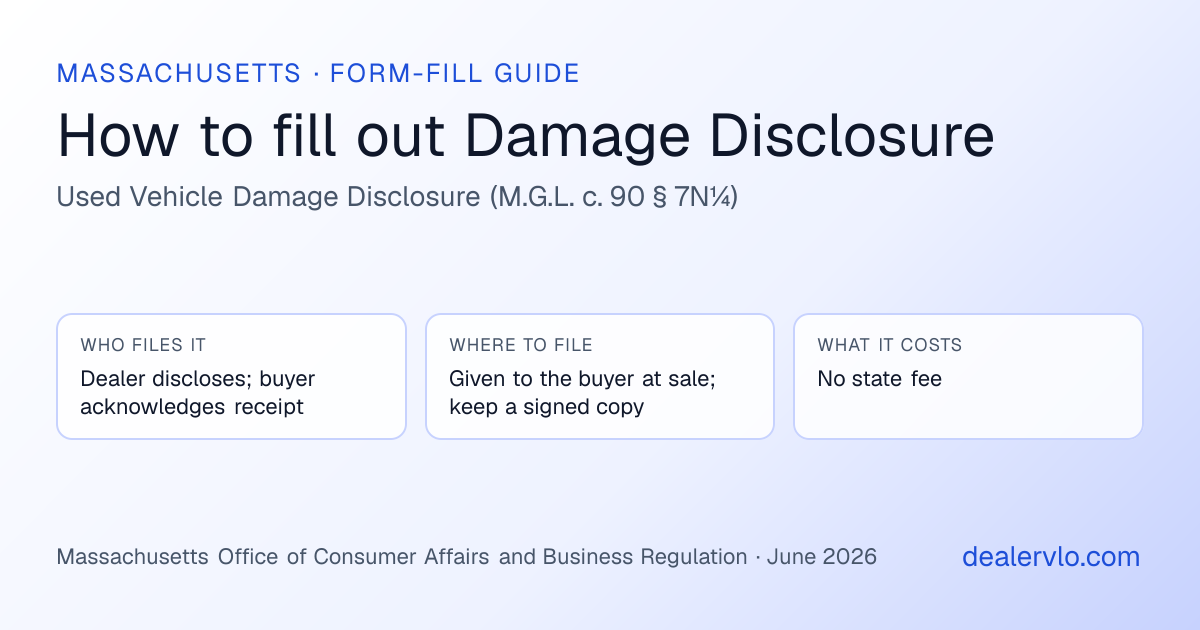
- What it is
- A written disclosure of salvage/rebuilt title history and known prior damage; no official MA form
- Who completes it
- Dealer discloses; buyer signs to acknowledge receipt
- Where to file it
- Given to the buyer at sale; keep a signed copy in the deal jacket
- Processing time
- Provided at or before the sale; not filed with the RMV
- Cost
- No state fee
This guide is informational and does not replace the official Massachusetts instructions. Always confirm the current form and procedure with the Massachusetts Attorney General's Office (940 CMR 5.00) before you file.
The Damage Disclosure is one car's paperwork. A 20-second read on your lot, and the tax-and-fee math for the whole deal — built for dealers, no signup. Free calculators dealers actually use — no signup, no email.
DealerVLO turns your deal into a print-ready Massachusetts Damage Disclosure worksheet — VIN-decoded vehicle, buyer, co-buyer, and sale price laid out and ready to key in or copy over. $29/month, free to try — cancel any time.
What the Damage Disclosure is and why it matters
Massachusetts doesn't have a general "damage disclosure" statute with a repair-cost threshold. It has two specific rules. Under M.G.L. c. 90D § 20C(d), anyone who transfers a vehicle that has been issued a salvage title "shall fully and fairly disclose that fact to any transferee for value." Under the Attorney General's motor vehicle regulation, 940 CMR 5.04(2)(c), the dealer's Motor Vehicle Purchase Contract must designate the car as "a rebuilt vehicle which was previously declared a total loss by an insurance company" if the dealer knows, or with reasonable care should know, that it is one.
Other damage falls under a broader rule. 940 CMR 3.16(2) makes it a violation of the consumer protection law, M.G.L. c. 93A, to fail to disclose any fact that may have influenced the buyer not to buy. Known frame, flood or fire damage is the kind of fact a buyer would weigh, so the safe practice is to disclose it in writing too. This guide covers what goes on that written disclosure, who signs, and how it fits with the purchase contract and the rest of a Massachusetts deal.
Massachusetts has no state-issued damage disclosure form and no dollar threshold for one. The law requires two things. A seller must fully and fairly disclose a salvage title (M.G.L. c. 90D § 20C(d)), and the dealer's Motor Vehicle Purchase Contract must designate a rebuilt vehicle previously declared a total loss (940 CMR 5.04(2)(c)). A written disclosure the buyer signs is how you prove the first and back up the second; DealerVLO generates one pre-filled from the deal. Correction, October 2026: an earlier version of this guide said M.G.L. c. 90 § 7N¼ requires a damage disclosure above a statutory threshold. That was wrong. § 7N¼ is the Used Vehicle Warranty Law and has no such rule.
Documents to have before you start
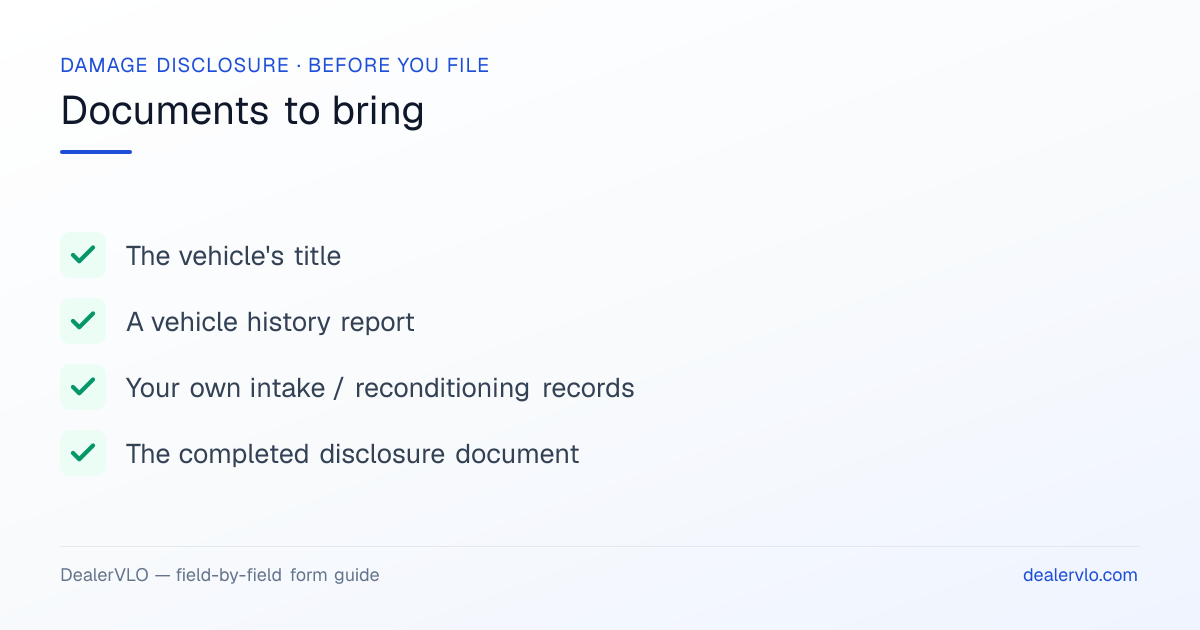
Gather these before you complete the disclosure. It isn't filed with the RMV, so what matters is that it reflects everything you know, or should know, about the car's title and damage history.
- The vehicle's title — Look for a salvage title or a "reconstructed" notation (the Massachusetts brand for a rebuilt total loss under c. 90D § 20D), and for any brand from another state.
- A vehicle history report — Run NMVTIS / Carfax / AutoCheck. The contract rule covers what you know or "in the exercise of reasonable care, should know."
- Your Motor Vehicle Purchase Contract — If the car is a rebuilt total loss, the designation goes on the contract itself (940 CMR 5.04(2)(c)). The separate disclosure doesn't replace it.
- Your own intake / reconditioning records — Frame work, airbag service, flood or fire notes, or engine/transmission replacement you performed or were told about.
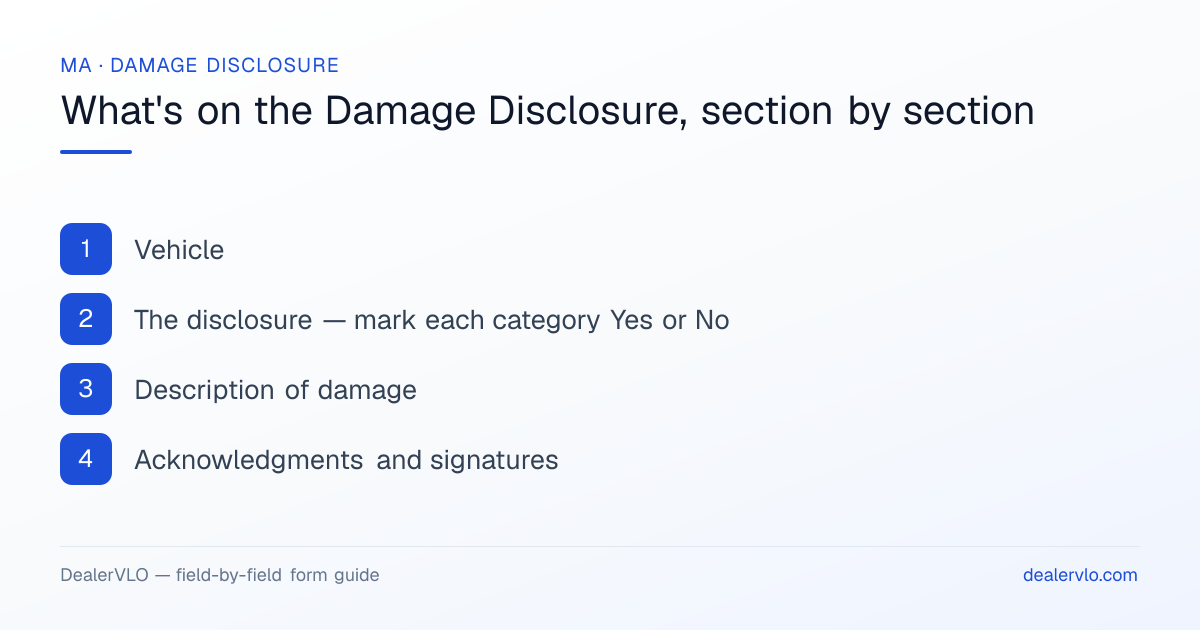
Damage Disclosure, section by section
Vehicle
Identifies the car the disclosure applies to. This pre-fills from the deal in DealerVLO; verify the VIN against the title.
| Field | Who fills it |
|---|---|
Year / Make / Model | You (dealer) |
Stock number | You (dealer) |
VIN Match the title and the vehicle. | You (dealer) |
Odometer at sale | You (dealer) |
Date of sale | You (dealer) |
Title history: the disclosures Massachusetts law requires
These two lines track the actual legal duties. Mark each Yes or No. Check the title and a history report, because a brand from another state counts too.
| Field | Who fills it |
|---|---|
A salvage title has been issued for this vehicle M.G.L. c. 90D § 20C(d): "fully and fairly disclose that fact." | You (dealer) |
Rebuilt vehicle previously declared a total loss by an insurance company 940 CMR 5.04(2)(c): also designate it on the Motor Vehicle Purchase Contract. A Massachusetts title shows "reconstructed." | You (dealer) |
Other known damage: disclose what you know
No Massachusetts statute lists these categories or sets a repair-cost threshold for them. They're on the disclosure because 940 CMR 3.16(2) treats failing to disclose a fact that may have influenced the buyer not to buy as a c. 93A violation. Answer each based on what you know from the title, the history report and your own records.
| Field | Who fills it |
|---|---|
Frame or unibody damage requiring straightening or major repair | You (dealer) |
Fire damage | You (dealer) |
Flood or water damage | You (dealer) |
Hail damage | You (dealer) |
Major collision damage (structural or significant repair) | You (dealer) |
Airbag deployment | You (dealer) |
Replacement or major repair of engine or transmission | You (dealer) |
Description of damage
If you answered Yes to anything, describe the damage and repair in the open field. Be specific: "front-end collision, frame straightened and repainted, 2022" is far better than "prior damage."
| Field | Who fills it |
|---|---|
Damage / repair description Fill it in whenever any line is marked Yes. | You (dealer) |
Acknowledgments and signatures
The buyer signs to acknowledge receiving the disclosure before the sale. The dealer certifies the information is accurate to the dealer's knowledge as of the sale date. Both sign at the desk, and the buyer gets a copy (940 CMR 5.04(4) requires a copy of any document the buyer signs).
| Field | Who fills it |
|---|---|
Buyer acknowledgment + signature | Buyer |
Dealer certification + signature | You (dealer) |
Common Damage Disclosure mistakes that cause rejections
Some forms and websites (including an earlier version of this guide) cite the Used Vehicle Warranty Law, M.G.L. c. 90 § 7N¼, for damage disclosure. That law covers warranties, repairs and refunds. It has no damage-disclosure rule or dollar threshold. The rules to cite are c. 90D § 20C(d), 940 CMR 5.04(2)(c) and 940 CMR 3.16(2).
940 CMR 5.04(2)(c) requires the rebuilt/total-loss designation on the Motor Vehicle Purchase Contract itself. The separate signed disclosure is extra proof, not a substitute.
A car can carry a salvage or rebuilt brand from another state, and the contract rule covers what you should know with reasonable care. Run NMVTIS or a history report before you sign.
Mark every line Yes or No. A blank reads as evasive and weakens the record that you disclosed what you knew.
The damage disclosure, the FTC Buyers Guide, and the MA Used Vehicle Warranty disclosure are separate documents. A compliant MA sale needs all that apply. See the MA paperwork checklist.
Keep the signed disclosure in the deal jacket. If a buyer later says you hid a salvage history or damage, the signed acknowledgment is your record of what you disclosed.
Common questions
Is there an official Massachusetts damage disclosure form?+
No. Massachusetts doesn't issue a numbered damage disclosure form. M.G.L. c. 90D § 20C(d) lets the Director of Consumer Affairs and Business Regulation set the timing, form and content of the salvage-title disclosure by regulation, but we found no regulation that prescribes a form. Dealers use their own written disclosure; DealerVLO generates one pre-filled from the deal.
What does Massachusetts require a dealer to disclose about damage?+
Three things. A salvage title must be fully and fairly disclosed to the buyer (M.G.L. c. 90D § 20C(d)). A rebuilt vehicle previously declared a total loss by an insurance company must be designated on the Motor Vehicle Purchase Contract when the dealer knows or should know (940 CMR 5.04(2)(c)). And under 940 CMR 3.16(2), failing to disclose any fact that may have influenced the buyer not to buy is a violation of M.G.L. c. 93A, which is the rule that reaches other known damage.
Is there a dollar threshold for damage disclosure in Massachusetts?+
No. Massachusetts law sets no repair-cost or percentage threshold for dealer damage disclosure. The salvage-title and rebuilt rules turn on the title history, not a dollar figure, and the general rule turns on whether the fact may have influenced the buyer. Some other states do use one. North Dakota, for example, has the seller of a recent-model car state whether its damage reached the greater of $10,000 or 25% of its pre-damage value.
Does M.G.L. c. 90 § 7N¼ require a damage disclosure?+
No. § 7N¼ is the Massachusetts Used Vehicle Warranty Law. It sets the dealer's warranty by mileage and the buyer's repair and refund rights. It has no damage-disclosure requirement or damage threshold. It also requires a private seller to disclose known defects that impair safety or use, which is a different duty.
Who fills out the damage disclosure, the dealer or the buyer?+
The dealer completes and certifies it, marking each line based on the title, the vehicle history and the dealer's own records. The buyer signs to acknowledge receiving it before the sale.
Does the damage disclosure replace the FTC Buyers Guide or the purchase contract?+
No. The FTC Buyers Guide covers warranty status, and the Motor Vehicle Purchase Contract must still carry the rebuilt/total-loss designation under 940 CMR 5.04(2)(c). The damage disclosure is a separate signed record of the title history and damage you disclosed.
Do I file the damage disclosure with the RMV?+
No. It's given to the buyer at the time of sale and you keep a signed copy in the deal jacket. It is not part of the RMV-1 title and registration package.
Is there software that fills out the Damage Disclosure automatically?+
Yes. Dealer management software like DealerVLO turns the deal you already entered into a print-ready Massachusetts Damage Disclosure worksheet — the VIN-decoded vehicle, buyer, co-buyer, lienholder, and sale price laid out and ready to copy onto the form or key into the state's system. It's $29/month flat with a 14-day free trial, and the same deal also generates your federal documents (Bill of Sale, FTC Buyers Guide, odometer disclosure) and any other state's title forms.
- Massachusetts used car dealer paperwork checklist
- Salvage and branded title disclosure rules in every state
- Selling salvage and rebuilt title cars as a dealer
- The Massachusetts Used Vehicle Warranty Law for dealers
- How to fill out the Massachusetts RMV-1
- How to get a used car dealer license in Massachusetts
- Massachusetts dealer plates
- How Massachusetts car sales tax works on a dealer sale
- Dealer license in Boston
- Dealer license in Worcester
- Dealer license in Springfield
- Title application forms in every state
- How much is a dealer's license? Cost in every state
Stop filling out the Damage Disclosure by hand.
DealerVLO turns your deal jacket into a print-ready MA Damage Disclosure worksheet — VIN-decoded vehicle, buyer, co-buyer, lienholder, and sale price laid out, so keying it in or copying it over takes minutes. $29/month. 14-day free trial, cancel any time.
Curious how it works? See how DealerVLO auto-fills every dealer document — bill of sale, FTC Buyers Guide, odometer disclosure, and state title & registration forms for all 50 states, from one deal.
Bond amounts, fees, and form rules change. Get a short email when your state does. No spam, unsubscribe anytime.