Sourcing and merchandising used trucks at an independent lot
Trucks hold value, carry gross, and punish sloppy buying. How independent dealers source used trucks: configuration math, work vs. retail trucks, inspections.
Part of the Buying & sourcing inventory guide: How to buy at dealer auctions without getting buried
Switching from another DMS? Compare DealerVLO to DealerCenter, Frazer, or Lot Wizard.
Trucks are the best and worst inventory on an independent lot. Best, because demand is durable, values hold, and buyers show up knowing what they want and pay gross for it. Worst, because no vehicle category punishes a sloppy buy harder — the wrong configuration sits like a boat anchor, and truck problems (frames, four-wheel-drive systems, deleted emissions) are expensive in exactly the ways a lot walk doesn't reveal.
Here's how I approach them.
14-day free trial, then $29/mo · Cancel anytime
Configuration is the whole game
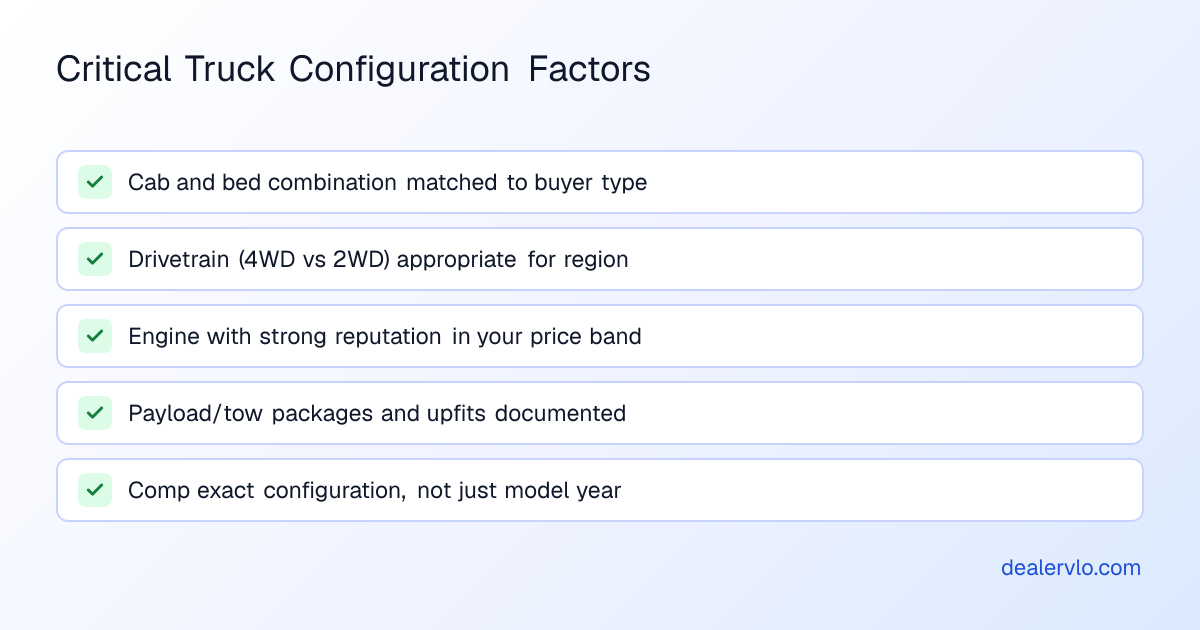
With sedans, trim is a detail. With trucks, configuration is the product. The same model year and badge can be a fast-turning unit or a permanent resident depending on the boxes:
- Cab and bed: crew cab short bed is the family-truck default that retails everywhere. Regular cab long bed is a work tool — great buy if you price it for the contractor, dead if you price it like a retail truck.
- Drivetrain: in the snow belt, 4WD isn't a feature, it's a requirement — a 2WD half-ton in New England needs to be bought at a discount deep enough to find its narrow buyer. Reverse that logic in the Sun Belt.
- Engine matters more than trim. Certain engines carry reputations (good and bad) that buyers arrive already knowing. Know which powertrains in your price band have the loyal following and which have the lawsuit history — the market prices both in, and so should your bid.
- Payload/tow packages, gooseneck hitches, upfits: to the right buyer these are worth real money; they're also your clue about how hard the truck worked in its last life.
The retail-back method applies double here: comp the exact configuration, not "2019 F-150." The spread between configurations of the same truck can be wider than the spread between model years.
Work truck or retail truck? Decide before you bid
Every used truck is one of two products, and mixing up which one you're buying is the classic mistake:
- The retail truck — crew cab, mid-to-upper trim, clean history, sensible miles. Competes with franchise used departments; buyers cross-shop it online; condition and photos win the deal. You pay up for it and it turns fast.
- The work truck — higher miles, cosmetic honesty, vinyl floors, maybe a toolbox and ladder rack. Its buyer is a contractor who cares about the frame, the drivetrain, and the price — and often pays cash or needs simple financing. Margins are strong because franchise stores don't want it.
Both make money. An independent lot's edge is usually the work truck, because the big stores wholesale exactly the units your contractor customer is looking for. But the work truck bought at a retail-truck price is the worst unit on your lot.
Before you authorize the work: see whether a repair earns back its cost plus the holding days it adds.
Open the Recon ROI CalculatorThe inspection traps that cost four figures
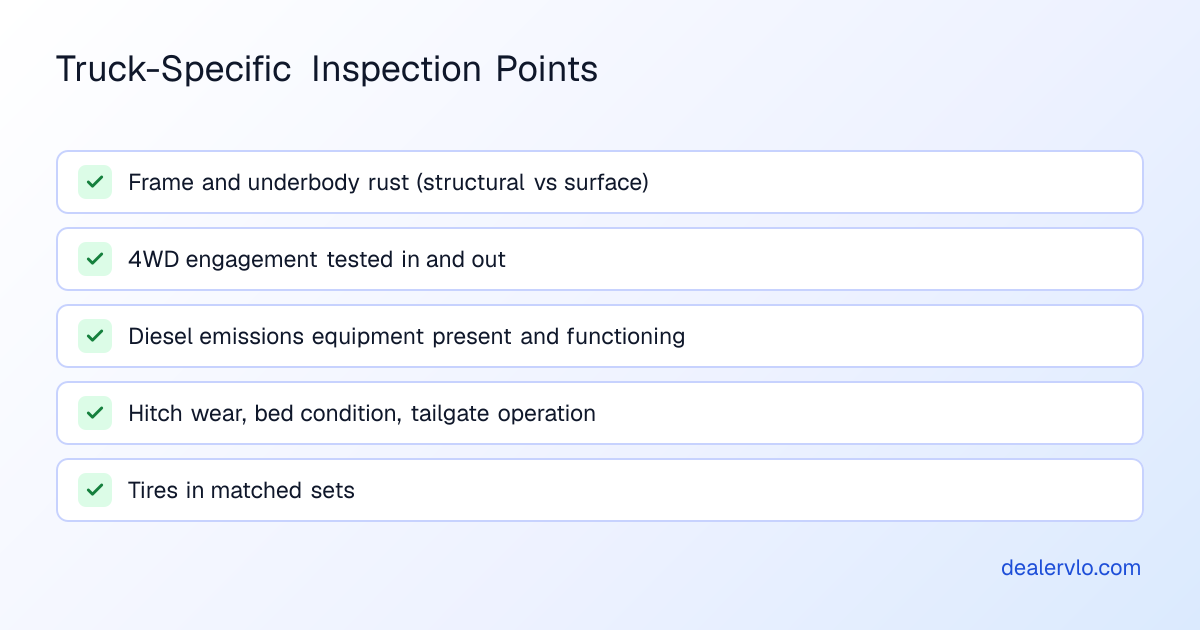
Truck-specific checks that go beyond the normal used-car walk:
- Frame and underbody rust — in salt states this is the whole inspection. Surface rust is life; scaling, flaking structural rust is a pass at any price, because it fails the buyer's mechanic even when it technically passes yours.
- 4WD engagement, in and out, actually tested — transfer case and front-end repairs erase margins. Thirty seconds in the auction lot beats a $2,500 surprise.
- Diesel emissions equipment — a deleted or modified emissions system on a diesel is a federal problem, not a preference. Confirm the equipment is present and functioning before you own it, especially on trucks from states that don't test.
- Hitch wear, bed condition, tailgate operation — reads as a history report written in steel. Heavy towing life isn't disqualifying, but it belongs in your bid.
- Tires in matched sets — truck tires are expensive enough to be a line item, not a footnote, in your recon math.
14-day free trial, then $29/mo · Cancel anytime
Where the good trucks actually come from
- Auction fleet and commercial lanes — well-maintained, honestly graded, high-mile work trucks; the natural source for the contractor product. (Lane tactics are in our dealer auction buying guide.)
- Direct-from-consumer buying — "we buy trucks" is the most productive version of the we-buy-cars pitch, because retail truck owners know their truck's value and will still sell for convenience. One-owner local trucks with service records are the best retail units you'll ever stock.
- Your own trades — the sedan buyer trading a half-ton is handing you the inventory your next buyer wants. Appraise trucks aggressively; the trade you win is the auction trip you skip.
Merchandising: answer the truck buyer's questions
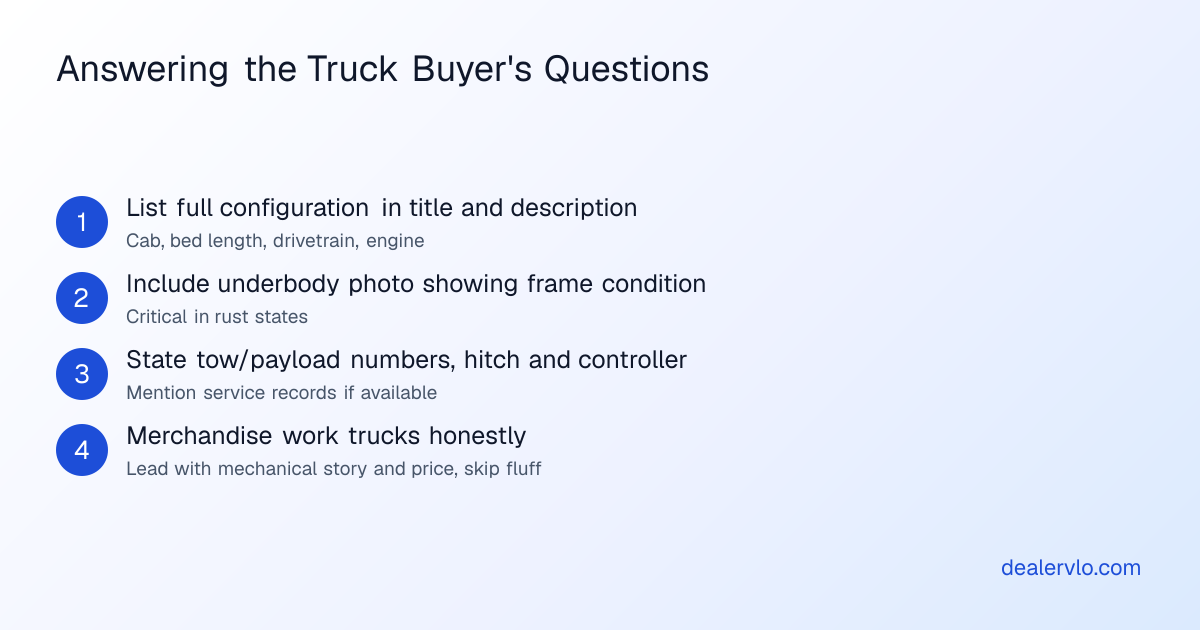
Truck shoppers filter harder than any other buyer. A listing that says "2020 Silverado, clean!" with six photos loses to the listing that answers the questions the buyer actually has:
- Configuration in the title and text: cab, bed length, drivetrain, engine. The buyer searching "crew cab 4x4 5.3" finds you or doesn't based on whether you wrote it down.
- The underbody photo. In a rust state, one honest photo of a clean frame does more selling than every glamour shot combined — and filters out the buyer who'd have walked at the lift anyway.
- Tow/payload numbers stated, hitch and controller noted, service records mentioned if you have them.
- The work truck merchandised as a work truck: lead with the mechanical story and the price, skip the sunset photography. Its buyer respects honesty and hates fluff.
Trucks reward the dealer who does the unglamorous homework — configuration comps, underbody time, honest listings. That homework is also the moat: the lot down the street isn't doing it, which is exactly why their crew cab sits at the wrong price while yours turns in three weeks.
14-day free trial, then $29/mo · Cancel anytime