How independent dealerships win 'near me' searches (without paying for ads)
Local SEO for used-car dealers: the Google Business Profile setup that matters, why reviews beat backlinks, and what your site needs for 'used cars near me'.
Part of the Marketing, leads & your website guide: Used Car Dealer Marketing: What a Small Lot Should Do First — and What to Skip
Switching from another DMS? Compare DealerVLO to DealerCenter, Frazer, or Lot Wizard.
When someone in your town types "used cars near me," Google shows three lots on a map before it shows anything else. Getting into that three-pack is worth more than any listing site subscription you're paying for — the click goes straight to you, there's no middleman reselling your own leads back to you, and it costs nothing but attention.
I run a small lot in Massachusetts. Here's what actually moved the needle for us, in the order I'd do it again.
14-day free trial, then $29/mo · Cancel anytime
The Google Business Profile is 80% of the game
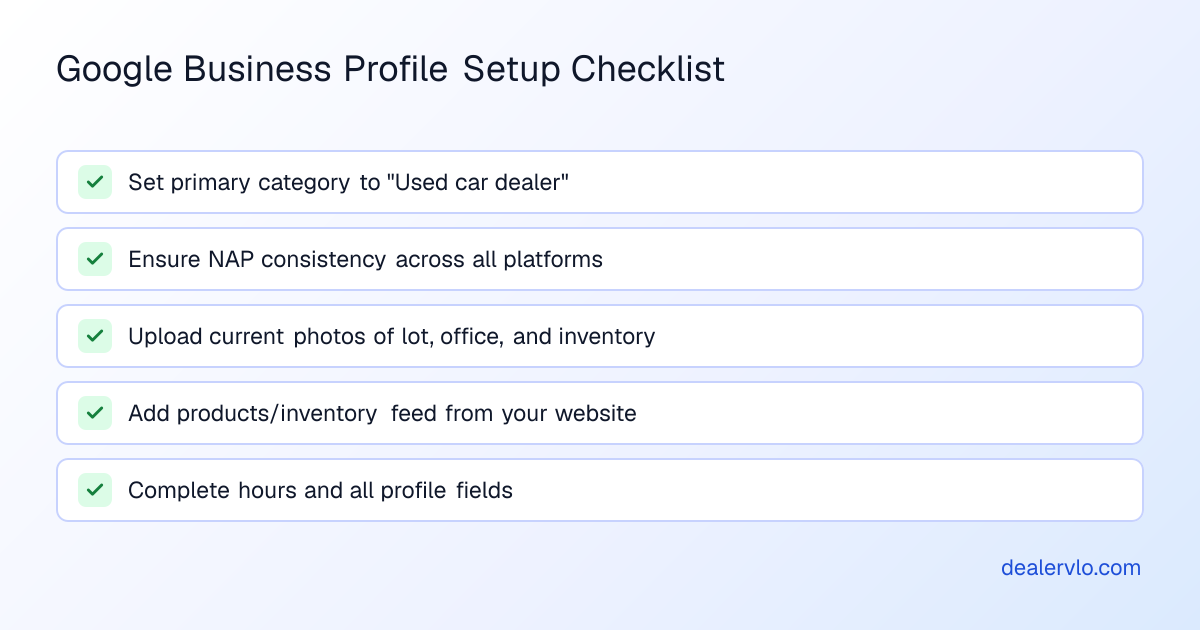
Local rankings run on your Google Business Profile (GBP), not your website. Most dealer profiles are half-finished, which is the opportunity.
- Category: primary category "Used car dealer" — not "Car dealer," which throws you into franchise competition. Add secondaries that genuinely apply (used truck dealer, car finance and loan company if you do BHPH).
- NAP consistency: your Name, Address, Phone must match exactly — on your GBP, your website, your state license record, and the big directories. "Simon's Service" in one place and "Simons Service LLC" in another quietly splits your identity.
- Hours, photos, and posts: real photos of the lot, the office, and cars you're proud of — updated as inventory turns. A profile with this-month photos beats a stale one with better reviews more often than you'd think.
- The products/inventory feed: if your website exposes your cars, link it. Google increasingly shows actual vehicles in local results.
Reviews are the local ranking currency
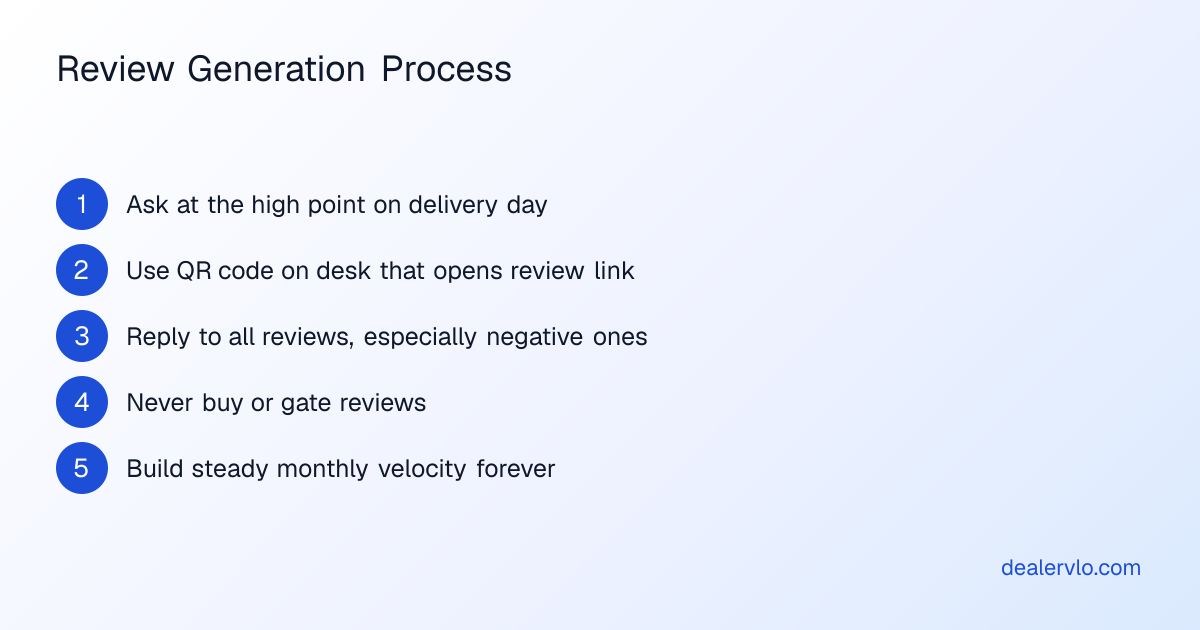
Locally, review velocity and recency beat almost everything else. Not a hundred reviews someday — a steady few every month, forever.
- Ask at the high point, which is delivery day, not a week later by email. Buyer's sitting in the new car, you hand them the plate frame, you ask. A QR code taped to the desk that opens your review link removes every step.
- Reply to all of them, especially the bad ones. The reply is read by the next hundred shoppers, not the angry one.
- Never buy or gate reviews. Filtering happy customers to Google and unhappy ones to a form is against Google's policy, and the platforms are good at spotting purchased batches. One flag undoes a year of honest asking.
The review ask scales with your process, not your marketing budget. If every delivery includes the ask, a 100-car-a-year lot generates more review signal than most franchise stores manage — because almost nobody actually asks consistently.
Paste one car page: see its mobile speed against Google's published lines, and whether shoppers can find and reach you.
Open the Dealer Website CheckYour website's job in local search
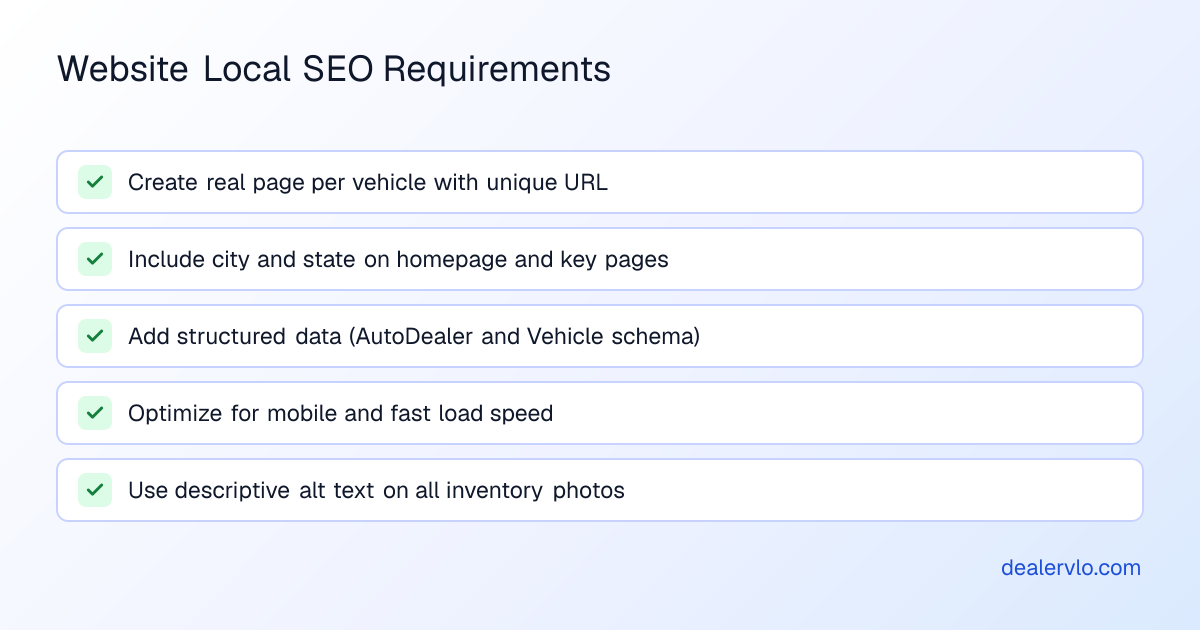
The map pack runs on your GBP, but the organic results below it — and the "website" click from your profile — run on your site. What matters:
- A real page per vehicle. Every car should have its own URL with the year/make/model/trim in the title, real photos with descriptive alt text, mileage, and price. One long inventory page with no per-car links gives Google nothing to rank.
- City and state on the pages that matter. Your homepage title should say what and where you are: "Quality used cars in Tewksbury, MA" beats "Home". You don't need thirty doorway pages for every suburb — one honest location, stated clearly, on real pages.
- Structured data.
AutoDealerschema on the site andVehicleschema on inventory pages tells Google the machine-readable version of what you sell. This is also, increasingly, what AI assistants read when someone asks them to find a dealership. - Speed and mobile. Your buyers are on phones in a break room. If your inventory takes eight seconds to load, they're back on the marketplace apps.
This is the part where I'll be direct about the product: this checklist is why the dealer websites DealerVLO generates come with per-vehicle pages, location-aware titles, schema, and image alt text out of the box — because most independent dealers' sites are a template from 2014 that has none of it, and nobody at the lot has time to retrofit SEO. Whatever software you use, hold it to this list.
14-day free trial, then $29/mo · Cancel anytime
The citations that matter (and the ones that don't)
Get listed accurately on the handful of places Google trusts for local data: Google (obviously), Apple Maps, Bing Places, Yelp, Facebook, and your state's dealer association directory if it publishes one. That's an afternoon of work. The "500 citations for $99" packages create the NAP inconsistencies you just spent time fixing — skip them.
What to expect, honestly
Local SEO compounds slowly and then all at once. The GBP cleanup shows up in weeks; the review engine takes months to build and then becomes your moat, because a competitor can copy your website in a day but can't copy two years of weekly reviews. Track one number: how many phone calls and direction requests your GBP reports each month. When that line bends up, the lot feels it.
None of this requires spending a dollar on ads — which is exactly why the dealers who do it consistently own the map in their town.
14-day free trial, then $29/mo · Cancel anytime