CDK vs Dealertrack: which enterprise DMS — and does an independent lot need either?
CDK Global vs Dealertrack for independent used-car dealers: what each is built for, why both are quote-only enterprise systems, and when a small lot needs neither.
Part of the Choosing dealer software guide: The best DMS for independent used-car dealers in 2026 — an honest list from a dealer
Switching from another DMS? Compare DealerVLO to DealerCenter, Frazer, or Lot Wizard.
Every few weeks a dealer asks me some version of "should I go with CDK or Dealertrack?" — usually someone who just got off a demo call and is trying to figure out which enterprise system is the safer bet. It's a fair question, and it has a real answer. But it's usually the wrong question for the lot asking it.
Both are excellent at what they're built for. Neither is built for a 10–50 car independent used lot. So this is two comparisons in one: how CDK and Dealertrack actually differ, and whether a lot like yours needs either. I run my own used lot in Tewksbury, and I'll tell you where each one genuinely wins — and where the honest move is to stop shopping the enterprise tier entirely.
14-day free trial, then $29/mo · Cancel anytime
The short answer
CDK Global is an all-in-one franchise DMS: its core is the service lane, the parts counter, and full dealership accounting, with OEM reporting layered on. Dealertrack, a Cox Automotive product, is strongest as the F&I and registration layer — its lender network and digital contracting, and its registration-and-titling service. If you run a franchise store with fixed operations, CDK's breadth fits. If your bottleneck is F&I throughput and lender connections at volume, Dealertrack's depth fits.
If you run an independent used-car lot, though, the punchline is that most of either system is surface area you'll pay for and never touch — and both are quote-only, sold through a sales process, and onboarded through an implementation project. More on that below.
What CDK Global actually is
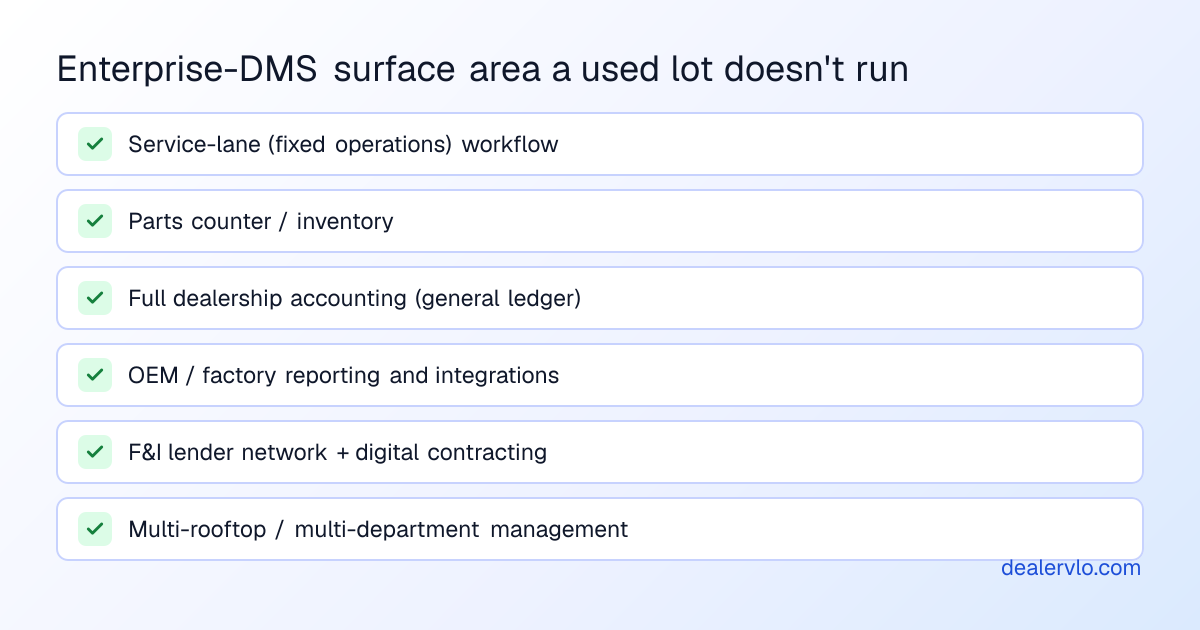
CDK is built around franchise operations. The heart of it is fixed ops — scheduling and billing the service department, running the parts counter — plus a full dealership general ledger and the OEM reporting a factory store has to produce. Sales and F&I sit on top of that spine, not the other way around.
That's a genuinely deep, integrated product for a store that runs all of those departments under one roof. It's also why standing it up is a project: implementation, data migration, configuration, and training before you go live. You don't sign up for CDK on a Tuesday and title a car on Wednesday.
For an independent used lot, the question isn't whether CDK is good — it's whether you have a service department and a fixed-ops ledger to run at all. If you don't, you're buying a franchise operating system to do a used-car job.
What Dealertrack actually is
Dealertrack comes at it from a different angle. Its center of gravity is F&I and the transaction rails: the lender network and digital contracting that let a high-volume store shop and book financing, and its registration-and-titling service. It's a Cox Automotive product, so it lives in that ecosystem.
Where Dealertrack earns its price is throughput — a store pushing serious deal volume through a network of lenders, wanting that whole flow digitized. That's its strongest area, and it's a real one.
But it's a franchise-scale need. A small independent lot financing a handful of deals a month through a couple of local credit unions and a buy-here-pay-here book doesn't have the volume to justify an enterprise F&I platform. The lender network is the answer to a bottleneck most small lots don't have.
14-day free trial, then $29/mo · Cancel anytime
Where they overlap — and where the money goes
Set the feature lists aside and the two look similar in the ways that matter to a small lot:
- Neither publishes a price. Both are quote-only, priced per dealership by the modules you choose. You'll get a number after a demo, not before.
- Both onboard as a project. Data migration, configuration, training — weeks, not an afternoon.
- Both assume a bigger operation than an independent lot: multiple departments, higher deal volume, factory or lender relationships at scale.
None of that is a knock. It's just what enterprise software is. The mistake is buying it for a lot that doesn't operate at that scale — you carry the cost and the complexity of a franchise store without the franchise store's reasons for them. If you want to see how per-module pricing actually stacks up in practice, I broke down one mid-market example in DealerCenter pricing, explained.
Does an independent lot need either?
Here's the used-car job, start to finish: decode a VIN into inventory, build a deal with correct tax and payment math, fill your state's title and registration paperwork from that deal, put the car on a website, and move on. That's it. That's what actually turns cars on a small lot.
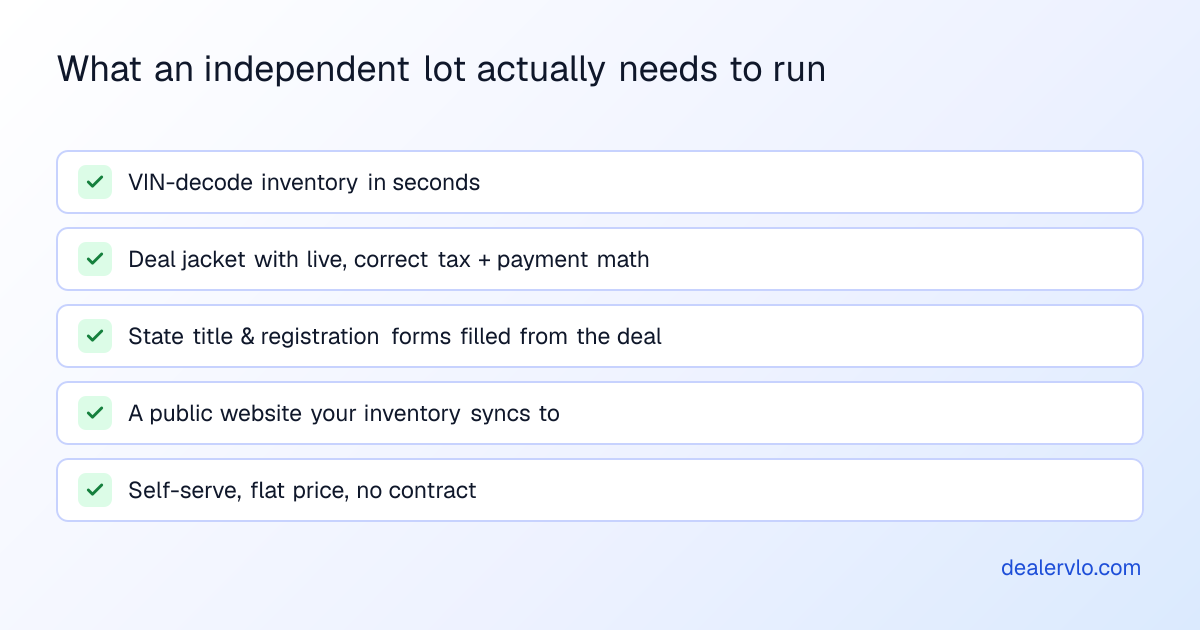
An enterprise DMS does all of that too — buried inside a franchise operating system you're also paying for. For a 10–50 car lot, the smart move is a tool sized to the job: flat price, self-serve, month-to-month, everything a used lot needs and nothing it doesn't. That's the whole reason I built DealerVLO, and it's the same logic behind my ranked list of the DMS options for independent lots — right-size first, then compare.
If you're specifically weighing DealerVLO against one of these two, I keep an honest side-by-side for each: DealerVLO vs CDK and DealerVLO vs Dealertrack, and the full comparison hub covers the rest.
How to decide
If you're still not sure which tier you belong in, walk it in order:
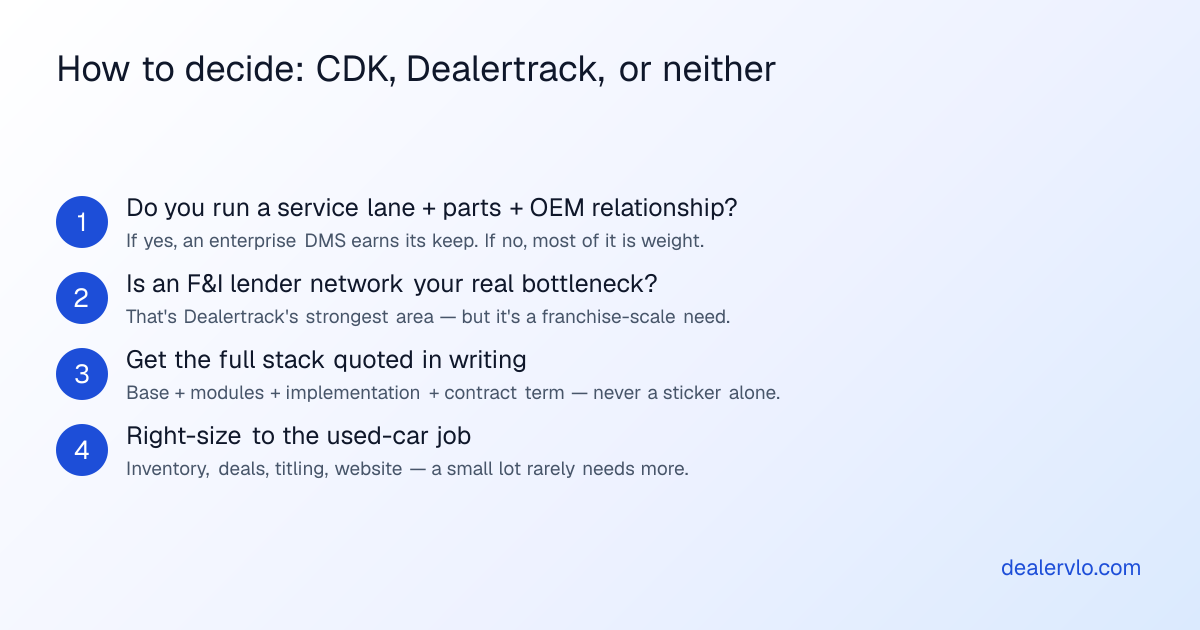
The first question does most of the work. If you don't run a service lane and a fixed-ops ledger, you're almost certainly not a CDK store. If an enterprise F&I lender network isn't your bottleneck, you're not a Dealertrack store. And if you get a quote either way, price the whole stack in writing — base, modules, implementation, and contract term — because the sticker is never the number that matters. Moving between systems is easier than it sounds, too; I wrote up how a migration actually goes in switching from Lot Wizard.
Frequently asked questions
What is the difference between CDK and Dealertrack? CDK Global is an all-in-one enterprise DMS built around franchise operations — service, parts, dealership accounting (a full general ledger), OEM reporting, and multi-rooftop management. Dealertrack, a Cox Automotive product, is strongest as the F&I and registration layer: its lender network and digital contracting, and its registration-and-titling service. Neither publishes pricing — both are quote-only, contract-based, enterprise-range.
Is CDK or Dealertrack better for an independent used-car dealer? For most independent lots, neither. Both are built for franchise stores and high-volume groups that run a service department, a fixed-operations ledger, and OEM relationships. An independent lot selling 10–50 used cars a month has none of that, so most of an enterprise DMS is surface area you pay for and never use.
How much do CDK and Dealertrack cost? Neither publishes a price. Both are quote-only, set per dealership by the modules you choose. There's no public price, no self-serve trial, and no contract term to read off a page (Dealertrack's DMS page says no long-term contracting but doesn't state the term). Dealertrack DMS pricing, explained has what its site does say.
Do CDK or Dealertrack offer a free trial or self-serve signup? No. Both require a sales call and a demo, and onboarding is an implementation project measured in weeks. If self-serve signup and a published price matter to you, that alone rules both out for a small lot.
What should a small independent lot use instead? A tool sized to the used-car job: inventory with VIN decode, the deal jacket with live tax and payment math, federal and all-50-state title paperwork filled from the deal, BHPH, and a public website — flat, self-serve, no contract. That's what DealerVLO does at $29/month.
Bottom line
CDK vs Dealertrack is a real decision — for a franchise store. CDK if you run service, parts, and a factory ledger; Dealertrack if enterprise F&I throughput is your bottleneck. But if you run an independent used lot, the better question is whether you belong in the enterprise tier at all, and the answer is usually no. Right-size the software to the used-car job and keep the cost and complexity where they belong.
That's exactly what DealerVLO is built for — the used-car job, one flat price, live the same afternoon. See what's included on the pricing page, or start a free trial and run a real deal before you decide.
14-day free trial, then $29/mo · Cancel anytime
Paste a VIN, the buyer, and the price — see the title & registration form filled in for 50 states, free, no signup.
Open the State Form Auto-Fill