The In-Person Used-Car Sale: From Test Drive to Close on an Independent Lot
The in-person sales process for a one- or two-person lot: greeting walk-ins, qualifying buyers, test drives that sell, price objections, and closing the deal.
Switching from another DMS? Compare DealerVLO to DealerCenter, Frazer, or Lot Wizard.
The moment a buyer steps onto your lot
The used car sales process for dealers starts the moment a buyer pulls onto your lot. Everything that happened before—the online listing, the lead, the phone call—ends when they park and walk toward your inventory. This article covers the in-person sequence from that first greeting through the signed deal, written from the point of view of a one- or two-person independent lot where you're often the only salesperson, lot manager, and closer all at once.
This isn't a guide to financing disclosures, contract compliance, or title work—those come after the handshake. This is about the sales process itself: how you qualify a buyer without interrogating them, build confidence during the test drive, navigate the price objection, and close without pressure tactics that blow up your reputation in a small market.
Compliance note: This article discusses sales process and technique. It does not constitute legal, tax, or insurance advice. Every state regulates dealers differently—confirm your disclosure, licensing, and insurance obligations with your state regulator and your attorney before you sell a car. For dealer licensing requirements by state, see our used car dealer license guide.
14-day free trial, then $29/mo · Cancel anytime
The greeting: read the buyer, don't pounce
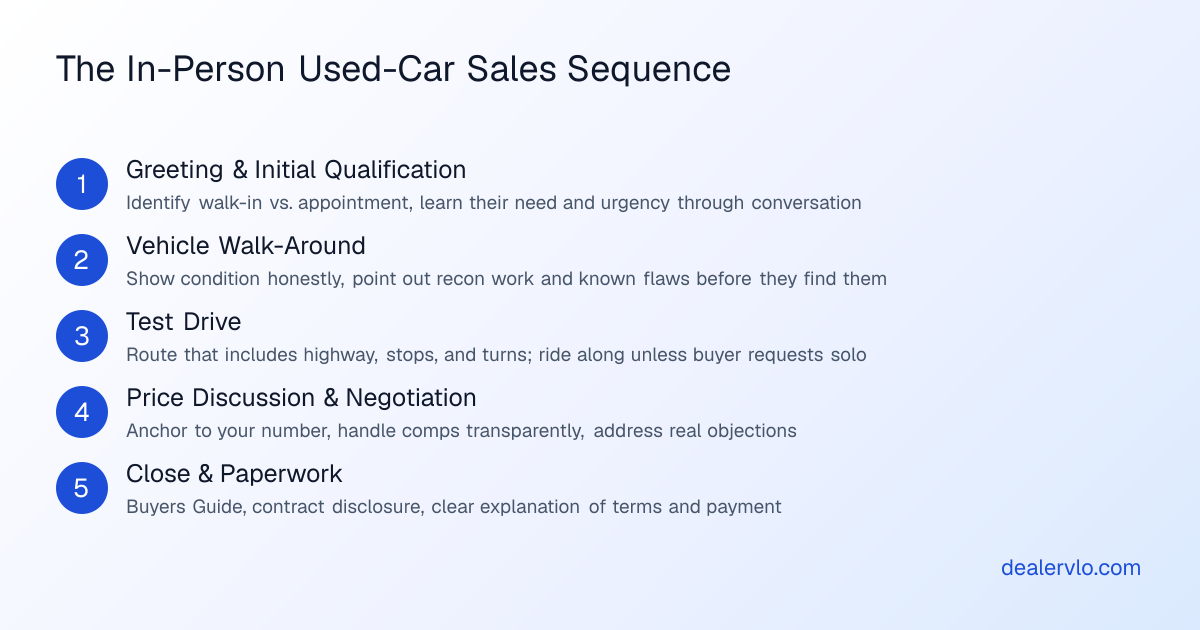
Walk-ins fall into two buckets: the shopper who called ahead or messaged you about a specific car, and the drive-by who saw your sign and pulled in. Your opening changes based on which one you're facing.
If they're here for a car they saw online, you already know the vehicle and probably the rough budget. Greet them by name if you have it, confirm which unit they came to see, and walk them straight to it. Don't tour the whole lot—they picked this car for a reason. If it's gone or wrong for them, you'll find that out in thirty seconds and pivot then.
For the true walk-in with no appointment, your first job is to figure out urgency and fit without sounding like you're taking a loan application. Start with the car they're standing next to. "Good eye—that one just came in. What are you driving now?" gets you their trade situation and whether they're replacing something or adding a vehicle. "What brought you in today?" sounds generic, but the answer tells you whether they're killing time, lost a car yesterday, or have been looking for three months.
Don't ask budget in the first sixty seconds. It sounds like you're pre-qualifying them for financing, and it puts people on defense. You'll learn their range faster by watching which cars they slow down for and which they walk past. If you've priced your inventory well, the spread across your lot will do the qualifying for you.
Qualifying without interrogating
The goal of the first five minutes is to answer three questions: what do they actually need, when do they need it, and can they buy today if the car and number are right? You learn this through conversation, not a checklist.
Listen for household clues. "We need something reliable" means different things if it's a college kid's commuter versus a second car for a spouse. "I need a truck for work" from a contractor is a different sale than "I want a truck" from someone who likes the look. The use case tells you what features matter and which objections you'll hit later.
Timing is the second piece. "My lease is up next month" and "my car died this morning" are both urgent, but one has a deadline and the other has desperation—you handle those differently. "Just looking" might mean they're three months out or it might mean they're embarrassed about their credit and don't want to admit they're serious. You find out by talking about the car, not their situation. Pressure creates resistance; relevance creates urgency.
The third piece—can they actually buy—comes out organically if you're listening. Someone who mentions "my bank" or "my insurance agent" has thought through the transaction. Someone who asks "what's the cheapest thing you have?" might be cash-strapped or might just be testing you. You won't know until you show them a car and see how they react.
Skip the myth that you need to "control" the buyer or follow a rigid six-step process. You're not selling copiers. The buyer came to you because they need a car and you have it. Your job is to make the transaction easy and trustworthy, not to manipulate them into something they'll regret and unwind in three days.
The walk-around: show them what they can't see online
Once you know which vehicle fits, walk them around it before you hand over keys. This is not a spec-sheet recital—they can read the listing—this is where you point out the things a photo doesn't show and answer the question they're all wondering: what's wrong with it?
Start with the good. "This one came off a lease—service records in the glovebox, no stories." "I bought this at auction last month, put new pads and rotors on it, detailed it yesterday." You're building trust by being specific. Vague praise sounds like sales talk; details sound like you know the car.
Then acknowledge the warts before they find them. "There's a door ding on the passenger side, pretty typical for a car this age. Didn't warrant a repaint, but it's priced accordingly." "The wheels have some curb rash—cosmetic, but you should know it's there." Pointing out flaws yourself proves you're not hiding anything, and it defuses the negotiation later when they try to use the same flaw for leverage.
Show them the work you did. Pop the hood, point to new belts or a fresh battery. Open the door, show them clean carpets or a new headunit. If you detailed and reconditioned the car properly, this is where it pays off—it separates you from the curber down the street who wiped it down and called it clean.
If the buyer is knowledgeable—they crouch down to look at tire tread, or they ask about the timing belt—let them inspect. Don't rush it. A buyer who's checking the car is a buyer who's serious.
The test drive: mechanics and confidence
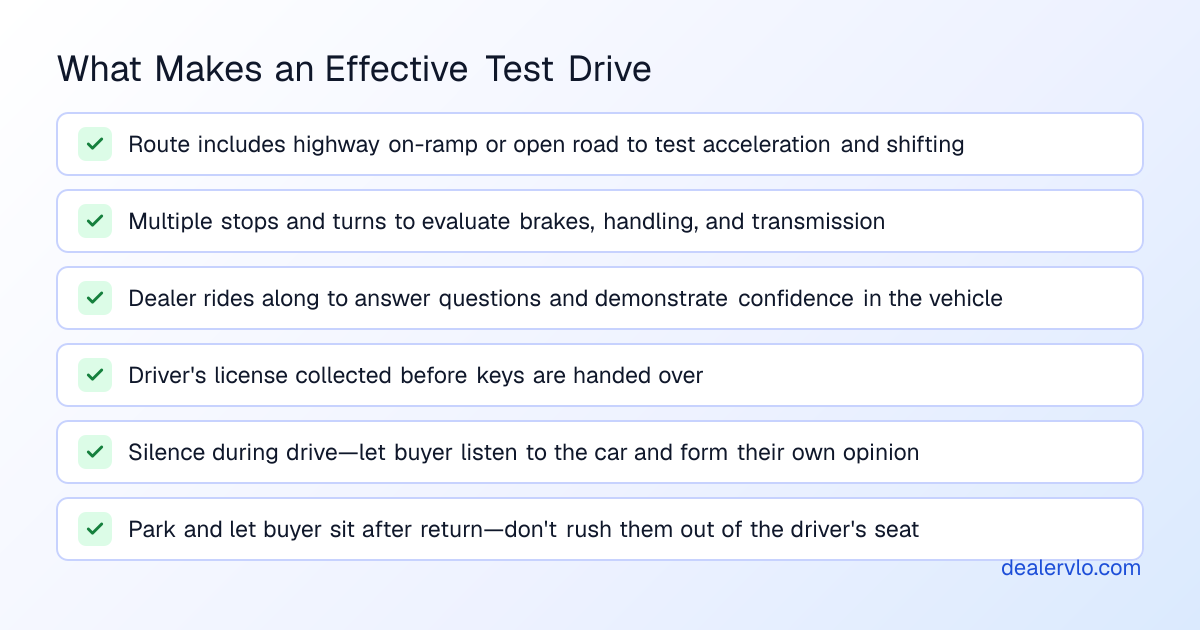
You're legally required to carry garage liability insurance that covers vehicles during test drives, and most independent dealers carry this as part of their commercial auto policy. The coverage protects both you and the driver during a standard test drive where you or your employee is present. Some dealers ask to see a driver's license before handing over keys, and a few require proof of personal insurance, though the latter is more common for extended or overnight drives.
Before you leave the lot, set the route. You want a loop that includes a highway on-ramp or a stretch of open road, a few stop signs, and a turn or two—enough for them to feel the transmission shift, hear the engine under load, and test the brakes. Avoid routes with heavy traffic where they never get above thirty miles per hour; you learn nothing and they leave unsure.
Go with them unless they explicitly ask to drive alone. You're not babysitting—you're available to answer questions and you're demonstrating confidence in the vehicle. If they do ask to solo it, that's fine for a short drive, but get a clear ID first and make sure your insurance agent has confirmed your policy covers unaccompanied drives. Some dealers use a brief liability waiver for solo drives; check with your agent and attorney on what your policy requires and what your state allows.
During the drive, stay quiet unless they ask a question. Don't narrate every turn or sell them on features while they're trying to listen to the engine. If they're silent, they're evaluating. If they start talking—"this rides smoother than I expected," "the pickup is nice"—they're buying themselves on it, and your job is just to agree and let them keep going.
Pay attention to what they test. If they're checking blind spots and adjusting mirrors, they're picturing themselves in it. If they ask "does the AC blow cold?" or "how's it handle in snow?", they're thinking past the test drive to ownership. Answer specifically, and if you don't know, say so—don't guess about winter traction if you're in Texas and the car has summer tires.
When you get back, park and let them sit in it for a moment. Don't rush them out. This is the gut-check moment, and if they're mentally buying, silence works better than pitch.
Handling the price objection: it's always coming
If the test drive went well, you're about to hear one of three things: "What's your best price?", "I found the same car cheaper across town," or "I love it but it's out of my budget." All three are negotiation openers, not rejections, and your response sets the tone for whether this closes or dies.
Start by anchoring to your number. "I'm asking $12,400. It's priced at market for the miles and condition, and I've got the recon receipts to back it up." You're not being rigid—you're showing you priced it deliberately, not arbitrarily. If you used a solid pricing strategy and can point to comps or recent auction data, do it. Transparency beats stubbornness.
If they cite a lower comp, ask for details. "Where'd you see it? Same year and miles?" Half the time it's a different trim, higher mileage, or salvage title. If it's legitimately cheaper and comparable, acknowledge it. "That's a fair comp. Mine's got new tires and brakes, which that one probably doesn't, but I can work with you a little." You're negotiating condition and value, not defending an inflated number.
If they're stuck on monthly payment, you're in financing territory, which is outside the scope of this article—but recognize it early so you don't burn time negotiating sale price when the real issue is loan approval. If you offer in-house financing, this is where that becomes the path forward. If you don't, have a network of lenders you can refer them to and keep the conversation on the transaction, not the monthly nut.
The "I need to think about it" objection usually means one of three things: they're not convinced on the car, they want to check with a spouse or mechanic, or they're hoping you'll panic and drop the price if they walk. Your read on the test drive tells you which. If they loved the car but hesitate, ask directly: "What's holding you back?" Most of the time they'll tell you, and it's something you can solve—they want to bring their mechanic by, they're trading in another car and need to settle that first, or they legitimately need to talk to a partner. All of those are fine; set a follow-up time and let them go.
Don't chase someone off the lot with a new number. It looks desperate and it trains buyers to walk for a discount. If your price is fair and the car is right, say so and let them leave. A lot of "I need to think about it" buyers come back the next day when they realize the car they wanted is still the car they want.
Whatever number you land on, the buyer's real question is the same: what does it cost to drive away? Being able to answer that instantly—sale price, sales tax on the right base, doc, title, minus their trade and down—is a closing tool in itself. Fumbling it at the desk is where fair deals fall apart.
Build the whole deal — price, tax on the right base, doc, title, minus trade and down — into the out-the-door number and the monthly payment.
Open the Out-the-Door Price CalculatorClosing: paperwork, not tricks
If they're ready to buy, the close is simple: write it up. You're not strong-arming them into a signature—you're turning a handshake into a binding agreement that protects both of you.
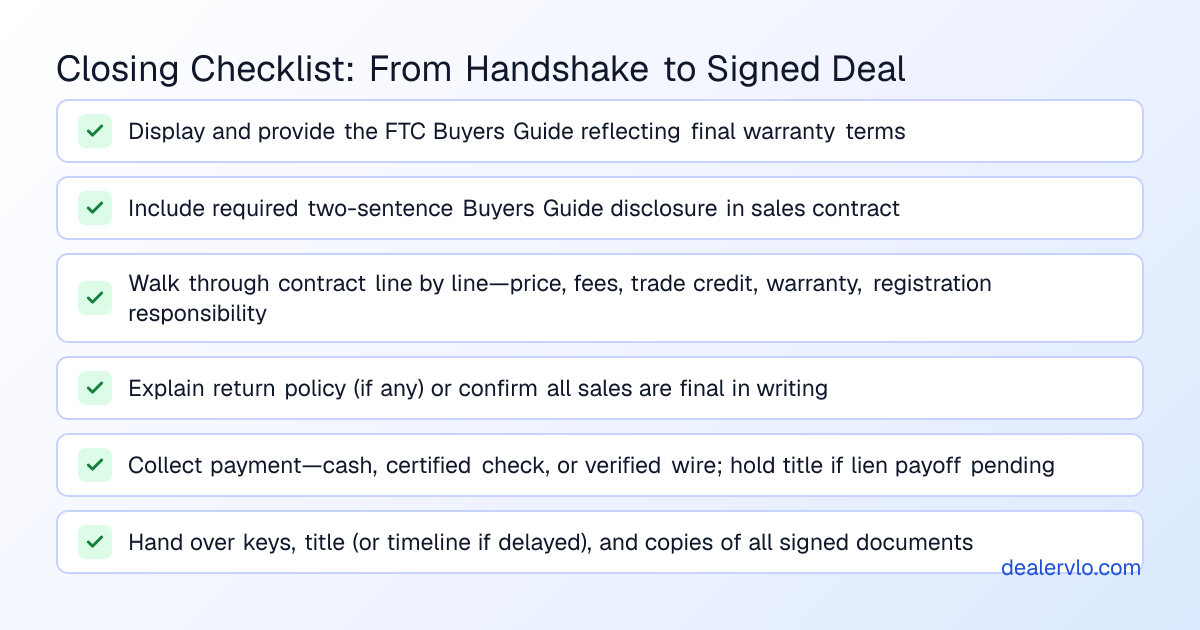
Start with the Buyers Guide. Federal law requires dealers who sell more than five used vehicles in a year to display a Buyers Guide on every used car offered for sale, and the rule applies in every state except Maine and Wisconsin. The Guide must be prominently displayed—hung from the rear-view mirror, attached to a side window, or placed under a windshield wiper—and visible from outside the vehicle. You can remove it for the test drive, but it goes back up immediately after.
At closing, you give the buyer the Buyers Guide or a copy, and it must reflect the final negotiated warranty terms. You also include a specific two-sentence disclosure in the sales contract stating that the Buyers Guide is part of the contract and that its terms override any conflicting language in the sale document. The exact wording is prescribed by the FTC, and your contract template should already have it. If a transaction is conducted in Spanish, you must use a Spanish-language Buyers Guide.
Violations of the Used Car Rule can result in penalties up to $53,088 per violation in enforcement actions, so this isn't optional. For more on managing dealer paperwork and compliance, see our dealer paperwork software overview.
Walk them through the contract line by line: sale price, any trade credit, fees, warranty terms, and who's responsible for registration. Don't rush this. A buyer who doesn't understand what they're signing is a buyer who calls you angry two days later or tries to unwind the deal. Answer every question, even the dumb ones.
Some states grant buyers a right to cancel within a few days; others do not unless the dealer voluntarily offers it. If your state requires it or if you offer a return policy as a business practice, make sure that's documented clearly in writing and explained before they sign. If you don't offer returns, say so up front: "All sales are final once you drive off the lot." No surprises.
Once they sign, collect payment—cash, certified check, or verified wire; personal checks clear before the car leaves unless you know the buyer—and hand over keys, title, and a copy of everything they signed. If you're holding the title for a lienholder payoff or out-of-state registration, explain the timeline in writing so they're not calling you in a week wondering where their plates are. For out-of-state transactions, see our out-of-state car sale checklist.
14-day free trial, then $29/mo · Cancel anytime
After the close: follow-up and reputation
The sale doesn't end when they drive off. What happens in the next week determines whether they send you referrals or trash you online.
Call or text them the next day. "Just checking in—how's the car running?" It takes thirty seconds and it catches buyer's remorse before it turns into a lawsuit. If they're happy, great. If they found a problem you missed, you have a chance to make it right while they still trust you. A small concession now—a free oil change, splitting the cost of a repair—is cheaper than a chargeback, a bad review, or a complaint to your state's dealer regulator.
If they had a good experience, ask for a referral. "If you know anyone looking, send them my way." Word-of-mouth is still the highest-converting lead source for independent dealers, especially in small markets where your reputation is the entire business. A happy customer who tells three friends is worth more than any online ad.
Keep their contact information and follow up periodically—not every week, but every few months. "Hey, just wanted to check in. Need anything for the car? Know anyone looking?" You're staying top-of-mind for the next time they need a vehicle or their cousin does. If you're running a lean operation without a CRM, at minimum keep a spreadsheet. Better, a cloud-based DMS built for independent dealers keeps every customer's contact details and deal history in one place, so follow-up doesn't depend on your memory. Repeat and referral business lays out a simple system for it.
The rest of the sales system: before the lot, and behind the counter
The in-person sale is the middle of a longer process. Two other pieces decide how many buyers reach your lot and how consistently they're handled when they do.
Before they arrive. Most buyers contact you before they visit — a listing inquiry, a message, a call. How fast and how well you answer decides whether that lead becomes a walk-in at all. Converting online leads into showroom appointments covers the first reply, asking for the visit, and the follow-up cadence for the ones who go quiet.
Once it isn't just you. The day you add a salesperson, the process has to live somewhere other than your head. Hiring your first salesperson covers when you're actually ready and who to hire. Building a pay plan that doesn't leak gross keeps their incentives lined up with yours, and measuring salesperson performance shows what to track beyond units sold.
At the handoff to paperwork. Every used car you offer for sale needs its FTC Buyers Guide displayed, and the buyer gets it with the final warranty terms at the sale. The full list of what belongs in the file is in the deal jacket checklist.
The process is a system, not a script
The best independent dealers don't follow a sales script—they follow a system that adapts to each buyer while hitting the same checkpoints every time. Greet them based on why they're there. Qualify them by listening, not interrogating. Show them the car honestly, test-drive it thoroughly, and handle the price objection with transparency and confidence. Close with clean paperwork and no surprises. Follow up after the sale.
The reason this works on a small lot is the same reason it works at scale: you're solving a problem for someone who needs a car, and you're doing it without games. If the car is right and the price is fair, the sale happens. If it's not, no amount of closing technique will force it, and trying just costs you reputation.
Every dealer has a style—some are verbose, some are blunt, some crack jokes, some stay businesslike. The style doesn't matter as much as the substance. Know your inventory, price it right, be honest about condition, and follow through on what you promise. Do that consistently and you'll close more deals than someone with a better pitch and a worse reputation.
For additional benchmarks on inventory turn, days-to-sale, and gross profit expectations, see our used car dealer benchmarks guide. If you're working to build out your lot with the right inventory mix, check out our guide to the best used cars to stock in 2026 and our sourcing strategies for used trucks.
Frequently asked questions
Do I need insurance to let a buyer test-drive a car on my lot?
Yes. Test drives fall under your dealer liability coverage (garage liability, or the newer auto dealers coverage form), which is written for driving your inventory; dealers open lot is a different coverage that protects the cars themselves. Policies set their own conditions, so ask your agent how yours handles unaccompanied drives and who counts as a permitted driver. Many dealers copy the driver's license before handing over keys. Some states also require proof of insurance for the dealer license, so check with your dealer board. Our used car dealer insurance guide explains each coverage.
What is the FTC Buyers Guide and when do I have to use it?
The FTC Buyers Guide is a disclosure form that dealers who sell more than five used vehicles in a twelve-month period must display on every used car they offer for sale. The requirement applies in all states except Maine and Wisconsin. The Guide must be visible and posted prominently—hung from the rear-view mirror, attached to a window, or placed under a wiper. You can remove it for a test drive but must replace it immediately after. At closing, you give the buyer the original or a copy, and you include a specific two-sentence disclosure in the sales contract stating that the Buyers Guide is part of the contract and overrides conflicting terms. Violations can result in penalties up to $53,088 per violation.
How do I handle a buyer who says they found the same car cheaper somewhere else?
Ask for specifics: where they saw it, the year, mileage, and condition. Many times the comp is a different trim, higher miles, or has issues the buyer didn't notice in the listing. If it's legitimately cheaper and comparable, acknowledge it honestly and explain the difference—your car may have new tires, fresh brakes, a clean history, or better recon work. You're negotiating value and condition, not defending an arbitrary price. If you priced the car correctly based on your market and your costs, you can explain your number confidently without sounding defensive or dropping your price out of panic.
Should I let a buyer test-drive a car alone or should I always ride along?
Most dealers ride along on test drives unless the buyer specifically asks to drive solo. Going with them isn't about babysitting—it shows confidence in the vehicle and lets you answer questions on the spot. If a buyer asks to go alone, it's generally fine for a short drive, but check your insurance policy first to confirm solo drives are covered, collect a clear copy of their driver's license, and consider having them sign a brief waiver if your agent or attorney recommends it. Extended or overnight test drives almost always require proof of the buyer's personal insurance, since the risk and duration are higher.
What's the best way to respond when a buyer says they need to think about it?
First, figure out what "think about it" really means. Ask directly: "What's holding you back?" or "Is there something about the car or the price that doesn't work for you?" Most of the time they'll tell you—they want to bring their mechanic, check with a spouse, or compare it to one more car across town. All of those are legitimate, and you can set a follow-up time or offer to hold the car for a day with a small deposit. If they genuinely loved the car during the test drive and the price is fair, let them leave without chasing them off the lot with a drop in price. Desperation discounts train buyers to walk for a better deal and hurt your reputation. A buyer who needs to think will usually come back if the car is right.
Do buyers have a legal right to return a used car after they buy it?
It depends on the state and the dealer's policy. Some states require dealers to offer a right to cancel within a few days; in others, the right exists only if the dealer voluntarily offers it. If your state mandates a cooling-off period or if you choose to offer a return window as a business practice, document it clearly in writing and explain it before the buyer signs. If you don't offer returns, tell them up front: "All sales are final once you take delivery." Either way, make sure the buyer understands the policy before they drive off, so there's no confusion or dispute later.
14-day free trial, then $29/mo · Cancel anytime