How to Price Used Cars for Your Lot: Markup Strategy, Market Comps & Profit Margins
Step-by-step pricing playbook for dealers: use KBB, NADA & Black Book for comps, apply market adjustments, set 10–20% margin targets, and adjust for condition and mileage before the car hits your lot.
Pricing a used car is the single most important decision you make before it hits the lot. Too high and it sits, eating holding costs; too low and you leave money on the table. The right price balances what you paid, what the market will bear, and the gross profit you need to keep the lights on. This is your front-line pricing playbook: start with acquisition cost, pull comps from the three major guides, adjust for local market conditions and vehicle specifics, then set a margin that fits your turn goals and the car's realities.
Disclaimer: This article covers general pricing strategy and market data. It does not constitute financial or legal advice. Confirm any regulatory requirements with your state's dealer licensing authority before setting retail prices or advertising claims.
Start with your all-in acquisition cost
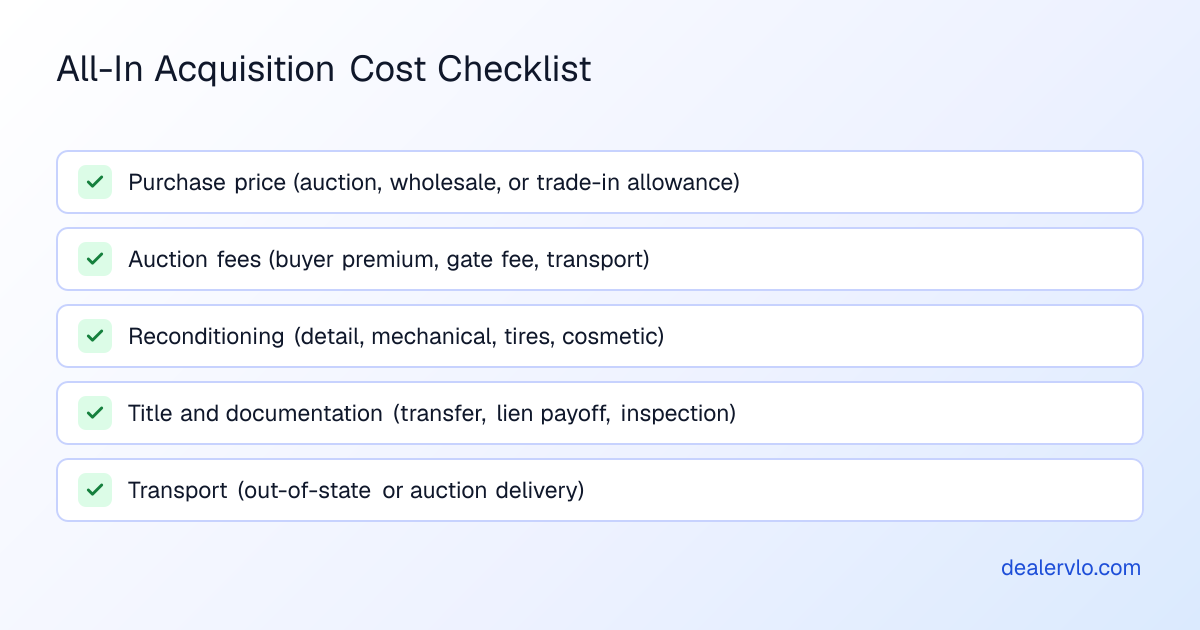
Before you price a car, you need to know what you're into it for. That's not just the auction hammer price or what you gave the customer on trade—it's every dollar you spent to make the car lot-ready.
Add up:
- Purchase price – what you paid at auction, wholesale, or trade-in allowance
- Auction fees – buyer premiums, gate fees, transport (these vary by auction and change frequently, so check the current fee schedule before you bid)
- Reconditioning – detailing, mechanical repairs, tires, brakes, cosmetic touch-ups
- Title and documentation – title transfer, lien payoff if you took a trade, inspection fees
- Transport – if you bought out of state or had it shipped from auction
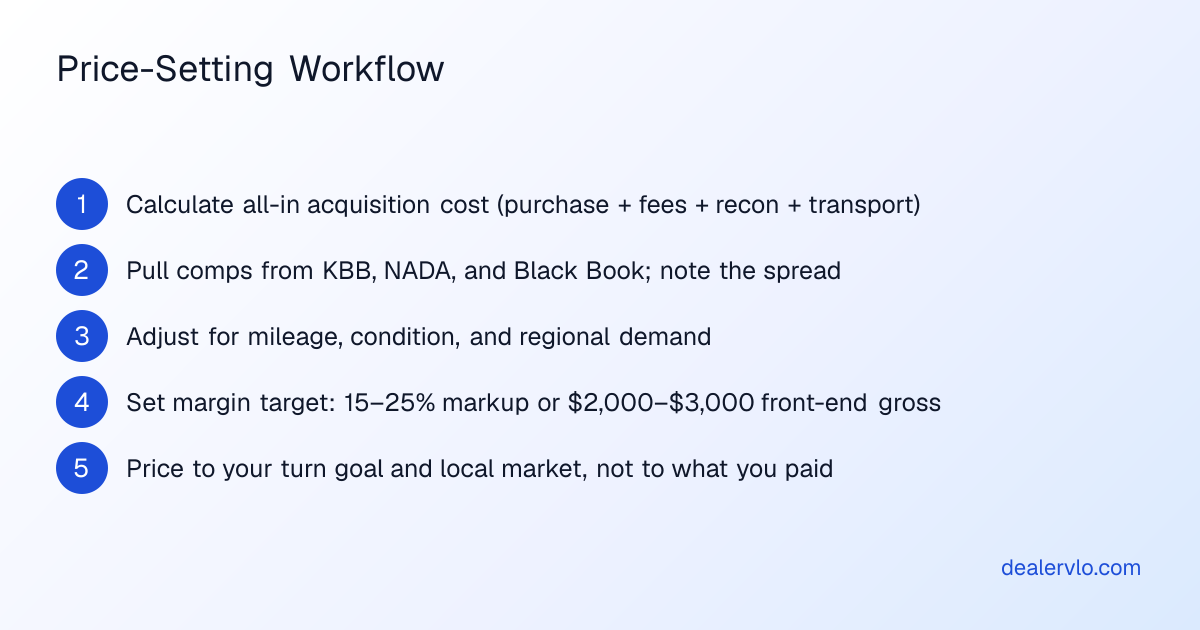
That all-in number is your floor. Everything you do from here is about finding the spread between cost and retail that gives you the gross you need while staying competitive enough to move the unit.
Pull comps from the three major guides
Once you know your cost, you need to know what the market says the car is worth. Most dealers triangulate three guides—KBB, NADA, and Black Book—because each one pulls data from a different angle, and the spread between them tells you where you have room to price.
Kelley Blue Book (KBB)
KBB has been around since 1926 and is now owned by Cox Automotive. It pulls transaction data from dealerships, listings on AutoTrader, and wholesale auction results from Manheim, adjusting values for over 100 geographic areas and updating them weekly.
For dealers, the two values that matter are:
- Auction Value – KBB's estimate of what the car would bring at a wholesale dealer auction. Use this as a sanity check against what you paid.
- Typical Listing Price (formerly Suggested Retail) – this assumes the car has been fully reconditioned and has a clean title, and it bakes in your profit, advertising, sales commissions, and other operating costs. It's a realistic ceiling for what you can ask on your lot.
KBB is consumer-facing and tends to reflect what retail buyers expect to see, so it's a good baseline for online listing price.
NADA Guide
NADA is now part of J.D. Power and is geared specifically toward dealers. It uses dealer sales data and regional trends, which means its values often run a bit higher than other guides because they're based on actual dealership transactions and assume cars are in good condition.
NADA gives you three tiers:
- Trade-in value (rough, clean, average)
- Retail value – what dealers aim to sell for
- Certified pre-owned boost – if you're offering any kind of warranty or CPO program
NADA doesn't publish private-party values, so it's purely a dealer tool. Many lenders and banks use NADA for financing approvals, which means if you price near NADA retail, you're more likely to have your customer's loan come back clean.
Black Book
Black Book is subscription-only and dealer-focused. It's published by National Auto Research, a division of Hearst, and has been used by dealers, lenders, and fleet remarketers since 1955. Black Book physically visits over 60 wholesale auctions every week to collect live sales data, so its values reflect what dealers are actually paying at auction right now.
Use Black Book to:
- Set realistic trade-in offers (its wholesale values are the most current)
- Understand what you should have paid at auction
- Gauge how much room you have between wholesale and retail
Black Book and NADA work well together—Black Book for the buy side, NADA for the sell side.
You don't need to match all three guides. Pull all three, note the spread, and use the range to position your car. If all three guides cluster tight, you have less wiggle room. If there's a wide spread, you have flexibility—and you need to decide whether you're chasing volume or gross.
Apply regional and market adjustments
National guide values are a starting point, but your market is local. A crew-cab diesel pickup that sells in two days in Montana might sit for sixty in suburban Boston. KBB adjusts for over 100 geographic areas, but you still need to overlay what you're seeing on your own lot and in your local classifieds.
Check:
- Local demand – trucks and SUVs command premiums in rural and snow-prone areas; fuel-efficient compacts move faster in cities with high gas prices and tight parking.
- Brand perception – Honda, Toyota, Lexus, and Acura consistently command higher resale because buyers trust their reliability. Fiat, Jeep, and Chrysler typically need deeper discounts to overcome reliability concerns.
- Seasonal factors – convertibles sell in spring and summer; AWD crossovers move in fall. If you're pricing a convertible in November, you're either discounting it to move it or planning to hold it until March.
- Local inventory – if your market is flooded with a particular make or color, you're competing on price. If you're the only dealer within fifty miles with a clean example of what buyers want, you have pricing power.
The guides give you the national average; your job is to adjust for the block you're on and the month you're in. Don't fight your local market—if buyers in your area won't pay NADA retail for a Dodge Journey, price it to move and take the gross you can get.
For more on managing cars that sit too long, see our guide on inventory aging markdown strategy.
Adjust for mileage and condition
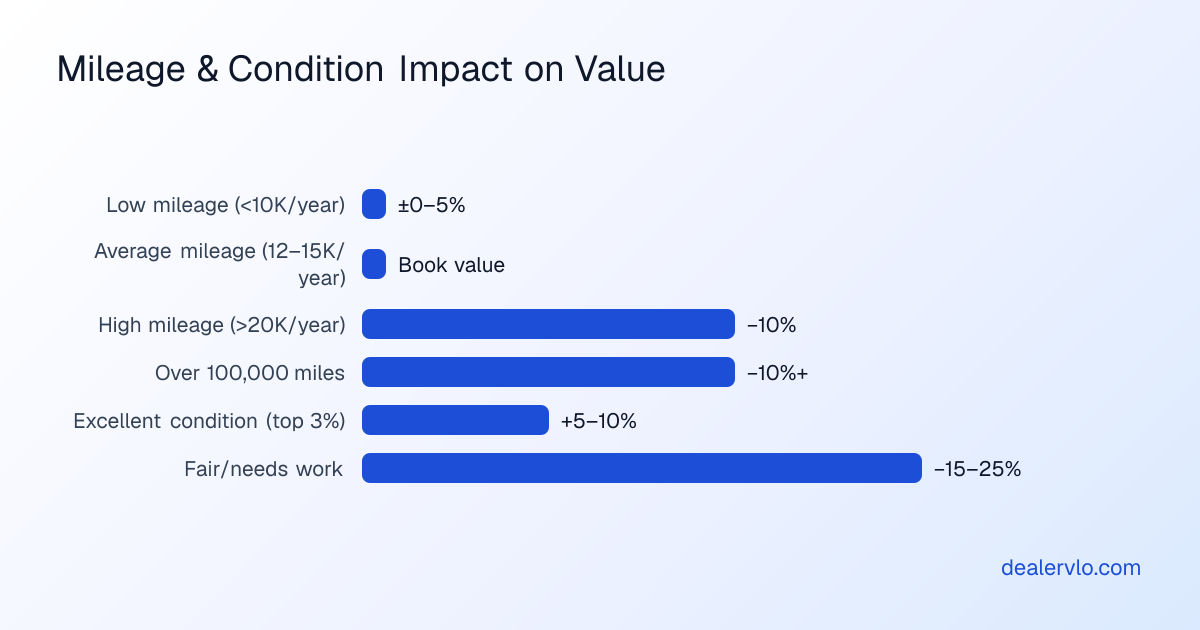
Mileage and condition can swing value by thousands of dollars. The guides assume average mileage (around 12,000 to 15,000 miles per year) and good condition, so anything that deviates—high or low—requires an adjustment.
Mileage
The general rule: if the car's mileage-to-age ratio is under 10,000 or over 20,000 miles per year, reduce its book value by roughly 10 percent. A six-year-old car with 150,000 miles (25,000 per year) is going to need a discount; a six-year-old car with 30,000 miles (5,000 per year) might justify a small premium if condition matches.
The 100,000-mile mark is a psychological threshold. Retail buyers see it as a red flag, even if the car is mechanically sound. CarMax buys cars over 100,000 miles but doesn't retail them—they go straight to auction at deeply discounted wholesale prices. If you're pricing a car north of 100K for retail, you're fighting buyer perception, so price it aggressively or plan to wholesale it.
Condition
Condition trumps mileage in many cases. A well-maintained high-mileage car with full service records and fresh tires can outsell a low-mileage car with curb rash, stained seats, and deferred maintenance. Only about 3 percent of used cars qualify as "Excellent" condition according to KBB—most fall into "Good," and many are "Fair."
If your car needs work to reach retail-ready condition, either:
- Recondition it fully and price it at clean retail, or
- Sell it as-is at a discount that reflects the buyer's cost to fix it
Half-measures—listing a car with known issues at clean retail price—just result in days on lot and price cuts later. For guidance on presenting cars at their best, see how to photograph used cars for your dealer lot.
Set your margin target: 10–25% markup, $2,000–$3,000 front-end gross
Now comes the math. You know your all-in cost, you know the market comps, and you've adjusted for mileage and condition. The question is: what margin do you need, and what margin can the market give you?
Industry markup ranges
The typical used-car markup runs 10 to 35 percent above acquisition cost, with most dealers landing in the 15 to 25 percent range. That percentage translates to different dollar amounts depending on the car:
- A $8,000 acquisition cost at 20 percent markup gives you a $9,600 asking price and $1,600 gross.
- A $15,000 cost at 20 percent gives you $18,000 and $3,000 gross.
High-dollar cars often carry lower percentage margins but higher absolute gross; budget cars need higher percentage margins to hit a minimum per-unit gross that covers your overhead.
Target gross profit per unit
A healthy front-end gross in 2026 is $2,000 to $3,000 per unit. When you add back-end gross (warranties, GAP, finance reserve), top-performing franchised dealers average around $3,200 to $4,500 total gross per car. Independent dealers typically run 15 to 20 percent lower, so you're looking at roughly $2,700 to $3,600 all-in if you're doing well.
Keep in mind that gross profit is not net profit. After you pay for floorplan interest, advertising, sales commissions, and overhead, the typical used-car dealership nets 1 to 3 percent on total revenue. That means for every $20,000 in sales, you're keeping $200 to $600 at the bottom line. The dollars you leave on the table in pricing are real money you can't get back.
Balancing margin and turn
You have two levers: margin and velocity. A $3,500 gross on a car that sits ninety days costs you holding costs, floorplan interest, and opportunity cost. A $2,200 gross on a car that sells in ten days frees up capital for the next deal.
Your pricing strategy should match your inventory turn goals. If you're running a high-volume operation and aiming for sixty-day turn or better, price near the lower end of the market comp range and move units. If you're cherry-picking low-mileage, clean-title cars and can afford to wait for the right buyer, price for gross and hold. Just don't mix strategies—high asking prices and short turn expectations don't coexist.
For a deeper look at turn rate and how it drives profitability, see our article on inventory turn rate for used car dealers.
Punch in cost, recon, holding days, and sale price to see your true net gross and margin.
Open the Profit Margin CalculatorPrice to your lot strategy, not to the guide
The guides are data, not gospel. Your pricing decision is a business decision: what does this car need to do for you?
Ask yourself:
- How fast do I need to turn this unit? If you're cash-tight or your floorplan is expensive, price it to move.
- What's my days-on-lot average for this segment? If sedans sit ninety days and trucks move in twenty, price accordingly.
- Am I the high-service dealer or the price leader? If you offer warranties, deliver cars detailed to showroom standards, and handle all the paperwork, you can command a premium. If you're running a no-frills cash lot, price to compete with the guy down the street.
- What's my recon into this car? If you spent $1,800 in mechanical work and paint, you need gross to cover it. If it came off lease and needed a wash and wax, you have room to price tight.
The worst pricing mistake is anchoring to what you paid and adding a fixed percentage across the board. A car you overpaid for at auction doesn't justify a high retail price—the market doesn't care what you paid. Price to the market, and if you're upside down on a car, wholesale it or take a small loss and move on. Holding overpriced inventory kills cash flow and crushes your turn rate.
Track wholesale trends to time your buys and pricing
Wholesale prices move, and those moves ripple into retail pricing six to eight weeks later. Watching the Manheim Used Vehicle Value Index (published by the same Cox Automotive that owns KBB) gives you early warning of where retail prices are headed.
As of late 2024 into early 2025, wholesale used-car prices rose by around 0.3 percent in a two-week period, and the index sat about 0.6 percent higher than a year prior. Inventory levels held steady at roughly a 48-day supply, which signals a balanced market—not flooded, not starved.
What that means for you:
- If wholesale is rising, retail will follow. You have a few weeks to price existing inventory more aggressively before the market catches up.
- If wholesale is falling, tighten your margins now or you'll be chasing the market down with price cuts later.
- If inventory supply is climbing, expect more competition and price pressure. If supply is tight, you have more pricing power.
You don't need a subscription to Manheim's data—KBB publishes summaries of the index in their news section, and most auction houses send weekly market reports if you're a regular buyer. Use that intel to time your acquisitions and adjust your lot pricing before you're forced to.
Watch your net, not just your gross
It's easy to obsess over front-end gross and forget that gross profit isn't the same as cash in your pocket. The used-car sector generated around $159.5 billion in receipts as of the 2022 Economic Census, but the typical dealer nets only 1 to 2 percent per car after all costs.
Every car you price carries fixed and variable costs:
- Floorplan interest – if you're financing inventory, every extra day on the lot costs you
- Reconditioning overruns – the $600 detail that turns into $1,400 when you find a leaking sunroof drain
- Advertising and listing fees – photos, lot space, online classifieds, lead-gen platforms
- Sales commissions and overrides – your sales team expects to get paid
- Overhead – rent, utilities, insurance, licenses
If you're shooting for $2,500 front-end gross but your holding costs and commissions eat $1,800 of it, you netted $700. If the car sat for seventy days, you might have been better off pricing it $500 lower and selling it in twenty.
Track your net profit per unit, not just your gross. That's the number that tells you whether your pricing strategy is working. If you're hitting gross targets but your net is eroding, your turn is too slow or your costs are too high—and pricing is the fastest lever you can pull to fix it.
Don't forget compliance and disclosure requirements
Pricing isn't just math—it's also regulatory. Your state has rules about what you can and can't do when you advertise a price, and the FTC's rules apply nationwide.
Make sure you:
- Advertise the actual price – if you're adding fees, doc fees, or dealer-installed options, disclose them clearly before the buyer sits down
- Comply with your state's dealer regulations – some states cap doc fees, some require specific disclosures on the buyer's order, and some have lemon laws that apply to dealers but not private sellers
If you're not sure what applies in your state, check with your state's motor vehicle division or dealer licensing board before you print window stickers or run online ads. For state-specific requirements, see our licensing guides for California, Florida, Texas, New York, and other states.
Pricing mistakes cost you profit; compliance mistakes cost you your license.
Frequently asked questions
What is a good profit margin on a used car for a dealer?
A healthy front-end gross profit in 2026 is $2,000 to $3,000 per unit. When you include back-end gross from warranties and finance products, top-performing franchised dealers average $3,200 to $4,500 total gross per car, and independent dealers typically run 15 to 20 percent lower. Overall business net profit margins in the used-car sector typically land between 1 and 3 percent after all operating costs.
Should I use KBB, NADA, or Black Book to price my used cars?
Use all three and triangulate. KBB reflects consumer expectations and online listing comps, NADA is built on dealer sales data and matches what lenders use for approvals, and Black Book gives you real-time wholesale auction values. The spread between them shows you how much pricing flexibility you have. Price near the guide that matches your turn and gross goals for that specific car.
How much should I discount a car with over 100,000 miles?
The 100,000-mile mark is a psychological barrier for retail buyers, even if the car is mechanically sound. Expect to discount 10 percent or more below book value to move it at retail, or consider wholesaling it instead. Major retail chains like CarMax buy cars over 100K miles but send them straight to auction rather than retailing them, which tells you the retail market is weak at that mileage threshold.
How do I adjust pricing for high-mileage or low-mileage cars?
If the car's mileage-to-age ratio is under 10,000 miles per year or over 20,000 miles per year, reduce the book value by around 10 percent. A low-mileage car in excellent condition might justify a small premium, but buyers are skeptical of suspiciously low mileage unless you have service records to back it up. High-mileage cars need aggressive pricing to overcome buyer resistance.
How long does it take for wholesale price changes to affect retail prices?
Wholesale price changes typically become retail price changes after six to eight weeks. If you see wholesale auction values climbing, you have a short window to adjust your retail pricing upward before the rest of the market catches up. If wholesale is falling, tighten your margins now or plan to cut prices later when you're competing with dealers who bought cheaper inventory.
What markup percentage should I use on used cars?
The typical used-car markup runs 10 to 35 percent above your all-in acquisition cost, with most dealers landing in the 15 to 25 percent range. Lower-priced cars often need higher percentage margins to hit a minimum dollar gross that covers overhead, while higher-priced cars can run lower percentages but still generate strong absolute gross. Price to the dollar gross you need and the turn rate your business demands, not to a fixed percentage.
Bottom line
Pricing a used car is equal parts data and judgment. Start with your all-in cost, pull comps from KBB, NADA, and Black Book, adjust for mileage and condition, and set a margin that balances the gross you need with the turn rate your business requires. Watch your local market, track wholesale trends, and remember that gross profit means nothing if the car sits on your lot eating holding costs. Price every car to do a job—move fast, maximize gross, or fill a gap in your inventory mix—and adjust when the market tells you you're wrong. The best pricing strategy is the one that keeps your lot turning and your cash flow healthy.