Selling a car to an out-of-state buyer: the dealer's checklist
Six questions before an out-of-state deal leaves your lot: whose sales tax applies, how the buyer drives home legally, where the title goes, and registration.
Part of the Compliance, taxes & deal paperwork guide: What goes in a used-car deal jacket: the complete checklist
Switching from another DMS? Compare DealerVLO to DealerCenter, Frazer, or Lot Wizard.
An out-of-state buyer is a good problem to have — your market just got bigger. But the deal that's routine when the buyer lives ten minutes away turns into a minefield when they're registering the car two states over. I've had buyers drive up from Connecticut and fly in from Florida, and the paperwork question is never "what do I do?" — it's "which state's rules apply to which piece?"
Here's the checklist I run before any out-of-state deal gets penciled.
14-day free trial, then $29/mo · Cancel anytime
1. Whose sales tax applies — and who collects it?
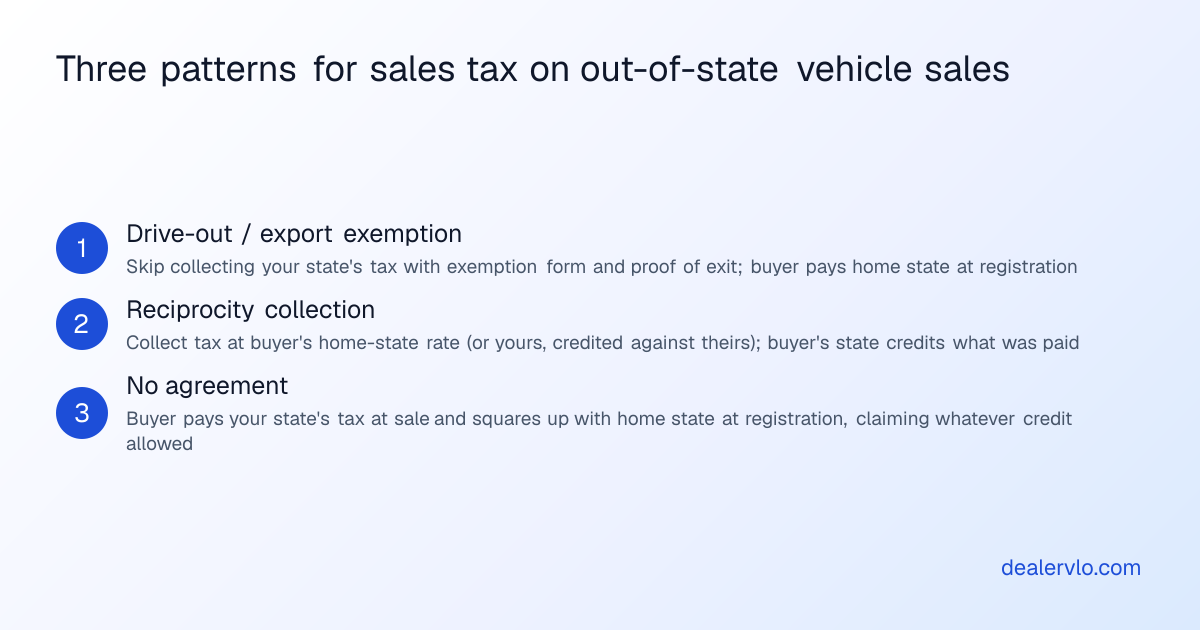
This is the one that costs money when you get it wrong. There are three broad patterns, and you need to know which pair of states you're dealing with:
- Drive-out / export exemption. Some states let you skip collecting your own state's tax when the vehicle is leaving immediately for registration elsewhere — usually with an exemption form and proof the car left. The buyer then pays their home state's tax at registration.
- Reciprocity collection. Some states have you collect tax at the buyer's home-state rate (or your rate, credited against theirs). The buyer's state then credits what was paid so they aren't taxed twice.
- No agreement. Worst case, the buyer pays your state's tax at sale and squares up with their own state at registration, claiming whatever credit their state allows.
Never quote an out-of-state deal until you've checked both ends. A buyer from a no-credit pairing who gets taxed twice will remember exactly one thing about your dealership. Call your state's tax line or check the department of revenue's dealer bulletin for the specific state pair — this is a ten-minute check that prevents a four-figure mistake.
Two examples from states we cover in depth: Virginia charges its 4.15% Motor Vehicle Sales and Use Tax with no trade-in credit, so a Virginia buyer's math differs from what a reciprocity table implies. And Georgia doesn't have vehicle sales tax at all — it has the 7% one-time TAVT collected at titling — so "tax paid at sale" means something different there.
2. How does the buyer drive it home legally?
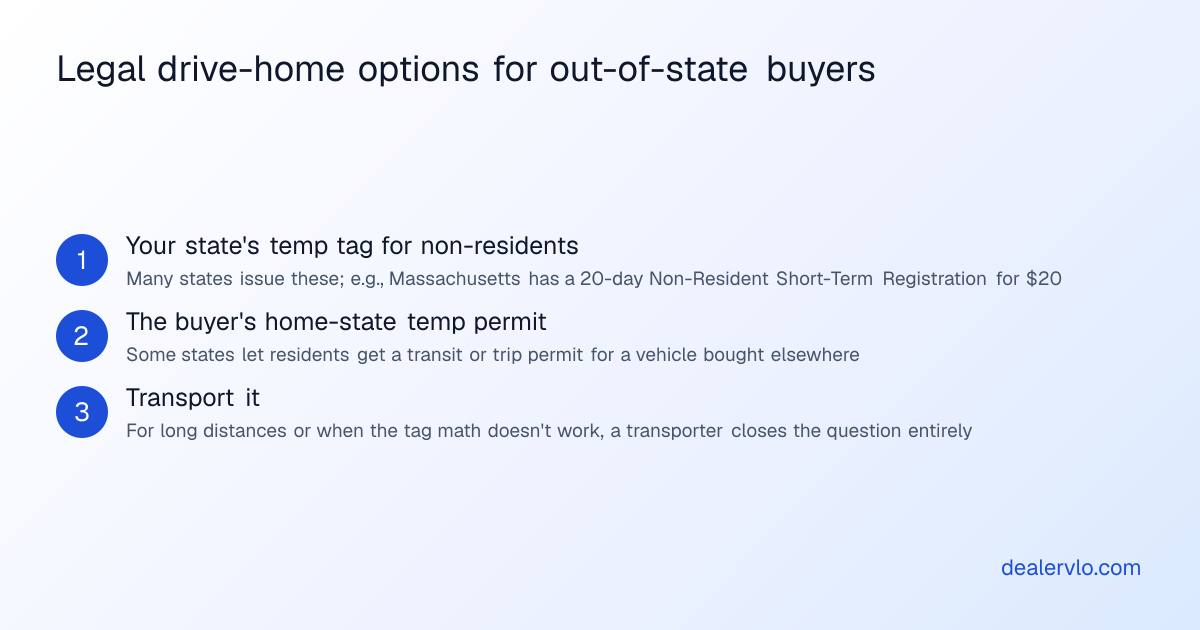
Your dealer plates are not the answer — those are for your dealership's use, not for sending a customer across three state lines. The options:
- Your state's temp tag for non-residents. Many states issue one. Massachusetts, for example, has a Non-Resident Short-Term Registration: $20 for a 20-day temporary plate specifically so an out-of-state buyer can drive the vehicle home and register it there.
- The buyer's home-state temp permit. Some states let their residents get a transit/trip permit for a vehicle bought elsewhere.
- Transport it. For long distances or when the tag math doesn't work, a transporter closes the question entirely — and for a flown-in buyer it's often cheaper than the flight home would suggest.
Whatever the path, confirm the buyer's insurance is bound on the new vehicle before it leaves. Their carrier can usually add it with a phone call from your desk.
Build the whole deal — price, tax on the right base, doc, title, minus trade and down — into the out-the-door number and the monthly payment.
Open the Out-the-Door Price Calculator3. Where does the title actually go?
On an in-state deal you know the routine. Out of state, map it before delivery:
- Cash deal: the assigned title generally travels with the buyer (or mails to them), and they file it with their home state's title application — a different form in every state. We keep field-by-field walkthroughs for the biggest ones in our title application forms index.
- Financed deal: the lender dictates title routing, and the lien gets recorded under the buyer's home state rules. Confirm with the lender which state's title work they expect and who submits it — some lenders want you to run the buyer's state paperwork, some handle it themselves.
14-day free trial, then $29/mo · Cancel anytime
4. What will their home state demand at registration?
The buyer will hit requirements you can't complete for them — but you can make sure the car and the paperwork survive them:
- VIN verification / inspection. Many states require a physical VIN inspection on any vehicle coming in on an out-of-state title. If the buyer's state does, tell them up front so it's an errand, not a surprise.
- Odometer disclosure done right. The federal disclosure on the assigned title must be complete and clean — an error that a familiar clerk might wave through at home becomes a rejection in a state where nobody knows you.
- Emissions/safety rules. A car that's exempt where you are may need a smog check or safety inspection where it's going. California-bound vehicles deserve special attention on emissions equipment.
5. Paper the file like it will be audited
Out-of-state deals are exactly the ones tax auditors pull, because they're where exemptions get claimed. Keep in the jacket: the bill of sale showing the buyer's out-of-state address, a copy of their license, the exemption or reciprocity form if you used one, proof of transport or the temp tag issued, and the odometer disclosure. If the vehicle "left the state," your file should prove it did.
6. Slow the deal down by one conversation
Every problem above is cheap before delivery and expensive after. My rule: the moment a buyer gives me an out-of-state address, the deal gets a five-minute detour — check the tax pairing, pick the drive-home path, confirm the title routing, and tell the buyer what their state will ask of them. Buyers don't mind. What they mind is a title stuck in limbo three weeks later.
The checklist
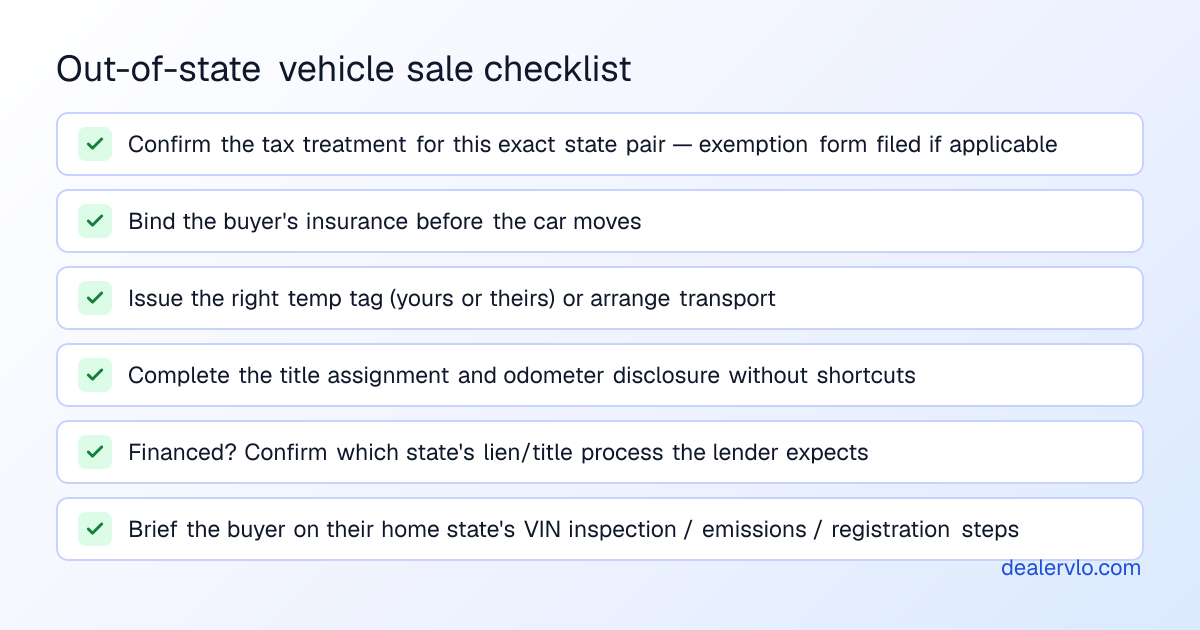
- Confirm the tax treatment for this exact state pair — exemption form filed if applicable.
- Bind the buyer's insurance before the car moves.
- Issue the right temp tag (yours or theirs) or arrange transport.
- Complete the title assignment and odometer disclosure without shortcuts.
- Financed? Confirm which state's lien/title process the lender expects.
- Brief the buyer on their home state's VIN inspection / emissions / registration steps.
- Copy everything into the deal jacket.
DealerVLO's deal jacket handles the parts software can handle — the bill of sale, odometer disclosure, and title paperwork for a growing list of states, printed filled from one deal record, with the buyer's out-of-state address carried through every document consistently. The five-minute conversation is still yours.
14-day free trial, then $29/mo · Cancel anytime