How Texas motor vehicle sales tax works on a dealer sale — and when SPV doesn't apply
Texas vehicle sales tax is 6.25% statewide. Subtract your trade-in value first—it cuts the taxable amount. For dealers: SPV doesn't apply.
Part of the Compliance, taxes & deal paperwork guide: What goes in a used-car deal jacket: the complete checklist
Switching from another DMS? Compare DealerVLO to DealerCenter, Frazer, or Lot Wizard.
If you run a used-car lot in Texas, motor vehicle sales tax is part of every single deal — and it's one of the things buyers ask about at the desk. Here's how it actually works on a dealer sale, including the trade-in credit that changes the math and the SPV rule that confuses everyone because it doesn't apply to you.
14-day free trial, then $29/mo · Cancel anytime
The Texas motor vehicle sales tax rate: 6.25%, statewide
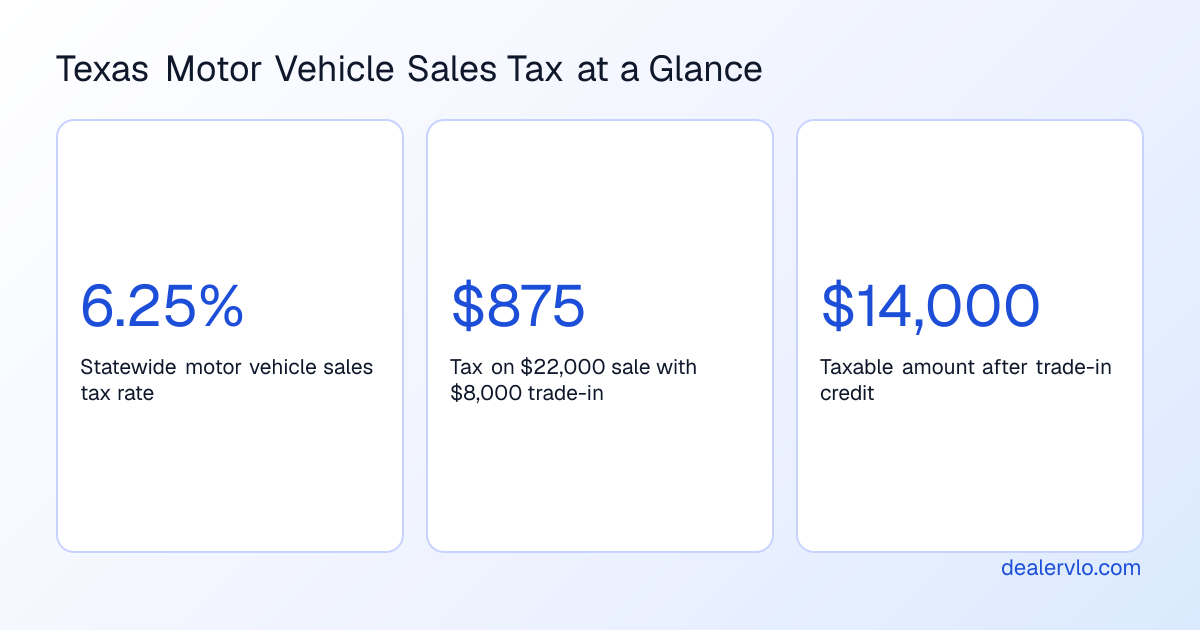
Texas charges 6.25% motor vehicle sales tax on vehicle sales. It's a state tax — unlike general sales tax, there's no local add-on rate stacked on top of a dealer vehicle sale. The 6.25% is the number, everywhere from El Paso to Beaumont.
Note the name: motor vehicle sales tax. It's a separate tax from the general sales and use tax you might collect on parts or accessories, with its own rules and its own remittance path.
The trade-in credit
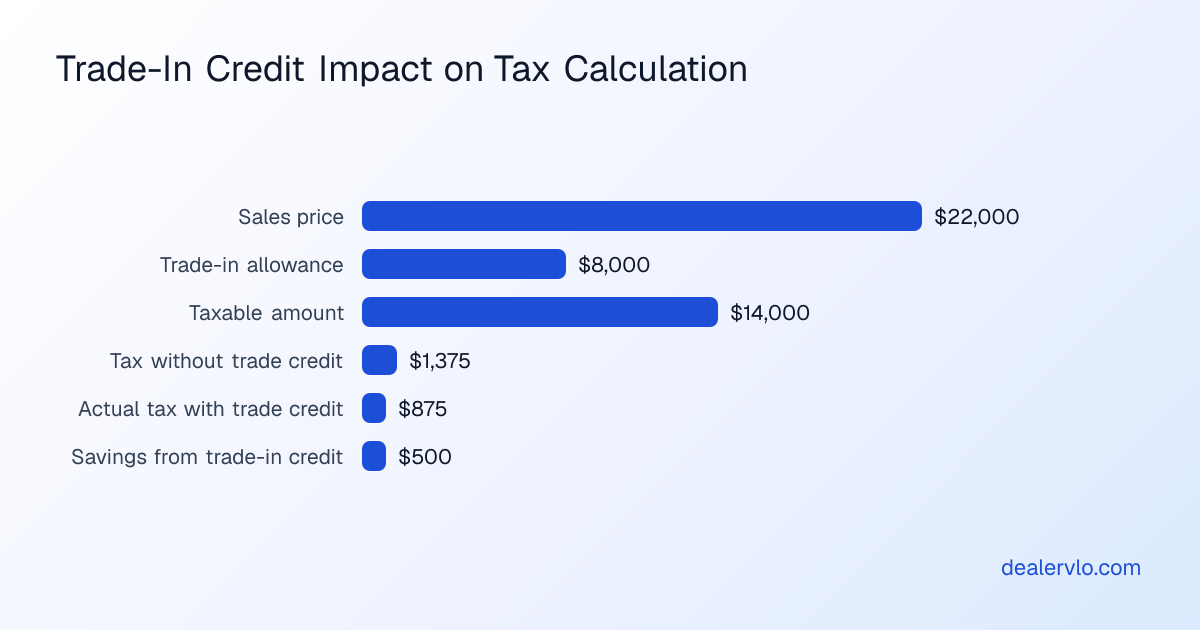
On a dealer sale, the tax is calculated on the sales price minus the trade-in allowance.
Say a customer buys a $22,000 truck from you and trades in a vehicle you allow $8,000 on. The taxable amount is $14,000 — so the tax is $875, not $1,375. That $500 difference is real money at the desk, and it's one of the honest advantages you have over a private-party sale.
Two details worth knowing:
- The credit applies to licensed dealer sales. That's you.
- If the customer trades down — their trade is worth more than the vehicle they're buying — no motor vehicle tax is due on the swap.
Build the whole deal — price, tax on the right base, doc, title, minus trade and down — into the out-the-door number and the monthly payment.
Open the Out-the-Door Price CalculatorSPV — the rule that doesn't apply to your deals
Texas has a Standard Presumptive Value (SPV) system: on private-party sales, tax is calculated on the higher of the sales price or a percentage of the vehicle's book value, so people can't title a $15,000 car "sold for $500."
Buyers walk in believing SPV applies everywhere. It doesn't. SPV applies to private-party sales, not licensed dealer sales. On your deals, the tax base is the actual sales price minus the trade-in — full stop. When a customer questions the tax line on your paperwork, that's the explanation.
14-day free trial, then $29/mo · Cancel anytime
How you remit it
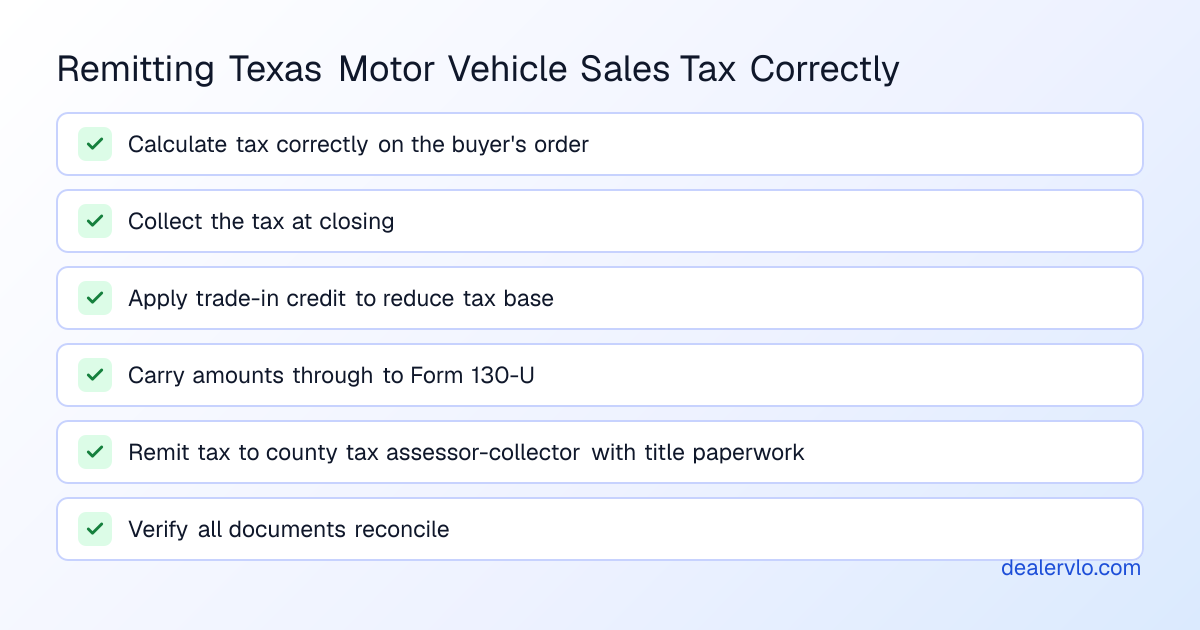
On a dealer sale of a vehicle with a gross weight of 11,000 pounds or less, the dealer collects the tax and remits it to the county tax assessor-collector (CTAC) when you file the title and registration paperwork — the same trip as your Form 130-U.
That means the tax lives inside your deal jacket: it has to be calculated correctly on the buyer's order, collected at closing, and carried through to the 130-U. Get the trade-in credit wrong on any of those documents and the numbers don't reconcile.
The short version
- 6.25%, statewide, on dealer sales
- Tax base = sales price minus trade-in allowance
- Trade-downs owe no tax
- SPV is for private-party sales — not your deals
- You collect it and remit to the county with the 130-U at title time
DealerVLO calculates Texas motor vehicle sales tax with the trade-in credit automatically on every deal — the buyer's order, the tax line, and the 130-U all agree because they come from the same numbers.
14-day free trial, then $29/mo · Cancel anytime