How to fill out the Form 130-U in Texas
A field-by-field walkthrough of the Texas Form 130-U (Application for Texas Title and/or Registration) for licensed used car dealers — what goes in every section, who signs what, and the documents you attach. Verified against the official form as of June 2026.
Don't waste another second filling out the Texas Form 130-U.
Let DealerVLO fill out every form for you instantly.
Filing these every week? DealerVLO fills the Form 130-U from the deal you already entered, $29/month flat. See pricing
Switching from another DMS? Compare DealerVLO to DealerCenter, Frazer, or Lot Wizard.
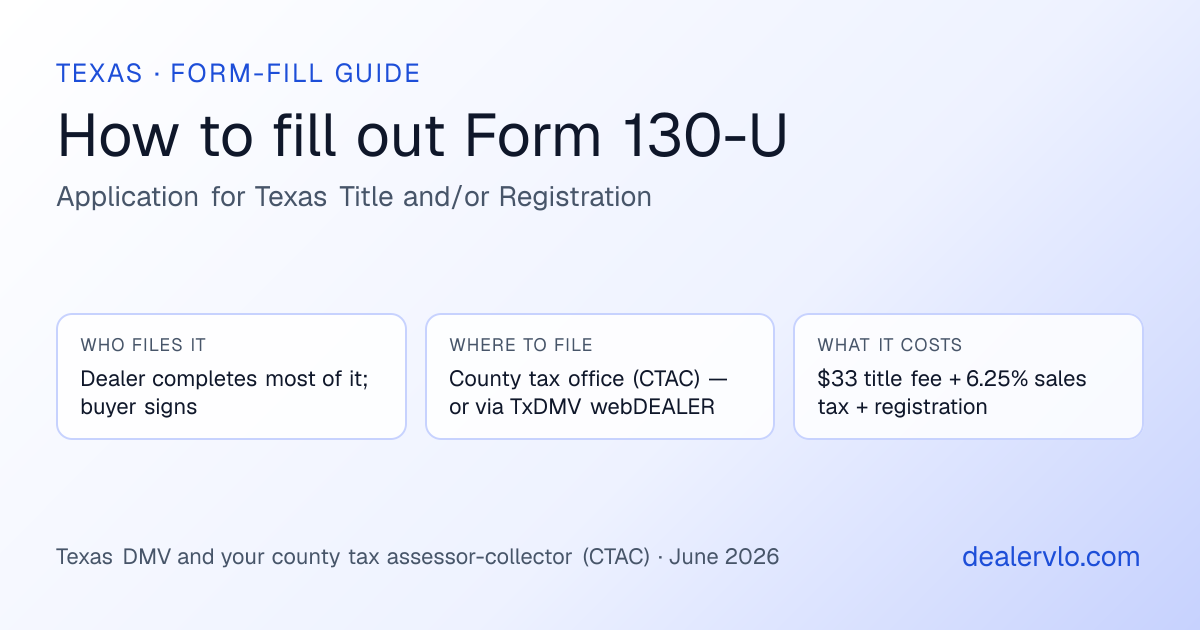
Filling out the TX Form 130-U after a sale:
- What it is
- Texas's combined vehicle title + registration application
- Who completes it
- Dealer completes most of it; buyer signs
- Where to file it
- County tax office (CTAC) — or via TxDMV webDEALER
- Processing time
- Plates same day; title processed in ~2–3 weeks
- Cost
- $33 title fee + 6.25% sales tax + registration
This guide is informational and does not replace the official Texas instructions. Always confirm the current form and procedure with the Texas DMV and your county tax assessor-collector (CTAC) before you file.
See the TX Form 130-U filled — from just a VIN
Enter a VIN, the buyer's name, and the price. We decode the vehicle and drop it onto the actual Texas Form 130-U — the same fill DealerVLO produces from a deal. Watermarked preview; nothing is saved.
What the Form 130-U is and why it matters
Form 130-U is how a vehicle gets titled and registered in Texas. As a licensed dealer, you complete it for the buyer and submit it — with the assigned title and the tax and fees — to the buyer's county tax assessor-collector (CTAC). Until it's filed, the buyer doesn't legally own a titled, registered vehicle.
Texas gives the dealer (and the buyer) 30 calendar days from the date of sale to file. Miss that window and the buyer eats penalties. Many Texas dealers now file electronically through TxDMV's webDEALER system instead of walking paper to the county, but the data on the 130-U is the same either way — this guide walks every field a dealer fills.
Form 130-U is the standard application used to title and register a vehicle in Texas. TxDMV revises it periodically and publishes companion line-by-line instructions as Form VTR-130-UIF — if your form's revision date differs from the one referenced here, follow the field labels rather than the numbers, since TxDMV occasionally renumbers fields between revisions.
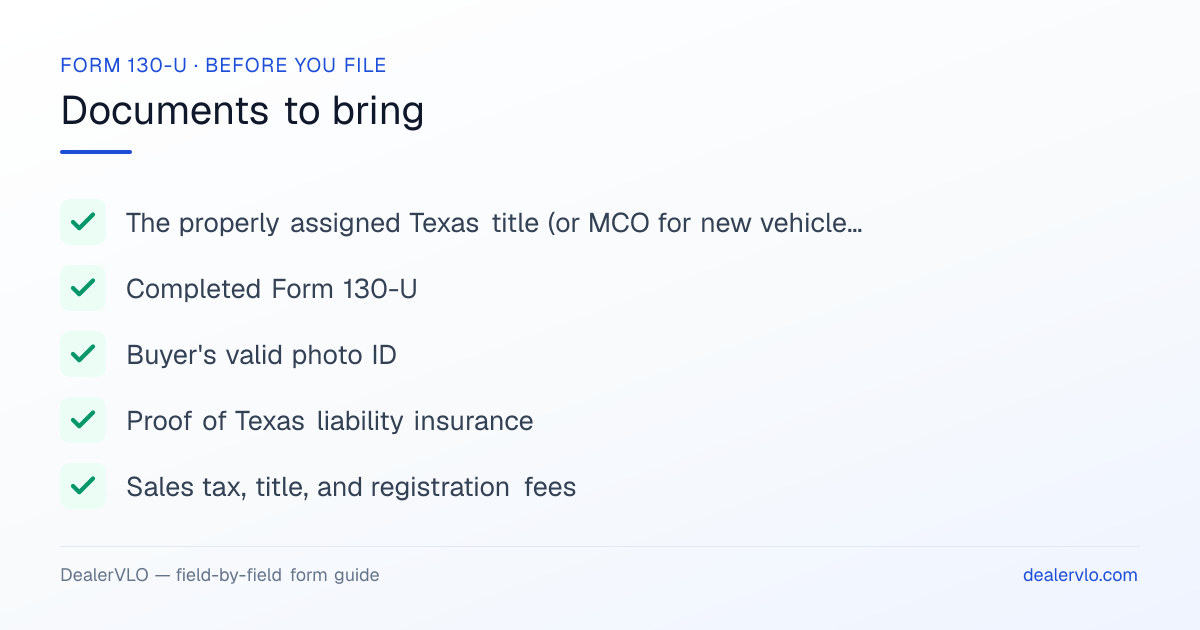
Documents to have before you start
Gather these before you complete the Form 130-U. A missing attachment is the number-one reason the the Texas DMV and your county tax assessor-collector (CTAC) bounces a title application back.
- The properly assigned Texas title (or MCO for new vehicles) — Front-and-back complete, including the federal odometer disclosure and your dealer reassignment if the vehicle passed through your inventory.
- Completed Form 130-U — One per vehicle, signed by both you (the selling dealer) and the buyer.
- Buyer's valid photo ID — Texas DL/ID or other acceptable identification; the ID number goes on the application.
- Proof of Texas liability insurance — Required before the vehicle can be registered — shown at the county office, not stamped on the form.
- Sales tax, title, and registration fees — Remitted to the county tax assessor-collector (CTAC) at the time of titling.
- Lienholder name + Certified Lienholder ID, if financed — Required so the title records the lien and routes correctly.
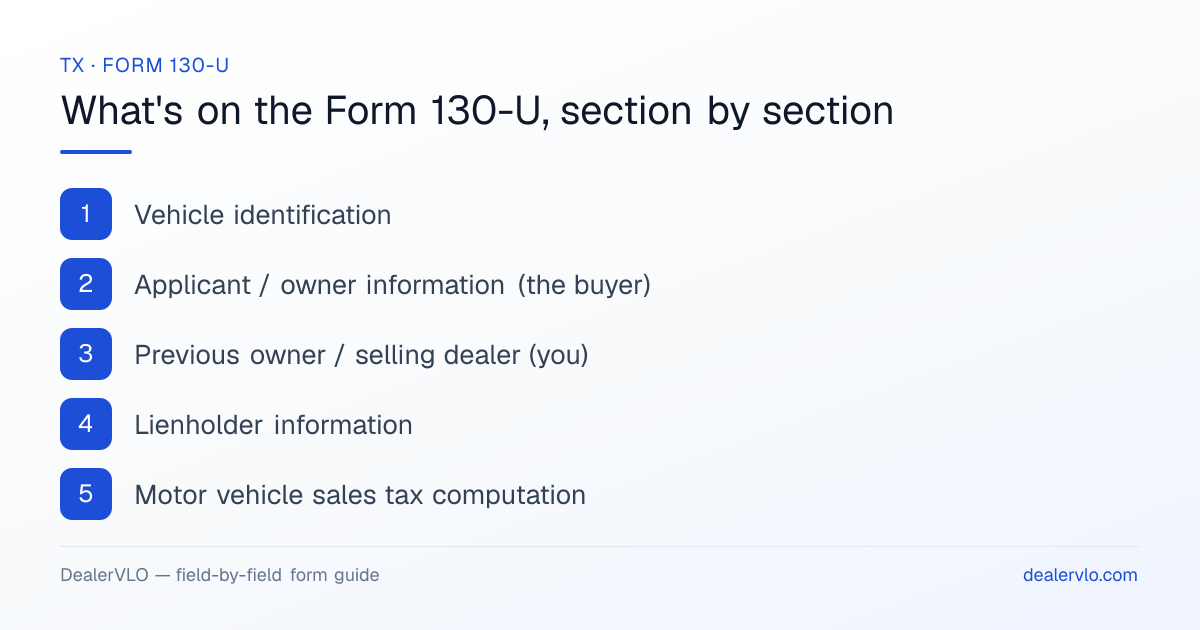
Form 130-U, section by section
Vehicle identification
The block that identifies the car. Most of it comes off the assigned title — verify the VIN character-for-character against the title and the vehicle, because a single wrong digit is the most common rejection.
| Field | Who fills it |
|---|---|
Vehicle Identification Number (VIN) Match the title and the vehicle exactly. | You (dealer) |
Year, Make, Model, Body Style Body style uses TxDMV codes (e.g. 4D, PK, CP). | You (dealer) |
Major and Minor color | You (dealer) |
Odometer reading (no tenths) + brand Whole miles; mark Actual, Not Actual, or Exceeds Mechanical Limits to match the title disclosure. | You (dealer) |
Empty weight / carrying capacity Required for trucks and certain vehicles. | You (dealer) |
Texas license plate number Only if plates are being transferred. | You (dealer) |
Applicant / owner information (the buyer)
This is the new owner — the buyer — not your dealership. Enter the legal name and Texas address exactly as they appear on the buyer's ID. A second buyer goes in the additional-applicant fields, with the ownership connector ("and" / "or") set correctly.
| Field | Who fills it |
|---|---|
Applicant's legal name (Owner 1) From the buyer's ID — match it exactly. | You (dealer) |
Additional applicant (Owner 2) Only if there's a co-buyer; set the "and/or" ownership connector. | You (dealer) |
Applicant ID type and number Texas DL/ID or other acceptable ID. | Buyer |
Applicant mailing address | You (dealer) |
Vehicle physical/residential address Determines the county of registration. | You (dealer) |
Registrant (if different from owner) | You (dealer) |
Previous owner / selling dealer (you)
Where you identify yourself as the selling dealer. The GDN is mandatory for a dealer sale — leaving it off is a fast rejection.
| Field | Who fills it |
|---|---|
Previous owner name + city/state Your dealership as the selling entity. | You (dealer) |
Dealer GDN (General Distinguishing Number) Required on every dealer sale. | You (dealer) |
Date of sale Starts the 30-day filing clock. | You (dealer) |
Lienholder information
Cash deal? Leave this blank. Financed? Record the lender so the lien prints on the title and the title routes to the right place.
| Field | Who fills it |
|---|---|
First lienholder name Blank for a cash sale. | You (dealer) |
Certified Lienholder ID number | You (dealer) |
Lienholder mailing address | You (dealer) |
Additional liens / electronic title request Check if applicable. | You (dealer) |
Motor vehicle sales tax computation
The part dealers get wrong most often. Texas motor-vehicle sales tax is 6.25% of the sales price minus any trade-in allowance and dealer discounts. Standard Presumptive Value (SPV) does NOT apply to licensed-dealer sales — that's only for private-party and out-of-state purchases. Use your actual sales price.
| Field | Who fills it |
|---|---|
Sales price The actual price — must match your buyer's order / contract. | You (dealer) |
Trade-in description (year/make/VIN) + allowance Subtracted from the sales price before tax. | You (dealer) |
Fair Market Value deduction + GDN/Lessor number Lessors/rental only — usually N/A for a retail sale. | You (dealer) |
Taxable amount Sales price − trade-in − discounts. | You (dealer) |
6.25% motor vehicle sales tax | You (dealer) |
Late-tax penalty (if filed after 30 days) 5% of tax if 1–30 days late, 10% after. | You (dealer) |
Tax remitted to the county (CTAC) Collected at titling and remitted by the dealer. | At the counter |
TX Sales tax & title fee calculator
Free · no signup · updates as you type
Dealer sale: 6.25% of the sales price less trade-in. Standard Presumptive Value (SPV) does not apply to licensed-dealer sales — use your actual price. Title fee ~$33 (varies by county); registration runs roughly $50.75 base for a passenger vehicle plus local fees. Informational only; the county tax office (CTAC) collects the final amount.
Stop re-keying this onto the Form 130-U.
DealerVLO runs this math on every deal and drops it — with the VIN, buyer, and sale price — straight onto the official TX Form 130-U, the bill of sale, and the FTC forms. One screen, no re-keying.
14-day free trial — no charge until day 14, then $29/month. Cancel any time.
Certification and signatures
Both parties certify the application under penalty of law. Don't pre-sign — the buyer signs as the new owner and you sign as the selling dealer when the deal closes.
| Field | Who fills it |
|---|---|
Seller / dealer signature + date | You (dealer) |
Applicant / owner signature(s) + date | Buyer |
The Form 130-U is one car's paperwork. A 20-second read on your lot, and the tax-and-fee math for the whole deal — built for dealers, no signup. Free calculators dealers actually use — no signup, no email.
DealerVLO fills the official Texas Form 130-U straight from your deal — VIN-decoded vehicle, buyer, co-buyer, and sale price already in place. $29/month, free to try — cancel any time.
Common Form 130-U mistakes that cause rejections
SPV applies to private-party and out-of-state purchases — not licensed-dealer sales. As a dealer you compute 6.25% on your actual sales price (less trade-in and discounts). Entering an SPV figure overstates or understates the tax and flags the application.
Texas taxes the sales price minus the trade-in allowance. If the buyer traded a vehicle, enter its description and allowance so tax is computed on the net — omitting it overcharges the buyer.
Your dealership's General Distinguishing Number must appear in the selling-dealer block on every dealer sale. A blank or wrong GDN gets the application bounced.
The VIN and odometer reading on the 130-U must match the assigned title and the vehicle. Verify all three against each other before filing.
Texas requires the title/registration application to be filed within 30 calendar days of the sale. Late filing adds a transfer penalty plus a sales-tax penalty (5% if 1–30 days late, 10% after). File on time — or submit through webDEALER to speed it up.
Title and registration are processed by the county tax assessor-collector for the buyer's county of residence. Filing in the wrong county delays the title.
Common questions
Is Form 130-U the same as the Texas title application?+
Yes. Form 130-U is the Application for Texas Title and/or Registration — the single form used to title and register a vehicle in Texas. TxDMV publishes companion line-by-line instructions as Form VTR-130-UIF.
Who fills out Form 130-U — the dealer or the buyer?+
On a dealer sale, the dealer completes most of the form: the vehicle identification, the buyer's owner information, the selling-dealer block with the GDN, the lien information, and the sales-tax computation. The buyer provides their ID number and signs as the new owner. Both parties sign the certification.
How is sales tax calculated on a 130-U for a dealer sale?+
Texas motor-vehicle sales tax is 6.25% of the sales price, less any trade-in allowance and dealer discounts. For example, a $20,000 vehicle with a $5,000 trade-in is taxed on $15,000, or $937.50. Standard Presumptive Value (SPV) does not apply to licensed-dealer sales — use your actual sales price.
How long does a Texas dealer have to file the 130-U?+
Within 30 calendar days of the date of sale. After that, the buyer owes a transfer penalty plus a sales-tax penalty — 5% of the tax if 1–30 days late, and 10% if more than 30 days late. Filing through webDEALER helps dealers meet the deadline.
Can I file Form 130-U electronically?+
Yes. TxDMV's webDEALER system lets licensed dealers submit title and registration applications electronically to the county, print temporary tags, and track the title — instead of carrying paper 130-U forms to the county tax office. The information captured is the same as the paper form.
Do I still need a Texas safety inspection to register?+
Texas ended the annual safety inspection requirement for non-commercial vehicles on January 1, 2025. An inspection program replacement fee is now collected at registration instead. Emissions testing is still required in certain counties. Confirm current county requirements before you register.
What does it cost to title and register a vehicle in Texas?+
Expect a title application fee of about $33 (varies by county), the 6.25% motor-vehicle sales tax on the taxable price, and registration fees (roughly $50.75 base for a passenger vehicle plus local and processing fees). The county tax assessor-collector collects all of it at titling.
Is there software that fills out the Form 130-U automatically?+
Yes. Dealer management software like DealerVLO fills the Texas Form 130-U from the deal you already entered — the VIN-decoded vehicle, buyer, co-buyer, lienholder, and sale price are placed for you instead of hand-writing them. For most states that's the official DMV form itself; where a state issues its form only through its own dealer portal, you get a print-ready worksheet with every value already in place. It's $29/month flat with a 14-day free trial, and the same deal also generates your federal documents (Bill of Sale, FTC Buyers Guide, odometer disclosure) and any other state's title forms.
- How to get a used car dealer license in Texas
- How to fill out the Massachusetts RMV-1
- All dealer guides
- Texas dealer plates
- E-signatures and e-titling for Texas dealers
- How Texas car sales tax works on a dealer sale
- Texas rebuilt vehicle statement (VTR-61)
- Title application forms in every state
- How much is a dealer's license? Cost in every state
Stop filling out the Form 130-U by hand.
DealerVLO fills the official TX Form 130-U straight from your deal jacket — VIN-decoded vehicle, buyer, co-buyer, lienholder, and sale price already in place. Print, sign, and file in about 90 seconds. $29/month. 14-day free trial, cancel any time.
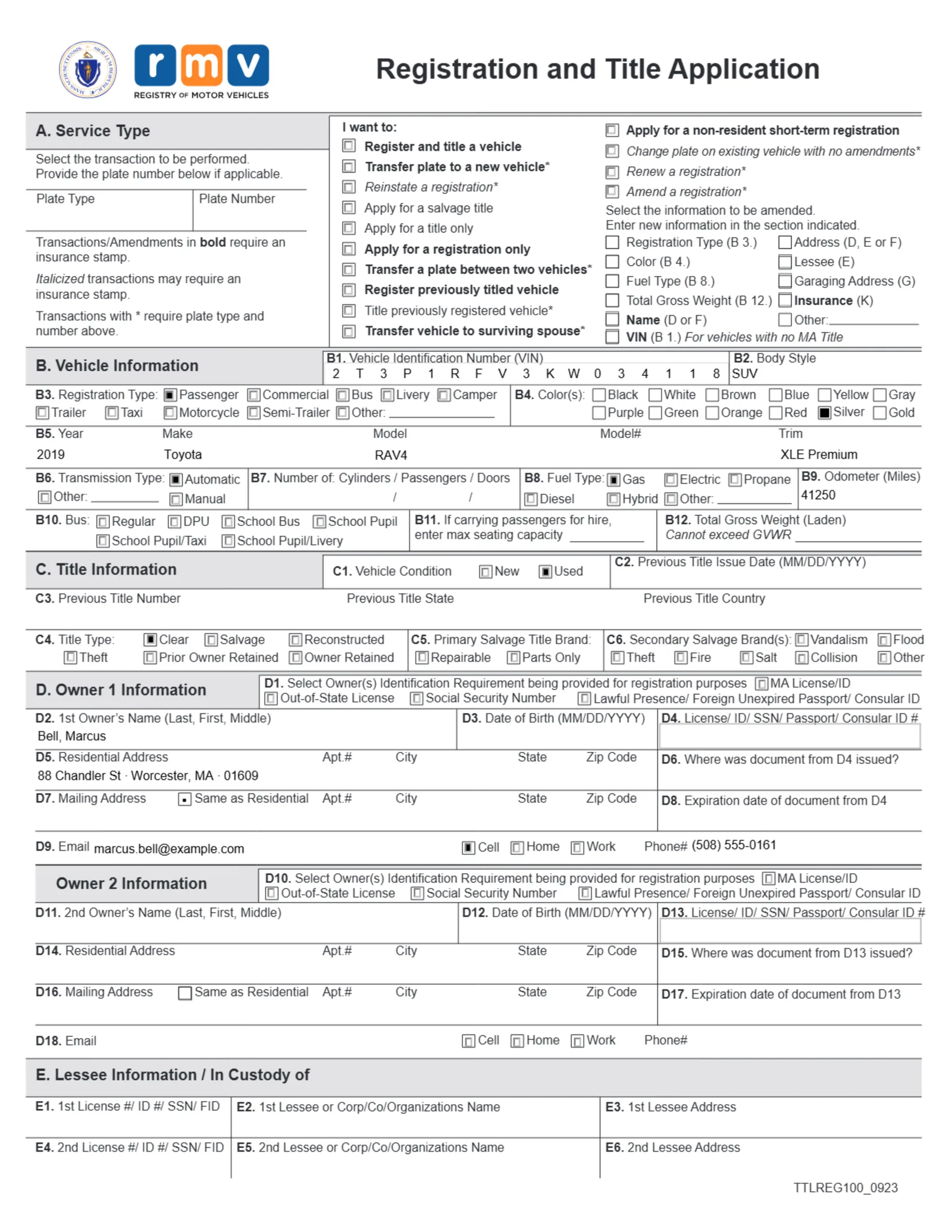
Curious how it works? See how DealerVLO auto-fills every dealer document — bill of sale, FTC Buyers Guide, odometer disclosure, and state title & registration forms for all 50 states, from one deal.
Bond amounts, fees, and form rules change. Get a short email when your state does. No spam, unsubscribe anytime.