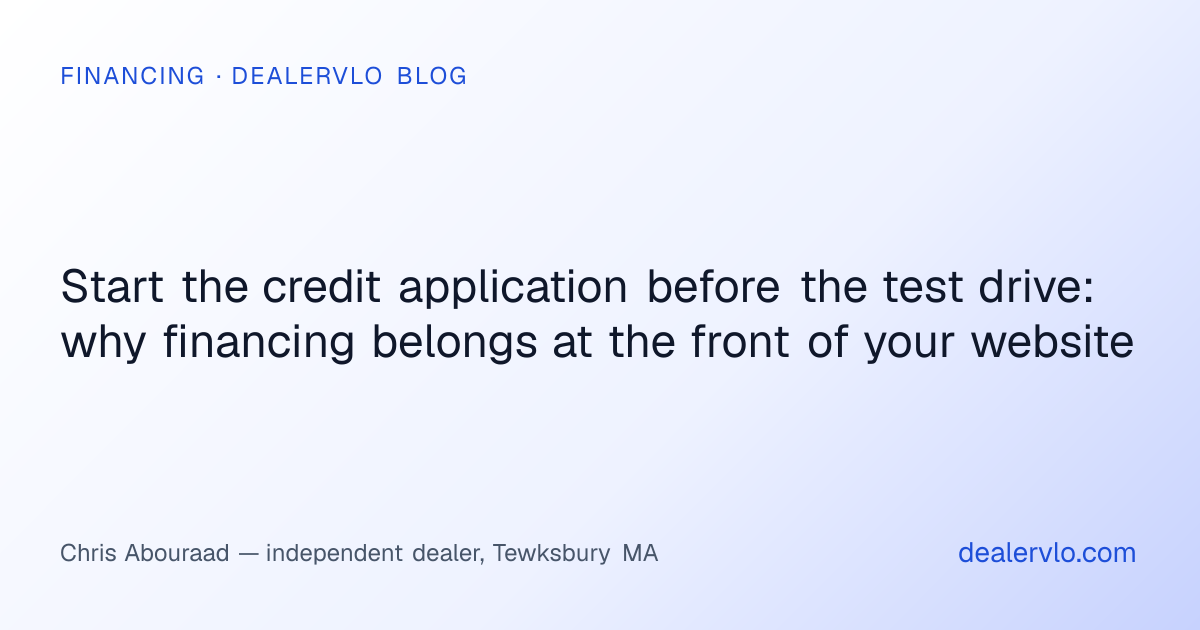
Start the credit application before the test drive: why financing belongs at the front of your website
Why used-car dealers should start financing before the customer walks in, what an online credit application should collect, and how to handle it safely.
Every dealer has lived this one. A shopper falls for a car on your lot, you spend an hour on the walkaround and the test drive, and then the credit comes back. They can't get approved for that car. Now you're either trying to talk them into something they didn't pick or watching them leave embarrassed, and you've burned the hour either way.
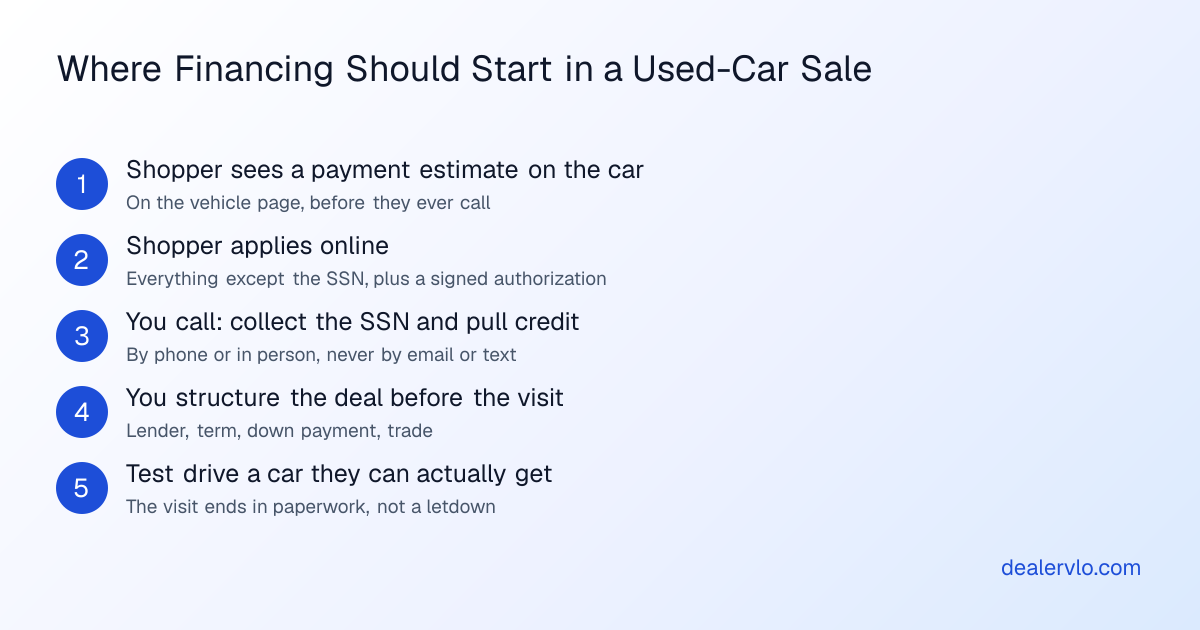
The fix isn't a better closing line. It's moving financing to the front of the sale, before the test drive and ideally before the visit, so the car you show is a car they can buy. Here's why that matters, where financing should show up on your website, what an online credit application should and shouldn't collect, and how to handle it without creating a data-security problem you don't need.
On most independent lots, financing decides the sale
A large share of used-car buyers finance, and on many independent and buy-here-pay-here lots it's most of them. For those buyers, the car they end up in isn't decided by what they like. It's decided by what they can be approved for: the lender, the payment, the down payment, and the term.
That makes financing the real qualifier. Until you know it, you're guessing. You can have a great conversation about a car the buyer will never be approved for, and a buyer with a thin file can walk past three cars that would have worked because nobody told them.
What you get by starting financing early
You stop test-driving cars they can't buy. When you know roughly what a buyer qualifies for, you steer the visit toward cars that fit. That's better for them, too: nobody enjoys getting told no after they've pictured themselves in the car.
You structure the deal before they arrive. With an application in hand, you can work out the lender, the down payment, and the term ahead of the visit, so the conversation at your desk starts from a real number. How to structure a deal from a monthly payment walks through that math.
Work backward from a customer's monthly payment to the highest vehicle price you can structure.
Open the Deal Structuring CalculatorYou learn about the down payment and the trade early. An application asks for both. If the buyer is planning on a trade that's upside down, you want to know on Tuesday, not at the desk on Saturday.
The visit is shorter. When the credit work is done before they show up, their time at the dealership goes to the car and the paperwork, not waiting on a decision.
You hear from the serious buyers first. Someone who fills out a credit application has told you they're ready to move. Those are the leads to call back fast.
14-day free trial, then $29/mo · Cancel anytime
Where financing should show up on your website
Shoppers don't go looking for your financing page. They look at cars. So financing has to meet them on the car:
- On every vehicle page. A payment estimate next to the price, with a button to apply for that car. That's the moment the question "can I afford this?" is on their mind.
- In your site menu. A Financing page one click from anywhere.
- On your homepage. A short section that says what you do: all credit types, how to apply, what happens next.
In DealerVLO, this is built into the dealer website that comes with your account. Every priced vehicle page shows a monthly payment estimate (clearly labeled as an estimate) with a button that takes the shopper to your Financing page with that car attached. The Financing page has its own switch in Settings, so a cash-only lot can turn it off and every financing link disappears with it. If you're still deciding whether a website is worth it at all, do car dealers need a website? covers that question.
What an online credit application should collect
A good application collects what a lender will ask for, so your follow-up call is about the deal, not about gathering basics:
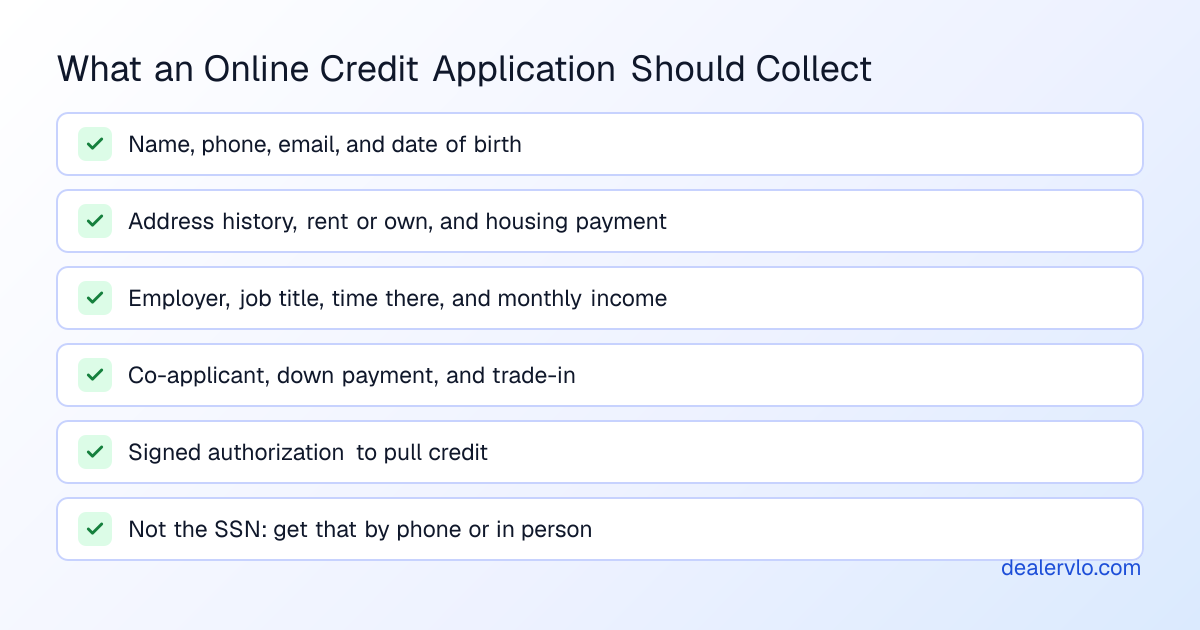
The signed authorization matters. It's the applicant's written permission for you to pull their credit for this application, and you want it in writing before you do. Ask your compliance advisor what your lenders and your state expect it to say.
Why we leave the Social Security number off the online form
DealerVLO's online credit application collects everything above and does not ask for a Social Security number or a driver's license number. That's a deliberate choice, for two reasons.
First, the SSN is the most damaging piece of information to lose. A form that never collects it can't leak it. Second, it's the biggest thing you can ask of a shopper who has never met you. Asking for it on a website before there's any relationship is a lot to ask.
So the flow is: the shopper applies online with everything except the SSN, and the application tells them up front that you'll ask for it in person or by phone, never by email or text. You call, you collect it, and you pull credit through your lender or credit portal the way you already do. That call is also the moment you start building the relationship, which is where deals actually get made.
Treat applications like the most sensitive thing you store
Even without an SSN, a credit application holds a date of birth, an address history, an employer, and an income. If your dealership arranges financing, the FTC's Safeguards Rule covers how you protect that kind of customer information. We covered what that rule asks of dealers in the FTC Safeguards Rule and your dealer software. In practice, it comes down to a few habits:
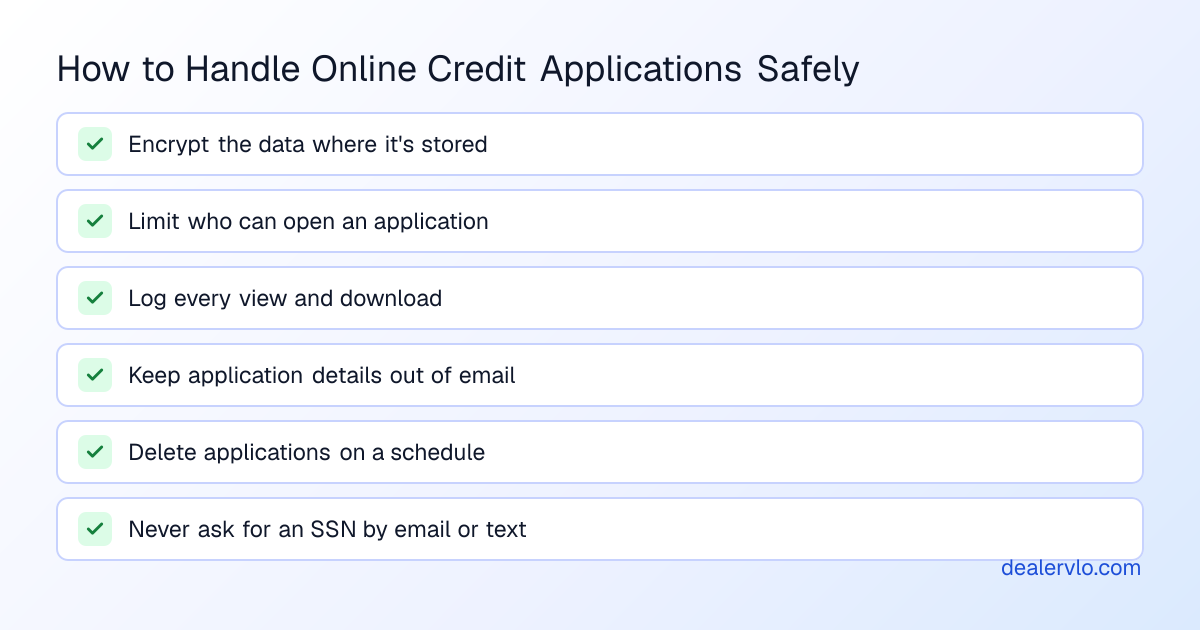
Here's how DealerVLO handles each of those. Applications are encrypted with their own key. Only owners, admins, and finance managers can open one; sales staff see that it came in, not what's in it. Every view and every PDF download is logged. The new-application email tells you someone applied, but never includes their details. And each application is deleted automatically after 25 months. When you're ready to work the deal, the application prints as a clean PDF with a blank SSN line to fill in at the desk. None of that replaces your own obligations under the rule, but it means the software isn't the weak spot.
14-day free trial, then $29/mo · Cancel anytime
The follow-up is where the deal is won
An application sitting in an inbox is worth nothing. The value is in what you do in the next hour:
- Call quickly. They applied because they're ready. Call while they're still thinking about the car.
- Collect the SSN on the call and pull credit through your usual lender or credit portal.
- Come back with a structure: what they're approved for, the payment, and what down payment gets them there.
- Invite them in to drive a car that fits. If the car they applied for doesn't work, have two that do.
In DealerVLO, the application arrives as a lead marked "credit application." When the buyer's ready, "Convert to deal" starts the deal with their name, address, and date of birth already filled in, so you're not retyping what they already gave you. If you run buy-here-pay-here, how BHPH dealers decide who to approve covers the underwriting side, and how to handle test drives and closing in person picks up once they're on the lot.
Not every lot needs the full application
If you don't want to handle full applications yet, a short pre-qualification form is a reasonable middle ground: name, contact details, budget, down payment, and employment, with no sensitive data. It still gets the financing conversation started early. DealerVLO's Financing page uses that shorter form until you turn the full application on. And if you don't offer financing at all, turn the Financing page off rather than inviting questions you can't answer.
Frequently asked questions
Should a used car dealer have an online credit application?
If you arrange financing, yes. A shopper who fills out an application before visiting has told you they're serious, and it lets you find out what they can be approved for before anyone test-drives a car. You spend the visit on cars they can actually buy, and you can have the deal structure ready when they arrive. If you're a cash-only lot, skip it and keep financing off your website.
Is it safe to take credit applications on my dealer website?
It can be, if the information is handled like the sensitive financial data it is. That means encrypting it where it's stored, limiting who at the dealership can open it, keeping it out of email, and deleting it on a schedule. Dealers who arrange financing are covered by the FTC's Safeguards Rule, so how you store this data is your responsibility, not just your software vendor's. Check your specific obligations with your compliance advisor.
Why doesn't DealerVLO's online credit application ask for a Social Security number?
Because a Social Security number is the most damaging thing to lose and the biggest thing to ask of a shopper who hasn't met you yet. The online form collects everything else a lender asks for, plus the applicant's signed authorization, and the dealer gets the SSN by phone or in person before pulling credit. The applicant is told up front that the dealership will never ask for it by email or text.
When should I run credit: before or after the test drive?
Before, whenever you can. Once you know roughly what a buyer can be approved for, you can steer the test drive toward cars that fit that approval instead of the one they'll fall in love with and can't get. With an online application, the call to collect the SSN and pull credit happens before the visit, not after it.
Can I turn off financing on my dealer website?
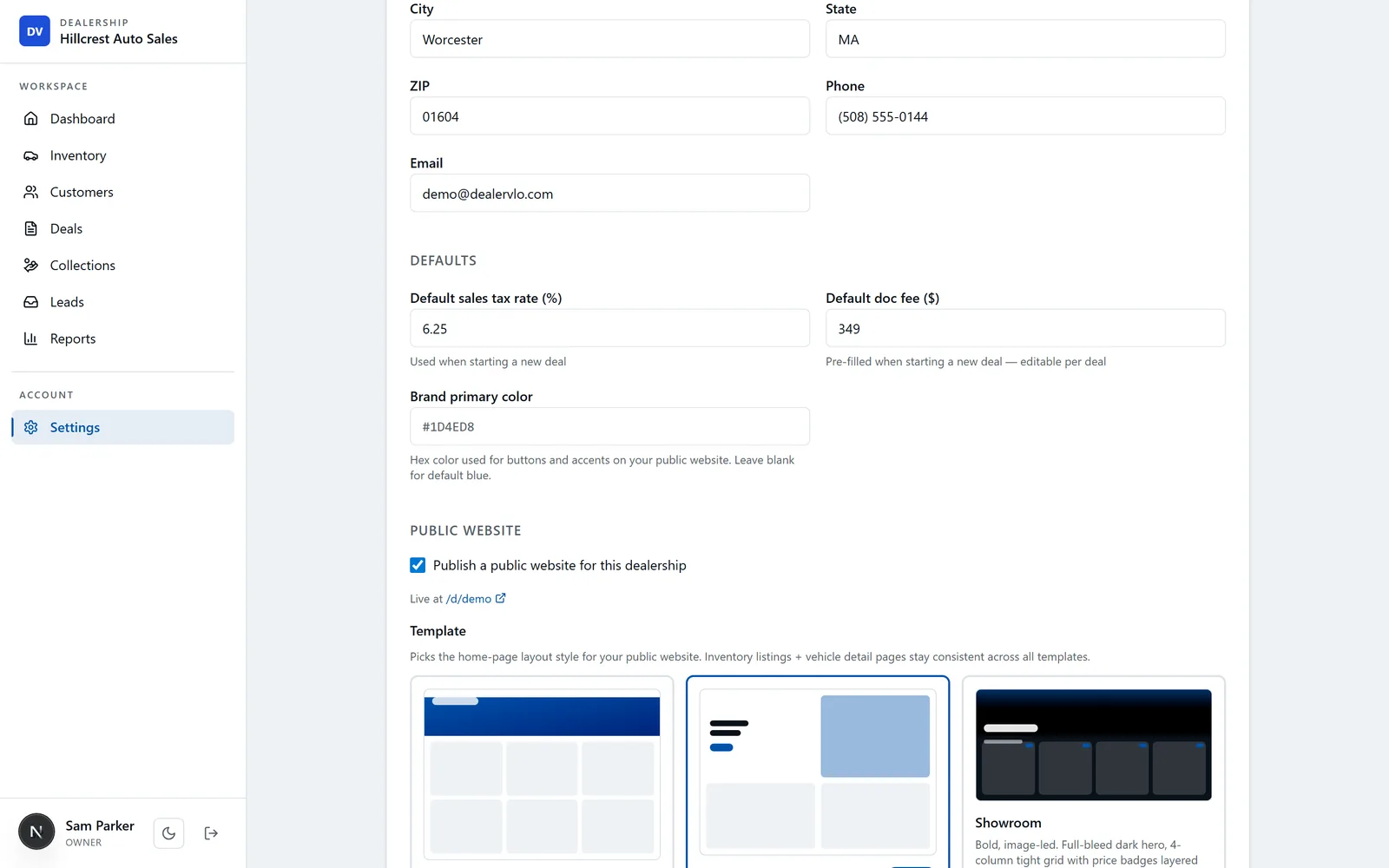
In DealerVLO, yes. The Financing page has its own on/off switch in Settings. Turning it off removes the page, the menu link, the homepage financing section, and the financing button under each vehicle's payment estimate. The online credit application is a separate switch that only works while the Financing page is on.
Bottom line
Financing decides most used-car sales, so find out where a buyer stands before the test drive, not after. Put a payment estimate and an "apply" button on every car, take the application online without asking for the SSN, call fast, and have the deal structured before they arrive.
DealerVLO puts the payment estimator, the Financing page, and a secure online credit application on the dealer website that comes with every account, for $29 a month flat. Start a free trial and turn it on in Settings → Financing.