Do you actually need a dealer website, or is Marketplace enough?
The honest answer for small lots: when Facebook Marketplace alone genuinely carries you, the five signs it's costing you deals, and what a website changes.
Part of the Marketing, leads & your website guide: Used Car Dealer Marketing: What a Small Lot Should Do First — and What to Skip
Switching from another DMS? Compare DealerVLO to DealerCenter, Frazer, or Lot Wizard.
Here's a question I take seriously because the people asking it aren't lazy — they're busy: "Marketplace sells my cars. Why would I pay for a website?"
It deserves a straight answer, not a sales pitch. So: there really is a stage where Marketplace alone carries a lot. There's also a line — earlier than most dealers think — where Marketplace-only starts quietly costing deals you never see. This post is about where that line is.
14-day free trial, then $29/mo · Cancel anytime
The honest case for Marketplace-only
A new lot moving a handful of sub-$10k cash cars to local buyers doesn't have a distribution problem Marketplace can't solve. It's the highest-volume free channel in the business, the buyers are real, and the cars move. If that's where you are, spending this month's energy on photos and the Marketplace playbook beats spending it on a website project. No shame in that stage — every lot passes through it.
The mistake isn't being there. It's building there — treating a rented channel as the foundation.
Rented land, and the day the rules changed
The clearest evidence isn't hypothetical. In 2021, Meta shut off the partner feeds that put dealer inventory into Marketplace. Then on January 30, 2023, it ended vehicle listings from business Pages entirely, and trade press reported the existing ones were removed. Dealers who'd built their pipeline on that channel had to start over; today the options are paid ads or posting car by car from a personal profile, as the Marketplace guide covers in detail.
That's not a knock on Meta — it's their platform, and it's still a great channel. It's the nature of every rented channel: the rules, the reach, and the price can change without asking you. Listings expire. Conversations live in their inbox. The history you build there belongs to the platform, not the lot. None of that matters much — until it's your only channel.
What the website actually does
Not "credibility" in the abstract — five concrete jobs:
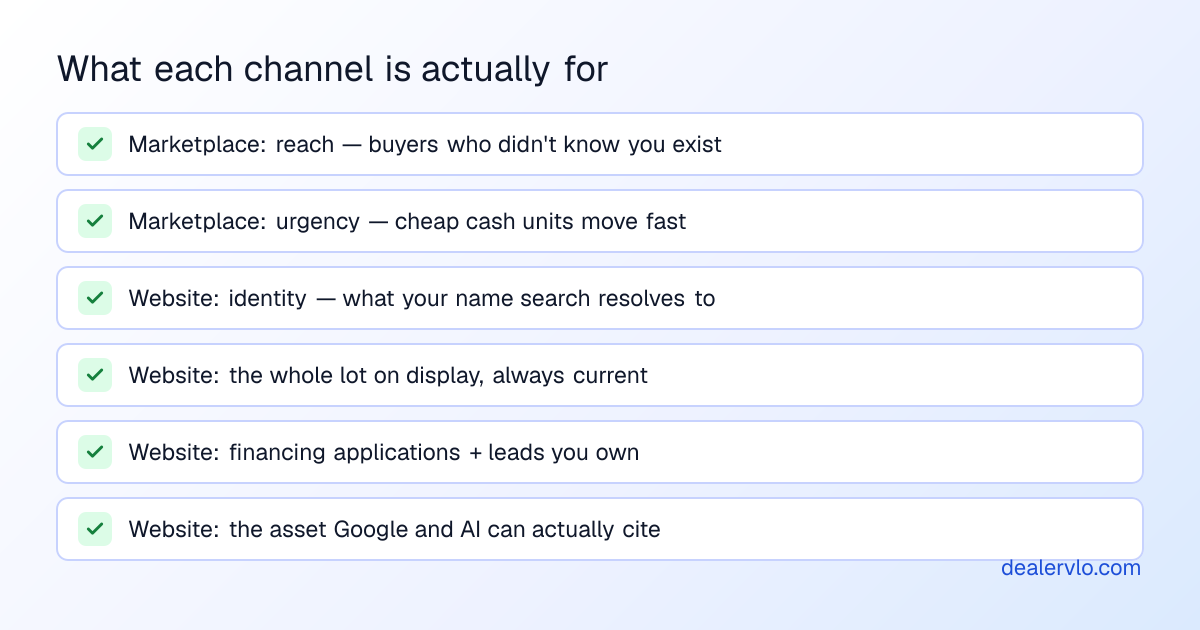
It's what your name resolves to. A Marketplace buyer who likes your car does the same thing every buyer does before driving forty minutes: Googles the dealership's name. What they find — a real site with your inventory, or a void — decides whether the trust you built in chat survives the search.
It's where your other free channels point. Your Google Business Profile earns the click; the website catches it. Your local SEO and the AI assistants that recommend dealers can only cite something that exists on the open web. Marketplace listings are invisible to all of it.
It shows the whole lot. Marketplace is one-listing-at-a-time; the site is your front line in one view, current the moment inventory changes — which is also what turns a one-car inquiry into a two-car conversation.
It takes the financing buyer. A secure credit application on your own domain is the difference between "come by and we'll see" and a finance-ready lead in your inbox. There's no Marketplace version of that.
It compounds. This is the quiet one. Every Marketplace listing resets to zero when it expires. A website's pages age upward — every month of existence builds the search history that makes month twelve better than month one. Rented channels rent reach; the owned channel accrues it.
The signs you've crossed the line
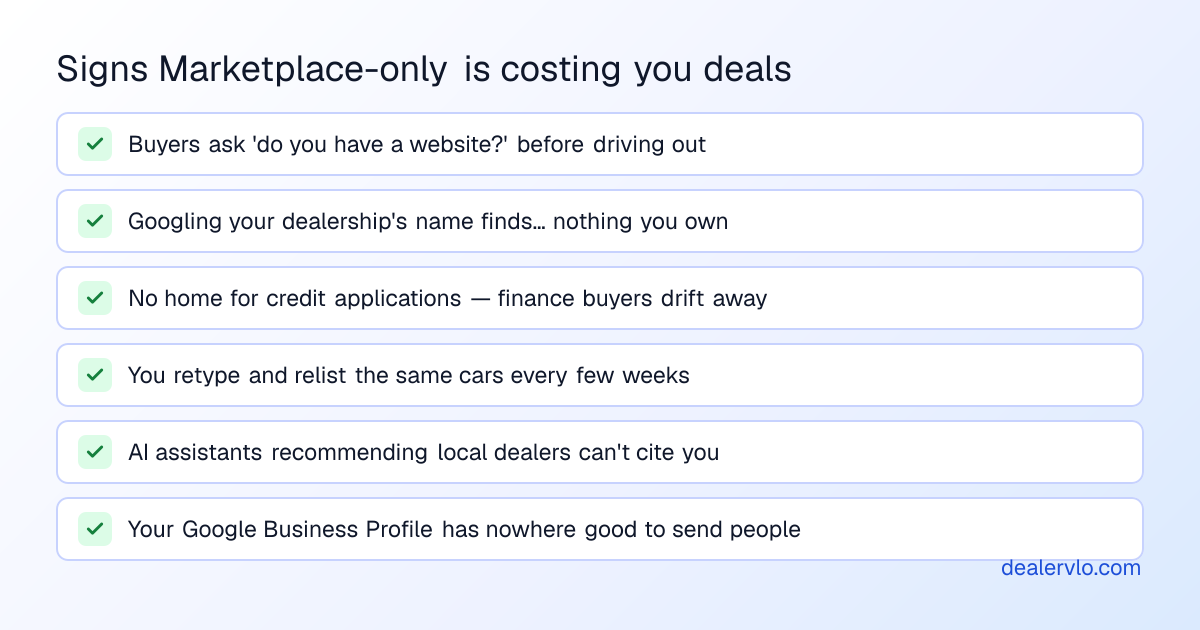
Any two of those and the audience already exists — buyers are already looking for the owned version of you and finding the void. At that point the website isn't a marketing experiment; it's catching demand you already generated.
What it costs — and the test that settles it
The full pricing breakdown is its own post; the short version is that published dealer-website pricing runs about $39–99/month standalone, and DealerVLO includes the site in its $29/month flat plan because the website and the inventory system work better as one thing. Whichever route you take, insist on the non-negotiable: the site must feed itself from your inventory. A website that needs manual listing work per car just recreates the Marketplace grind on your own domain.
Then run the honest experiment:
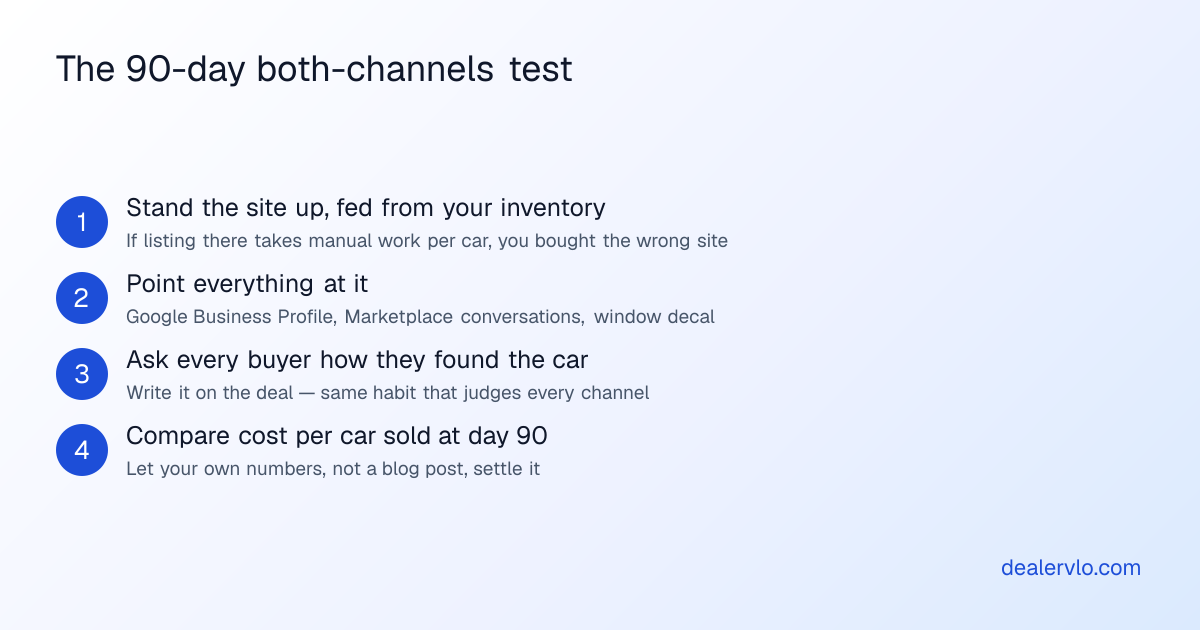
Ninety days of asking every buyer where they found the car — the same cost-per-car-sold discipline that judges every channel — and you'll know what the website does for your lot, in your numbers. That beats any blog post's opinion, including this one.
14-day free trial, then $29/mo · Cancel anytime
Frequently asked questions
Do car dealers really need a website in 2026?
Not on day one. But once you want name searches, Google Business Profile clicks, AI recommendations, or financing applications to land anywhere, you need the owned asset — and most lots cross that line early.
Is Marketplace enough to sell cars?
It can be enough to move metal, especially cash units. It can't be your foundation: the rules have changed before (partner feeds in 2021, business Pages in 2023), listings expire, and the history belongs to the platform.
What does a website do that Marketplace can't?
Resolves your name search, receives your GBP and AI-assistant traffic, shows the whole lot, takes credit applications, and compounds instead of resetting every 30 days.
What does one cost?
Roughly $39–99/month standalone from the published-price vendors; included in DealerVLO's $29/month flat plan. Full breakdown in the pricing post.
When's the right time?
When buyers ask for it, when your name search finds nothing, when you want financing leads, or when your Google profile has nowhere to send people — whichever comes first.
Bottom line
Marketplace is a great channel and a terrible foundation. Sell on the rented land — but build on your own: a site fed automatically from your inventory, so the lot you run is the lot the internet can see.
That's exactly how DealerVLO ships it: the dealer website isn't a module or an upsell — your inventory, photos, and lead form on your own domain, included in the same $29/month flat as the DMS. See what it looks like with cars on it at the live demo store, then stand yours up during the free 14-day trial — no charge until day 14.
14-day free trial, then $29/mo · Cancel anytime
Paste one car page: see its mobile speed against Google's published lines, and whether shoppers can find and reach you.
Open the Dealer Website Check