Mystery-Shop Your Own Used-Car Lot: A 30-Minute Test of How You Handle Buyers
Mystery shop your own car dealership with a simple 30-minute test—check lead response, phone handling, price consistency, and walk-up experience.
Part of the Marketing, leads & your website guide: Used Car Dealer Marketing: What a Small Lot Should Do First — and What to Skip
Switching from another DMS? Compare DealerVLO to DealerCenter, Frazer, or Lot Wizard.
You never see your lot the way a buyer does. You walk in the back door, you know every car, and when your phone rings it's usually a vendor or another dealer. Meanwhile, a shopper who found you on CarGurus just submitted a website inquiry, called the number on your listing, and drove past your lot — and you have no idea what any of those experiences felt like.
A paid mystery-shop service will test your sales process and send you a scorecard, but you can run a useful version yourself in about thirty minutes with a second email address, a friend's phone, and a notepad. The goal isn't a perfect score — it's finding the one broken step that's costing you deals, so you can fix it this week and test again next week.
14-day free trial, then $29/mo · Cancel anytime
Why owners never see their own lot
You operate in a completely different context than your buyers. When you look at your website, you're logged in, you already know the VIN and the price, and you're checking whether a photo uploaded. When a buyer lands on the same page, they're comparing your car to six others in six tabs, they've never heard your dealership's name, and the first thing they notice is whether the headlight photo is blurry or whether the description says "runs great" without listing the actual mileage.
The gap is even wider on the phone. You answer your own line knowing it's your business number, but a buyer calls the number printed on a Marketplace listing and hears hold music, a voicemail beep, or — worse — rings until it disconnects. After hours it's often worse, and a buyer who can't get through can call the next lot on their list in seconds.
Running your own lot makes you blind to the friction. A self-test forces you to see the lot as a stranger, and it's the fastest way to find the step where you're losing people.
The online test: website inquiry, listing quality, and photos
This is where a lot of buyers start, and it's the easiest test to run yourself. (For a closer look at the site itself, run the ten-minute dealer website audit.)
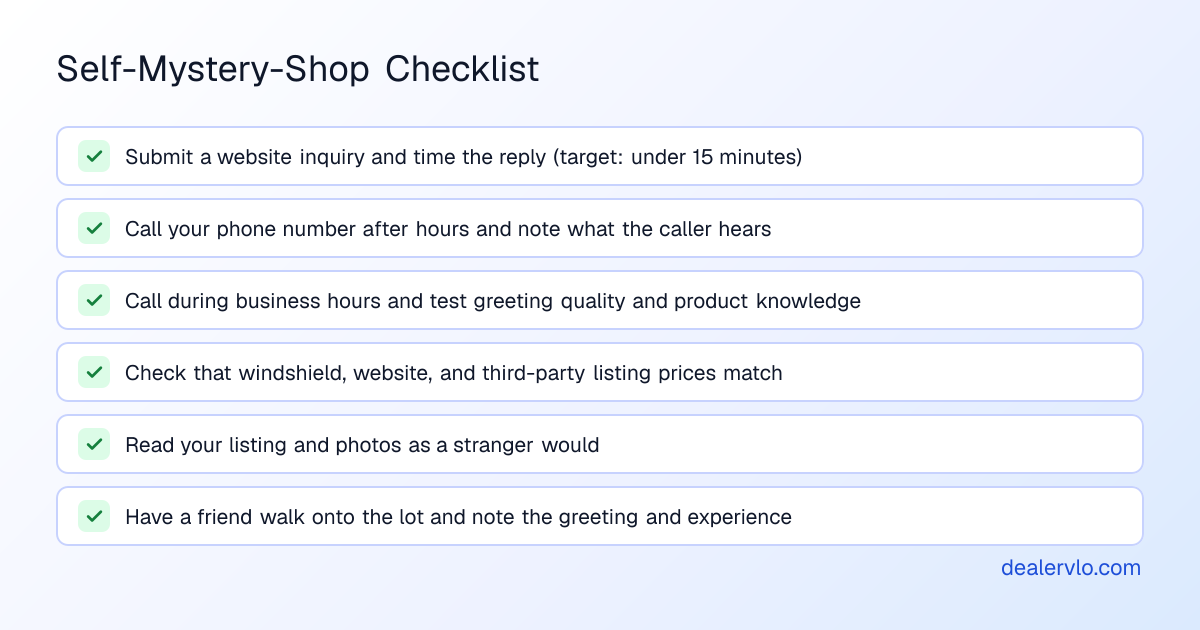
Submit a website inquiry and time the reply
Pick a car on your site and submit an inquiry from a second email address — or ask a friend to do it with their real email. Include a specific question: "Is the 2019 Accord still available? Does it have a backup camera?" Note the exact timestamp.
Now wait and see what happens. Time three things: the automated confirmation (if any), the first human reply, and whether that reply actually answers the question you asked.
DAS Technology's 2025 study found sixty-one percent of dealers answering an internet lead within fifteen minutes, and Pied Piper's 2026 study found fifty-one percent delivering what it grades a "perfect response" (fast, and answering the question) within that same window. If your first reply lands an hour later, or if it's a form letter that ignores the specific car and the question, you're losing people.
When a website lead comes in through DealerVLO, the system emails your dealership immediately and sends the buyer an automatic confirmation if they provided an email address — so the first human reply is on you, but at least the buyer knows the message went through. The lead inbox records each lead's source, the car they asked about, and a status you update as you work it.
If your test reply took longer than fifteen minutes, that's your first fix. Set a phone alert for new leads, or if you're the only one answering them, block fifteen minutes at the top of every hour to clear the inbox.
Read the listing and examine the photos as a stranger would
Open your car's listing on Cars.com, Autotrader, or Facebook Marketplace — wherever a buyer would find it — and pretend you've never seen the vehicle. Ask yourself:
- Are the photos well-lit, in focus, and shot from all the angles a buyer wants? (Exterior from every side, interior front and rear, engine bay, undercarriage, and any damage or wear.)
- Does the description include the trim, the actual mileage, the key features, and honest notes about condition?
- Are there spelling or grammar mistakes that make the lot look careless?
A buyer shopping online sees your listing next to every similar car in their search radius. If your photos are dark or your description just says "runs great," they've already moved to the next listing. The guide to writing used-car listing descriptions covers what a good one includes.
In DealerVLO, your website and the listing feeds to CarGurus, Cars.com, and Autotrader read each car's price from the same inventory record, but the quality of what you write and shoot is still your job. If your test shows weak photos or a thin description, spend an afternoon re-shooting your top five cars and writing real descriptions that name the trim and the equipment.
Paste one car page: see its mobile speed against Google's published lines, and whether shoppers can find and reach you.
Open the Dealer Website CheckThe phone test: after hours and business hours
Your website lists a phone number, your third-party listings list a phone number, and Google shows a phone number. The question is what a buyer hears when they call it.
Call yourself after hours
Use a friend's phone or block your caller ID, and call the main sales number listed on your website and your listings after you've closed for the day. Note what happens: voicemail, an answering service, silence, or a forwarded line that rings forever.
If the caller reaches voicemail, is the greeting current and professional, or is it the default carrier message with your number read back in a robot voice? If they reach an answering service, does the service know your inventory, or do they just take a message?
Buyers shop in the evenings and on weekends, when you're closed, and a buyer who hits a dead line can call the next lot before you open in the morning. If your after-hours test shows a dead end, your options are a human answering service or an AI phone-answering system; get quotes for both, since pricing varies by provider and call volume. Either beats losing the call, and even a current voicemail greeting with your hours and a callback promise beats the carrier default.
Call yourself during business hours
Call your own number during the day from a number your team won't recognize. Count the rings before someone answers, and note the greeting: do they state the dealership name, or just say "hello"?
Ask a specific question about a car on the lot — "Do you have the 2020 Escape with thirty thousand miles?" — and see whether the person answering can pull it up and give you an answer. If they put you on hold for three minutes or transfer you twice, that's friction a buyer won't tolerate when they're comparing six lots.
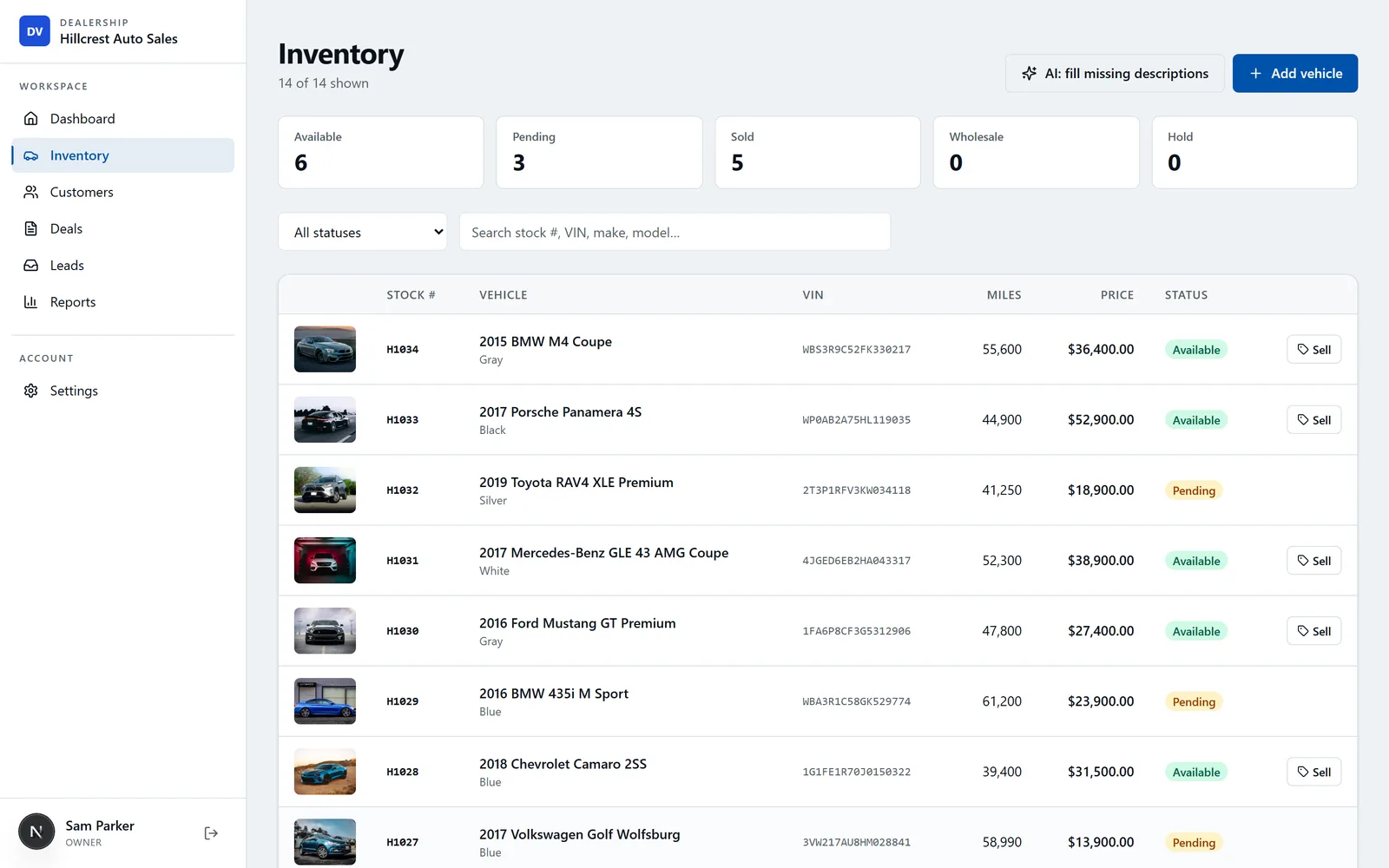
If your business-hours test shows slow pickup or weak product knowledge, the fix is process: one person owns the phone during open hours, and that person has access to your inventory list with stock numbers, prices, and key details. In DealerVLO, the inventory page searches by stock number, VIN, make, or model, so whoever answers the phone can confirm a car in seconds.
The price-match test
This is the easiest test to fail, because the price lives in three places and it's easy for them to drift out of sync.
Pick three cars on your lot and check:
- The windshield sticker price.
- The website listing price.
- The third-party site price (Cars.com, Autotrader, Facebook Marketplace, CarGurus).
All three should show the same number, and it should be the real price. In March 2026 the FTC sent warning letters to 97 dealership groups saying advertised prices must include every mandatory fee, and on September 15, 2026 FTC staff published pricing-transparency FAQs that spell it out: a fee you'd charge every buyer, such as a doc fee or a required add-on, belongs in the advertised price, and only charges the government requires, such as taxes, stay out. The FAQs are staff guidance, and your state may add its own disclosure rules, so check those too.
If your windshield says $12,995, your website says $12,495, and Autotrader still shows $13,200 from two weeks ago, you're confusing buyers before they ever call. DealerVLO's website and listing feeds read the same price from each car's inventory record, and the listing sites update with the next daily feed — so when you change a price in DealerVLO, it flows to your site immediately and to CarGurus, Cars.com, and Autotrader overnight. The window sticker prints the online price, so if you're updating prices in DealerVLO and reprinting stickers weekly, the three stay in sync. The website shows exactly the price you enter and doesn't add fees, so if every buyer pays your doc fee, enter prices that include it and turn on the Settings option "My advertised prices already include the doc fee" so the sticker footer says so. The window sticker guide covers what else belongs on the sticker.
If your test shows mismatched prices, fix the source of truth first. Decide whether the price lives in your DMS, your website, or a spreadsheet, update every car to match, and reprint every windshield sticker. Then set a weekly calendar reminder to check three random cars and confirm the prices still match.
14-day free trial, then $29/mo · Cancel anytime
The walk-up test: in-person first impression
The online tests catch the problems buyers hit before they ever visit, but if they do make the drive, the walk-up experience is where you close or lose them.
Have a friend or an employee from another department visit your lot as if they were shopping. They should park, walk onto the lot, and browse. Ask them to note:
- Is the entrance clear and welcoming, or does it look like a service bay?
- Are the vehicles clean, unlocked (or easy to see inside), and accessible, or are half of them blocked by a truck?
- How long before a salesperson greets them — and does the greeting feel helpful or pushy?
- Does the salesperson ask qualifying questions (what are you looking for, what's your budget, do you have a trade) or immediately start pitching a car?
- Are prices clearly visible on windshields, or do you have to ask?
- If they visit at dusk, is the lot well-lit and safe?
A common walk-up leak on a small lot: the owner is on the phone or in the office, and a buyer stands on the lot for five minutes without anyone noticing. If you're often alone, keep the office door open and look up every time you hear a car door close. If you have salespeople, the rule is the same — someone owns greeting every walk-up within two minutes, and the greeting is a question, not a pitch.
If your walk-up test shows a weak greeting or a cluttered lot, start with the clutter. Move cars so the best six are visible from the road, wash them, and make sure prices are on every windshield. Then coach your team: the first words out of their mouth should be "What are you looking for today?" — not "Can I help you?" or "That's a great car."
Score it and fix one thing a week
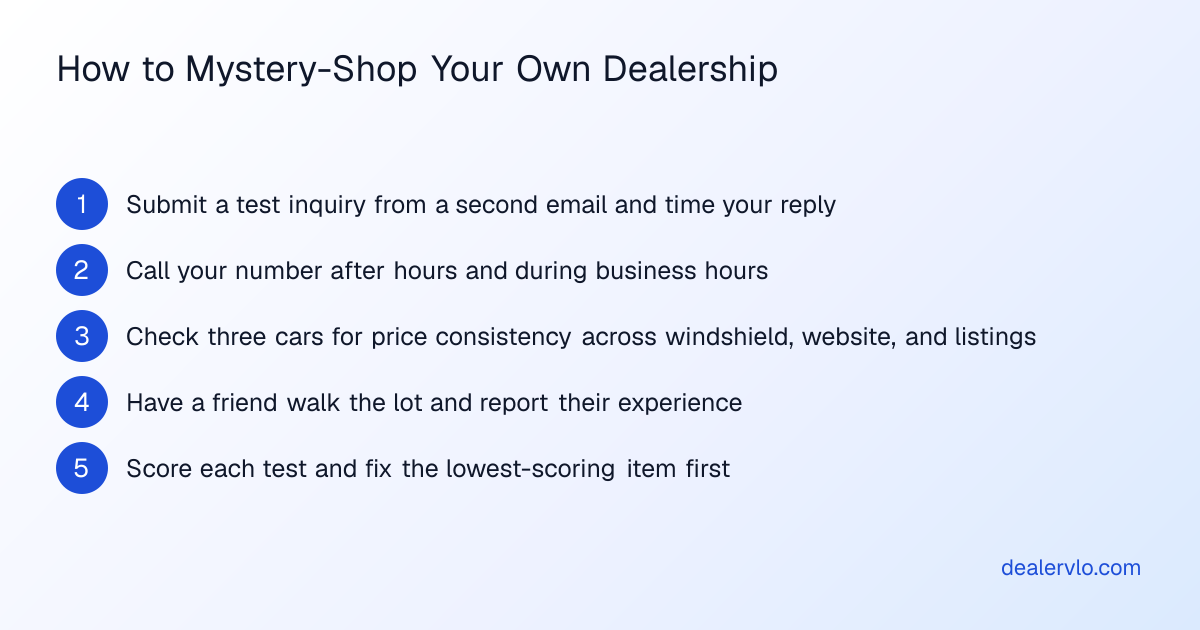
A mystery shop is only useful if you turn it into a list and work the list. Create a simple scorecard with a one-to-five rating or a pass-fail check for each test:
- Website lead response: Did I get a reply within fifteen minutes? Within an hour? Within twenty-four hours? Did it answer my question?
- Phone (business hours): Did someone answer within three rings? Were they courteous and knowledgeable?
- Phone (after hours): Did I reach a person, a service, or voicemail? Could I leave a message?
- Listing quality: Are photos clear and complete? Is the description accurate and thorough?
- Price match: Do the windshield, website, and third-party prices match exactly?
- Walk-up experience: Was I greeted within two minutes? Did the salesperson listen and ask what I needed?
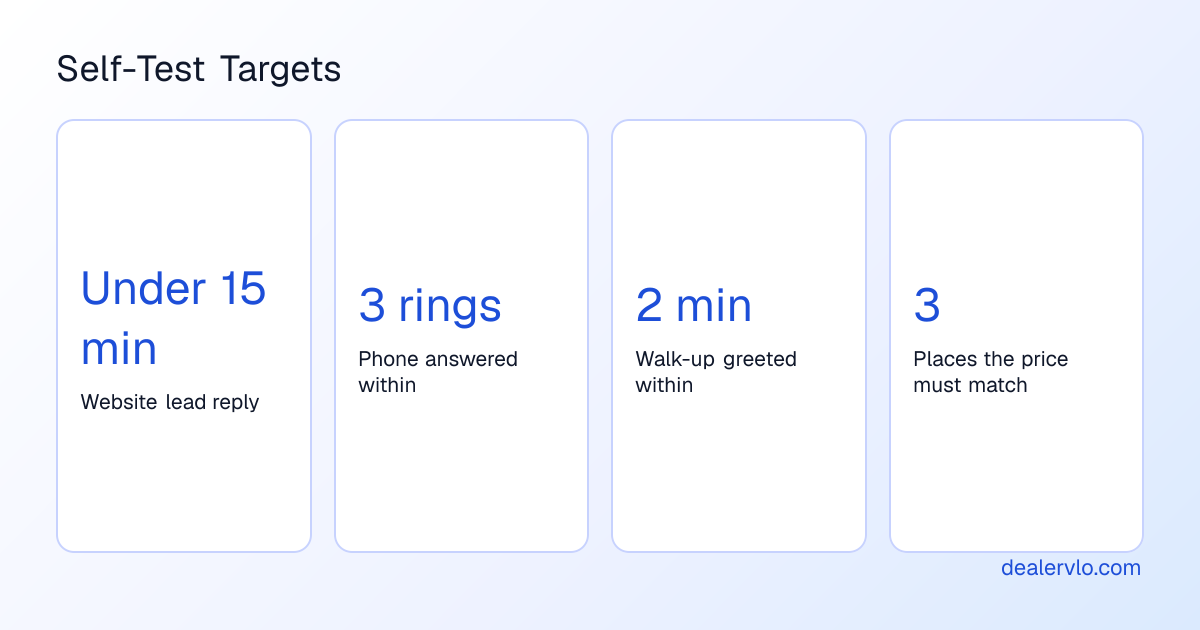
Look at your scores and fix the worst one first. If you scored a two out of five on lead response but a four on walk-up, spend the next week tightening lead response — set alerts, block time, and re-test in seven days. Once lead response is a four, move to the next lowest score.
The mistake is trying to fix everything at once. Pick one, fix it, prove it with a re-test, then move to the next. Fix one step a week and in three months you've worked through the whole list.
Where DealerVLO fits (and where you still have to do the work)
DealerVLO handles the infrastructure that keeps listings, prices, and lead notifications consistent — but it doesn't answer the phone, write your descriptions, or greet the walk-up. Here's the split.
What DealerVLO does automatically
When a shopper submits an inquiry through your DealerVLO website, the system emails your dealership immediately and sends the buyer an automatic confirmation if they provided an email. That means the buyer knows their message went through, and you get the email right away — but the speed and quality of your human reply is still on you.
The lead inbox records each inquiry's source, when it came in, and a status you update as you work it. Every lead ties to the vehicle when the shopper asked from a car's page, so you can see exactly what they were looking at. DealerVLO does not text or call on your behalf, and it doesn't set follow-up reminders or track your response time — those are your processes.
Your dealer website is included, and inventory posts to it automatically. The listing feeds to CarGurus, Cars.com, and Autotrader pull from the same inventory record, so when you update a price or mark a car sold in DealerVLO, the website changes immediately and the listing sites update with the next daily feed. The window sticker prints the online price, so if you're managing inventory in DealerVLO and reprinting stickers weekly, your windshield, website, and third-party listings stay in sync, with reprinting the sticker as the one manual step.
DealerVLO also auto-fills the FTC Buyers Guide from each vehicle's page — you can print it and hang it on the car before it ever hits the lot, which is one less thing to scramble for when a buyer shows up.
What you still own
Lead response speed and quality are entirely your process. DealerVLO gets you the alert and records the lead, but whether you reply in five minutes or five hours, and whether you answer the buyer's actual question or send a form letter, is up to you. If your mystery shop shows slow replies, the fix is blocking time every hour to clear the inbox or setting a phone alert.
Phone handling — business hours and after hours — is outside DealerVLO's scope. The system doesn't make or receive calls. If your after-hours test shows a dead end, you'll need to add an answering service or an AI phone system separately.
Photos and descriptions are your content. DealerVLO holds the photos, decodes the VIN, and posts the listing, but the quality of what you shoot and what you write is the difference between a click and a scroll. If your test shows weak photos, spend a Saturday re-shooting your top ten cars with your phone in good light, and write descriptions that name the trim, the features, and the condition.
Walk-up greeting and sales process happen offline. DealerVLO doesn't track who walked onto the lot or whether they were greeted — that's your team and your process.
The self-mystery-shop finds the gaps. DealerVLO closes the ones that are about data consistency and lead capture; you close the ones that are about speed, quality, and people.

A follow-up test: texting (if you text at all)
If you text buyers (appointment reminders, trade-in offers, event invites), add one more item to your checklist, but do not test it by texting strangers. The core rule is consent: get a buyer's permission before you send marketing texts, and know that the rules on what counts as consent and how you honor an opt-out vary. Instead of a test message, have whoever handles your compliance review your opt-in forms and a sample of your outbound texts, and confirm your texting platform stops messaging anyone who replies STOP.
DealerVLO does not send texts or calls, so texting sits with whatever platform you use for SMS.
How fast does my dealership respond to leads? A one-week tracking exercise
If your mystery shop showed a slow reply but you're not sure whether it was a fluke, run a one-week tracking exercise. For every website lead that comes in, note the timestamp of the inquiry and the timestamp of your first human reply. At the end of the week, calculate your median response time and your percentage under fifteen minutes.
For a benchmark, DAS Technology's 2025 study found sixty-one percent of dealers answering an internet lead within fifteen minutes. Speed matters past the first reply, too: Foureyes' analysis of more than eight million sales opportunities in the first half of 2025 found leads closed at 12.4 percent within the first three days, falling to 2.3 percent across days four through seven. If your one-week test shows a median response time over an hour, or if more than half your leads wait until the next business day, that's costing you deals.
The fix is usually process, not tools. Block two fifteen-minute windows a day to clear the lead inbox — one mid-morning, one mid-afternoon — and set a phone alert so new inquiries don't sit unread. If you're the only one handling leads and you're out buying cars or at the auction, turn on an out-of-office auto-reply that says "I received your message and I'll reply by [time]" — that's better than silence.
DealerVLO's lead inbox shows when each lead came in and its status, so you can see at a glance which ones are still marked New and how long they've been waiting. It doesn't calculate your response time or send you a reminder — that's your own tracking — but having every lead in one place with its source and the car makes it easier to triage and reply fast.
For a deeper look at converting online inquiries into showroom appointments, see our guide to converting online leads to appointments. And if you want to keep working leads beyond the first week, the follow-up cadence after week one is covered in our dead-leads follow-up article.
Secret-shop your competitors while you're at it
Once you've tested your own lot, run the same test on two or three competitors in your area. Submit an inquiry on one of their cars, call their number after hours, check whether their prices match across platforms, and if you're feeling bold, walk onto their lot.
You're not spying — you're seeing what your buyers see when they're comparing you to the other options in six tabs. If a competitor replies in five minutes with a personalized answer and a photo of the car, and you're still sending a form letter an hour later, you know why they're closing deals you're not.
The comparison also shows you what's normal in your market. If every other lot in town has an after-hours answering service and you're the only one going to voicemail, that's a gap worth closing. If you're the only lot with mismatched prices, you're the one losing trust.
Tie it to your monthly close checklist
A self-mystery-shop is most useful when it's a recurring event, not a one-time audit. Add it to your month-end close checklist as a standing task: once a month, submit a test inquiry, call your own number, check three prices, and have someone walk the lot.
Track your scores month over month. If lead response was a two in January, a three in February, and a four in March, you're improving. If a score drops (say, windshield prices stop matching the website because you got busy and stopped reprinting stickers), you catch it before it costs you a week of confused buyers.
The self-test isn't a replacement for a full paid mystery shop with a detailed scorecard and a recorded phone call — but it's free, it's fast, and you can run it every week if you want. It's easy to go years without seeing your lot through a buyer's eyes, until a deal falls apart and you don't know why. Thirty minutes a month and a simple checklist will show you the problem while you can still fix it.
Frequently asked questions
How often should I mystery-shop my own car dealership?
Run a full self-test monthly, and spot-check one element weekly. For example, submit a test inquiry every Monday and time your reply, or call your after-hours number every Friday to confirm the greeting is still current. Monthly gives you a baseline; weekly catches problems before they cost you deals. Add the full test to your month-end close checklist so it becomes routine, and track your scores over time — if lead response was a two in January and a four in March, you know the fix stuck.
What's a good lead response time for a small used-car dealership?
Fifteen minutes is the benchmark the industry studies use. DAS Technology's 2025 study found sixty-one percent of dealers answering an internet lead within fifteen minutes, and Pied Piper's 2026 study found fifty-one percent giving what it grades a "perfect response" (fast, and actually answering the question) within that window. If your median response time is over an hour, block two fifteen-minute windows a day to clear your inbox and re-test the next week.
Do I need to hire a mystery-shop service or can I do it myself?
Start by doing it yourself with a second email address and a friend's phone — you'll catch most of the big leaks for free. Paid services deliver a detailed scorecard, a recorded phone call, and an objective third-party perspective, which is valuable once or twice a year for a full audit. But the self-test you can run weekly or monthly is more useful for finding and fixing problems fast, because you're not waiting for a report or paying per shop. Run your own test every month and consider a paid service once a year to catch blind spots.
How do I make sure my listing prices and windshield sticker prices stay in sync?
Decide on one source of truth — your DMS, your website, or a master spreadsheet — and update every price there first. Then set a weekly calendar reminder to reprint windshield stickers and confirm your third-party listings pulled the new price. In DealerVLO, the website and the listing feeds to CarGurus, Cars.com, and Autotrader all read from the same inventory record, and the window sticker prints the online price — so when you change a price in DealerVLO, it flows to your site immediately and to the listing sites with the next daily feed. That leaves reprinting the windshield sticker as the one manual step.
What should I do if my after-hours phone test shows I'm missing calls?
If your after-hours number goes to voicemail or rings forever, a buyer who can't get through can call the next lot on their list in seconds. Your options are a human answering service or an AI phone-answering system; get quotes for both, because pricing varies by provider and call volume. Either is better than a dead line. At minimum, record a professional voicemail greeting with your hours, your website, and a promise to call back first thing in the morning.
Can I test texting compliance without actually sending unsolicited texts?
Yes. Never send a test text to a number that hasn't agreed to hear from you: get consent before marketing texts, and know that the rules on what counts as consent vary. Instead of a test message, have whoever handles your compliance review your opt-in forms and a sample of your outbound texts, and confirm your texting platform stops messaging anyone who replies STOP. DealerVLO doesn't send texts, so this check is about whatever platform you use.
Bottom line
You'll never see your lot the way a buyer does unless you force yourself to become one. A thirty-minute self-mystery-shop — a test inquiry, two phone calls, a price check, and a walk-up — will show you the one broken step that's costing you deals every week. Score it with a simple checklist, fix the worst item first, and re-test next week. Run it monthly and you'll catch the leaks while they're still small.
DealerVLO keeps your listings, prices, and lead notifications consistent so you can focus on the human side — speed, quality, and the greeting. Run your first self-test this week, track your scores, and fix one thing at a time.
14-day free trial, then $29/mo · Cancel anytime