Used-Car Dealer Marketing Budget Breakdown: How Much to Spend Per Vehicle
Build a realistic used-car dealer marketing budget from per-vehicle costs, revenue percentages, and channel ROI, with examples for 15- and 40-unit/month lots.
Part of the Marketing, leads & your website guide: Used Car Dealer Marketing: What a Small Lot Should Do First — and What to Skip
Switching from another DMS? Compare DealerVLO to DealerCenter, Frazer, or Lot Wizard.
Most independent used-car dealers either overspend on channels that don't pull, or underinvest altogether and wonder why inventory sits. A functional used car dealer marketing budget starts with two numbers: what you sell per month and what each sale should cost you in marketing dollars. From there, you allocate across channels by return, not by what the rep promises.
This guide walks through the industry benchmarks, channel-by-channel costs, and worked examples for a 15-unit operation and a 40-unit lot. Every figure comes from verifiable 2025-2026 industry data, so you can build your budget with confidence and adjust it as your volume changes.
Note: This article discusses financial planning and industry benchmarks, not legal or tax advice. Consult your accountant or attorney before making budget commitments.
14-day free trial, then $29/mo · Cancel anytime
What dealers actually spend per vehicle sold
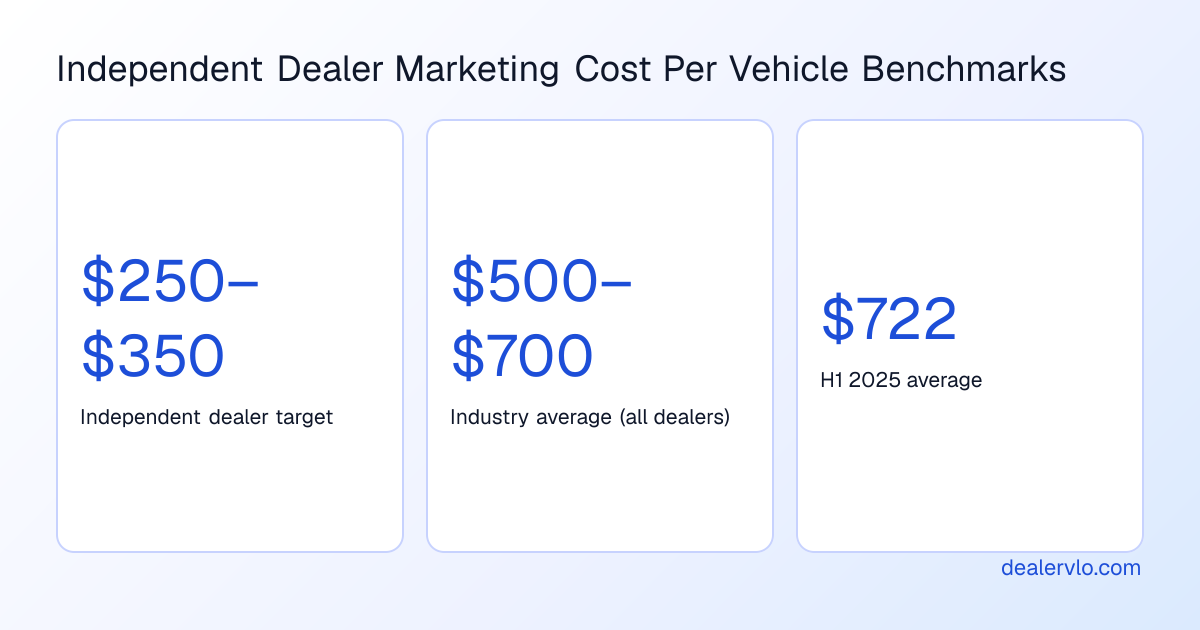
The most useful benchmark is cost per vehicle retailed. NADA's 2025 annual dealership data puts franchised new-car dealers at $739 in advertising per new vehicle sold—about $586,000 per dealership for the year. That's franchise-store data, so treat it as a reference point, not a target for an independent lot.
Independent used-car dealers typically run leaner. Many come in closer to $250 to $350 per vehicle sold, and buy-here-pay-here operators often spend near the low end of that range because their customer acquisition leans on referrals and repeat buyers. That lower cost-per-unit is a realistic efficiency target when you're not carrying new-car inventory or co-op advertising commitments.
If you're selling fifteen units a month and spending $250 per sale, your monthly marketing budget runs around $3,750. At $350 per unit, it's $5,250. Those numbers scale linearly: a forty-unit lot spending $300 per vehicle budgets $12,000 a month. The cost-per-unit approach automatically adjusts as your volume grows, which keeps marketing spend proportional to revenue.
When you're setting up your dealership, understanding all your startup costs—including marketing—matters from day one. You can review the full breakdown of what it takes to open a used-car dealership to see how marketing fits into your overall capital plan.
How marketing fits into your gross profit and revenue
Another way to frame your budget is as a percentage of revenue or gross profit. Dealerships commonly allocate somewhere between 0.5 and 2 percent of gross revenue to marketing, though the exact percentage varies with volume, margin, and market.
For a rough cross-check: if you're doing $2 million in annual revenue and spending $30,000 to $42,000 a year on marketing, you land in the 1.5 to 2.1 percent range, which aligns with the independent-dealer benchmarks. A higher-volume operation grossing $6 million and spending $12,000 a month ($144,000 annually) sits at 2.4 percent—still reasonable if your per-unit cost remains below $400.
The percentage method is useful for annual planning, but the per-vehicle metric is easier to track month to month and adjust when your inventory turns faster or slower than expected.
Where to put your money: channel allocation and ROI
Digital channels now capture seventy to seventy-five percent of total dealer advertising spend, and the most competitive dealers push that share closer to eighty-five or ninety-five percent. The traditional seventy-twenty-ten split—paid media, production, and measurement—has shifted toward dedicating forty to fifty percent of budget to content and organic infrastructure like local search, on-site SEO, and social media.
Here's what each major channel costs and what it delivers.
Third-party listing sites (AutoTrader, Cars.com, CarGurus)
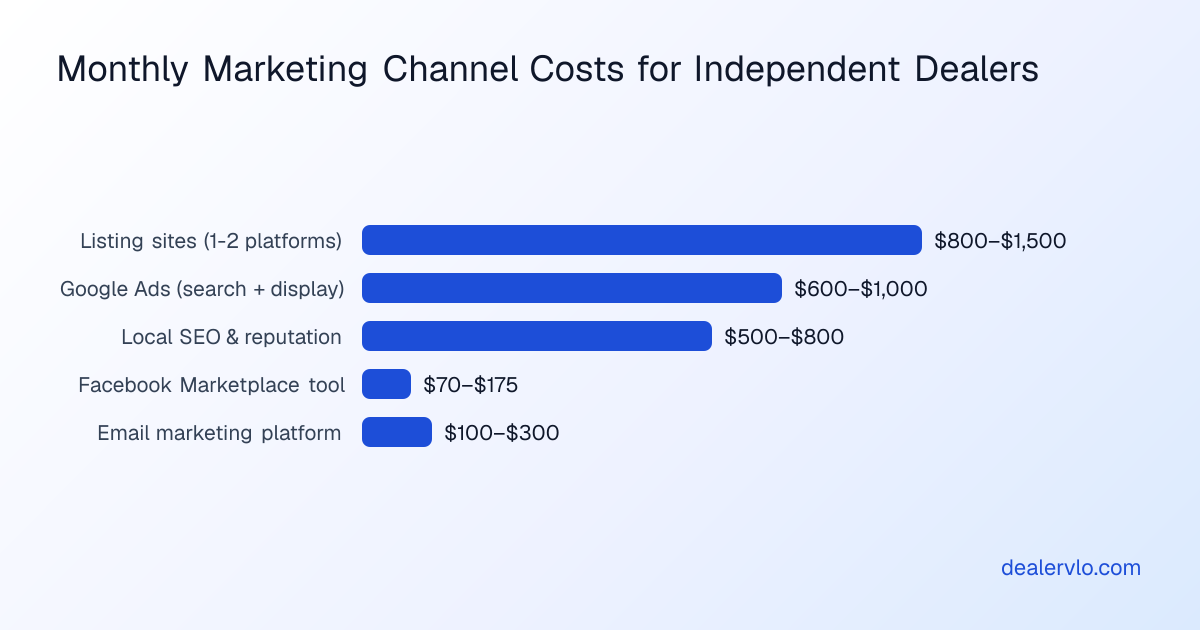
Listing sites receive the largest single-channel investment among dealerships. For an independent lot, a realistic monthly budget runs $800 to $1,500 across one or two platforms, depending on your inventory size and package tier. Listing sites work because buyers already intend to shop; you're paying for visibility in an active marketplace. The cost per lead is predictable, and the conversion rate is typically higher than cold-traffic sources.
If you're managing thirty to fifty units, one premium listing package on AutoTrader or Cars.com and a basic presence on a second site often covers your needs. Beyond that, the incremental return drops fast. Don't let a rep upsell you to every enhanced placement unless you've tested it and tracked the source in your CRM.
Facebook Marketplace
Facebook Marketplace is not a replacement for the listing sites—it's a complementary channel that reaches a different buyer demographic at nearly zero incremental listing cost. Quality automation tools built for dealers cost around $70 to $175 per month, and they handle syndication, photo formatting, and message routing so you're not manually posting fifty cars.
Some dealers report an additional six to twelve sales per month from Marketplace alone once they systematize posting and response. That's anecdotal and will vary by market, but even at the low end, the cost per incremental sale is hard to beat. Marketplace buyers tend to message outside business hours and expect fast replies, so pair it with a text-response workflow or a virtual assistant who monitors it.
Marketplace isn't a fit for every market or price point, but if your average retail is under $20,000 and you serve a metro area, it's worth the tool cost to test for three months.
Local SEO and Google Business Profile
Local SEO covers your Google Business Profile optimization, review generation, citation cleanup, and on-page work so you rank when someone searches "used cars near me" or your city plus "used car dealer." As a standalone service, local SEO typically costs $500 to $1,500 per month.
For independent dealers, the low end of that range—$500 to $800—buys consistent review requests, monthly profile posts, and basic citation management. You don't need the $3,000-plus packages franchise stores buy; you need accurate NAP data, a steady stream of Google reviews, and a mobile-friendly site with your inventory feed.
Local SEO has a longer payback than paid search, but once you rank in the local three-pack, the marginal cost per lead drops to nearly zero. If you're planning to stay in the same location for years, this is one of the highest-return investments over time.
Our guide to used-car dealer benchmarks includes organic traffic and lead-source mix data so you can compare your performance to similar-volume stores.
Pay-per-click advertising (Google Ads)
Google Ads for dealerships typically costs $600 to $1,000 per month total—$400 to $700 in ad spend and the rest in management fees if you outsource. Automotive PPC often carries a cost per lead between $40 and $120, depending on your metro and how tight your keyword targeting is.
Dealers using integrated campaigns—where PPC and SEO share keyword data and landing pages—report an average cost per qualified lead closer to $38, which is competitive. The key is sending clicks to inventory-specific landing pages, not your homepage, and excluding wholesale, trade-in, and junk-car terms that burn budget.
PPC gives you immediate visibility and is easy to scale or pause, which makes it useful when you need to move aged inventory or you're launching in a new market. The downside is that the spend stops working the day you turn it off, so it's best as part of a mix rather than your only channel.
Email marketing and remarketing
Email remains one of the highest-ROI channels when you have a database to work with. Email marketing generates strong returns when it's targeted and timely.
Most independent dealers underuse email because they don't systematically capture leads and past buyers in a CRM. If you collect email at inquiry, test drive, sale, and service, you'll build a list worth nurturing. Monthly inventory highlights, price-drop alerts, and trade-in incentive emails cost almost nothing to send and pull buyers back when they're ready.
Pair email with Facebook and Google remarketing pixels so you can stay visible to people who visited your site or a vehicle detail page but didn't convert. Remarketing ads cost a fraction of cold traffic and convert at two to three times the rate.
Turn your ad spend into a cost per car sold and a real ROI — and see how many units the spend has to produce just to break even.
Open the Marketing ROI CalculatorScaling your budget with lot size: two worked examples
Here's how the numbers play out for a smaller operation and a mid-size independent lot.
Example one: 15 units per month
You're retailing fifteen cars a month, with an average selling price around $18,000 and a per-unit gross near $2,200. At $300 cost per vehicle sold, your monthly marketing budget is $4,500.
Here's one way to allocate it:
- Listing sites (Cars.com or AutoTrader, mid-tier package): $900
- Facebook Marketplace automation tool: $100
- Local SEO and review management: $600
- Google Ads (modest campaign, tight geographic targeting): $700
- Photography and content (batch shoots, occasional video): $300
- Email marketing platform and design: $100
- Reserve / testing budget: $1,800
That reserve lets you test a direct-mail postcard campaign, a promoted post on Instagram, or a sponsorship of a local event without blowing your month. You'll learn more by trying three small things than by going all-in on one unproven channel.
At this volume, your used-car reconditioning budget and your marketing budget are probably similar in size. Both matter, and both scale with volume.
Example two: 40 units per month
You're selling forty units a month, average retail price $16,500, per-unit gross around $2,000. At $300 per vehicle sold, you budget $12,000 monthly.
Allocation might look like this:
- Listing sites (two platforms, enhanced packages): $2,200
- Facebook Marketplace tool and boosted posts: $400
- Local SEO, reputation management, and content: $1,500
- Google Ads (search and display, broader geography): $2,500
- Professional photography (weekly shoots, 360-degree spins): $800
- Email and SMS marketing platform: $300
- Video ads and social creative: $600
- Trade show, event sponsorships, or direct mail: $1,200
- Reserve / seasonal campaigns: $2,500
At this scale, you have room to test performance marketing channels like YouTube pre-roll or geofenced mobile ads near competitor lots. You can also invest in higher-quality creative—short testimonial videos, walkaround clips for high-margin units, and seasonal sale campaigns—that smaller lots can't afford to produce consistently.
You'll also want to track cost per lead and close rate by source in your CRM so you know which channels earn their budget month over month. If Google Ads consistently delivers at $50 per lead and Facebook delivers at $90, shift dollars toward Google until the cost rises or the volume caps out.
14-day free trial, then $29/mo · Cancel anytime
How to adjust when volume changes
Your marketing budget should flex with sales, not stay fixed. If you jump from twenty units a month to thirty because you bought a competitor's inventory or opened a second lot, your marketing spend needs to increase by roughly the same proportion to maintain lead flow.
The mistake most dealers make is cutting marketing first when a slow month hits. That creates a lag—you spend less in March, leads drop in April, and sales fall in May. By the time you realize the problem, you've lost two months of momentum.
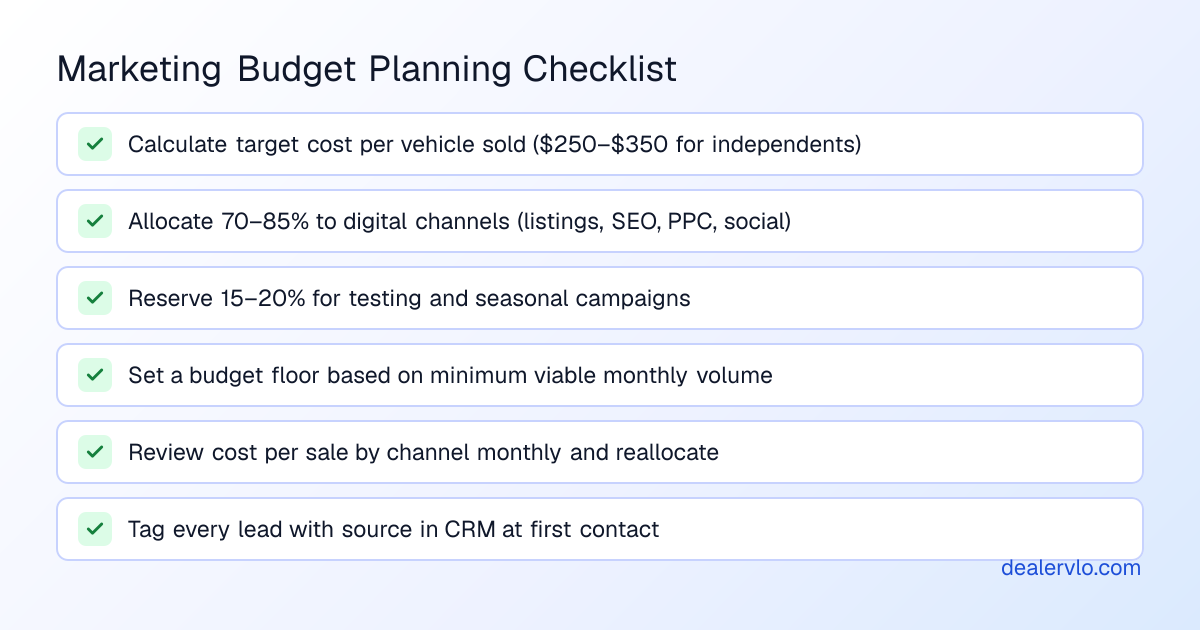
Instead, set a floor based on your minimum viable monthly volume and a ceiling based on your growth target. If you need to retail at least twelve units to cover overhead, your floor is $3,000 to $4,200 (at $250 to $350 per unit). If your goal is twenty-five units, your ceiling is $6,250 to $8,750. Budget toward the ceiling, and only pull back when you have three consecutive months below target and confirmed that the market—not your ad spend—is the cause.
When you're scaling, your pricing and markup strategy has to support the higher volume, too. If you're spending $12,000 a month on marketing but your per-unit gross is only $1,200, the math doesn't close. Marketing and pricing work together.
What not to spend money on
A few channels consistently underperform for independent used-car dealers, and it's worth naming them so you don't waste budget.
Broad radio and TV advertising rarely pays off unless you're in a small market where rates are cheap and frequency is achievable. A single weekly radio spot won't move cars; you need sustained presence, and that costs more than most independents can justify. If you're curious about broadcast, test it with a limited four-week buy and track every lead by asking how they heard about you.
Untargeted direct mail to cold lists usually returns poorly. Targeted mail to people whose vehicles are six-plus years old, who live within ten miles, and who match your buyer profile can work, but broad "we buy cars" postcards to every address in a ZIP code bleed money.
Overpriced "premium" lot photography packages that charge $50-plus per vehicle for the same six-angle shots you can take in-house. A $600 camera, a mobile app for editing, and a systematic photo process will beat a vendor package in quality and cost after the first thirty cars.
SEO and reputation-management contracts that lock you in for a year with no month-to-month performance tracking. If an agency won't show you keyword rankings, traffic, and lead source monthly, walk.
Track everything, or you're guessing
No budget framework works if you don't know which channels deliver. Every lead should be tagged with a source in your CRM the moment it arrives—phone, web form, Facebook message, walk-in from a Google search, referral, whatever. At month-end, run a source report and calculate cost per lead and cost per sale by channel.
If you spent $900 on AutoTrader and it delivered twenty-two leads and four sales, your cost per sale is $225. If you spent $700 on Google Ads and got fourteen leads and one sale, that sale cost you $700. Over three months, the pattern becomes clear, and you move budget toward what works.
Don't rely on the platform's attribution. Facebook will claim credit for a sale that started on Google; Google will claim one that started on AutoTrader. Use your CRM as the single source of truth and ask every buyer how they found you.
Frequently asked questions
How much should an independent used-car dealer spend on marketing per vehicle sold?
Independent dealers typically spend $250 to $350 per vehicle sold. Buy-here-pay-here operations often run closer to $250 because they rely more on referrals and repeat business. Multiply your monthly unit sales by your target cost per vehicle to set your budget—for example, twenty units at $300 per vehicle equals a $6,000 monthly marketing budget.
What percentage of revenue should a used-car dealership allocate to marketing?
Most dealerships allocate between 0.5 and 2 percent of gross revenue to marketing. For a dealership doing $2 million in annual revenue, a marketing budget of $30,000 to $42,000 per year falls in the typical range for independent operators.
Which marketing channels give the best ROI for independent used-car dealers?
Third-party listing sites like AutoTrader and Cars.com deliver the highest intent traffic but also cost the most, typically $800 to $1,500 per month for independent dealers. Facebook Marketplace costs only $70 to $175 monthly for automation tools and can add six to twelve incremental sales. Local SEO runs $500 to $800 per month and has the lowest long-term cost per lead once you rank. Google Ads costs $600 to $1,000 monthly total and delivers immediate, scalable visibility with a cost per qualified lead around $38 to $120 depending on your market.
How should I split my budget between digital and traditional advertising?
Digital channels should represent seventy to seventy-five percent of your total marketing spend at minimum, with leading dealers pushing that to eighty-five or ninety-five percent. The old seventy-twenty-ten model—paid media, production, and measurement—has shifted toward dedicating forty to fifty percent of budget to organic content, local SEO, and social presence. Traditional media like radio, TV, and print now accounts for less than thirty percent of dealer ad dollars, and independent lots often spend even less because digital delivers better tracking and ROI.
What does a realistic monthly marketing budget look like for a 15-unit-per-month dealership?
At $300 cost per vehicle sold, a fifteen-unit lot should budget around $4,500 per month. A balanced allocation might include $900 for listing sites, $600 for local SEO, $700 for Google Ads, $100 for Facebook Marketplace automation, $300 for photography, $100 for email marketing, and $1,800 in reserve for testing and seasonal campaigns. That mix covers lead generation, organic visibility, and creative production while leaving room to experiment with new channels.
Should I cut my marketing budget during a slow sales month?
Cutting marketing spend when sales dip typically makes the problem worse because of the lag between ad spend and closed sales. Leads generated this month often convert next month, so a March budget cut creates an April lead shortage and a May sales drop. Instead, set a budget floor based on your minimum viable monthly volume and only reduce spend after three consecutive months below target when you've confirmed the market—not your lead flow—is the issue. Marketing is what fills your pipeline, and an empty pipeline guarantees a slow month ahead.
Bottom line
A realistic used-car dealer marketing budget starts with your monthly unit sales, multiplies by a cost-per-vehicle target between $250 and $350, and allocates seventy-five to ninety-five percent of that total to digital channels that you can track. Listing sites, local SEO, Google Ads, and Facebook Marketplace form the core for most independent dealers, with email and remarketing filling the gaps.
Build your budget around the per-vehicle cost, track every lead by source, and shift dollars toward what closes. The math is simple, but only if you measure it.
14-day free trial, then $29/mo · Cancel anytime