Used Car Reconditioning Cost: Budgeting & ROI for Dealers
Used car reconditioning costs for independent dealers: typical spend ($1,000–$1,700), category breakdowns, budgets by vehicle type, and when to wholesale.
Switching from another DMS? Compare DealerVLO to DealerCenter, Frazer, or Lot Wizard.
What you're really spending to put cars on the line
Every car you put on the lot starts with an acquisition cost, but the number that determines whether you make money is what you spend getting it retail-ready. Used car reconditioning cost—everything from brakes and tires to paint touch-up and detailing—directly cuts into your front-end gross, and getting it wrong means you either wholesale a car you could have retailed or burn profit on a unit that should have gone straight to auction.
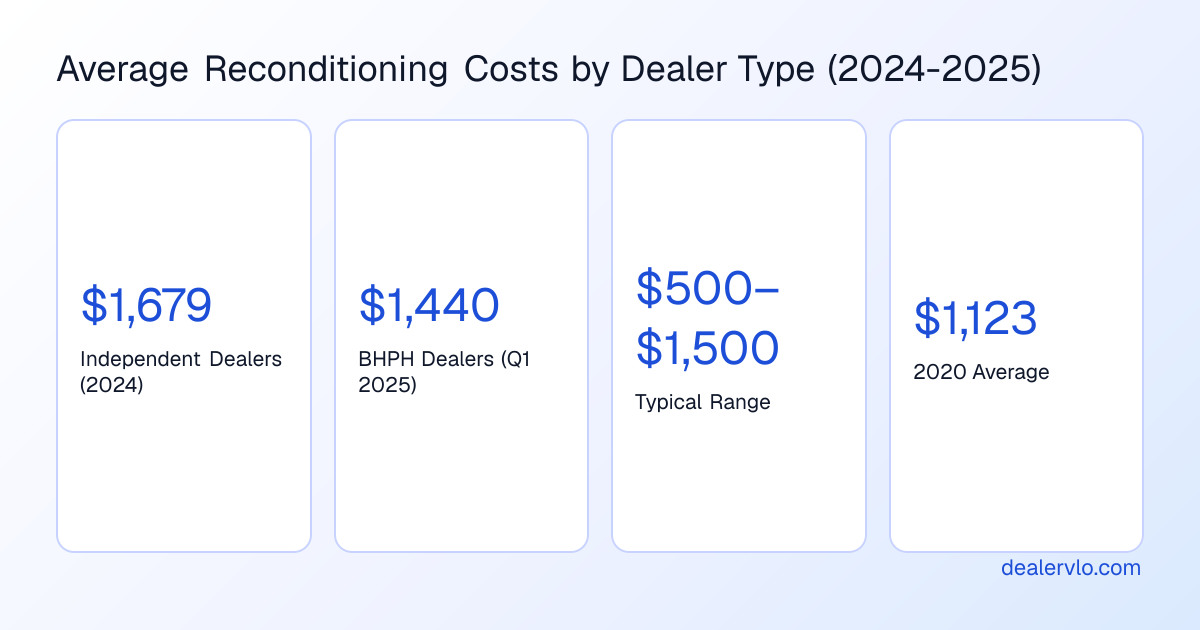
The average independent dealer is spending around $1,400 to $1,700 per vehicle on reconditioning in 2024–2025, a meaningful jump from $1,123 just four years earlier. BHPH operators run a bit lower—closer to $1,440—while dealers chasing CPO standards can easily double that figure once certification fees stack on top of mechanical and cosmetic work.
The real challenge isn't the average; it's knowing which cars deserve $400 and which justify $2,000, and having a framework to kill the recon process before a $1,200 estimate turns into a $2,800 loss. This guide walks through what reconditioning actually costs, how to budget it by vehicle segment, what drives the expense up or down, and when to cap your spend and send a car to wholesale instead.
14-day free trial, then $29/mo · Cancel anytime
What reconditioning includes and what it doesn't
Reconditioning cost is everything you spend to take a vehicle from as-bought condition to front-line ready: mechanical repairs, parts, tires, brakes, fluids, body and paint work, interior repair, detailing, and state inspection fees. It does not include your acquisition cost, transport, auction fees, or back-office overhead—those are separate line items. Recon is purely the delta between "just bought it" and "customer can drive it home today."
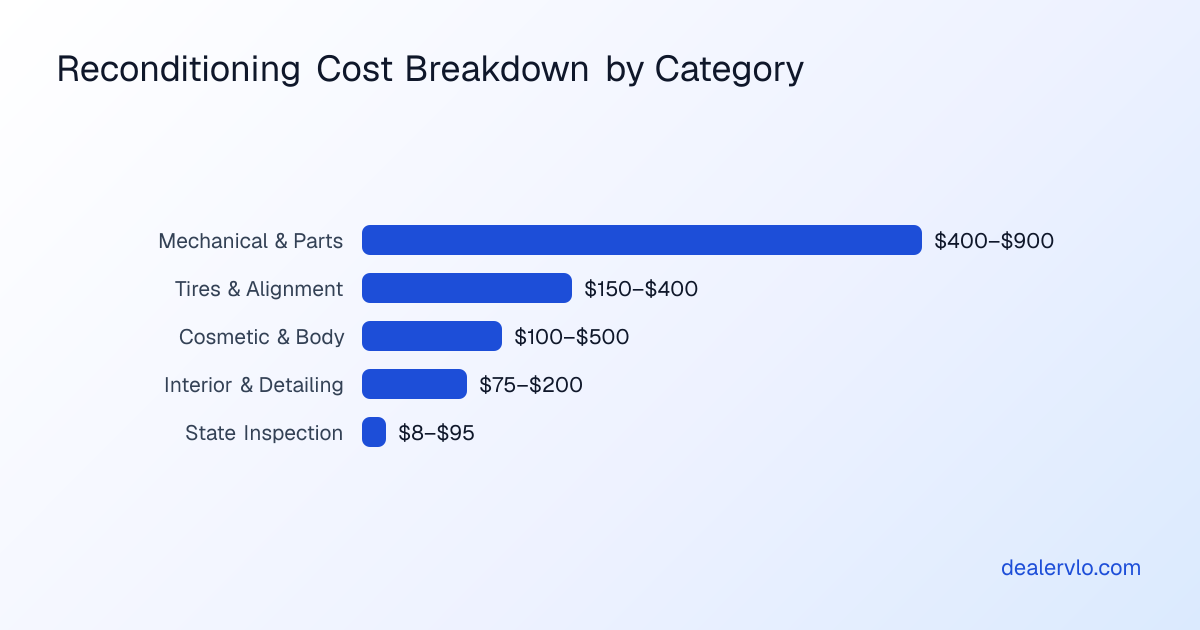
Most dealers break recon into four buckets:
- Mechanical: Engine, transmission, suspension, brakes, electrical, HVAC, and any drivetrain work needed to pass inspection and meet your safety standard.
- Tires & alignment: New rubber if tread is below your threshold, plus alignment if the car pulls or shows uneven wear.
- Cosmetic & body: Paint touch-up, dent removal, bumper scuffs, headlight restoration, and glass repair or replacement.
- Interior & detailing: Deep clean, odor treatment, upholstery repair, carpet shampoo, and the final polish before photos.
State safety inspection is also part of the bill. Costs vary widely: Texas now charges a flat $7.50 inspection program replacement fee, while Pennsylvania dealers pay $35–$50 for safety inspections at independent shops (dealerships often charge $45–$60), and combined safety-plus-emissions runs $70–$95. North Carolina's safety-only inspection is $29.15, and safety-plus-emissions is $40.15. Budget $15–$95 depending on your state and whether emissions testing applies.
One often-missed line item: holding cost while the car sits in recon. Industry benchmarks put daily carrying cost—floor-plan interest, insurance, depreciation, and overhead—at roughly $40 to $50 per vehicle per day. If your recon cycle runs ten days instead of three, you've added $280–$350 in silent cost before the car ever hits the lot. Faster reconditioning isn't just about turning inventory; it's about preserving margin.
Average reconditioning cost: what the data shows
NIADA reports that independent dealers paid an average of $1,679 in reconditioning in 2024, up from $1,455 in 2023 and $1,123 in 2020. BHPH dealers saw reconditioning costs rise 8.9 percent to $1,440 in Q1 2025. Broader industry figures commonly put average recon spend in the range of $500 to $1,500 per unit, though the number swings widely with vehicle age, acquisition source, and whether you're chasing franchise certification standards.
Consumer-facing sources cite similar ranges: one analysis pegs the average at $1,112 per vehicle, while another suggests $1,500 as a typical spend. ACV Auctions calls $1,000 a reasonable ballpark estimate for most cases. One independent dealer reported an average recon cost of just $400 on the vehicles he acquires, a figure that likely reflects careful buying and a lean in-house service operation.
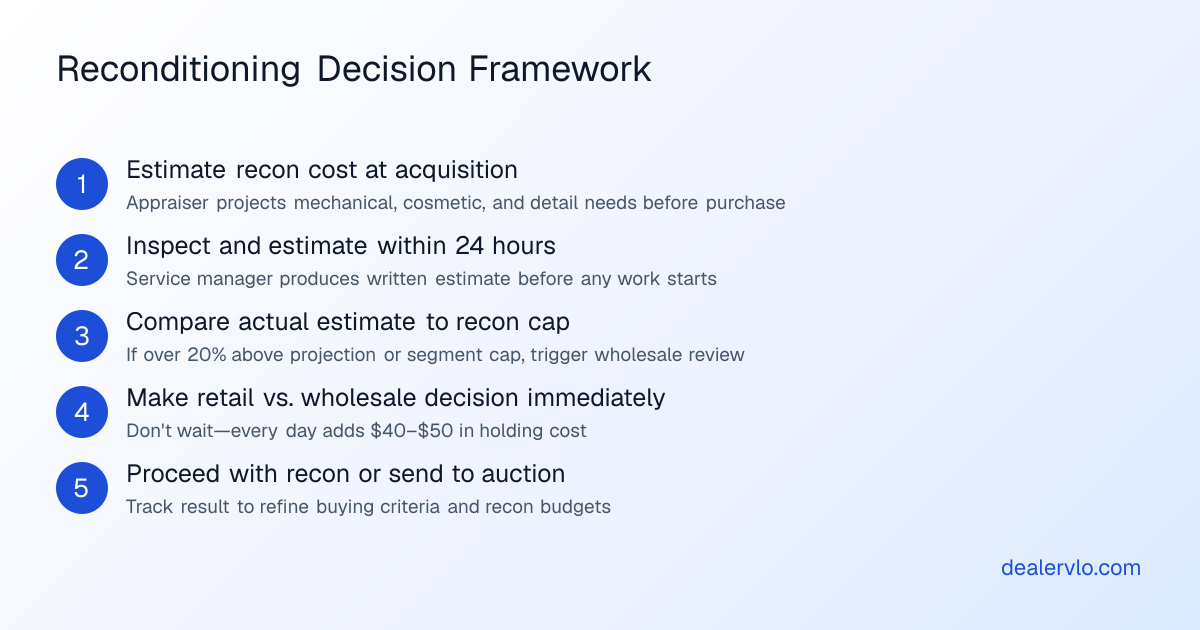
The spread matters more than the average. A late-model trade-in with 40,000 miles and a clean history might need $300—fluids, brakes, detail, inspection. A wholesale buy with 110,000 miles, a check-engine light, and a cracked bumper can easily hit $2,000 before you've addressed the interior. The key is setting category-specific caps and killing the recon process when actual cost blows past your estimate by more than 20 percent.
Dealers who use pre-approval workflows often set a baseline threshold—commonly $600 to $800 per car—and allow the service department to proceed without additional sign-off when the estimate falls below that line. Anything above triggers a retail-versus-wholesale review before work starts.
Budgeting reconditioning by vehicle type and price point
The same reconditioning checklist applied to every car is a recipe for blown margins. A $6,000 high-mileage sedan and a $22,000 low-mileage crossover need different recon budgets, different timelines, and different wholesale triggers.
Economy sedans and older high-mileage inventory ($4,000–$8,000 retail): Keep recon tight—ideally under $600. At this price point, your front-end gross is often $1,500 to $2,000, and customers expect basic transportation, not showroom finish. Focus on safety, mechanicals that pass inspection, a clean interior, and a solid detail. Skip expensive cosmetic work unless it's safety-related. If the car needs tires, brakes, and a head gasket, you're better off wholesaling it and moving on.
Mid-range crossovers and trucks ($12,000–$20,000 retail): Budget $800 to $1,400. Buyers at this tier expect a vehicle that looks and drives well, so cosmetic touch-up, new tires if tread is marginal, and a thorough mechanical check are justified. This is also the sweet spot for inventory turn rate optimization—cars in this segment move faster when they're clean and priced right, so spending an extra $200 on paint correction or upholstery repair often pays back in days-to-sale.
Late-model, low-mileage, or CPO candidates ($20,000–$35,000+ retail): Recon budgets of $1,500 to $2,500 are common, and CPO certification can add another $800 to $1,200 on top. Edmunds data shows non-luxury certified pre-owned vehicles fetch a premium of $1,245 to $1,328, while luxury CPO vehicles command a premium of $1,938 to $2,051, so the premium can justify the expense—but only if the car qualifies and you have the volume to support a CPO program. For independent dealers without factory certification, focus on delivering CPO-quality reconditioning (new tires, fresh brakes, full detail, minor paint work) and market the car as "dealer-certified" or "inspected and serviced."
Trucks and commercial vehicles: Tires, brakes, and suspension components cost more, and buyers scrutinize mechanical condition closely. Budget an extra 20–30 percent over your passenger-car baseline. One dealer noted that brake pad inspections run about $20 per vehicle, with pads themselves costing $20 for a set—but on a three-quarter-ton truck, expect to double or triple that for pads and rotors.
The most profitable dealers set recon caps as a percentage of expected gross profit—typically 30 to 40 percent. If you're aiming for $2,000 gross on a car, cap recon at $600 to $800. If actual cost comes in higher, reassess the retail price or send it to auction.
When to cap recon spend and wholesale instead
The fastest way to protect your gross profit is knowing when to stop. If the actual reconditioning amount comes in more than 20 percent above your buyer or appraiser's estimate, stop the process and wholesale the vehicle. That single rule can increase your annual gross profit by tens of thousands of dollars, because every car you over-recondition is a unit that erodes margin across your entire inventory.
Here's the framework most dealers use:
-
Set a hard recon cap before you buy. Your appraiser should estimate recon cost at acquisition and flag any car that's likely to exceed your segment cap. If you're targeting $1,200 gross on a $9,000 sedan, a $1,000 recon estimate means you're buying at the edge—any surprise pushes you into negative territory.
-
Inspect and estimate within 24 hours of acquisition. The longer a car sits before you know the real recon number, the more sunk cost and emotional attachment build up. Gather your appraisers and service manager once a day to review trade-ins and make the retail-versus-wholesale call quickly.
-
Wholesale immediately if recon blows the cap. Don't rationalize. Don't hope you can get an extra $500 on the retail price to cover the overage. The car that needs $2,200 in work when you budgeted $1,200 is a wholesale unit, period. Most dealers need to wholesale some percentage of their acquisitions to maintain inventory turns and profitability goals, and the cars that exceed recon caps are the cleanest candidates.
-
Factor in holding cost. Every day a car spends in recon accrues $40–$50 in carrying cost. If your shop is backed up and a car will sit for two weeks waiting for a part, that's another $560–$700 in silent cost. Sometimes the right move is to wholesale a car that would be profitable in a three-day recon cycle but loses money in a fifteen-day one.
Aged inventory pressure amplifies the problem. Vehicles sitting on your lot for 60–90 days face significant downward price pressure, and dealers often sell at or below cost just to free up capital and lot space. If you're already 60 days in and reconditioning cost was high, you're stacking two margin killers on the same unit.
Before you authorize the work: see whether a repair earns back its cost plus the holding days it adds.
Open the Recon ROI CalculatorReconditioning time and the hidden cost of delay
The national average reconditioning cycle time is 12.2 days—nearly two weeks from acquisition to frontline-ready. NADA recommends a three-day cycle, but the North American average runs ten to twelve days, and independent dealers often see four to five days as realistic. Every extra day beyond your target costs $37–$50 in holding costs, and longer time-to-line means slower turns and more capital tied up in non-selling inventory.
Common bottlenecks that stretch recon time:
- Waiting for parts. One delayed part order can add a week to the cycle. Dealers with in-house service departments and strong vendor relationships turn cars faster than those relying on outside shops.
- Approval delays. If every recon estimate requires manager sign-off and your manager reviews once every two days, you've built a four-day lag into the process before work even starts.
- Service backlog. If your service bays are full of customer pay work, recon cars sit. Some dealers dedicate one bay exclusively to recon and measure tech performance on cycle time, not just cost.
- Quality control and photo prep. The car may be mechanically ready but still waiting on final detail, photos, and lot placement. Track "service complete" separately from "front-line ready" to identify where the delay really lives.
Faster reconditioning improves margin in two ways: it cuts holding cost, and it gets cars onto the lot while they're still fresh and desirable. A car that's ten days old when it hits your website is more attractive than one that's been sitting in your back lot for three weeks, even if the customer never knows the difference. If you're running a cloud-based DMS, you can track time-to-line by acquisition source, tech, and vehicle type, which makes it easier to spot patterns and fix the bottlenecks that cost you money.
14-day free trial, then $29/mo · Cancel anytime
ROI on reconditioning: what's worth spending
Reconditioning is an investment, and like any investment, it should deliver a measurable return. The question isn't "how much does recon cost?"—it's "does this dollar of recon generate more than a dollar of gross profit?"
Edmunds data shows non-luxury certified pre-owned vehicles command a premium of $1,245 to $1,328, while luxury CPO vehicles command a premium of $1,938 to $2,051. If CPO certification costs you $1,200 in extra recon and fees, you're netting a solid return on non-luxury vehicles plus the faster sale that comes with CPO credibility. That's a clear win on the right car—but only if the car qualifies and your market values the certification.
For non-CPO inventory, the ROI math is harder to quantify but follows similar logic. A $300 paint correction job on a $16,000 crossover might let you price $500 higher and sell three days faster, which is a strong return. The same $300 spent on a $7,000 sedan with thin margin might not move the needle on price or days-to-sale, which makes it a bad bet.
NADA data puts average used front-end gross in the range of roughly $2,000 to $2,800 per unit in recent years, measured after recon. NIADA Q1 2025 data shows retail dealers averaging $1,921 gross per vehicle. If your recon spend is eating 50–70 percent of that gross, you're either buying wrong, reconditioning wrong, or pricing wrong—and usually it's a combination of all three.
The dealers who consistently hit higher gross profit are the ones who:
- Buy with recon cost already factored. They estimate recon at the point of appraisal and pass on cars that won't clear their margin threshold.
- Recondition in-house or with predictable vendor pricing. Outsourcing recon to the lowest bidder every time introduces cost variability and delays. Long-term vendor relationships or in-house service produce more consistent results.
- Track recon cost per vehicle and per category. If you don't measure it, you can't manage it. A DMS that tracks recon by line item lets you see which categories are blowing budget and which techs or vendors deliver the best cost-per-day performance.
- Kill losers fast. The car that's going to lose money is obvious within 48 hours of acquisition. Wholesale it immediately and reinvest that capital in a better unit.
Managing recon cost across your operation
Reconditioning cost isn't just a per-car problem—it's an operational one. Dealers who treat recon as an afterthought end up with inconsistent quality, unpredictable timelines, and margin erosion across the board. Dealers who treat it as a core process see measurable improvements in gross profit, turn rate, and customer satisfaction.
Standardize your inspection and estimate process. Every car should go through the same mechanical inspection checklist within 24 hours of acquisition, and the service manager or lead tech should produce a written estimate before any work starts. That estimate becomes your go/no-go decision point. If your threshold is $800 and the estimate is $1,200, you make the wholesale call immediately, not after you've already spent $600.
Set category-specific caps and track variance. A $15,000 crossover might have an $800 mechanical cap, a $200 tire cap, a $150 cosmetic cap, and a $100 detail cap. If the mechanical estimate comes in at $1,100, that car is either repriced, sent to wholesale, or approved as an exception with a documented reason. Track how often you exceed caps and by how much—chronic overspend in one category usually points to a vendor problem, a buying problem, or a parts-sourcing problem.
Measure time-to-line by acquisition source. Trade-ins often recon faster and cheaper than auction buys, because you've seen the car in person and talked to the owner. Wholesale buys are higher-risk. If your auction cars are taking twice as long to recondition and costing 30 percent more, that's a signal to tighten your auction buying criteria or adjust your recon budget assumptions for those units.
Dedicate resources to recon. If your service bays are always full of customer pay work and recon cars sit for days waiting for an open slot, you're losing money on holding cost. Some dealers run a dedicated recon bay or outsource recon to a trusted independent shop that can guarantee a three-day turnaround. Speed and predictability are worth paying for.
Review gross profit and recon cost together. A car that grossed $2,400 sounds great until you see it cost $1,600 to recondition and sat on the lot for 47 days. Net margin after recon and holding cost might be $400, which is a mediocre outcome. The cars that look like winners on the front end often turn into losers when you account for total cost of ownership. Your dealer management system should make it easy to run a report showing gross profit, recon cost, days-to-sale, and net margin per vehicle—if it doesn't, you're flying blind.
What new dealers need to know about recon budgets
If you're just starting out or planning to open a dealership, reconditioning cost is one of the most commonly underestimated expenses. The cost to open a used car dealership includes working capital for inventory acquisition, but many new dealers budget only for purchase price and forget that every car will need another $500 to $1,500 before it can be sold.
Here's what to plan for:
- Build recon cost into your initial inventory budget. If you're buying ten cars at an average of $8,000 each, you're not spending $80,000—you're spending $80,000 plus $5,000 to $12,000 in recon, plus another $2,000 to $3,000 in holding cost if it takes two weeks to get them all ready. Budget $1,200 per car as a starting assumption and adjust from there based on your acquisition strategy.
- Develop vendor relationships before you need them. Line up a mechanic, a body shop, a detailer, and a glass guy before you buy your first car. Get pricing, set payment terms, and agree on turnaround times. Scrambling to find a shop after you've already bought a car with a cracked windshield costs you time and leverage.
- Understand your state's inspection requirements. If you're in Pennsylvania, budget $70–$95 per car for combined safety and emissions. If you're in Texas, it's $7.50 plus any emissions fees in applicable counties. If you're setting up in another state, confirm the current inspection fee structure—it varies widely, and some states require dealer-specific inspection licenses or certifications.
- Track everything from day one. Even if you're running on spreadsheets at first, record acquisition cost, recon cost by category, days in recon, days on lot, sale price, and net margin for every car. After your first 20 or 30 sales, you'll see patterns—certain vehicle types consistently recon under budget, others always blow it—and you can adjust your buying strategy accordingly.
Frequently asked questions
What is the average used car reconditioning cost for independent dealers?
The average used car reconditioning cost for independent dealers is around $1,679 per vehicle as of 2024, up from $1,455 in 2023. BHPH dealers typically spend slightly less, averaging $1,440 in Q1 2025. Industry benchmarks commonly cite a range of $500 to $1,500 per unit, depending on vehicle age, condition, acquisition source, and the dealer's quality standards. Late-model, low-mileage cars often recon for under $800, while older high-mileage vehicles or those needing body work can easily exceed $2,000.
What does reconditioning cost include?
Reconditioning cost includes everything spent to take a vehicle from as-bought condition to front-line ready: mechanical repairs, parts, tires, brakes, fluids, body and paint work, interior repair, detailing, and state inspection fees. It does not include acquisition cost, transport, auction fees, or overhead. Most dealers break recon into four categories—mechanical, tires and alignment, cosmetic and body, and interior and detailing—plus state inspection, which ranges from $7.50 in Texas to $70–$95 in Pennsylvania depending on whether emissions testing is required.
How do I decide whether to recondition a car or wholesale it?
If the actual reconditioning estimate comes in more than 20 percent above what your appraiser projected at acquisition, stop the process and wholesale the vehicle. Set a hard recon cap as a percentage of expected gross profit—typically 30 to 40 percent—and enforce it. Inspect every car within 24 hours of acquisition, get a written estimate, and make the retail-versus-wholesale decision immediately. Factor in holding cost as well: a car that would be profitable in a three-day recon cycle may lose money if it will take two weeks. The cars that exceed your recon cap or timeline are the cleanest wholesale candidates.
How long should reconditioning take?
NADA recommends a three-day reconditioning cycle from acquisition to frontline-ready, but the North American average is ten to twelve days, and many independent dealers see four to five days as realistic. The national average is 12.2 days. Every extra day costs $40–$50 in holding cost—floor-plan interest, insurance, depreciation, and overhead—so faster reconditioning directly improves margin. Common bottlenecks include waiting for parts, approval delays, service backlog, and final detail and photo prep. Tracking time-to-line by acquisition source and technician helps identify where delays occur.
What's a realistic recon budget for a $10,000 to $15,000 vehicle?
For a mid-range vehicle retailing at $10,000 to $15,000, budget $800 to $1,400 in reconditioning cost. Buyers at this price point expect a vehicle that looks and drives well, so plan for a thorough mechanical inspection, new tires if tread is marginal, cosmetic touch-up, and a solid detail. If the car needs major mechanical work or body repair that pushes recon above $1,500, reassess whether the unit has enough margin to justify retail, or wholesale it and reinvest in a cleaner example. Cap recon at 30 to 40 percent of your expected gross profit to preserve margin.
Does spending more on reconditioning increase sale price or speed?
It depends on the vehicle and price segment. Edmunds data shows non-luxury certified pre-owned vehicles fetch a premium of $1,245 to $1,328, while luxury CPO vehicles command a premium of $1,938 to $2,051, so CPO-level reconditioning and certification can deliver measurable ROI on the right car. For non-CPO inventory, cosmetic improvements like paint correction or upholstery repair on a $16,000 crossover may justify a higher price and faster sale, while the same spend on a $7,000 economy sedan often doesn't move the needle. The key is matching recon investment to buyer expectations in each segment and tracking whether higher recon spend correlates with shorter days-to-sale and higher gross profit in your actual sales data.
The bottom line
Used car reconditioning cost is the single largest variable expense between acquisition and sale, and the dealers who manage it tightly are the ones who consistently hit higher gross profit and faster turns. The average is useful context—expect to spend $1,400 to $1,700 per vehicle if you're buying typical independent-dealer inventory—but the real skill is knowing which cars deserve $400 and which justify $2,000, and having the discipline to wholesale the ones that blow your cap.
Set recon budgets by vehicle segment and price point, not by gut feel. Inspect and estimate within 24 hours of acquisition. Kill the recon process if actual cost exceeds your estimate by more than 20 percent. Track time-to-line and holding cost as closely as you track recon spend, because a cheap recon job that takes three weeks still kills your margin. And measure everything—gross profit, recon cost by category, days-to-sale, and net margin per vehicle—so you can see which acquisition sources, vehicle types, and recon strategies actually make you money.
Reconditioning isn't an afterthought; it's the operational lever that turns an OK deal into a profitable one or a marginal buy into a loss. Get the process right, and you'll move more cars, faster, at better margins. Get it wrong, and you'll wonder why your gross profit never matches your expectations.
14-day free trial, then $29/mo · Cancel anytime