Best AI Tools for Used-Car Dealers in 2026 (by the Job They Do)
The AI tools worth a used-car lot's money in 2026, ranked by the job they do — lead response, appraisal, merchandising, and AI built into the deal itself.
Part of the Marketing, leads & your website guide: Used Car Dealer Marketing: What a Small Lot Should Do First — and What to Skip
Switching from another DMS? Compare DealerVLO to DealerCenter, Frazer, or Lot Wizard.
Every week another AI tool lands in a dealer's inbox promising to sell more cars while you sleep. Most of the roundups ranking them are written by people who've never run a lot, so they lead with whatever pays the affiliate commission. Here's a different cut: the AI worth a small lot's money in 2026, organized by the job it does — because that's how you actually decide what to buy.
The short version, if you only read this far: the highest-ROI AI job for an independent is never letting a lead go cold, followed by getting cars merchandised and listed fast. And the best tool for either is usually the one that's already inside software you run — no per-transaction toll, no extra silo. The rest of this ranks the categories and tells you what to look for.
14-day free trial, then $29/mo · Cancel anytime
The five jobs AI actually does on a lot
Ignore the brand names for a second. Strip the market down and AI is doing five distinct jobs on a used-car lot. Knowing which job you're buying for is the whole decision.
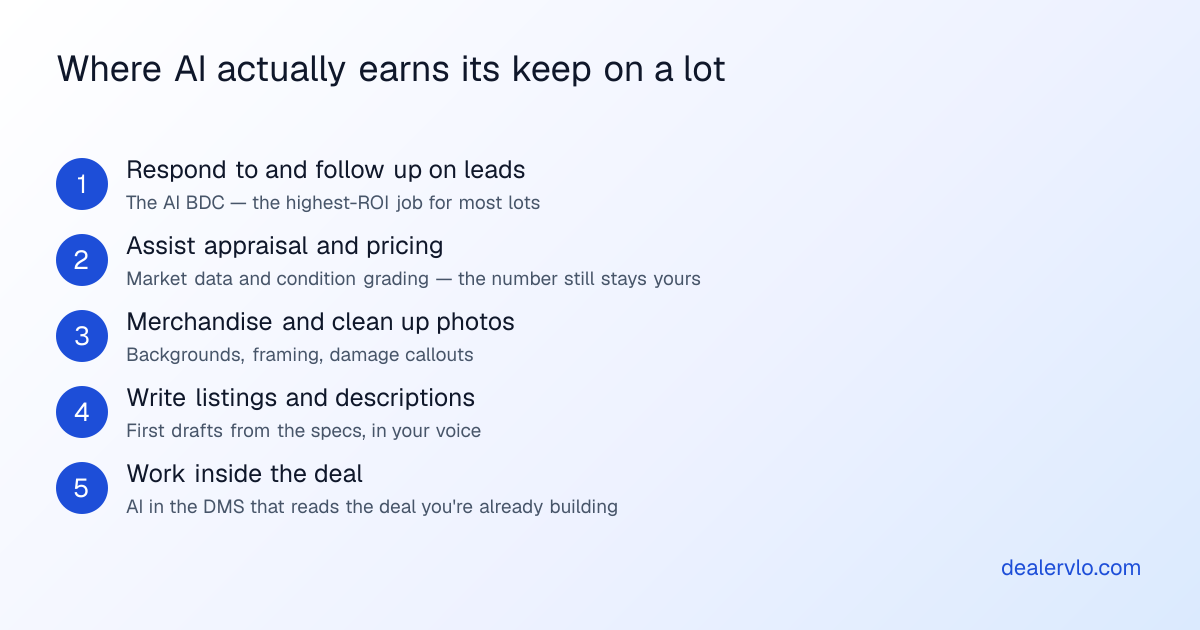
Rank them by return for a single-rooftop store and it's not close: lead response first, merchandising second, everything else after. Let's take them in order.
1. Lead response and follow-up (the AI BDC) — start here
This is the one that pays. Most lost deals aren't lost at the desk; they're lost in the hours after an online lead comes in and nobody answers. An AI BDC (business development center) responds instantly, qualifies, and keeps following up on the leads your team lets slip — nights, weekends, the third and fourth touch nobody makes.
For a small lot the win isn't replacing a salesperson; it's covering the gaps a two-person store can't. The tools here range from standalone conversational-AI platforms to the AI features now built into dealer CRMs. The right choice depends on your lead volume — a lot doing a handful of leads a day doesn't need an enterprise BDC platform. We went deep on how to pick one, vendor-free, in AI BDC for car dealerships: the short rule is that lead volume decides.
What to look for: a human-in-the-loop mode (AI drafts, you approve), pricing that isn't a fee per lead, and a hand-off to a real person the moment the buyer is ready.
2. Appraisal and pricing assistance — useful, with a hard limit
AI is genuinely good at two parts of appraisal: pulling market data (what comparable units are actually transacting for) and grading condition from photos. What it is not good at is telling you the number — because the number depends on your cost of money, your recon, your lot's turn, and what you can retail it for in your market.
The honest way to use appraisal AI is to let it inform the market and condition read, then work the number backward from your retail. We unpacked exactly which layers are worth buying and which stay in your head in AI car appraisal tools. The retail-back math itself doesn't need AI at all:
Dump it at auction now or retail it? Compare the two nets and find the break-even day.
Open the Wholesale vs. Retail CalculatorWhat to look for: transparency about where the market data comes from, and a tool that hands you a range to decide from — not a black-box "buy at $X" you can't audit.
3. Merchandising and photo cleanup — fast, low-risk
This is the safest place to let AI run. Background replacement, consistent framing, blur-plate and damage callouts, spin views — merchandising AI turns a phone photo shoot into lot-ready images in minutes, and better photos measurably move metal faster. There's little downside: a bad output is obvious and you just don't use it. Pair it with the fundamentals in getting cars photographed and listed well and it's a real time-saver.
What to look for: it should speed up your existing process, not lock your photos inside a platform you can't export from.
14-day free trial, then $29/mo · Cancel anytime
4. Listing and description writing — a first draft, not the final word
Generative AI writes a competent vehicle description from the specs in seconds, which beats a blank box every time. The trap is publishing the raw output — it drifts generic, and it will happily invent a feature the car doesn't have. Treat it as a first draft you edit, and give it a real prompt. Our ChatGPT prompts for car dealers library has the skeletons that keep it from making things up.
What to look for: control over voice and the discipline to fact-check every spec before it goes live. A listing with a wrong feature is worse than a plain one.
5. AI inside the deal — the one most roundups miss
Here's the category the affiliate lists skip because there's no commission in it: the AI built directly into your DMS or deal workflow. Instead of you copying numbers between apps, it reads the deal you're already building — flags a math or compliance gap, checks the paperwork, surfaces the thing you'd catch on your third coffee. It acts on your real data, and because it's part of software you already pay for, it doesn't add a per-transaction fee.
That's the approach we took with DealerVLO: AI that reviews the deal jacket you're building rather than a bolt-on you feed by hand — and no per-transaction API tolls, which is exactly the fee that eats a thin used-car margin. If you want the bigger picture on using AI without letting it run the store, the hub is AI for used-car dealers, and there's a related angle on getting your lot surfaced by AI answer engines in get your dealership recommended by ChatGPT.
What separates a tool worth paying for
Across all five jobs, the same handful of things separate a tool that earns its keep from one that just adds a bill.
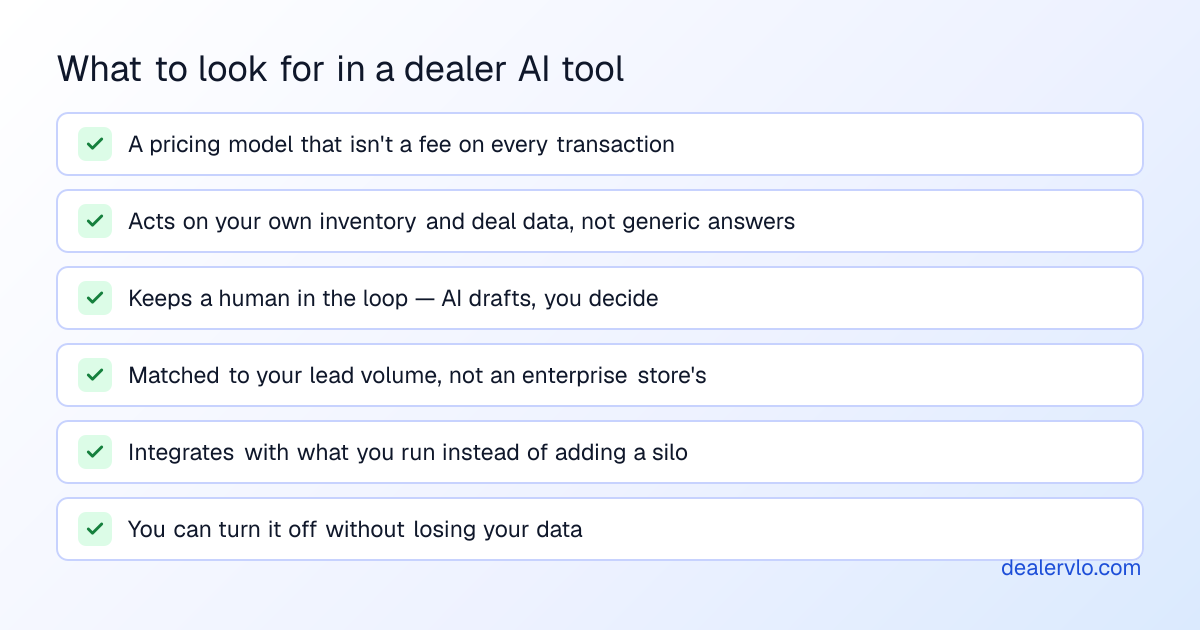
The pricing model matters more than the feature list. On a used-car deal you might make a few hundred to a couple thousand dollars of gross — a tool that charges per lead or per sale is taking a cut of that on every unit, forever. A flat subscription, or AI included in software you already run, doesn't scale its bite with your success.
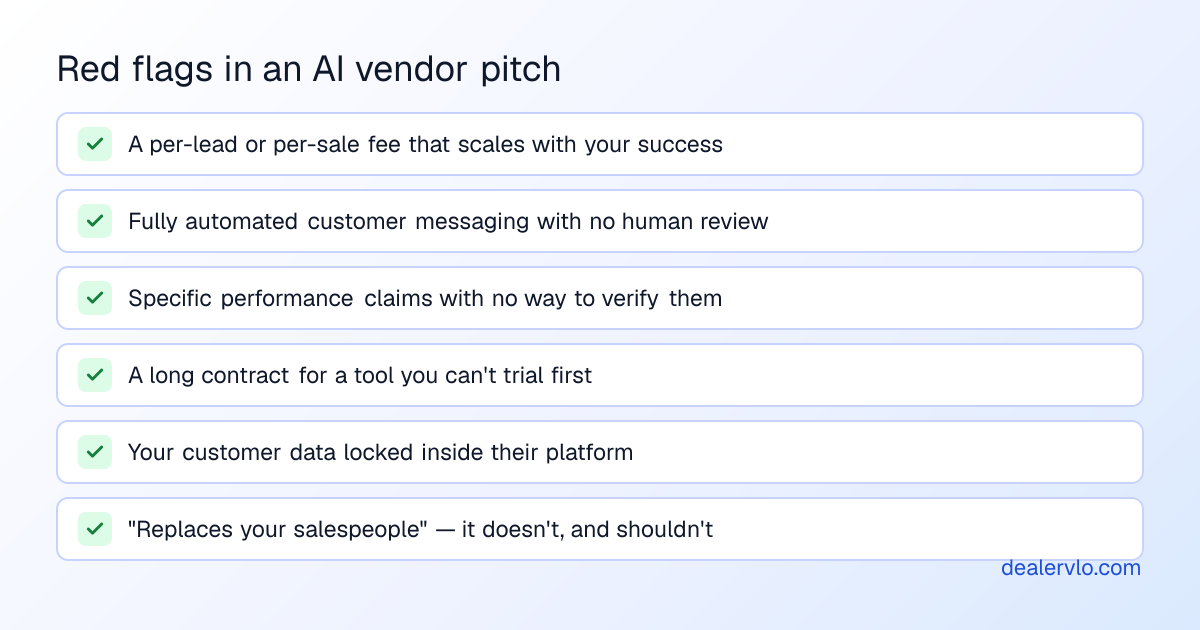
And watch the pitch itself:
Frequently asked questions
What are the best AI tools for used-car dealers? Rank them by job, not brand: lead response (an AI BDC), appraisal/pricing help, merchandising and photos, listing writing, and the AI built into your DMS. The best pick in each is the one that fits your volume and doesn't charge per transaction.
Do I need AI tools for a small lot? Not a whole stack. Most single-rooftop lots win most from never letting a lead go cold and getting cars listed fast — start there, and prefer AI that's built into software you already run.
How much do AI dealer tools cost? It varies too much to quote, and it changes constantly — judge the pricing model instead. A per-transaction or per-lead fee scales with your success; a flat subscription or included AI doesn't. On a thin margin, the per-transaction toll costs the most.
Is DMS-native AI better than a standalone tool? For most independents, yes — it acts on the deal data you already have and usually adds no per-transaction fee. Standalone tools can win at one narrow job but add another login, bill, and data silo.
Bottom line
Don't buy AI by the brand on the roundup. Buy it by the job: cover your lead response first, speed up merchandising second, and lean on AI that's built into the software you already run before you bolt on a separate subscription for every task. Keep a human in the loop, avoid per-transaction fees, and treat every AI output as a draft you approve.
DealerVLO builds the AI into the deal itself — it reviews the jacket you're working, with no per-transaction tolls — so you get the highest-ROI AI job without another login. Start a 14-day free trial and see it on a real deal.
14-day free trial, then $29/mo · Cancel anytime