AI Car Appraisal Tools: What They Can Tell You — and What Still Has to Be You
AI appraisal tools bundle market comps, condition grading, and a recommended number. Which parts are worth paying for, and which part must stay yours.
Part of the Buying & sourcing inventory guide: How to buy at dealer auctions without getting buried
Switching from another DMS? Compare DealerVLO to DealerCenter, Frazer, or Lot Wizard.

Three products in one box — and only two are for sale
Every AI appraisal pitch promises the same thing: point your phone at a car and know what to pay. And like most AI pitches aimed at dealers, it's a bundle of true things and one quiet overreach.
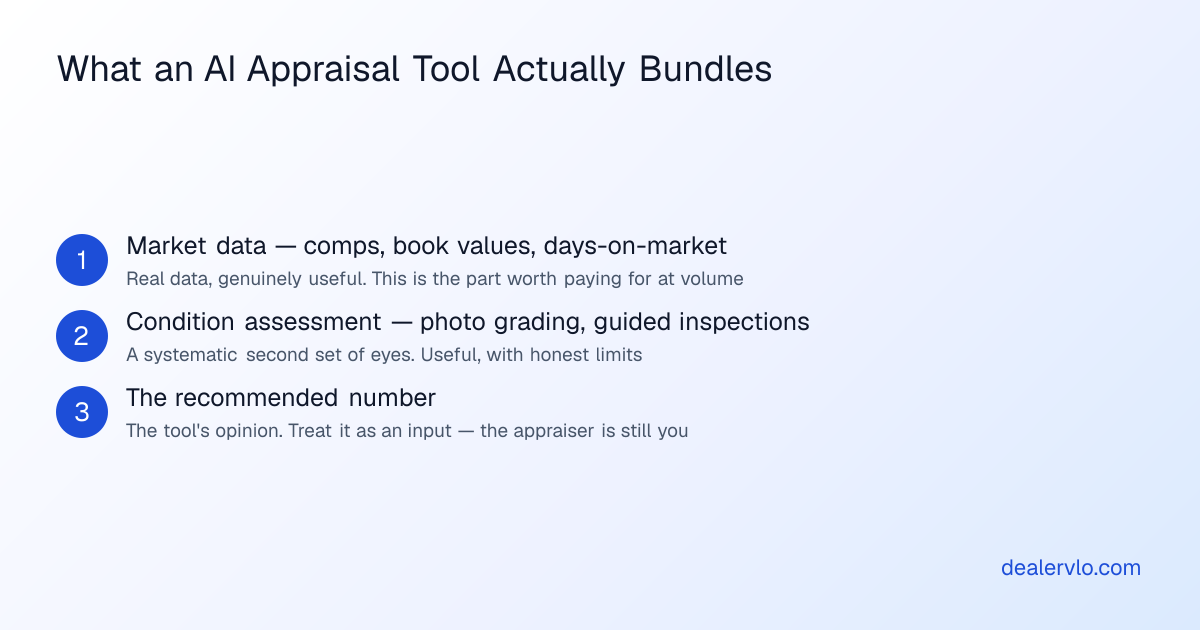
Here's the unbundling that makes the whole category make sense. An AI appraisal tool is three layers in one subscription: market data (live comps, book values, days-on-market — real information, aggregated faster than you can pull it), condition assessment (AI grading from photos or guided inspections — a systematic second set of eyes), and a recommended number. The first two are products. The third is an opinion wearing a product's clothes — and treating it as the answer is how dealers overpay in the lane with great data on the screen.
I use AI daily on my lot and wrote the working guide on it. The rule there applies here with full force: AI drafts, you decide. In appraisal terms: the tool reports, you appraise.
14-day free trial, then $29/mo · Cancel anytime
The market-data layer: genuinely good, worth real money at volume
Let's give the category its due. The data layer is the strongest part of these tools, and it isn't hype: live retail comps, auction results, book values, days-on-market for your segment — assembled in seconds instead of the twenty minutes of tab-juggling it takes by hand. If you evaluate a lot of cars, that time compounds into real money, and paying for speed on data you'd gather anyway is a rational trade.
The questions that separate good data from a good demo: where it comes from and how local it gets. A national average on a vehicle whose value swings by region is precision without relevance — trucks, AWD, and convertibles all price differently depending on where you sell. Make the demo show you comps scoped to your actual market radius, and ask how stale the feed runs. Data quality is the product; everything else is interface.
The condition layer: a second set of eyes, not a replacement pair
AI condition grading — from photos, scans, or guided walk-around apps — earns a more qualified yes. As a consistency tool it's real: it asks about the same items every time, doesn't get lazy on the fifth car of the day, and produces a documented record that makes your appraisal defensible later. For a lot where three different people work trades, that standardization alone can be worth it.
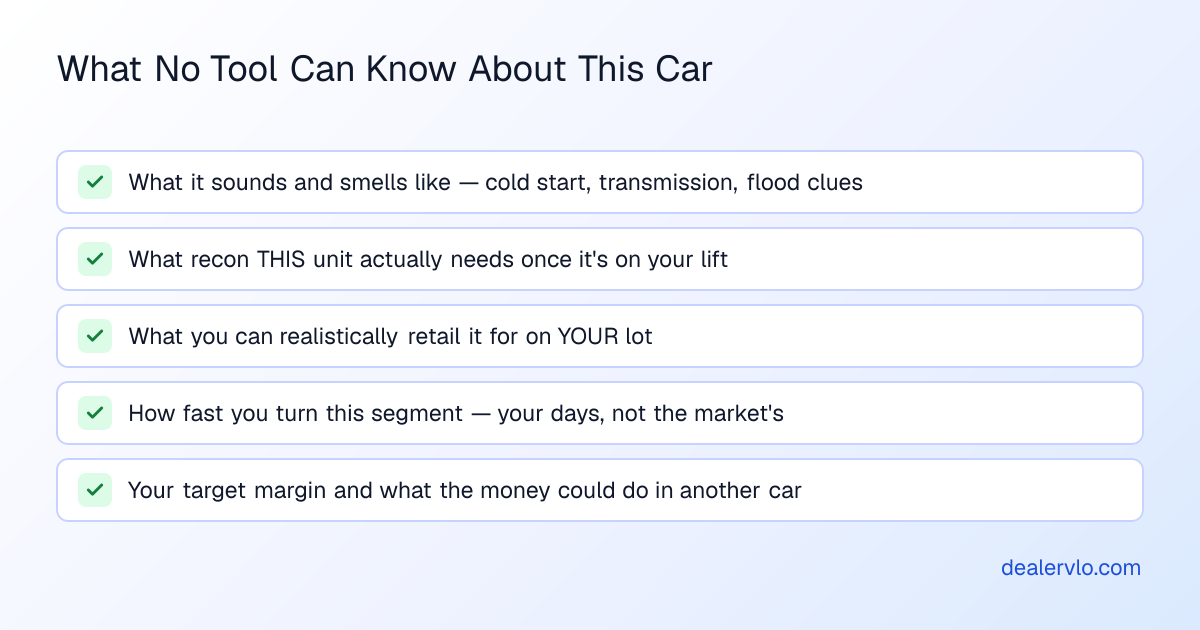
The limits are physical, and no model update fixes them: a photo can't hear the cold start, smell the flood car, or feel the transmission hunt on the test loop. The walk-around habits in how I appraise a trade don't get replaced by the app — the app documents what the walk-around finds. And the grade feeds a recon estimate that is, at best, an average — what this specific unit needs once it's on your lift is knowable only from your shop and your standards.
The recommended number: where you take the wheel back
Here's the layer to be stubborn about. The tool's suggested value or max bid is built from market data plus averaged assumptions — average recon, average margin targets, average turn. But an appraisal isn't a market question; it's a your-lot question. The right number works backward from your exit: what you can realistically retail this unit for, minus the recon it actually needs, minus holding for the days it'll sit, minus the margin you're in business to make. That's the retail-back method, and no subscription knows those inputs — they're yours.
The practical protocol: let the tool put the market on one screen, then set your max number with your own math before emotions or auction adrenaline get a vote. When the tool's recommendation and your number disagree, that's not a malfunction — it's the tool telling you what an average dealer could pay, and your math telling you what you can. Trust yours.
Work out the most you can bid at the lane and still hit your target margin.
Open the Auction Profit CalculatorThe free stack, for lower-volume buying
If you're appraising a few cars a week, run the honest comparison before subscribing: comps pulled from the listing sites you already browse, book access you may already have, and a general AI assistant to organize the mess — the comp-organizer and condition-report prompts do exactly this. It's slower per car and close to free, and it keeps every judgment rep in your hands, which is how appraisal skill compounds. The subscription starts making sense when volume turns those saved minutes into saved days — same arithmetic as the AI BDC decision: the tool earns its keep when the alternative stops being "you, slightly slower" and becomes "not done at all."
14-day free trial, then $29/mo · Cancel anytime
If you demo one
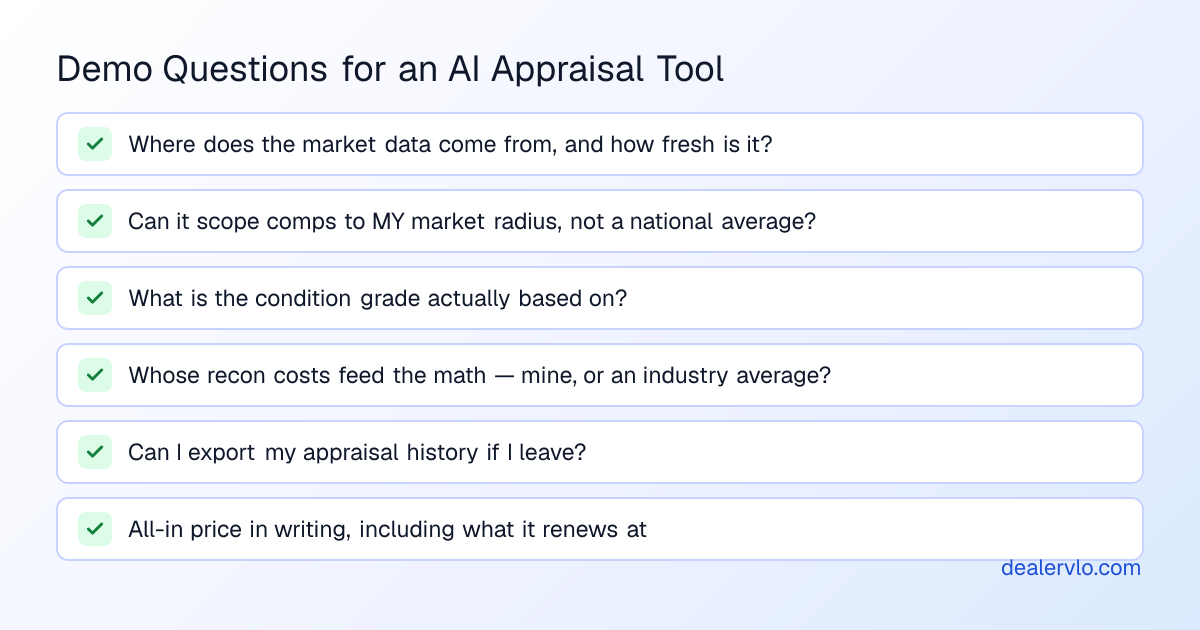
The checklist above is the whole method, and two items deserve the spotlight. "Whose recon costs feed the math?" — if the answer is an industry average, every recommended number the tool ever shows you carries someone else's shop rates. And "can I export my appraisal history?" — your appraisal records are your buying education in data form; a tool that keeps them when you leave is charging you rent on your own judgment. As with every vendor in the AI-for-dealers wave: all-in price in writing, month-to-month if you can get it, and let the demo answer with specifics or let the silence answer for it.
Frequently asked questions
What is an AI car appraisal tool?
It's software that helps a dealer value a vehicle by bundling three things: aggregated market data (live comps, book values, days-on-market), AI-assisted condition assessment (grading from photos, scans, or guided inspections), and a recommended value or bid. The market-data layer is essentially a faster window into what similar cars are listing and selling for; the condition layer flags issues systematically; the recommended number is the tool's opinion — and the part a dealer should treat as an input, not an answer.
Are AI vehicle appraisals accurate?
The data parts are as accurate as their sources — comps and book values reflect real listings and auction results, and that's genuinely useful. The judgment part is where accuracy gets slippery: a recommended price can't know your recon costs, your buyer, your exit plan, or what the car sounds like on a cold start. Treat the tool as an accurate report of the market and an incomplete report of the car, and keep the final number yours. Any tool claiming its number removes the need for dealer judgment is overclaiming.
Can AI tell me what to pay for a trade-in or an auction car?
It can tell you what similar cars are bringing, which is most of the homework. It can't tell you your max number, because that depends on things only you know: what recon this specific unit needs, what you can retail it for on your lot, how fast you turn this segment, and your target margin. The honest workflow is data from the tool, max bid from your own math — working backward from your realistic exit.
How much do AI appraisal tools cost?
Most are subscription products and many don't publish pricing — expect a demo and a per-rooftop quote. Before paying, price the alternative honestly: book-value access you may already have, free listing sites for comps, and a general AI assistant to organize what you collect. For low-volume buying the free stack often covers it; at high volume, the time savings of an integrated tool can genuinely pay.
Do I need an appraisal tool as a small independent dealer?
It scales with how many cars you evaluate. Appraising a few trades and auction runs a week, you can pull comps manually and use a free assistant to organize them — slower per car, nearly free. Evaluating dozens of units weekly, the integrated data and consistent condition workflow start paying for themselves in hours saved and mistakes avoided. Either way, the tool informs the number; it shouldn't set it.
Bottom line
Buy data. Rent a second set of eyes if your volume justifies it. Never outsource the number. The market layer of these tools is real and the condition layer is useful — but the recommended price is an average dealer's answer to a question only you can ask about your lot, your shop, and your exit. Data from the machine, number from the dealer.
And keep the foundation under it: when you do buy the car, the appraisal notes, the recon spend, and the eventual gross should land in one system so your next appraisal is smarter than your last. That's the part DealerVLO handles for $29/month — every unit's real costs and real outcome on record, which is the only appraisal dataset that's actually about your lot. The rest of the AI toolkit is in the working guide.
14-day free trial, then $29/mo · Cancel anytime