How to Win Auction Arbitration: Documentation & Dispute Tactics for Wholesale Buyers
Auction arbitration under the June 2026 NAAA guidelines: filing deadlines by auction, the documentation that wins claims, and dispute tactics for wholesale buyers.
Part of the Buying & sourcing inventory guide: How to buy at dealer auctions without getting buried
Switching from another DMS? Compare DealerVLO to DealerCenter, Frazer, or Lot Wizard.
What changed in June 2026—and why it matters
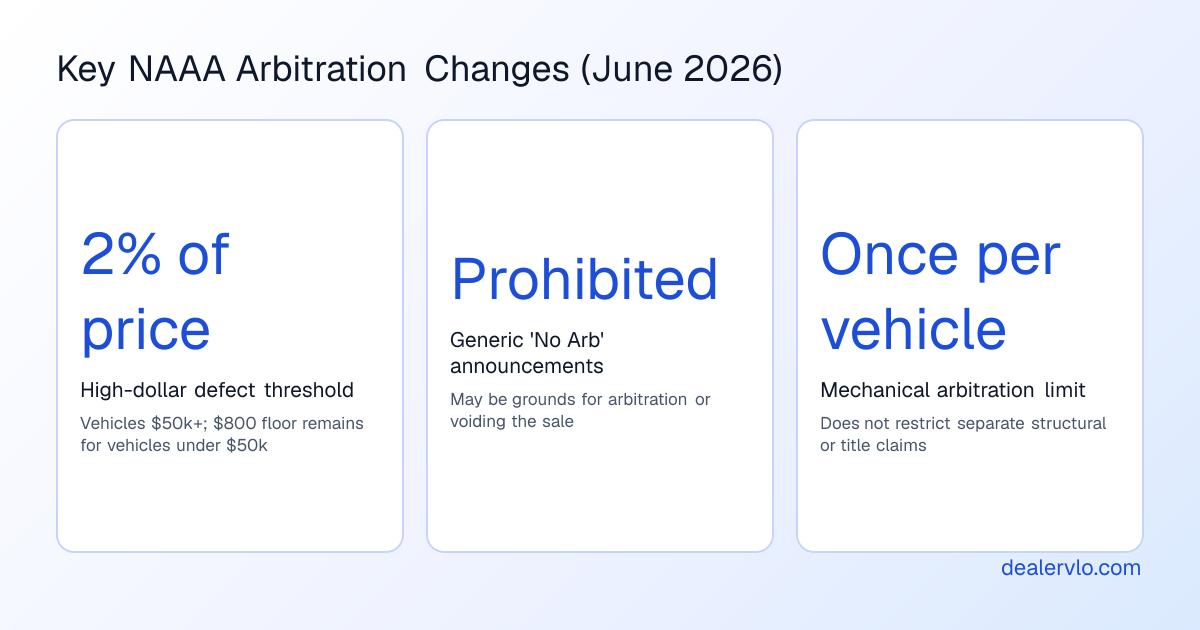
Auction arbitration is where wholesale deals go to live or die after the hammer drops. The National Auto Auction Association's updated arbitration guidelines took effect June 1, 2026, and the changes hit high-dollar inventory hardest: vehicles selling for fifty thousand or more now face a steeper per-defect threshold, generic "No Arb" seller announcements are prohibited, and the guidelines spell out that the one-mechanical-claim-per-vehicle limit doesn't block a separate structural or vehicle-history claim.
Strictly speaking, the NAAA guidelines are recommendations: each auction adopts them "in whole or in part" into its own terms. Manheim moved to the new thresholds on June 1, 2026, but don't assume every auction adopted every change. Whether you win or lose a claim comes down to knowing your auction's thresholds, filing inside its window, and getting the right evidence in before its deadline. This guide walks through the rules, the platform-specific timelines, and the documentation tactics that actually move arbitrators.
Note: Arbitration policies are contractual terms set by each auction, and they change. The auction-specific figures below were checked against each auction's published policy on September 26, 2026, and linked so you can confirm the current version before you file. This is not legal advice.
Updated September 26, 2026: every auction-specific figure in this post was re-checked against the auctions' own published policies, and several were corrected.
14-day free trial, then $29/mo · Cancel anytime
Updated NAAA thresholds: what qualifies as arbitrable in 2026
The June 2026 NAAA guidelines use a two-tier dollar threshold. For vehicles purchased under fifty thousand dollars, the eight-hundred-dollar threshold is unchanged: any single undisclosed mechanical defect that costs eight hundred or more to repair is eligible for arbitration. For vehicles selling at fifty thousand or above, each individual defect must carry a repair cost of at least two percent of the purchase price.
Run the math on a sixty-thousand-dollar truck: two percent is twelve hundred dollars, so a defect that costs nine hundred to repair doesn't clear the bar even though it would on a thirty-thousand-dollar sedan. The intent is to filter out minor issues on high-value inventory, but it also means you need a repair estimate in hand before you file—guessing gets expensive.
Warning lights don't let a seller off the hook, either. The guidelines say disclosing a warning light or diagnostic trouble code does not relieve the seller of arbitration responsibility, and the 2026 update extended that from lights to codes. If a seller announced a check-engine light but the real problem is an expensive failure behind it that clears the threshold, you may still have a claim.
One more clarification that matters: the limit of one mechanical arbitration per purchase does not restrict you from filing a separate claim for structural damage or vehicle-history issues (odometer and title problems fall in that group) within the timelines in the NAAA's Appendix I. You can arbitrate the transmission and then, if you discover flood history, arbitrate that too. They're independent claims.
Filing deadlines by auction and sale channel
Miss the filing window and your claim dies before anyone reads it. Deadlines vary by auction and by how you bought the vehicle—in-lane, simulcast, or online—and at most auctions they start counting on sale day, which is day one.
Under the NAAA's Appendix I, in-lane purchases get either sale day only or seven calendar days, depending on the defect, and online purchases get a minimum of seven calendar days. Each auction sets its own close-of-business cutoff and can go longer. Here's what the big ones publish:
- Manheim: in-lane claims must be filed by close of business on sale day, and the car must be back at the auction by the close of gate hours that day. Simulcast and Timed Sale (OVE) purchases get ten calendar days from the sale date, sale day counting as day one. (Manheim timelines)
- ACV Auctions: ten calendar days from the date of purchase, with a longer window where the NAAA policy provides one. (ACV arbitration policy)
- Copart: arbitration covers defects a wholesale seller failed to disclose or announce, on Green and Yellow Light vehicles only. Windows run up to 21 days or 300 miles depending on the item, and Copart may charge a $400 arbitration fee, refunded along with shipping and other reasonable costs if your claim succeeds. (Copart arbitration policy)
- DealerCenter's Auction Center: DealerCenter is best known as a dealer management system, but it also runs Auction Center, a dealer-to-dealer online auction, and its rules count in business days: ten business days by default, starting the business day after you're notified of the winning bid; fifteen for fire, flood, or frame/structural damage, or for a vehicle more than four hundred miles from your location; thirty for grey-market, true-mileage-unknown, total-loss, lemon-law, and similar history issues; and forty-five if the vehicle was unavailable for pickup. (Auction Center arbitration rules)
- OPENLANE and ADESA: OPENLANE and the Carvana-owned ADESA US marketplace each publish their own policies, and OPENLANE's own materials don't all quote the same window. Read the current policy on the platform before you buy.
Low-dollar vehicles often carry limited or no arbitration rights. Manheim's Limited Arbitration Rights policy, effective April 1, 2026, makes every vehicle sold for $3,000 or less "As-Is" regardless of sale light. Arbitration there is limited to odometer problems (inoperative, or true miles unknown), title branding, discrepancies, or encumbrances, requirements of law, and the seller's own representations, with no mechanical or structural guarantees. If you're buying sub-three-thousand cars there, plan on keeping what you bought.
The short version: know your platform's policy before you bid, and if you're buying digitally, confirm which sale channel your purchase counts as—the label sets your deadline. When in doubt, assume the shorter window and file early.
For a broader look at auction buying strategy and how to price defects before you bid, see our dealer auction buying guide and how to use MMR and Black Book auction pricing.
Evidence deadlines are shorter than filing deadlines—and they kill more claims
You filed on time. Great. Now there's a second, tighter clock on the evidence. ACV gives you two calendar days from ACV's request to send photos, video, or other evidence. OPENLANE and ADESA Clear give two business days after you start the claim to provide supporting documentation. Manheim gives five calendar days from the arbitrator's notice or request. DealerCenter's Auction Center gives four business days to answer a request for more information. Miss the evidence deadline and you can lose the claim even if the defect is real and arbitrable.
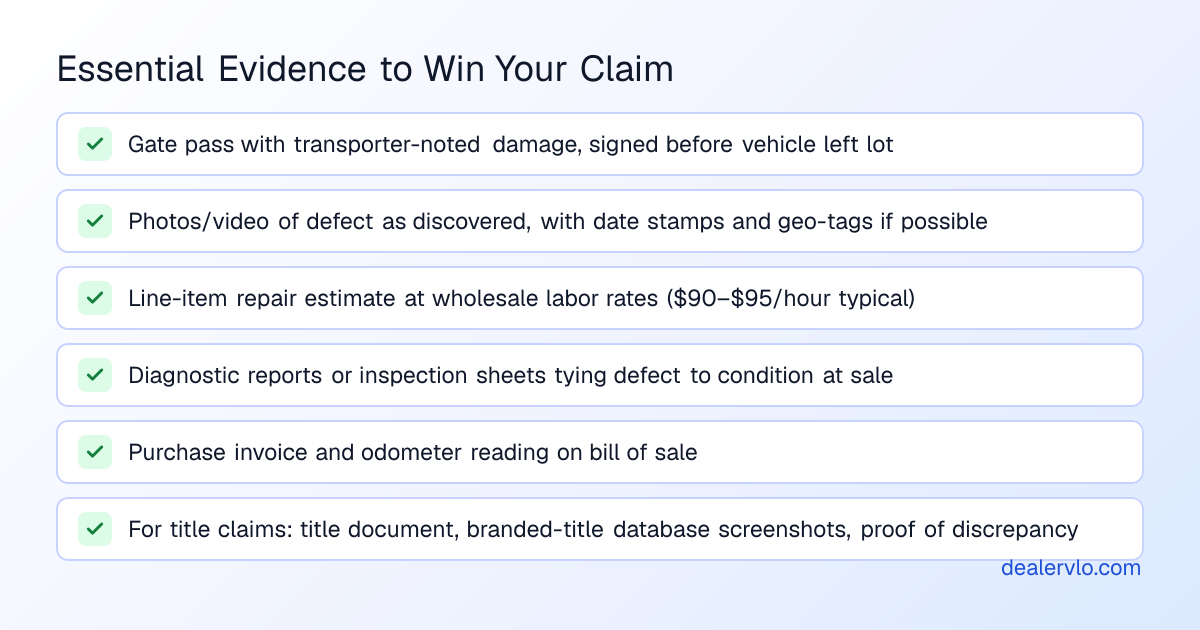
What counts as evidence? A record of the car's condition at pickup, photos or video of the defect as discovered, the repair estimate (line-item, at wholesale labor rates), and any diagnostic reports or inspection sheets that tie the defect to the vehicle's condition at sale. If you're claiming a title issue, you need the title itself and whatever shows the discrepancy.
The condition record at pickup is the document dealers skip most. Before your transporter or driver leaves the auction lot, walk the vehicle and write down every ding, scrape, fluid leak, warning light, or mechanical symptom—on the gate release, the carrier's bill of lading, or both. If damage isn't documented before the vehicle leaves the lot, you'll have a hard time proving it didn't happen in transit or at your facility, and transport damage isn't the seller's problem.
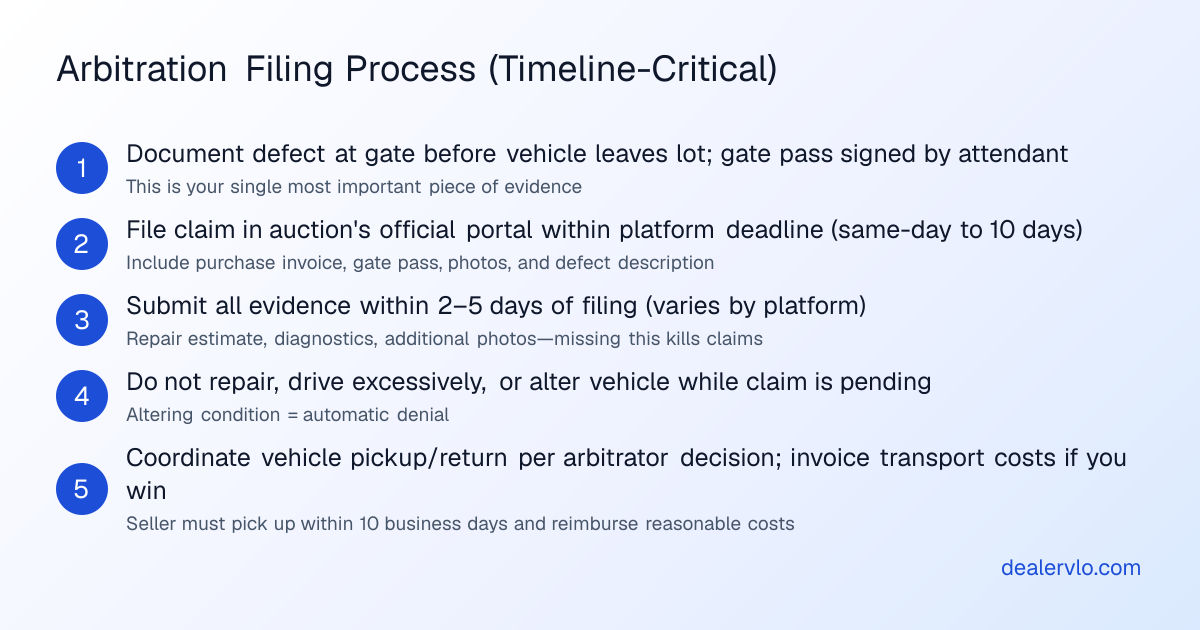
Never repair the vehicle before arbitration closes. The moment you replace the part or clear the code, you destroy the evidence; DealerCenter's Auction Center rules, for one, say repairs made before a final decision may result in denial. Leave the defect exactly as-is, document it thoroughly, and wait for the arbitrator's instruction. If they want an independent inspection, they'll tell you. If they award a credit, you can fix it after the case settles.
One more automatic disqualifier: miles. The NAAA leaves the mileage limit to each auction, and the limits differ a lot. At Manheim, a vehicle with more than 200 miles since the time of sale is not eligible for arbitration. ACV requires that the odometer hasn't risen 150 miles or more over the mileage shown on its platform at delivery. Copart allows no more than 300 added miles. Don't test-drive it across three states before you file.
What happens when you win (and when you don't)
A full cancellation—where the sale is voided and you return the vehicle for a refund—isn't the only outcome, and some platforms say they prefer the alternative. ACV's policy says it generally treats "payment for parts and labor expenses, at wholesale rates" as appropriate instead of cancelling the transaction. Labor is priced at the auction's rate, not your shop's: Manheim uses $95 an hour for mechanical estimates and $75 for paint and body (California locations use higher rates), and ACV uses $90 an hour for combustion-engine vehicles and $100 for EVs.
This means your repair estimate matters. Submit a retail quote from your corner mechanic and the arbitrator will adjust it down to wholesale, potentially lowering your credit. Get the estimate from a wholesale shop or your own reconditioning bay and price it at the platform's published rate. Line-item clarity also matters—"fix engine, $2,400" gets challenged; "replace timing chain, tensioner, and guides, 8.2 hours labor at $95/hour, parts per supplier quote" is far easier to approve.
What happens after a cancellation depends on the auction's rules. The NAAA guidelines limit reimbursement to commercially reasonable costs based on local wholesale repair or transportation rates. DealerCenter's Auction Center spells out more: the seller picks the vehicle up within ten business days after the arbiter's decision, reimburses reasonable transport costs you actually incurred (excluding air travel, meals, and lodging) for certain claim types, and if the seller doesn't pick up in time you may charge reasonable storage of up to $50 per day after notifying Auction Center and waiting five business days. Other auctions handle pickup, transport, and storage their own way, so check the policy for the one you bought from.
Losing costs money too. Copart refunds its $400 fee only when the claim succeeds. ADESA Clear charges the buyer a $195 invalid-inspection fee when a third-party inspector finds no evidence of the claimed issue.
Partial credits settle faster than cancellations, but you need to decide whether the offered amount covers your actual loss. Say the arbitrator offers eight hundred dollars and your real repair cost is fifteen hundred: you can push back, but the burden is on you to prove the higher figure. Most of the time I take the credit, fix it, and move on—time is money, and wholesale margin doesn't support drawn-out disputes over a few hundred dollars.
Your claims also affect the seller. ACV's GO GREEN program, which protects sellers against undisclosed defects, lets ACV raise a seller's fees, move them to a basic tier, or end their participation when their arbitration costs over the last three months run above the median for similar sellers. ADESA Clear may charge the seller a $95 fee when the buyer's claim is found valid. When you file a legitimate claim, you're not just recovering your own loss—you're creating a record that follows that seller.
Dump it at auction now or retail it? Compare the two nets and find the break-even day.
Open the Wholesale vs. Retail CalculatorCommon reasons claims get denied—and how to avoid them
You already know the top killers: missed evidence deadline, vehicle repaired before the claim closed, too many miles at return, or a defect cost below the threshold. Here are the others that catch dealers off guard.
No record of pre-existing damage at pickup. If the scratch, dent, or fluid leak isn't noted before the vehicle leaves the lot, you can't show it happened before the sale. This is especially brutal on transport damage—if your hauler delivers a car with a cracked bumper and you didn't document it at origin, you're fighting the trucker's insurance, not the auction.
The announcement or condition report already disclosed the defect. If the seller announced "transmission slips" or the condition report described the actual problem, you bought it knowing about that issue. The NAAA rules help when only a light or code was disclosed—that alone doesn't relieve the seller—but if the announcement was specific and the defect matches, your claim fails.
The defect falls under "Arbitration Limitations." That's the NAAA section listing what generally isn't arbitrable. It includes wear items such as tires, wipers, belts, brake pads, rotors, bulbs, filters, timing belts, shocks, and struts. If you're arbitrating worn brakes on a truck with a hundred-seventy-thousand miles, expect a denial.
You didn't follow the platform's claim-filing process. Every auction has a specific portal, form, or contact. Manheim, ACV, and Copart claims go through their own systems, and DealerCenter's Auction Center asks for an email with the VIN, sale details, a description, and photos or video. Filing through the wrong channel can delay or sink your case. Read the buyer guide and use the official channel.
The vehicle is outside arbitration eligibility. Low-dollar, very old, and kit or homemade vehicles carry reduced or no arbitration rights (details in the section below). Manheim's $3,000 cutoff applies regardless of sale light, so even a green-light vehicle under that price is as-is for mechanical defects.
If your claim gets denied and you believe the denial is wrong, check whether the auction's policy offers a way to ask for reconsideration. Expect the bar to be high: you'll need information that wasn't available during the original review, such as a second opinion from an independent inspector or a repair shop's diagnostic report with date-stamped photos.
For related operational advice on inspecting and reconditioning wholesale purchases, see our guide on how to detail and recondition cars for resale and our dealer trade-in appraisal guide for inspection checklists you can adapt to auction pickups.
Strategic checklist: how to maximize your win rate
Here's the operational playbook for every wholesale purchase where arbitration might come into play.
Before you bid: Confirm the auction's current arbitration policy, sale-channel timeline, and whether the vehicle falls under any exclusions. Check the online condition report and any announcements. On a vehicle of fifty thousand or more, calculate the two-percent threshold so you know the minimum repair cost that qualifies. For a detailed pre-bid pricing framework, see our guide on buying wholesale cars best practices.
At pickup: Inspect the vehicle before it leaves the lot. Note every defect—mechanical, cosmetic, operational—on the gate release or bill of lading. Take photos or video of the odometer, VIN, exterior, interior, and any visible damage or warning lights with the auction facility in the background (date stamps help). If you're picking up in person, test-drive it on the lot if allowed, and note any driveability issues.
First 24 hours after delivery: Do your full inspection. Check fluids, scan for codes, test all electrical and ADAS systems, inspect the undercarriage for frame or flood damage, and pull a fresh vehicle history report if title concerns come up. If you find an arbitrable defect, stop using the vehicle immediately—don't rack up miles or attempt diagnosis that could alter the condition.
Filing the claim: Use the platform's official claim channel. Include your purchase invoice, the pickup condition record, photos/video, and a brief description of the defect and why it wasn't disclosed. If you already have a repair estimate, attach it. If not, get one before the evidence deadline.
Evidence submission (this is where most dealers lose): Evidence deadlines run from two to five days depending on the platform, and some start when you file, others when the auction asks. Upload the complete repair estimate (line-itemed, at wholesale labor rates), diagnostic report or inspection sheet, and any additional photos. If the defect is intermittent, document multiple instances or get an independent shop to reproduce it and sign off. If the auction requests more documentation, send it the same day.
While the claim is pending: Don't repair it, don't drive it beyond what's needed to move it around your lot, and don't alter the defect. If the arbitrator schedules an independent inspection, make the vehicle available exactly as delivered. In DealerVLO, set the car's status to Hold while the claim is open; a car on Hold comes off your dealer website, so nobody calls about a car you can't sell yet.
After the decision: If you win a cancellation, follow the auction's return steps and submit your transport invoices inside its deadline (DealerCenter's Auction Center, for example, wants the invoice within five business days of the decision). If you win a partial credit, decide whether it's worth accepting; if you accept, do the repair and move the car to retail. If you lose and believe the decision was wrong, ask about reconsideration right away, with new evidence.
When the vehicle wasn't available on time: Document the delay. At Manheim, the Vehicle Availability policy (revised July 1, 2026) covers Simulcast and Timed sales: if the seller doesn't make the vehicle available within three business days of the sale date, the seller may be charged a fee of up to $500 per unfulfilled sale, passed on to the buyer. DealerCenter's Auction Center gives buyers forty-five business days to arbitrate a vehicle that was unavailable for pickup.
Before you decide whether a credit is enough, know what you actually have in the car. DealerVLO keeps each vehicle's acquisition cost and date, plus every reconditioning cost line by line, rolling into the car's all-in cost and margin. When the arbitrator offers eight hundred dollars, you can see in one screen whether that makes the deal whole.
14-day free trial, then $29/mo · Cancel anytime
How seller reputation and repeat claims affect outcomes
Arbitration isn't just a one-time dispute—it leaves a record. Auctions can see which sellers generate repeat claims, and ACV's GO GREEN terms show that a seller's arbitration costs can change what that seller pays or whether it keeps its protection. A seller with a pattern of non-disclosure is a seller you should be pricing, and eventually avoiding.
This creates a strategic angle: when you're deciding whether to file, consider not just your own loss but whether the defect represents a pattern. If you've bought three vehicles from the same consignor and all three had undisclosed check-engine problems, file all three and note the pattern in your claim narrative.
On the flip side, don't file nuisance claims on wear-and-tear issues that fall below the threshold or were clearly announced. A losing claim can cost you directly—ADESA Clear's $195 invalid-inspection fee and Copart's unrefunded $400 fee are two examples—and a string of them won't help your standing with the auction. File when you have a legitimate, documented, above-threshold defect that wasn't disclosed, and make your evidence airtight.
Vehicles and sales with limited or no arbitration rights
Some inventory is sold as-is by policy, and no amount of documentation will get a mechanical claim approved.
Low-dollar cars. At Manheim, every vehicle sold for $3,000 or less is as-is regardless of sale light, with arbitration limited to odometer problems, title branding, discrepancies, or encumbrances, requirements of law, and the seller's own representations. There are no mechanical or structural guarantees.
Older vehicles. By default under the NAAA guidelines, vehicles more than twenty model years old are sold as-is unless the seller states otherwise, and trailers, RVs, watercraft, and motorcycles can't be arbitrated past ten model years. DealerCenter's Auction Center uses a similar under-twenty-model-years limit. The NAAA leaves mileage limits to each auction. Check your auction's Arbitration Limitations section for its current rules.
Kit, homemade, and modified vehicles. Under the NAAA guidelines these sell as-is and can't be arbitrated for mileage and odometer issues, structural damage, missing warranty books, or model-year errors. DealerCenter's Auction Center goes further: kit or homemade vehicles can't be arbitrated at all.
Red Light, salvage, and parts-only sales. Expect your remedy to be limited to what the announcement and the auction's policy explicitly promise, and read both before you bid.
If you regularly buy in these categories, adjust your bid accordingly. Price in the cost of unknowns, budget for worst-case reconditioning, and walk away if the math doesn't work without an arbitration backstop. For pricing strategy on as-is and aged inventory, see our article on how to price used cars and dealer markup strategy.
What to do when arbitration is denied but you're certain you're right
Denials happen—sometimes because your evidence missed the mark, sometimes because the arbitrator applied the policy differently than you expected. If you believe the denial was wrong, you have two paths: whatever review the auction's own process allows, or escalation outside it.
Inside the auction, "new evidence" is what moves the needle: something the original arbitrator didn't see, such as an independent inspection report, a manufacturer technical service bulletin showing the defect is a known issue, or records showing the seller knew about the problem before the sale. Resubmitting the same photos with a longer narrative rarely works.
If that fails and the dollar amount is significant, read your buyer agreement's dispute-resolution terms. Some agreements send disputes to binding arbitration (the legal kind, not the auction kind) or set other rules for how and where you can bring a claim. If the amount justifies it, have an attorney read those terms before you spend money on the fight.
The practical reality: a lot of dealers, me included, eat smaller losses rather than chase them through legal channels. The smarter long-term play is to stop buying from that seller, document the pattern, and adjust your inspection and bidding to avoid repeat losses. If one platform consistently denies legitimate claims, move your volume to one that doesn't.
14-day free trial, then $29/mo · Cancel anytime
Frequently asked questions
How long do I have to file an auction arbitration claim after I buy a vehicle?
It depends on the auction and how you bought the car. Under the NAAA guidelines, in-lane purchases get either sale day only or seven calendar days depending on the defect, and online purchases get a minimum of seven calendar days, with sale day counting as day one. Manheim gives in-lane buyers until close of business on sale day and gives Simulcast and Timed Sale (OVE) buyers ten calendar days. ACV gives ten calendar days from purchase. DealerCenter's Auction Center counts in business days: ten by default, and longer for specific issues such as structural damage or a car that wasn't available for pickup. Always read the auction's current arbitration policy before you bid, because missing the window kills the claim.
What documentation do I need to win an arbitration claim at auction?
A written record of the car's condition at pickup, photos or video of the defect as you found it, a line-item repair estimate at wholesale labor rates (Manheim uses $95 an hour for mechanical work outside California; ACV uses $90 for combustion-engine cars and $100 for EVs), and any diagnostic report that ties the defect to the car's condition at sale. For a title claim, add the title and proof of the discrepancy. Evidence deadlines are short, often two to five days after you file or after the auction asks, so have it ready before you start the claim.
Can I still arbitrate a vehicle if the seller announced a check engine light?
Possibly. The June 2026 NAAA guidelines say disclosing a warning light or diagnostic trouble code does not relieve the seller of arbitration responsibility. So an announced check-engine light doesn't automatically cover an expensive undisclosed failure behind it, as long as the repair clears the dollar threshold. If the announcement described the actual defect, though, you bought it knowing about that issue and the claim won't hold.
What happens if I repair the vehicle before the arbitration closes?
You risk losing the claim. Once you replace the part or clear the code, the evidence is gone, and auction policies say so directly: DealerCenter's Auction Center rules, for example, say repairs made before a final decision may result in denial. Leave the defect as-is, document it, and don't drive the car beyond moving it around your lot. Fix it after the case settles.
What's the difference between a partial credit and a full sale cancellation in auction arbitration?
A partial credit pays you toward the repair and you keep the car. A cancellation (buyback) voids the sale, the car goes back, and you get your purchase price back. Some platforms state a preference: ACV's policy says payment for parts and labor at wholesale rates is generally appropriate instead of cancelling the sale. If a credit doesn't cover your real loss you can push back, but you'll need to prove the higher repair cost.
Do auction arbitration rules apply the same way at every auction?
No. The NAAA guidelines are recommendations that each auction adopts in whole or in part into its own terms. Windows, evidence deadlines, labor rates, low-dollar cutoffs, mileage limits, and fees all differ. For example, Manheim gives ten calendar days on digital purchases and uses a $95 mechanical labor rate outside California; Copart may charge a $400 arbitration fee that's refunded if your claim succeeds; DealerCenter's Auction Center counts its windows in business days. Read the specific auction's current policy before you bid.
Bottom line
Auction arbitration is a recoverable loss if you know your auction's rules, file inside the window, and get clean evidence in before the deadline. The June 2026 NAAA guidelines raised the bar on high-dollar vehicles and banned generic "No Arb" announcements, and they confirm that a mechanical claim doesn't use up your right to a separate structural or vehicle-history claim.
Your win rate comes down to discipline: document condition at pickup, never repair before the case closes, get your repair estimate line-itemed at the auction's labor rate, and hit the evidence deadline. When a credit is offered, weigh it against what you really have in the car and take it if it makes you whole—time in arbitration is time the car isn't on your lot earning.
If you're buying wholesale volume, know every car's true cost. DealerVLO's used car dealer software keeps acquisition cost, reconditioning lines, and days on the lot on every vehicle, and the dealer paperwork software side fills the deal forms when the car finally sells. Start a free 14-day DealerVLO trial at /signup and put your next auction buy in it.
14-day free trial, then $29/mo · Cancel anytime