How to Appraise a Trade-In as a Used-Car Dealer
A trade-in appraisal workflow for independent dealers: book-value tools, condition grading, recon cost estimates, and building an offer that holds margin.
Part of the Buying & sourcing inventory guide: How to buy at dealer auctions without getting buried
Switching from another DMS? Compare DealerVLO to DealerCenter, Frazer, or Lot Wizard.
Why a consistent appraisal process matters
Knowing how to appraise a trade-in as a dealer separates profitable inventory decisions from money losers. A customer walks in with keys in hand, you've got maybe fifteen minutes to inspect the vehicle and quote a number, and whatever you offer becomes your all-in cost once you add reconditioning. Get it right and you've acquired retail-ready inventory below market; get it wrong and you're upside-down before the unit ever hits the lot.
The gap between book value and actual dealer cost is where the work happens. Every trade carries hidden expenses—tires that looked fine from ten feet away, a check-engine light that clears but comes back, or a market that doesn't want beige sedans in your ZIP code this month. A disciplined appraisal workflow gives you a defendable number you can explain to the customer and, more importantly, to yourself when you're deciding whether to retail it, wholesale it, or pass entirely.
This guide walks through the step-by-step process: choosing and using book-value tools, grading condition honestly, estimating reconditioning cost, and calculating an offer that leaves room for the profit margin you actually need.
14-day free trial, then $29/mo · Cancel anytime
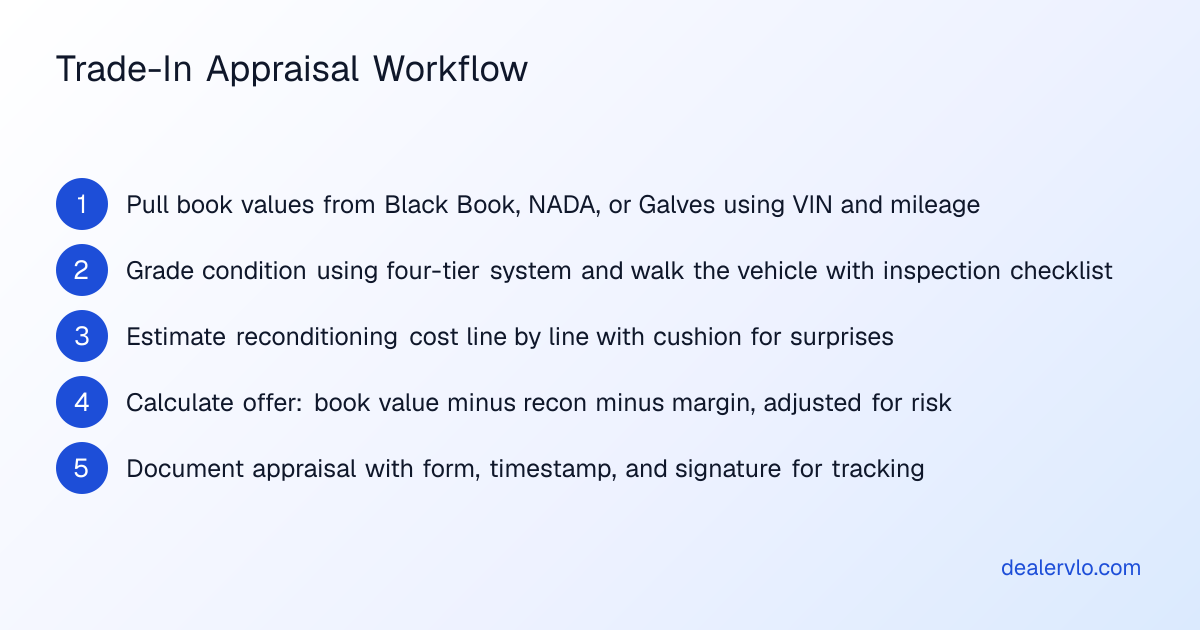
Step 1: Pull book values from dealer-focused tools
Consumer-facing sites show retail asking prices; you need wholesale benchmarks. Three tools dominate the independent-dealer world: Black Book, NADA Guides, and Galves. (For how those book values turn into a number you can actually pay, see how dealers determine the wholesale value of a car.)
Black Book visits over sixty auctions every week to collect real transaction data, making it the most auction-aligned of the three. It's been a standard for dealers, lenders, and fleet remarketers for decades, and it solves a problem you hit constantly: a meaningful share of VINs don't decode cleanly to a single trim level, and Black Book's database handles those ambiguous builds better than most.
NADA Guides, now operated by J.D. Power, reviews over one million actual transactions each month and has been valuing vehicles for more than seventy-five years. NADA values tend to reflect broader regional averages, and many lenders and credit unions use them as loan collateral benchmarks, which matters when your buyer is financing.
Galves distinguishes between Trade-in Value—the actual cash value of an as-traded consumer unit—and Market Ready Value, which assumes good cosmetic and mechanical condition with minor reconditioning. That two-tier structure mirrors your decision tree: can you retail this with light cleanup, or does it need real money before it's lot-ready?
Enter the VIN, mileage, and ZIP code into whichever tool you subscribe to. Pull all three values if you have access; when they agree, you've got a solid anchor, and when they diverge, the spread tells you the market isn't sure either—so budget extra caution into your offer.
Kelley Blue Book is widely recognized by consumers, but its wholesale value often includes a risk cushion, meaning dealers frequently offer slightly below KBB wholesale to cover hidden problems. If a customer brings a KBB printout, you're having a negotiation anchored to a number that wasn't built for your risk profile. Acknowledge it, then explain what your tools show and why.
Step 2: Grade condition using the four-tier system
Book values assume average condition for the vehicle's age and mileage. Your job is to adjust that baseline up or down based on what you actually see, hear, and smell.
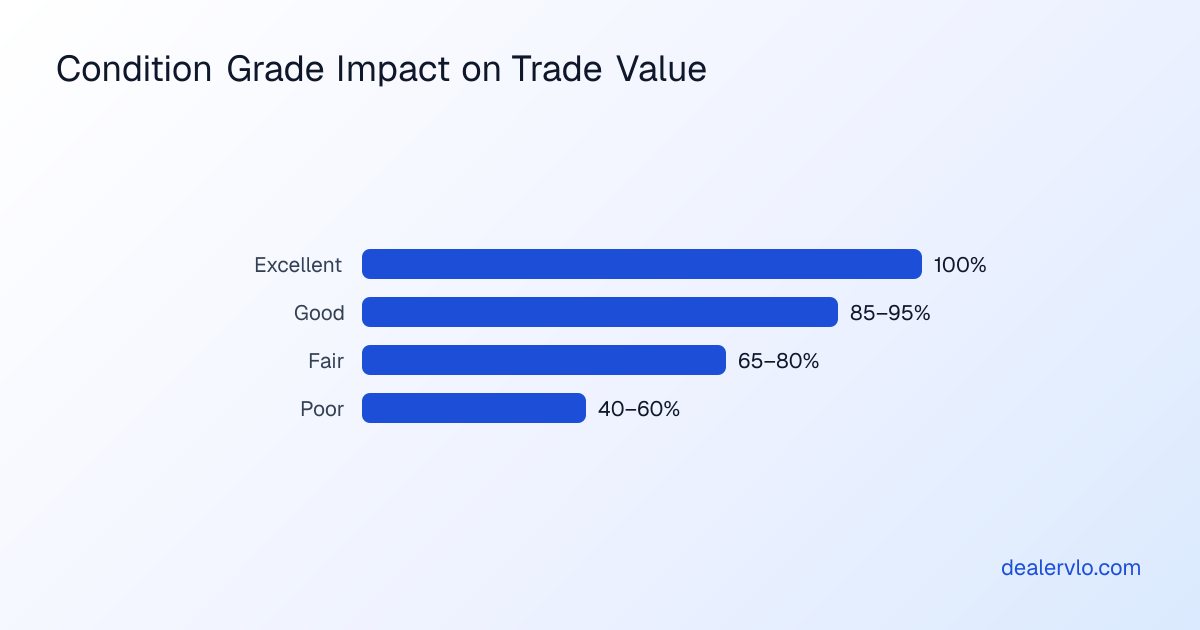
The industry uses four grades: Excellent, Good, Fair, and Poor. Here's what they mean in practice:
- Excellent: Low mileage, no visible wear, looks and drives like new. You'll rarely see this walk in as a trade unless it's a one-owner lease return.
- Good: Minor wear consistent with age, no mechanical problems, no cosmetic damage that shows in photos. This is your target acquisition grade—it needs a detail and safety inspection, not a rebuild.
- Fair: Visible cosmetic issues, higher mileage, or minor mechanical concerns. It's drivable and sellable, but it needs reconditioning investment before it's retail-ready. Your offer has to account for tires, brakes, paint touch-up, or whatever else the inspection turns up.
- Poor: Major mechanical problems, accident damage, or severe cosmetic issues. You're buying this for wholesale or parts value, not retail, and your offer should reflect that reality.
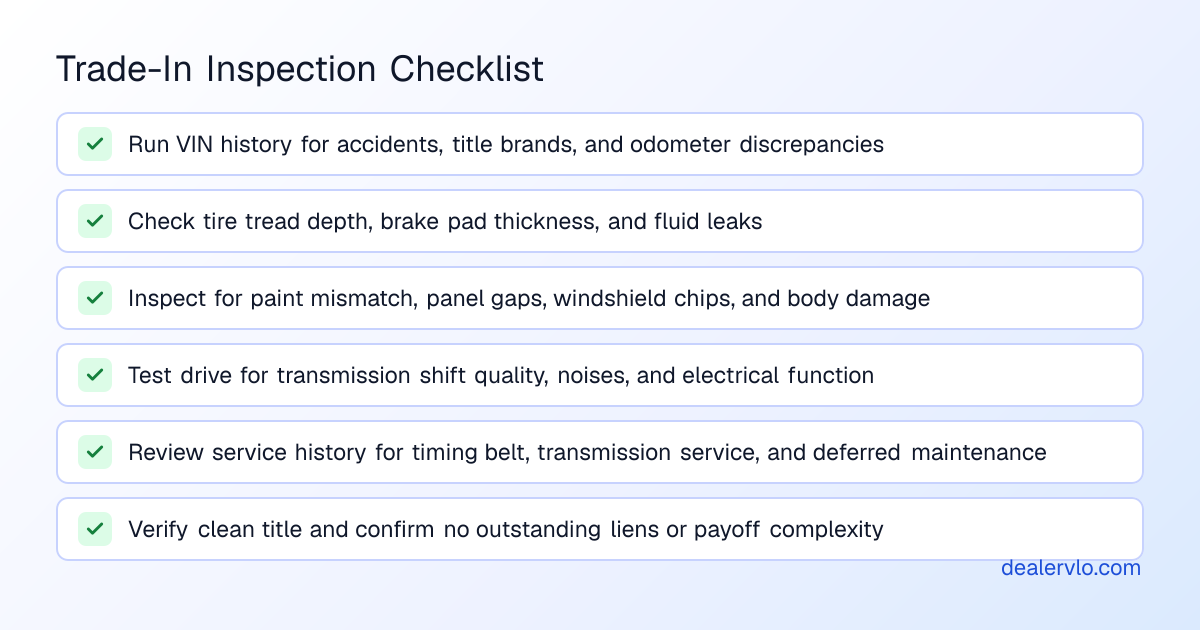
Walk the vehicle with a printed or digital checklist. Look for paint mismatch, panel gaps, windshield chips, tire tread depth, brake pad thickness, and fluid leaks. Check the service history if the customer has it—a timing belt done at the right interval is worth money, and a missing maintenance record is a yellow flag. Pull the door jamb stickers and compare the VIN; repainted doors sometimes don't match.
Run the VIN through your history provider for accidents and title brands. A clean guide value assumes a clean history; any reported accident or salvage/rebuilt title changes the number materially, and in many states a branded title kills your ability to finance the vehicle for a retail buyer.
Pay attention to local demand. A four-wheel-drive truck is worth more in a mountain market in November than the same unit is worth in the Southwest in July. Guides smooth out regional variation, but you don't have that luxury—if you can't move it locally, you're paying transport and auction fees to get it where it will sell. For more on how to think about regional inventory mix, see our guide to sourcing used trucks as an independent dealer.
Step 3: Estimate reconditioning cost line by line
Reconditioning is where used-car profit is quietly won or lost. Between acquisition and the moment a unit appears on your lot photographed and priced, it passes through mechanical inspection, repairs, tires, detailing, and sometimes body and paint. Every dollar and every day spent there comes straight out of your gross.
Reconditioning commonly runs somewhere in the $1,000–$1,500 range per vehicle, but that average hides enormous variation. A lease return that needs a detail and an oil change might cost you four hundred dollars; a high-mileage trade that needs tires, brakes, and a windshield can run two thousand or more before it's safe and presentable. Cosmetic work ranges from three hundred to six hundred dollars for minor touch-up, eight hundred to fifteen hundred for moderate repairs like bumper blend or dent removal, and over two thousand when you're into significant body or paint work.
Break reconditioning into line items during the appraisal:
- Mechanical safety: Brakes, tires, suspension, lights, wipers, fluids. If it won't pass your state's safety inspection, it can't be retailed, and the cost to get it compliant is non-negotiable.
- Service and maintenance: Oil change, air filter, battery test, alignment. Budget around eighty dollars for a state inspection if your jurisdiction requires one.
- Cosmetic: Detail, paint touch-up, headlight restoration, minor dent repair, interior stain or burn removal.
- Deferred maintenance red flags: Timing belt due, transmission service overdue, check-engine light stored codes. If the customer deferred it, you're paying for it.
One common mistake: assuming your estimate will match the actual bill. In practice, reconditioning estimates routinely come in under the true cost, because surprises appear once the tech gets the vehicle on the lift. If your appraisal assumes five hundred in recon and the bill comes back at eleven hundred, you just lost six hundred in gross—or worse, you're retailing a unit with deferred problems because you can't afford to fix them and still make money.
Build a cushion. If your line-item estimate totals nine hundred dollars, book twelve hundred in your offer calculation. The difference protects you from the surprises that always show up, and if the actual cost comes in lower, you've made extra gross instead of losing it.
For a deeper dive into how reconditioning cost and holding time affect your pricing strategy, see our guide to pricing used cars and dealer markup strategy.
Step 4: Calculate your offer using the margin-back formula
Your offer isn't the book value minus a guess. It's a formula: book value minus reconditioning cost minus desired profit margin, adjusted for anything that makes this specific vehicle harder or easier to sell than the average unit the book assumes.
Start with the book value that matches the vehicle's actual condition grade. If it's Fair, use the Fair value; don't use Good and then subtract for condition—you'll double-count the deduction and low-ball yourself out of the deal or into a reputation problem.
Subtract your reconditioning estimate, including the cushion. Then subtract your target profit margin. Independent dealers typically aim for fifteen hundred to two thousand dollars per unit in net profit; you need at least that much to cover your operating cost—the "pack" that pays your lot rent, insurance, utilities, and labor—and still have gross left over.
Here's a worked example. Say the book shows seventy-eight hundred dollars trade-in value for a Good-condition unit, but your inspection grades it Fair. The Fair book value is seventy-two hundred. You estimate nine hundred in reconditioning and budget twelve hundred to be safe. You want two thousand in gross. Your offer ceiling is $7,200 - $1,200 - $2,000 = $4,000. Anything above four thousand eats into your margin or your reconditioning budget, and you'll know exactly which when the repair order comes back.
Now layer in the adjustments the formula doesn't capture:
- Local demand: If every dealer in your market has three of these and nobody's buying, you're not retailing it—you're buying auction freight. Subtract transport and buyer fees.
- Title and history: Accident reported? Subtract another five hundred to a thousand depending on severity; buyers will see the same report you did. Branded title? You're wholesaling it, full stop.
- Days to turn: If this is a slow-moving body style or color in your market, your holding cost goes up and your offer needs to come down. A unit that sits for sixty days costs you interest, insurance, and an inventory slot that could have turned twice. For benchmarks on how often your inventory should turn, see our used-car dealer turn-rate guide.
- Retail vs. wholesale intent: If you're planning to retail it, you can justify a higher offer because your margin is larger. If you know it's going to auction the day after you take it in, your offer has to leave room for auction buyer fees, transport, and the risk that it brings less than you thought at the sale.
Walk the customer through the math if they're skeptical. Show them the book value you're using, explain the reconditioning line items you found during the inspection, and be honest about your margin. Most people understand that you're running a business, and transparency builds trust—and sometimes repeat customers who bring you their next trade even when they're not buying from you.
Punch in cost, recon, holding days, and sale price to see your true net gross and margin.
Open the Profit Margin CalculatorStep 5: Document the appraisal and train your team to be consistent
A verbal offer scribbled on scratch paper doesn't protect you when the customer comes back three days later insisting you said a different number, and it doesn't help your sales team understand why you passed on a trade they thought was a slam dunk.
Use a standard appraisal form—printed or digital—that captures the VIN, mileage, condition grade, book values, reconditioning estimate by line item, adjustments, and final offer. Have the appraiser sign it and timestamp it. File it whether you buy the vehicle or not; if the same unit shows up again in two months, you want to know what you said last time and whether anything changed.
If you have multiple people appraising trades, train them on the same process and the same condition definitions. "Good" can't mean one thing to your lot manager and another thing to your sales manager, or you'll have one person over-paying and another passing on deals you should have taken. Run calibration sessions: pull three vehicles, have everyone grade them independently, then compare notes and discuss the differences until the team converges.
Set authorization limits. A newer salesperson can appraise and quote up to a certain dollar amount or within a certain margin band; anything outside that requires a manager to sign off. This keeps your risk contained while your team builds judgment, and it gives you a checkpoint before you accidentally pay seventy-five hundred for a unit worth fifty.
Track your appraisal accuracy over time. Compare your estimated reconditioning cost to actual invoices, and compare your book values to what the vehicle eventually sells for (or brings at auction if you wholesale it). If your recon estimates are consistently low, you're either under-inspecting or under-budgeting, and your offers are too high. If your book values don't predict your sale prices, you're using the wrong tool or grading condition too optimistically.
For dealers managing appraisals and reconditioning workflows across multiple people, a DMS that tracks estimates versus actuals and flags variances in real time makes the feedback loop faster. See our guide to the best DMS systems for independent used-car dealers for options that handle trade appraisal workflows.
14-day free trial, then $29/mo · Cancel anytime
Common appraisal mistakes and how to avoid them
Anchoring to the customer's asking price. They found a retail listing online for ninety-five hundred and expect you to offer ninety percent of that. Retail asking price is not wholesale value, and your offer has to be built from your cost structure, not theirs. Acknowledge what they saw, explain the difference between retail and trade, and show your math.
Skipping the test drive. A transmission that shifts fine in the parking lot can shudder under load, and a vibration at highway speed doesn't show up at twenty-five miles per hour. Drive it, listen for noises, feel for pulling or wandering, and check that every electrical feature works. The customer isn't going to tell you the AC only blows hot or the cruise control is inoperative.
Ignoring service history gaps. No records doesn't mean the work wasn't done, but it does mean you can't prove it, and neither can your buyer. Treat missing service history as a risk factor, especially on timing-belt or transmission-service intervals. Budget for the service or discount your offer accordingly.
Underestimating cosmetic reconditioning. A door ding you can live with looks terrible in photos, and photos are how buyers shop now. If it needs paint or PDR before you'd feel good putting it online, include that cost in your appraisal—don't plan to "see how it looks after a detail" and hope it's fine. For more on how presentation affects salability, see our guide to photographing used cars as a dealer.
Overestimating your ability to retail everything. Some units are auction cars the moment they roll in: wrong color, too many miles, body style that doesn't sell in your market, or a history report that kills retail financing. Don't appraise them as if you're going to retail them. Price them as wholesale units—book value minus auction fees and transport minus a small margin—and either pass or buy them with your eyes open.
Letting emotion override the formula. The customer is nice, they're buying a high-margin vehicle from you, and you want to make the deal happen. None of that changes the reconditioning cost or the wholesale value. Stick to the formula. You can adjust your sales price or your F&I margins if you need to make the overall deal work, but don't overpay for the trade to get there—you're just moving the loss to a different line on the deal jacket, and it still costs you the same money.
Setting up appraisal workflows in your DMS
A paper appraisal form works, but a digital workflow inside your DMS eliminates re-keying, tracks who appraised what and when, and flags outliers before they become losses. Look for a system that lets you pull VIN and book values directly, attach inspection photos, build reconditioning estimates with line-item cost categories, and compare your estimate to the actual repair-order total once the work is done.
The better systems let you set approval thresholds—anything above a certain offer amount or below a certain margin gets routed to a manager before the offer goes to the customer. That's especially valuable if you're running multiple locations or if you have salespeople appraising trades on the lot without a manager standing next to them.
Integration with your inventory and accounting modules means the trade appraisal becomes the starting cost basis for the unit the moment you take it in, and every subsequent reconditioning invoice posts against that vehicle's record. You can see real-time gross as you go instead of discovering at month-end that you spent thirty-two hundred reconditioning a unit you appraised at fifteen hundred total cost.
For independent dealers looking to tighten appraisal accuracy and reconditioning tracking, a cloud-based DMS makes your data accessible from the lot, the shop, and the office without passing paper around, and it gives you reporting you can actually use to improve your process over time.
When to pass on a trade
Not every trade is worth taking, even when you're making a retail sale. If the numbers don't work, the honest answer is "I can't offer you what you need for that vehicle, but I'd still like to earn your business on the one you're buying—let's see if we can structure the deal another way."
Pass when:
- Your offer is so far below their expectation that taking the trade kills the deal and damages your reputation. Sometimes letting them sell it privately and coming back to you is the better outcome for everyone.
- The vehicle needs more reconditioning than you have capacity or expertise to handle. If it needs transmission work and you don't have a transmission shop you trust, you're guessing at cost and timeline, and both will be wrong.
- It's a body style or brand you can't retail and your auction access is limited. Buying a unit you have to wholesale only makes sense if you have a reliable, low-cost liquidation channel and the margin to cover it.
- The title or history is so problematic that you'll struggle to sell it even after disclosing. Salvage rebuilds, flood brands, odometer discrepancies, or liens you can't verify—all of these are pass signals unless you specialize in that market.
- Your lot is full of the same thing and it's not moving. Taking in a sixth silver Camry when the five you have have been sitting for forty-five days isn't inventory management, it's hoarding.
Passing doesn't mean losing the sale. Offer to help them get a clean payoff quote if they owe money, point them toward a reputable independent appraiser if they want a second opinion, or suggest they list it themselves and come back when it's sold. You've kept your cost structure intact and you've been straight with them, which matters more in the long run than closing one deal on a bad trade.
Appraisals for out-of-state trades
When a customer brings you an out-of-state trade, your appraisal process is the same but your back-end work doubles. You'll need to verify the title is clean and unencumbered in the issuing state, ensure there are no unsatisfied liens, and confirm you can legally title and register it in your state before you offer it for sale.
Some states require specific forms or notarizations that aren't standard in yours, and if the customer still owes money, the lienholder may be in a third state with its own payoff and release process. Budget extra time and, if necessary, extra cost into your offer to account for the complexity. A trade you can't title is a trade you can't sell, and a unit that sits in your inventory for three weeks waiting for a lien release is costing you money every day.
For a detailed checklist of what you need to handle out-of-state sales and trades, see our out-of-state car sale dealer checklist.
Final takeaway
A disciplined trade appraisal process protects your margin, speeds your decisions, and earns customer trust. Pull book values from dealer tools that reflect real auction and wholesale markets, grade condition honestly with a checklist, estimate reconditioning cost line by line with a cushion for surprises, and calculate your offer using the formula: book value minus recon minus margin, adjusted for local demand and vehicle-specific risk.
Document every appraisal, train your team to follow the same process, and track your accuracy over time so you can tighten your estimates and improve your results. When the numbers don't work, pass—your reputation and your cash flow are worth more than one deal. And when they do work, you've acquired inventory at a known cost with a clear path to profit, which is the entire point of taking trades in the first place.
Frequently asked questions
What book-value tool should I use to appraise trade-ins?
Black Book, NADA Guides, and Galves are the three most widely used dealer tools. Black Book pulls data from over sixty auctions weekly and is the most auction-aligned; NADA reviews over a million transactions per month and is often used by lenders; Galves separates as-traded value from market-ready value, which helps you decide whether to retail or wholesale a unit. If you have access to more than one, compare them—when they agree, you have a reliable anchor, and when they diverge, you know the market is uncertain and should build extra caution into your offer.
How do I estimate reconditioning cost accurately during an appraisal?
Break reconditioning into line items: mechanical safety (brakes, tires, suspension), service and maintenance (oil, filters, inspection), cosmetic work (detail, paint touch-up, dent removal), and deferred maintenance (timing belt, transmission service). Reconditioning commonly runs somewhere in the $1,000–$1,500 range per vehicle, but the spread is wide—a few hundred dollars for minor cosmetic work, up to a couple thousand for major mechanical or body issues. Always build a cushion into your estimate, because estimates routinely come in under the actual bill once the vehicle is on the lift and the surprises appear.
What's the formula for calculating a dealer trade-in offer?
Start with the book value that matches the vehicle's actual condition grade, subtract your reconditioning cost estimate (including a cushion for unknowns), then subtract your desired profit margin—typically fifteen hundred to two thousand dollars for an independent dealer. Adjust that number for local demand, accident or title history, and whether you're planning to retail or wholesale the unit. The formula is: book value minus reconditioning minus margin, adjusted for vehicle-specific risk and market conditions.
When should I pass on a trade-in instead of making an offer?
Pass when your offer is so far below the customer's expectation that it kills the deal and damages goodwill, when the vehicle needs reconditioning work beyond your capacity or expertise, when it's a body style or brand you can't retail and don't have a cost-effective way to wholesale, or when the title or history is so problematic that you'll struggle to sell it even after full disclosure. Also pass when your lot is already full of the same vehicle and it's not moving—taking in more of what you can't sell isn't inventory management, it's expensive storage.
How do I train my sales team to appraise trades consistently?
Use a standard appraisal form that captures VIN, mileage, condition grade, book values, reconditioning estimate by line item, adjustments, and final offer. Train everyone on the same four-tier condition definitions so "Good" means the same thing to every appraiser. Run calibration sessions where the team grades the same vehicles independently and then compares notes. Set authorization limits so newer staff can appraise within a certain margin band but anything outside that requires manager approval. Track appraisal accuracy over time by comparing estimated reconditioning to actual invoices, and use the data to tighten your process.
What do I do when a customer's trade has an out-of-state title?
Verify the title is clean and unencumbered in the issuing state, confirm there are no unsatisfied liens, and ensure you can legally title and register the vehicle in your state before offering it for retail sale. Some states require specific forms or notarizations that aren't standard in yours, and if the customer still owes money, the lienholder may be in a third state with its own payoff and release timeline. Budget extra time and cost into your offer to account for the complexity, because a trade you can't title is a trade you can't sell, and delays cost you money every day the unit sits in inventory waiting for paperwork.
14-day free trial, then $29/mo · Cancel anytime
Before you authorize the work: see whether a repair earns back its cost plus the holding days it adds.
Open the Recon ROI Calculator