How dealers actually make money at car auctions (and the mistakes that erase it)
The profit-side view of dealer auctions: the spread you're really buying, the eight mistakes that quietly erase your gross, and the buy-side habits that protect margin sale after sale.
Ask a room of independent dealers where they make their money and the honest ones will tell you the same thing: on the buy, not the sale. Retail price is mostly set by the market — comps, days on lot, and the three other silver sedans within ten miles. The one number you fully control is what you pay to own the car. That's why the auction is where your year is quietly won or lost.
It's also engineered against you. Everything about a sale day — the cadence, the lanes, the "last one, going once" — is built to make you raise the paddle one more time. Making money at auction isn't about secret buys. It's about protecting a spread you decided on before the car ran.
Buy the spread, not the car
Before you shortlist a single unit, get clear on what you're actually buying: the gap between what a car will retail for on your lot and what it costs you all-in to own and sell it. That spread is the whole game.
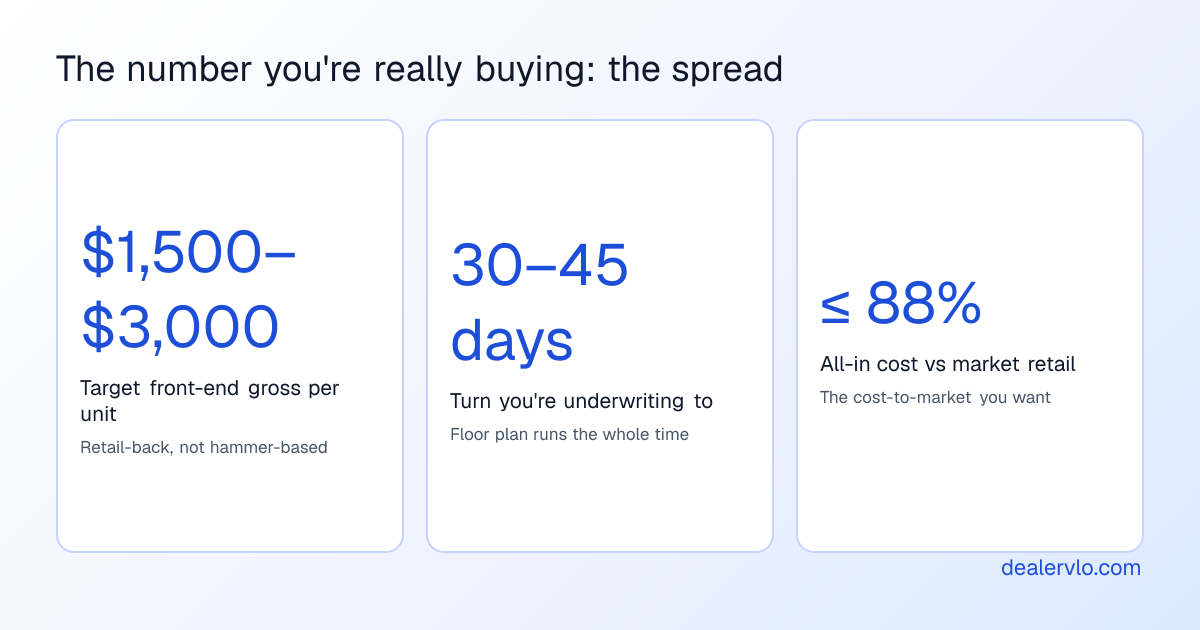
Work backward from retail. Pull the market retail for the exact unit — not the clean-book fantasy, the number three comparable cars are actually listed and selling for near you. Subtract the gross you need to make the deal worth doing. Subtract every cost of getting the car retail-ready and carrying it. What's left is your ceiling. Not a target — a ceiling. The auctioneer's job is to get you a dollar past it; yours is to stop one dollar short.
The eight mistakes that erase the spread
Every dealer who's struggled at auction has done some of these. I've done all of them.
1. Bidding off the hammer number. The hammer is the down payment on the cost, not the cost. The buy fee scales with sale price, transport is real, recon is real, and floor plan runs every day the car sits. Anchor on the hammer and you'll routinely pay $500–$1,500 more than the unit can carry.
2. Guessing recon low because you want the car. The condition report says "structural damage — none reported," announces a paint meter reading, notes tires at 4/32. Read it like a skeptic, not a buyer. Pad your recon estimate for what the report doesn't say. The most expensive words at any auction are "it's probably fine."
3. Ignoring the announcements and arbitration rules. Frame damage, title brands, odometer discrepancies, and "as-is" green-light status change what you can do if the car isn't what you thought. Know the arbitration window and thresholds before you bid, not after you've discovered the problem on your own lift.
4. Chasing the popular lanes. The clean, low-mile, in-demand units are where every dealer's paddle goes up, and competition is exactly what compresses your spread. The boring lanes — the unglamorous colors, the higher-trim units nobody's fighting over, the sale nobody drove to — are where discipline gets paid.
5. Letting cadence set your pace. Auctioneer rhythm is designed to keep you in the moment and out of your spreadsheet. Your walk-away number was calculated in a calm room. Trust that version of yourself over the one standing in the lane with the chant going.
6. Forgetting the car costs money while it sits. A great buy that takes 90 days to sell can lose to an average buy that turns in 30. Floor plan, insurance, and the opportunity cost of that slot on your lot are all part of the buy decision. Underwrite to a turn, not just to a price.
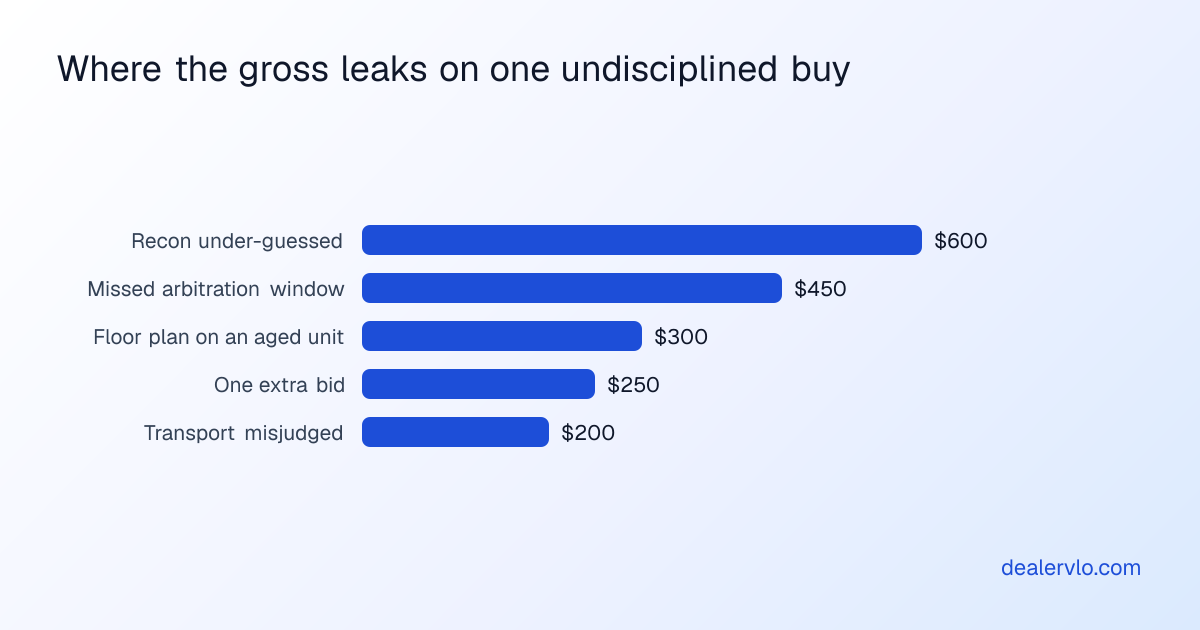
Look at how small each leak is on its own — a bid here, a couple hundred of recon there, a few extra weeks of floor plan. None of them feels like a mistake in the moment. Stacked on one $12,000 unit, they quietly eat the entire gross you thought you bought. This is why auction losses are so hard to see: no single decision looks wrong.
7. Buying with no exit plan for the miss. Some cars won't work — you'll misjudge one. The mistake isn't buying it; it's having no plan to move it. Know your wholesale-back number before you own the car, so a miss becomes a fast, small loss instead of a slow, large one aging on the back row.
8. Never reviewing your own results. This is the one that separates dealers who improve from dealers who repeat. Every buy is data. If you don't log it, sale day feels great every time and your bank account disagrees.
Work out the most you can bid at the lane and still hit your target margin.
Open the Auction Profit CalculatorThe habit that compounds: review your buys
Best practices aren't a list you memorize — they're what's left after you honestly review your own results and stop repeating your own patterns.
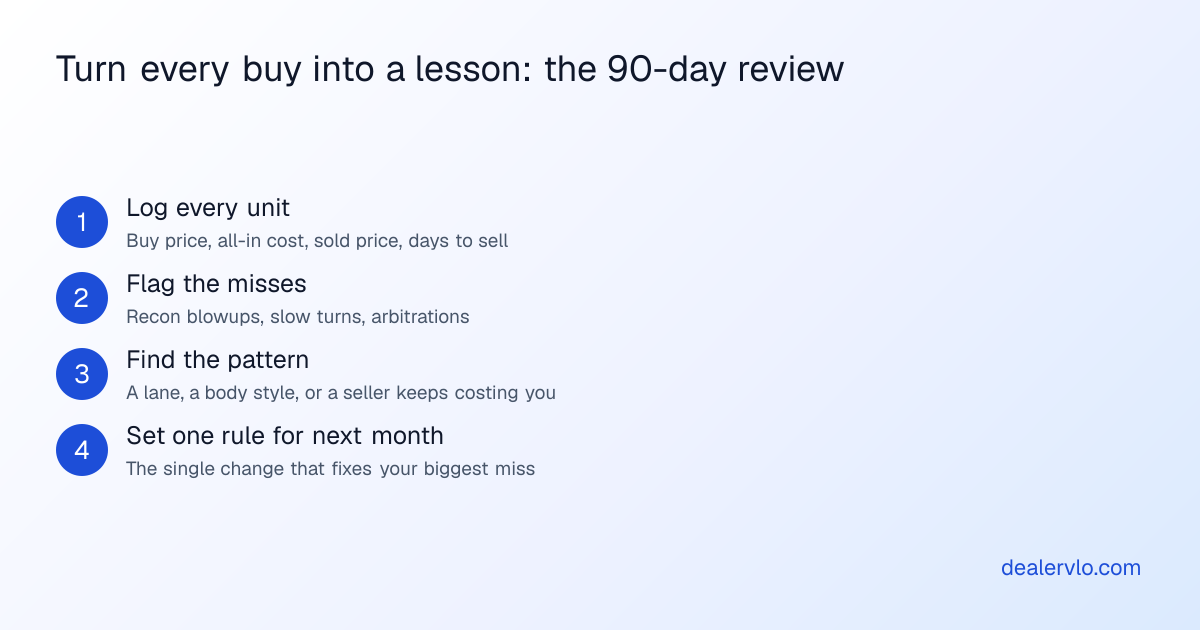
Log every unit: buy price, all-in cost, what it retailed for, and how many days it took. After 90 days the pattern is undeniable. Maybe a particular lane keeps burning you. Maybe a body style you love never turns. Maybe one seller's cars always need more recon than the report suggests. Pick the single biggest miss and make one rule for next month. Do that four times a year and your buying gets sharper on its own, no secret knowledge required.
The honest summary
Making money at auction comes down to a small number of unglamorous habits: buy the spread instead of the car, price the all-in cost instead of the hammer, respect the announcements, favor the boring lanes, underwrite to a turn, and review your buys like they matter — because they're where your margin actually comes from.
None of this is exciting on sale day. That's the point. The dealers who grind out a good living aren't the ones with the best instincts in the lane. They're the ones who did the math in a quiet room the night before and then had the discipline to stop one bid short.
When your all-in cost, target gross, and days-to-sell live in the deal record instead of your head, this discipline gets a lot easier to hold. DealerVLO tracks every unit from buy to sale, so the buy log that makes you sharper builds itself.