Paper Spread vs. Real Gross: Reading Margin in an Auction Run List
A real Boston sale of 387 cars, priced against retail: the biggest spread over the hammer usually isn't the best buy. How to read a run list for real gross.
Part of the Buying & sourcing inventory guide: How to buy at dealer auctions without getting buried
Switching from another DMS? Compare DealerVLO to DealerCenter, Frazer, or Lot Wizard.
Every dealer has done this at a sale: a clean SUV crosses the block, the hammer falls low, and your gut says that's ten grand of margin. Then the car hits your lot, the recon bill comes in, it sits ninety days, and the "ten grand" turns into a $2,800 gross you were lucky to get.
The gap between what a car looks like it made at the auction and what it actually makes on your books is the single most expensive misread in this business. So I took a real run list — a Boston-area wholesale sale on September 2, 2026, 387 cars — and priced the cleanest buys against live retail comps. The point isn't the specific cars. It's the method: how to tell paper spread from takeable gross before you raise your hand.
14-day free trial, then $29/mo · Cancel anytime
What actually crossed the block
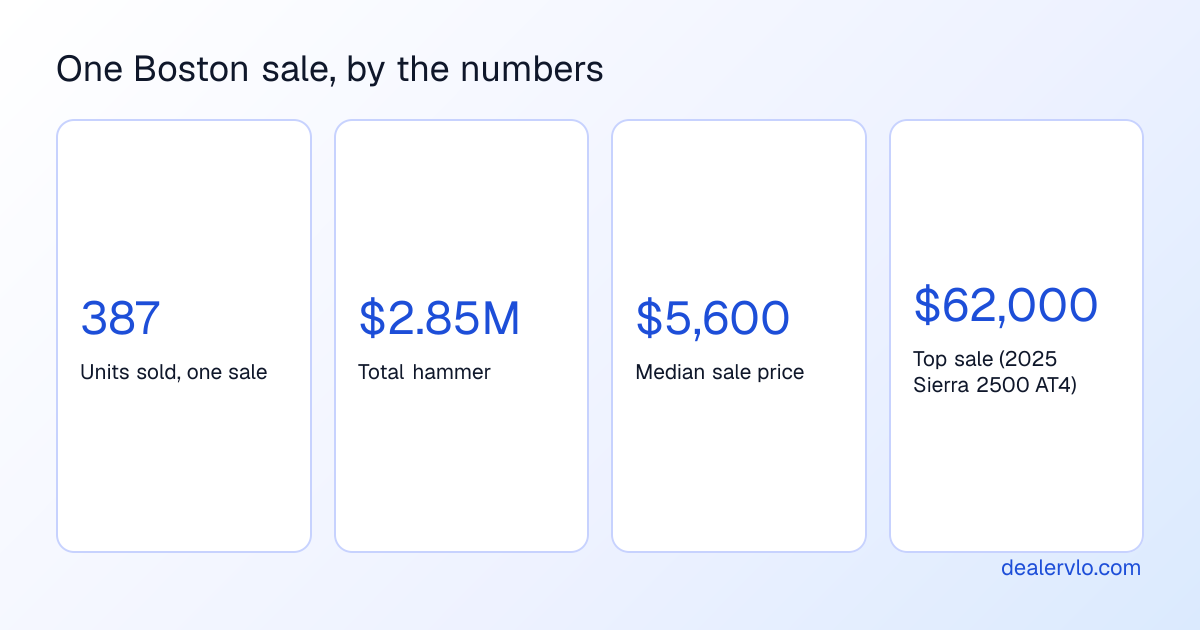
Three hundred eighty-seven units, about $2.85M in total hammer, a $5,600 median — this is a bread-and-butter sale, not an exotic boutique. The top car was a near-new 2025 GMC Sierra 2500 AT4 at $62,000. And a detail that matters more than any single price: only about half the cars carried a condition-report grade. The other half, you're buying on a walk-around and a prayer — which is the first place a "spread" quietly turns into a recon surprise.
The biggest-spread trap
Here's the number that should reframe how you read a run list. Look at how far apart the same model sold in this one sale:
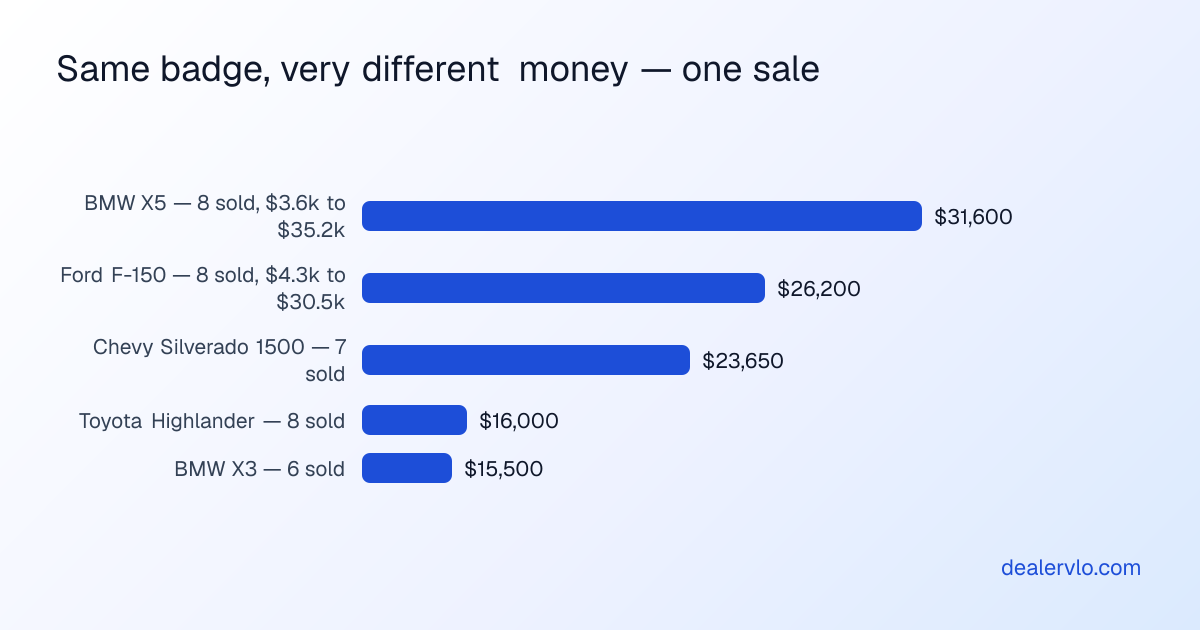
Eight BMW X5s ran, from $3,600 to $35,200. Eight F-150s, from $4,300 to $30,500. Seven Silverado 1500s spanning more than $23,000. The badge tells you almost nothing — the unit (year, miles, grade, options) and the lane it ran in are the whole story. Anyone who says "X5s are money" or "F-150s always print" is reading the wrong column. This is the same lesson behind how dealers actually make money at car auctions and the discipline in the dealer auction buying guide: you don't buy a model, you buy a specific car at a specific number.
Work out the most you can bid at the lane and still hit your target margin.
Open the Auction Profit CalculatorPaper spread vs. real gross
I pulled live retail comps (KBB, Edmunds, Cars.com, CarGurus, Carvana; September 2026) for the cleanest, most liquid buys in the sale and lined the typical retail ask up against the hammer. Every "spread" below is gross before recon, fees, pack, and holding — it's the ceiling, not the take. Rounded, and honestly approximate:
- 2019 Lincoln Aviator Reserve — 89k miles, grade 4.6. Hammer $18,250; retail ask roughly $28–31k. Paper spread ~$10–12k.
- 2021 BMW X5 xDrive40i — 107k miles, grade 4.8. Hammer $18,250; retail ask roughly $27–29k. Paper spread ~$9–10k.
- 2019 Toyota Tacoma SR5 V6 — 121k miles, grade 3.8. Hammer $18,000; retail ask roughly $25–28k. Paper spread ~$8k.
- 2020 Cadillac XT6 Premium Luxury — 91k miles, grade 4.0. Hammer $18,000; retail ask roughly $24–25k. Paper spread ~$6.5k.
- 2020 Honda Accord Touring 2.0T — 79k miles, grade 4.5. Hammer $18,500; retail ask roughly $23–26k. Paper spread ~$5.5k.
- 2015 Toyota 4Runner SR5 4WD — 152k miles, grade 4.6. Hammer $14,500; retail ask roughly $19–21k. Paper spread ~$5k.
Now read it like an operator, not a spreadsheet. The two biggest spreads are the two you should be most careful with. A first-year Lincoln Aviator and a 107k-mile German SUV show the fattest paper — but they're slow to retail, and a luxury three-row or a high-mile X5 can eat $2,000–$4,000 in reconditioning before it's front-line, plus real money in the days it sits waiting for the one buyer who wants it. (See what recon actually runs by segment in average reconditioning cost by vehicle type, and what the clock costs in gross profit vs. holding costs on aged inventory.)
The Tacoma and the 4Runner show smaller spreads — but that's the safe, fast money. Clean grades, brutal demand, low recon, and they retail in weeks, not months. A confirmed $4,000 gross that turns in three weeks beats a hypothetical $10,000 that ties up your floor plan for a quarter and might land at $5,000 after the recon bill. That trade-off is the whole game, and it's the same math as the auction vs. retail breakeven decision.
14-day free trial, then $29/mo · Cancel anytime
Subtract these before you call it margin
A paper spread becomes gross only after you take out everything the auction doesn't show you:
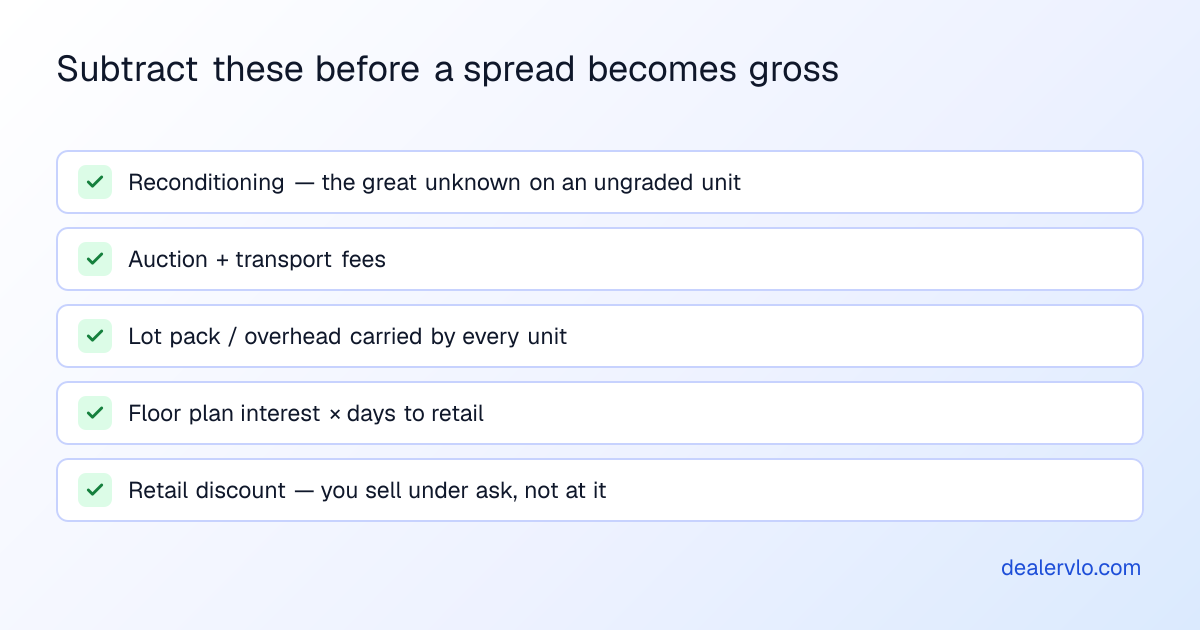
The one that gets dealers every time is the last one: you sell under your ask. That $28k retail number is the listing, not the check. Knock off the negotiation, the recon you didn't plan for, a couple of points of floor plan, and a lot pack, and a $10k paper spread is routinely a $3–5k real gross — good money, but a different decision than the one the paper implied.
Want to run those subtractions on a specific unit? The free wholesale-vs-retail calculator and recon ROI calculator do this math on a car you're eyeing — no signup, no email.
How to read the run list before the sale
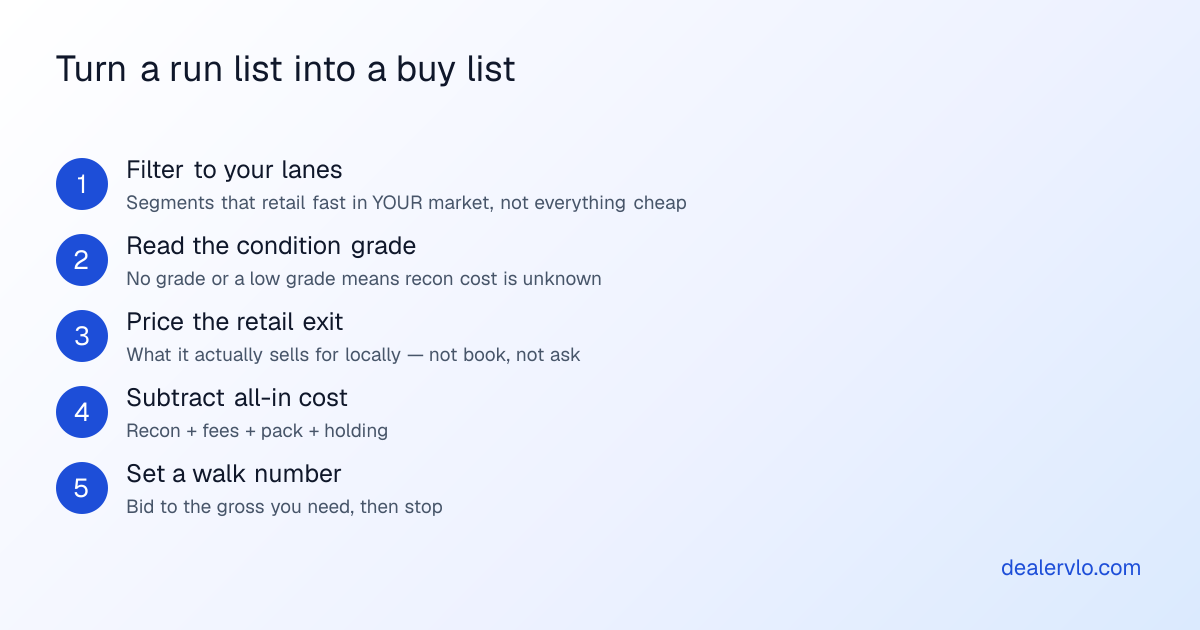
Do this the night before, not in the lane with your hand in the air:
- Filter to your lanes. Cut the list to the segments that retail fast in your market. Cheap isn't a segment.
- Read the grade. A high condition grade makes recon predictable; no grade means you're pricing in risk.
- Price the retail exit from live local comps — what that exact spec is actually selling for this week, the way you would when pricing a unit for turn. Anchor it with MMR / Black Book, don't stop there.
- Subtract all-in cost — recon, fees, pack, and the holding cost of your realistic days-to-turn.
- Set a walk number and bid to it. The spread tells you the ceiling; your walk number tells you when to put your hand down.
A free daily game: one used car, three guesses at wholesale and three at retail, then the comps behind the answer.
Open the Daily AppraisalFrequently asked questions
Isn't the spread between the auction price and retail my profit? No. The spread over the hammer is the ceiling, not the take. Real gross is what's left after reconditioning, auction and transport fees, your lot pack, and the holding cost of the days it sits — and after you sell under your asking price, not at it. On a lot of units the paper spread is double the gross you actually book.
Which auction buys usually have the best real margin? Not the ones with the biggest paper spread. The safest money is usually clean, liquid, low-recon units — Toyota and Honda trucks and SUVs — that retail in weeks. The huge-spread luxury units look great on paper but are slow to sell and expensive to recondition, so the spread erodes before it reaches your books.
How do I estimate retail before I bid? Price the retail exit, not the book. Pull live local comps for that exact year, trim, and mileage band — what similar units are actually listed and sold for in your market this week — then subtract your all-in cost to get a walk number. Book value is a reference, not your exit price.
What does the condition grade tell me about margin? It's a proxy for recon risk. A high grade makes the reconditioning bill predictable; a low grade or no grade means the cost that eats your spread is unknown until the car's on your rack. In this sale, only about half the cars carried a grade.
Bottom line
The best buy at a sale is almost never the one with the biggest gap between hammer and retail. It's the one where the gross survives contact with your recon shop, your floor plan, and your days-to-turn — and you knew that number before you bid. Paper spread is a headline. Gross is what clears.
Before your next sale, price a unit both ways — the wholesale-vs-retail calculator and the recon ROI calculator are free and take a minute.
And when you want that math to follow every car instead of living in your head, that's exactly what DealerVLO is built for: log the auction buy, the reconditioning against it, and the retail exit on one deal, and watch the real gross per unit instead of the one you hoped for in the lane. It's the DMS I run my own lot on — flat $29/month, no per-user fees. Start a free trial and turn your next run list into a buy list.
14-day free trial, then $29/mo · Cancel anytime