Average Used Car Reconditioning Cost by Vehicle Type: 2026 Benchmarks
Reconditioning cost benchmarks by vehicle type for independent dealers in 2026: sedan, truck, and luxury averages, plus the holding cost of slow recon.
Part of the Reconditioning guide: Used Car Reconditioning Cost: Budgeting & ROI for Dealers
Switching from another DMS? Compare DealerVLO to DealerCenter, Frazer, or Lot Wizard.
What reconditioning actually costs in 2026
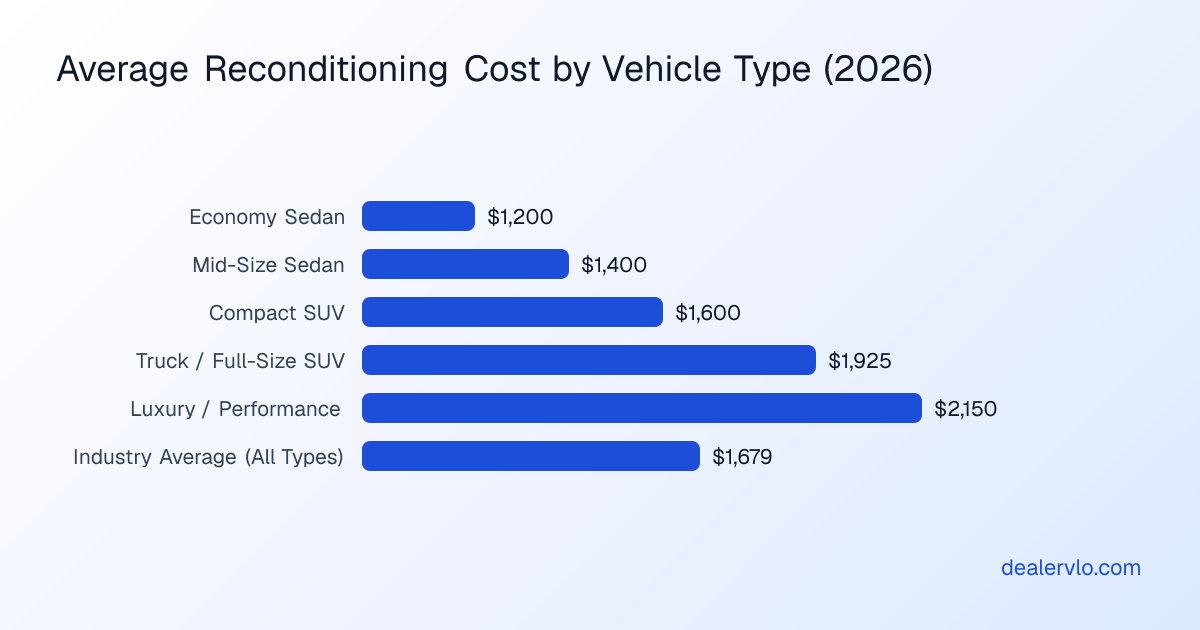
The average used car reconditioning cost for independent dealers hit $1,679 per vehicle in 2024 according to NIADA's latest data, up from $1,455 the year before and more than $500 higher than 2020 levels. That's the industry average across all vehicle types, but your actual cost per unit swings significantly depending on what you stock — a low-mileage economy sedan runs cheaper to front-line than a 90,000-mile luxury SUV with deferred maintenance.
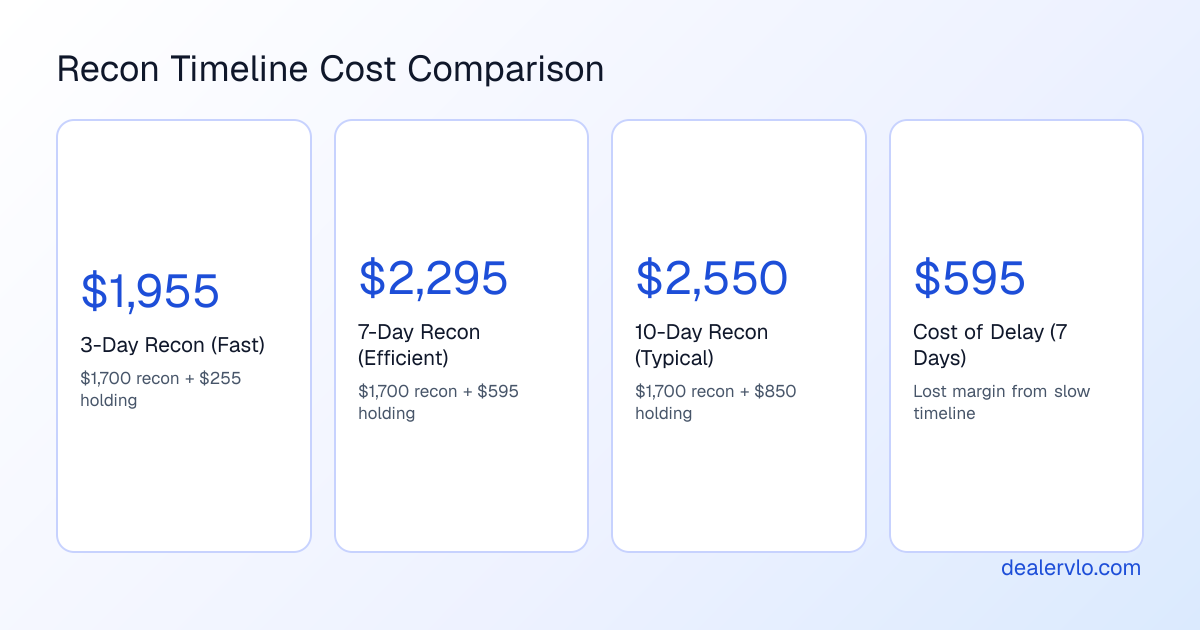
The bigger cost trap isn't the repair invoice — it's how long the work takes. Used inventory carries $85 per day in holding costs (floorplan interest, insurance, facility overhead), so the difference between a three-day and a ten-day reconditioning timeline adds $595 in carrying cost on top of your parts and labor. That differential can be the margin on the deal.
This post breaks down current reconditioning cost benchmarks by vehicle type and mileage tier, walks through the holding-cost math that makes speed worth real money, and gives you a framework to estimate total cost-to-front-line before you bid.
Note: This covers independent dealer reconditioning practices and cost benchmarks. It is not legal or tax advice — confirm your state's disclosure requirements and sales-tax treatment of reconditioning charges with your accountant or state motor vehicle agency.
14-day free trial, then $29/mo · Cancel anytime
Industry baseline: what dealers are spending now
NIADA tracks reconditioning costs across independent dealers and reports the 2024 average at $1,679 per vehicle, a sharp climb from prior years driven by parts inflation and labor rate increases. Buy-here-pay-here dealers — who often handle older, higher-mileage inventory — averaged $1,440, still up nearly 9% year-over-year.
Other industry sources cite ranges from $1,000 to $1,800 depending on vehicle condition and dealer standards. ACV Auctions pegs $1,000 as a ballpark for typical condition vehicles with common recon steps.
The spread matters because it reflects real operational differences. A dealer stocking late-model sedans with clean histories will see costs cluster toward the lower end, while a lot heavy on trucks or euro luxury cars will run above the average every time. If you're budgeting recon without adjusting for your mix, you're guessing.
For more context on how recon fits into your overall inventory cost structure, see our used car dealer benchmarks guide.
Cost breakdown by vehicle type
Sedans and economy vehicles
Economy sedans — your Civics, Corollas, base Malibus — typically land on the lower end of the reconditioning range, often between $1,000 and $1,400 for average-condition units. Parts availability is strong, labor hours are predictable, and consumables (brakes, tires, fluids) cost less than their truck and luxury counterparts.
Low-mileage examples in good condition can run under $1,000 if they only need detailing, a state inspection, and minor touch-up. Higher-mileage sedans or those with deferred maintenance (worn suspension, marginal tires, cosmetic needs) can push $1,500 to $1,700, especially if you're replacing multiple wear items to meet your lot's standards.
The predictability is the advantage here. You know what a set of rotors costs, you know the detailer's rate, and parts show up next-day from multiple suppliers.
Trucks and SUVs
Trucks and SUVs run 10% to 20% above the sedan baseline — call it $1,850 to $2,000+ for most units. NIADA explicitly notes that trucks should expect higher average costs, and the math backs it up: bigger brake components, larger tires (often $200+ each), more expensive fluids, and more labor hours for equivalent work.
Four-wheel-drive and all-wheel-drive systems add cost. Transfer case service, differential fluid, extra axles — the consumables stack up. Paint and body work costs more per panel because the panels are bigger. If the truck has aftermarket wheels or a lift, budget time to assess and repair what the last owner botched.
High-mileage trucks with towing history often need suspension work (ball joints, tie rods, shocks) that sedans of similar mileage skip. Rust is a bigger variable on trucks, especially in the Northeast and Midwest, and repairing rockers or cab corners eats both parts and labor budget fast.
That said, trucks turn faster and carry better margins when done right, so the incremental recon cost is usually worth it. Just don't budget sedan numbers and hope it works out.
Luxury and performance vehicles
Luxury and performance vehicles — your German sedans, Lexus models, Infinitis, and anything wearing a performance badge — run 20% to 35% above baseline, putting most units in the $2,000 to $2,300 range and higher if repairs get complicated.
Parts cost is the first issue. OEM brake pads for a BMW run triple what a Civic's cost. Tires are wider, lower-profile, and more expensive. Fluids are often brand-specific (synthetic oils, special coolants, transmission fluids with additive packages). Wear items like control arms, air suspension components, and adaptive dampers don't have cheap aftermarket alternatives that hold up.
Labor time runs longer because systems are more complex. Diagnosis requires scan tools that speak the right protocols. Simple jobs take longer because access is worse — replace the alternator on a V8 Audi and you're moving half the front end. If the vehicle has adaptive cruise, lane-keep, or other ADAS features, you may need recalibration after front-end work.
Cosmetic standards matter more on luxury inventory. Buyers expect flawless paint, pristine interiors, and every feature working. That means more detail time, more frequent paint correction, and higher parts cost for interior trim that snaps during removal.
Budget conservatively on luxury inventory and know your repair ceiling before you buy. The deal is made at purchase — if recon runs $2,200 and you didn't account for it, the margin is gone.
For guidance on selecting inventory that balances recon cost and turn speed, see our post on the best used cars to stock in 2026.
Mileage and condition adjustments
The industry average includes everything from 30,000-mile off-lease units to 120,000-mile trade-ins, so the range is wide. In practice, most dealers mentally bucket inventory into low, medium, and high mileage tiers and set repair dollar thresholds accordingly.
Low-mileage vehicles (under 60,000 miles, especially off-lease or single-owner) typically need the least work — call it $800 to $1,200 for most sedans and compacts. They're more likely to be current on maintenance, have good tires, and lack the deferred-maintenance pile that older units carry. Detailing and inspection often make up the bulk of cost.
Medium-mileage vehicles (60,000 to 100,000 miles) sit near the industry average. These units often need a fresh set of tires or brakes, some suspension refresh, and moderate cosmetic attention. Budget $1,400 to $1,800 depending on vehicle type and condition at intake.
High-mileage vehicles (over 100,000 miles) are unpredictable. Some run perfectly and need only consumables; others have deferred maintenance that turns a $1,500 budget into $2,500 once you get into it. Common needs include timing belts (if not done), suspension components, steering linkage, and more extensive cosmetic work. Plan for $1,800 to $2,500+ unless the previous owner's service records show recent major work.
Condition at intake matters as much as mileage. A 90,000-mile truck with full dealer service history and one owner may cost less to recon than a 70,000-mile example with four owners, no records, and mismatched tires. Inspect before you buy, set a repair budget, and walk if the math doesn't work.
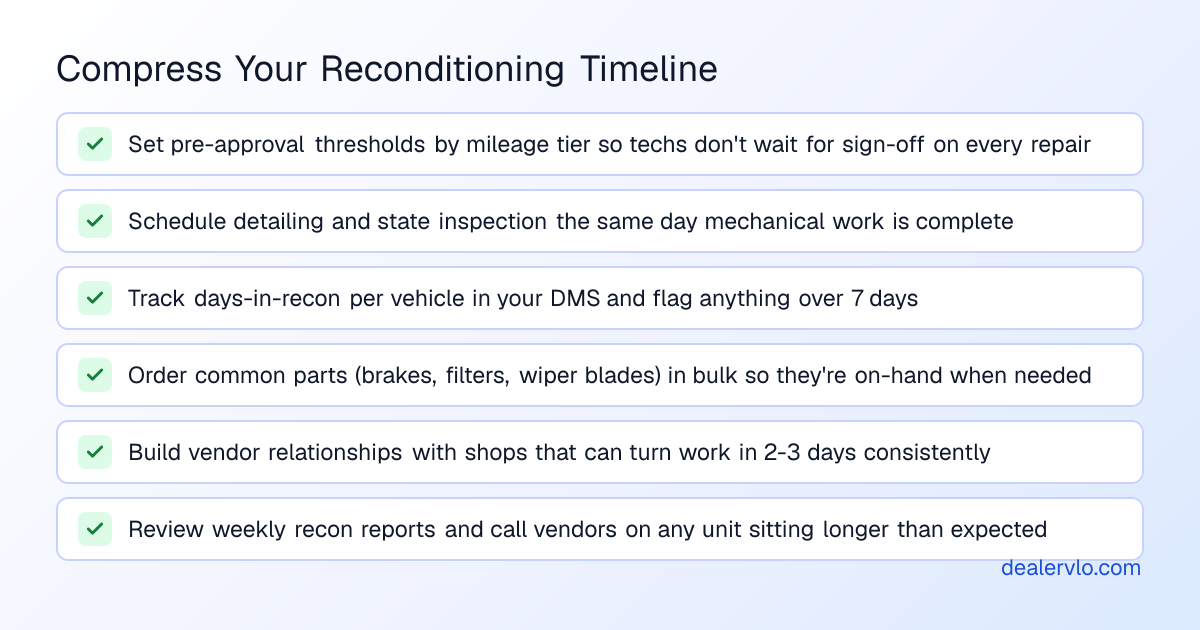
Many dealers set pre-approval thresholds by mileage tier — say, up to $1,000 for under-60k units, up to $1,500 for 60k–100k, and case-by-case above that. This keeps recon moving without requiring manager sign-off on every repair order while maintaining cost control.
For a full walkthrough of setting recon budgets and tracking spend, see our used car reconditioning cost budget guide.
The holding cost multiplier: why speed matters more than you think
Reconditioning cost is the line item you track, but holding cost is the hidden erosion that kills margin on slow-turning inventory. Used vehicles carry $85 per day in holding costs according to analysis from Gina Cocking at Colonnade Advisors — that's floorplan interest, insurance, facility overhead, and opportunity cost rolled together.
NIADA guidance says reconditioning should take four to five days in an efficient operation. But the reality for most independent dealers is longer — seven to ten days is common, and delays from parts backorders, shop scheduling, or inspection appointments push it further.
Do the math on the differential:
- 3-day recon timeline: 3 days × $85/day = $255 in holding cost
- 10-day recon timeline: 10 days × $85/day = $850 in holding cost
- Cost of delay: $595 per vehicle for those extra seven days
That $595 is on top of your parts and labor invoice. On a deal with $1,500 in gross, a slow recon timeline just cost you 40% of the margin before the unit ever hits the lot.
Floorplan interest is the biggest component of that daily holding cost. If you're paying interest on $85/day in total carrying cost and roughly half is floorplan, that's $42.50 per day in interest alone — call it $298 in extra interest over seven unnecessary days. The rest is insurance, facility cost, depreciation, and the opportunity cost of capital tied up in inventory that isn't selling yet.
The fastest way to cut holding cost is to compress the reconditioning timeline. Set repair budgets and pre-approvals before the vehicle arrives so your tech or outside shop isn't waiting for go-aheads. Schedule detail and inspection the day work is complete, not three days later when you get around to it. Track days-in-recon in your DMS and treat anything over seven days as a red flag.
For more on controlling total inventory carrying costs, see our used car dealer benchmarks guide.
Before you authorize the work: see whether a repair earns back its cost plus the holding days it adds.
Open the Recon ROI CalculatorBuilding your recon cost estimator
You need a framework to estimate total cost-to-front-line before you bid at auction or take a trade. Here's a structure that works, using the verified benchmarks above:
Step 1: Start with the vehicle type baseline
- Sedan or compact: Start at $1,400
- Truck or SUV: Start at $1,850
- Luxury or performance: Start at $2,100
Step 2: Adjust for mileage
- Under 60,000 miles: Subtract $200 to $400 (less deferred maintenance, fewer wear items)
- 60,000 to 100,000 miles: No adjustment (this is the average range)
- Over 100,000 miles: Add $300 to $600 (more likely to need suspension, steering, belts, hoses)
Step 3: Adjust for condition at intake
Walk the vehicle and make a realistic assessment:
- Clean history, current on maintenance, good tires: Subtract $200
- Average condition, some wear, maintenance unknown: No adjustment
- Deferred maintenance, cosmetic needs, worn tires/brakes: Add $400 to $800
Step 4: Add holding cost
Multiply your estimated days-in-recon by $85/day:
- 3-day target (best case): Add $255
- 7-day realistic (efficient operation): Add $595
- 10-day baseline (typical for many independents): Add $850
Step 5: Total cost to front-line
Sum your adjusted recon cost and holding cost. This is your total investment to get the vehicle retail-ready, and it should fit within your margin structure before you buy.
Example: 2019 Honda Accord EX, 72,000 miles, average condition
- Baseline (sedan): $1,400
- Mileage adjustment (60k–100k): $0
- Condition adjustment (average): $0
- Holding cost (7-day recon): $595
- Total cost to front-line: $1,995
Example: 2018 Ford F-150 XLT, 95,000 miles, needs tires and brakes
- Baseline (truck): $1,850
- Mileage adjustment (60k–100k): $0
- Condition adjustment (needs work): +$600
- Holding cost (10-day recon): $850
- Total cost to front-line: $3,300
If that F-150 costs you $18,000 at auction, your all-in before retail prep is $21,300. Know that number before you bid, not after.
For more on building margin into your pricing structure, see our guide on how to price used cars and set dealer markup strategy.
14-day free trial, then $29/mo · Cancel anytime
Tracking and controlling recon spend
The estimator gives you a target; tracking actual cost is how you know if you hit it. Most independent dealers track recon spend per vehicle in their DMS or a spreadsheet, broken into parts, labor, and detail.
Set category buckets so you can see patterns:
- Mechanical: Brakes, suspension, belts, fluids, tune-up items
- Cosmetic: Body work, paint, dent repair, trim replacement
- Detail: Wash, wax, interior shampoo, odor removal, paint correction
- Inspection and registration prep: State inspection, emissions, safety items required to pass
Review your recon log monthly and look for outliers. If trucks are consistently running $500 over budget, either adjust your purchase price or raise your baseline estimate. If one body shop is billing twice what another charges for equivalent work, that's a vendor problem worth fixing.
Pre-approval thresholds keep recon moving without turning every repair into a negotiation. Many dealers authorize their tech or outside shop to approve work up to a set dollar limit (say, $1,200) without calling for permission, then require sign-off above that. This prevents the three-day delay waiting for you to look at a quote on a $150 tie rod.
Days-in-recon tracking matters as much as dollar tracking. If your DMS tracks vehicle status, run a weekly report showing every unit in recon and how many days it's been there. Anything over seven days gets a call to the shop or the detailer to find out why. The $85/day holding cost clock is always running.
For dealers building or refining their intake and recon workflows, see our vehicle intake process guide.
What about the recon fee you charge customers?
Some dealers pass a reconditioning fee to the customer as a separate line item on the buyer's order. That fee — typically $500 to $2,000 according to consumer finance sources — is legal, negotiable, and unrelated to your actual cost.
Whether you charge a separate recon fee or bake the cost into your asking price is a pricing and presentation decision, not a cost-accounting one. The customer-facing fee is a markup and negotiation strategy; your actual cost to recon is what you track internally to protect margin.
Most independent dealers don't itemize recon as a separate fee. They set the asking price to cover acquisition cost, recon cost, holding cost, overhead, and desired profit, then negotiate the out-the-door number from there. Franchise stores are more likely to list recon fees separately, often as part of a bundle of dealer add-ons.
If you do charge a recon fee as a line item, know that buyers will negotiate it just like any other fee. Be ready to justify it or fold it into the price during negotiation. The important part is that your margin structure accounts for the actual dollars you spent, regardless of how you present it on the invoice.
For more on total deal structure and margin strategy, see our pricing and markup guide.
Market context: why recon costs are up and staying there
The $500+ increase since 2020 isn't a temporary spike — it reflects structural cost inflation in parts, labor, and consumables that hasn't reversed. Parts prices rose with supply-chain disruption during COVID and haven't come back down. Labor rates at independent shops and dealership service departments climbed steadily and continue to rise in 2026.
Turn time is also up. NIADA data shows the average used vehicle now takes 82 days of inventory supply to sell, and Colonnade Advisors pegs average turn time at 50.2 days in 2024, a 23% increase from the prior year. That's not recon time — that's total lot time — but slower turn amplifies the cost of holding inventory, which makes efficient recon timelines even more critical.
Independent dealers are also facing a wave of off-lease EVs hitting the wholesale market in 2026 — more than 300,000 units, over double the 2025 volume. Many of those vehicles will need battery health assessments, software updates, and charging equipment checks that legacy gas-vehicle recon processes don't cover. If you start stocking EVs, budget extra time and cost until you build the process.
CPO programs continue to command a price premium — Edmunds data shows CPO vehicles fetch an average of $1,600 more than non-certified equivalents — but the certification process adds cost and requires franchise dealer participation, putting it out of reach for most independents.
The bottom line: recon cost is higher than it was three years ago, and planning for that reality is better than hoping it reverses.
For broader context on independent dealer operating benchmarks, see our used car dealer benchmarks guide.
How software helps you track cost and compress timelines
Tracking recon cost and timeline manually — vehicle notes in a notebook, repair invoices in a folder, days-in-recon in your head — works until you're managing more than a handful of units at a time. Once you're turning even ten vehicles a month, you lose visibility fast.
A DMS that tracks vehicle status, recon spend by category, and days in each stage gives you the data you need to spot problems before they cost you margin. You should be able to pull a report showing every vehicle currently in recon, how many days it's been there, and how much you've spent so far. If a unit is on day nine and you've already burned $1,800 in parts and labor, you need to know that before you authorize another repair.
The same system should let you set cost alerts and approval workflows — flag any vehicle that crosses your pre-set recon budget, require manager approval above a threshold, and track whether your outside vendors are hitting their quoted estimates or running over.
On my own lot I track every vehicle's recon spend in DealerVLO from the day it arrives. I can see at a glance which units are sitting in recon too long, which ones blew the budget, and where the money went. That visibility has saved me from buying similar inventory that I now know runs over budget, and it makes monthly recon reconciliation a five-minute task instead of an afternoon with a calculator and a pile of receipts.
For dealers evaluating software options and cost structures, see our dealer software cost breakdown.
Bottom line
The average used car reconditioning cost sits around $1,679 for independent dealers in 2026, but that's an average across all vehicle types and conditions. Sedans run lower, trucks and luxury vehicles run higher, and mileage and condition push the number in both directions.
The bigger cost is holding time. At $85 per day in carrying cost, the difference between a three-day and a ten-day recon timeline is $595 per vehicle — money that comes straight out of your margin whether you track it or not. Fast recon isn't just good operations; it's a profit lever.
Build a cost estimator that reflects your inventory mix, track actual spend per vehicle, and set pre-approval thresholds that keep work moving without blowing your budget. Know your total cost to front-line before you bid, and treat anything over seven days in recon as a problem worth solving.
The dealers making money in 2026 aren't the ones spending the least on recon — they're the ones getting vehicles front-line ready fast, at a predictable cost, with margin left when the deal closes.
Frequently asked questions
What is the average cost to recondition a used car in 2026?
The industry average is $1,679 per vehicle based on the most recent NIADA data for independent dealers, up from $1,455 the prior year. Actual cost varies significantly by vehicle type — economy sedans typically run $1,000 to $1,400, trucks and SUVs run $1,850 to $2,000+, and luxury vehicles often hit $2,000 to $2,300 or higher. Mileage, condition, and your lot's standards also affect the final number.
How much does it cost to recondition a truck vs a sedan?
Trucks and SUVs typically cost 10% to 20% more to recondition than sedans, putting most units in the $1,850 to $2,000+ range compared to $1,000 to $1,400 for economy sedans. The difference comes from larger, more expensive parts (tires, brakes, fluids), more labor hours for equivalent work, and the higher likelihood of suspension and drivetrain wear on trucks, especially those with towing history or four-wheel drive.
What is included in dealer reconditioning cost?
Reconditioning cost includes mechanical repairs (brakes, suspension, fluids, belts, tune-up items), cosmetic work (paint, dent repair, trim replacement), detailing (wash, interior shampoo, odor removal, paint correction), and inspection and registration prep (state safety inspection, emissions testing, required safety items). It does not typically include transport from auction, title and registration fees, or lot prep like window stickers and key tags.
How long should reconditioning take?
Industry best practice is four to five days according to NIADA guidance. Most independent dealers realistically see seven to ten days from intake to front-line ready. Every day beyond five adds $85 in holding costs (floorplan interest, insurance, overhead), so compressing the timeline directly improves margin — the difference between three days and ten days is $595 per vehicle in additional carrying cost.
How do I estimate reconditioning cost before I buy a vehicle?
Start with a vehicle-type baseline (sedan $1,400, truck $1,850, luxury $2,100), then adjust for mileage (subtract $200–$400 for under 60k miles, add $300–$600 for over 100k) and condition at intake (add $400–$800 for deferred maintenance or cosmetic needs). Add holding cost based on your estimated days-in-recon ($85/day, so 7 days = $595). Sum those figures for your total cost to front-line — that number should fit within your margin structure before you bid at auction or take the trade.
Do luxury cars cost more to recondition?
Yes, luxury and performance vehicles typically cost 20% to 35% more to recondition than mainstream sedans, often running $2,000 to $2,300+. The premium comes from expensive OEM or high-quality aftermarket parts, longer labor times due to complex systems and difficult access, specialized fluids and consumables, and higher cosmetic standards — luxury buyers expect flawless paint, pristine interiors, and every feature working. Know your repair ceiling before you buy, because the margin is made at purchase.
14-day free trial, then $29/mo · Cancel anytime