How to Turn Inventory in 3–5 Days: Recon Workflow & Speed
A workflow for 3–5 day recon turnaround: intake checklist, approval thresholds, vendor coordination, and service, detail, and photo timing for small lots.
Part of the Reconditioning guide: Used Car Reconditioning Cost: Budgeting & ROI for Dealers
Switching from another DMS? Compare DealerVLO to DealerCenter, Frazer, or Lot Wizard.
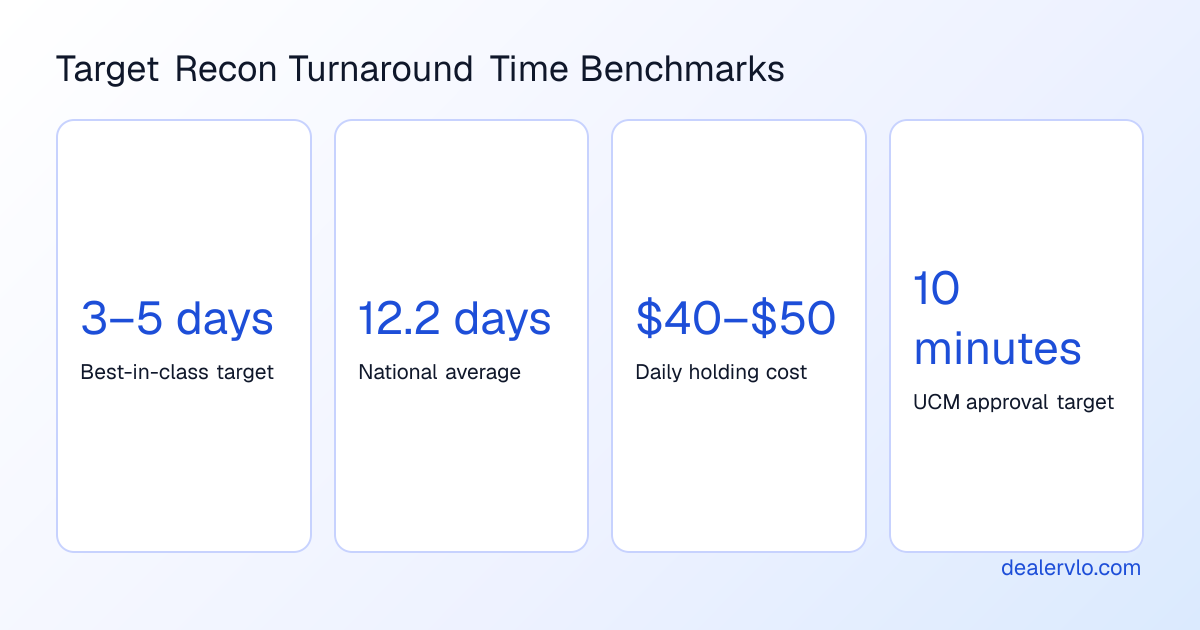
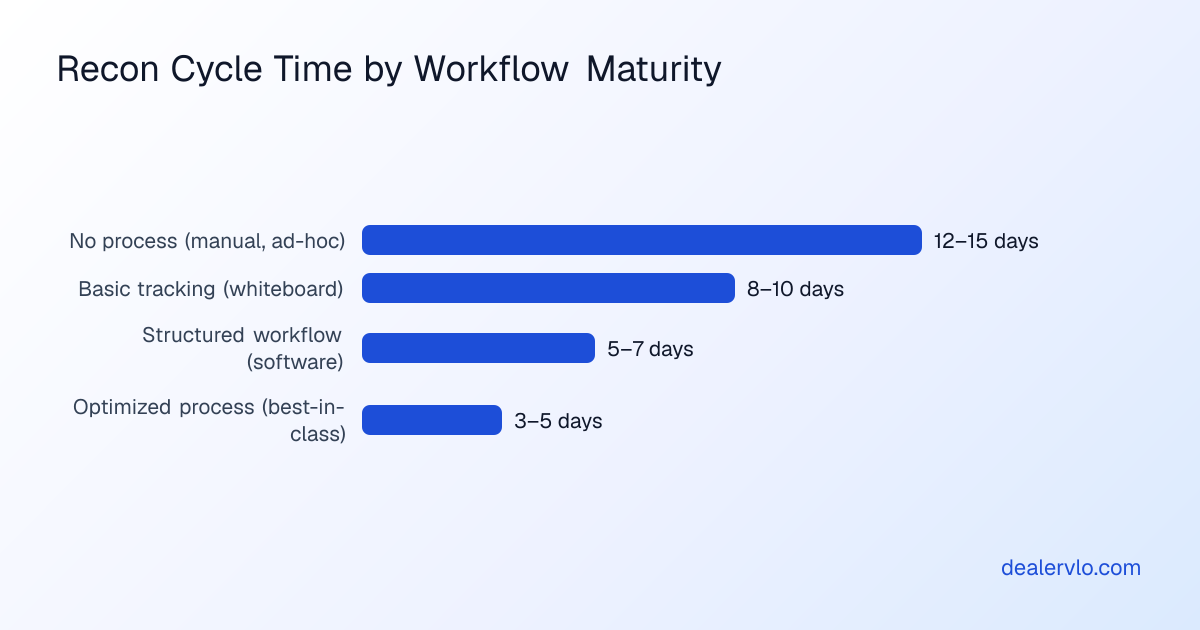
The difference between a three-day recon turnaround time and a twelve-day one is rarely parts cost or labor budget—it's workflow. The best-run lots get cars frontline-ready in three to five days, while plenty of lots without a defined process take a week or two. That gap doesn't come from spending more money; it comes from designing a process where the next step happens automatically, approvals take ten minutes instead of two days, and nobody has to wander the lot looking for a car that's been sitting somewhere for three days waiting on a signature.
This guide walks through the workflow blueprint that makes three-to-five-day recon real: intake checklists that prevent five-day parts delays, approval thresholds that keep techs working instead of waiting, vendor handoffs that don't lose cars for a week, and coordinated final steps so detail, photos, and QC all happen on the same day. If you're running eight to fifteen days and wondering where the time goes, you'll find it here—and you'll find the fixes that cost nothing but a process change.
Note: This article focuses on workflow design and timing. If you need help scoping what to spend on each unit, see our guide to used car reconditioning cost and budget.
14-day free trial, then $29/mo · Cancel anytime
Why recon turnaround time matters
Every day a car sits in recon costs you holding cost — floor plan interest (or the return on your own cash), insurance, and depreciation. Your number depends on your rates and the car, so work it out for your own lot. As a worked example: at $40 a day, a twelve-day cycle costs $480 per car before it ever hits the lot, and cutting it to five days saves 7 × $40 = $280 per car. At twenty cars a month, that's about $5,600 a month — money that drops straight to your bottom line.
Speed also affects gross. The longer a unit sits, the older it gets, and age kills price. A car that's frontline ready on day five sells faster and closer to your ask than one that lands on the lot two weeks later with another week of market depreciation baked in.
But here's the real reason workflow matters: predictability. A fast recon process is a consistent recon process. When you know every trade will be inspected within 24 hours, approved by lunch, and done in five days, you can price it accurately, market it immediately, and turn inventory before the calendar becomes a problem. Slow, unpredictable recon kills your ability to manage aged inventory before it costs you.
The critical first 24 hours: intake and the daily trade walk
The single biggest delay in recon happens before the wrench ever turns: the car sits for three or four days before anyone inspects it, parts get ordered a week late, and you've added five days to your cycle before you even knew the unit needed tires.
The fix is the daily trade walk. Every morning (or at minimum two to three times a week, run consistently), walk every new acquisition with your service manager or lead tech. Tag keys, assign stock numbers, log the car into your system, and do a quick visual: tires, body, glass, obvious mechanical red flags. The goal isn't a full inspection—it's to spot the stuff that requires parts or sublet work so you can order it that day instead of discovering it when the tech finally pulls the car in four days later.
A setup that works: walk at the same time on fixed days — say 8:00 a.m. three days a week — with whoever runs service and whoever buys the cars. Sales can join but doesn't have to. Anything that needs tires, glass, or body work gets flagged and scheduled before lunch, so parts delays show up on day zero instead of day four.
Your intake checklist should include:
- Keys tagged with stock number and location (on a board, not tossed in a drawer)
- Unit logged into your DMS or reconditioning workflow system
- Initial condition photos (four corners and interior—nothing fancy, just proof of what you bought)
- Visual inspection notes: tires, brakes, body damage, glass, interior tears, warning lights
- Parts pre-order: if it needs something obvious (tires, wipers, headlights), order it now
If you sublet body or glass work, schedule the pickup during the trade walk. Don't wait until the tech inspection three days later—by then you've already burned half your target cycle time.
Approval thresholds: ten minutes, not two days
The fastest way to kill recon speed is to require used car manager approval on every line item, then make the manager unreachable for six hours while they're at the auction or working deals. Best practice is now a ten-minute approval window, accomplished by texting the estimate to the manager's phone the moment the tech finishes the inspection.
Here's how it works in a well-run shop: the tech does the multipoint, creates the repair order in the workflow system (parts and labor already scoped), and with one click texts the full estimate to the used car manager. The manager might be at breakfast, at the desk, or buying cars—doesn't matter. They open the text, unclick anything unnecessary to retail the car, and approve. The car is still on the lift. Approval comes back in five minutes, and the tech starts work immediately.
If your manager can't respond in real time, set pre-approval thresholds by mileage or price bucket. For example:
- Under 50k miles, under $800: auto-approved, proceed with work
- 50k–100k miles, under $1,200: auto-approved
- Over 100k miles or over $1,500: requires manager sign-off
The point is to keep work flowing. Waiting two hours (or two days) for a $400 brake job approval is where your five-day target dies.
Workflow sequencing and timing targets
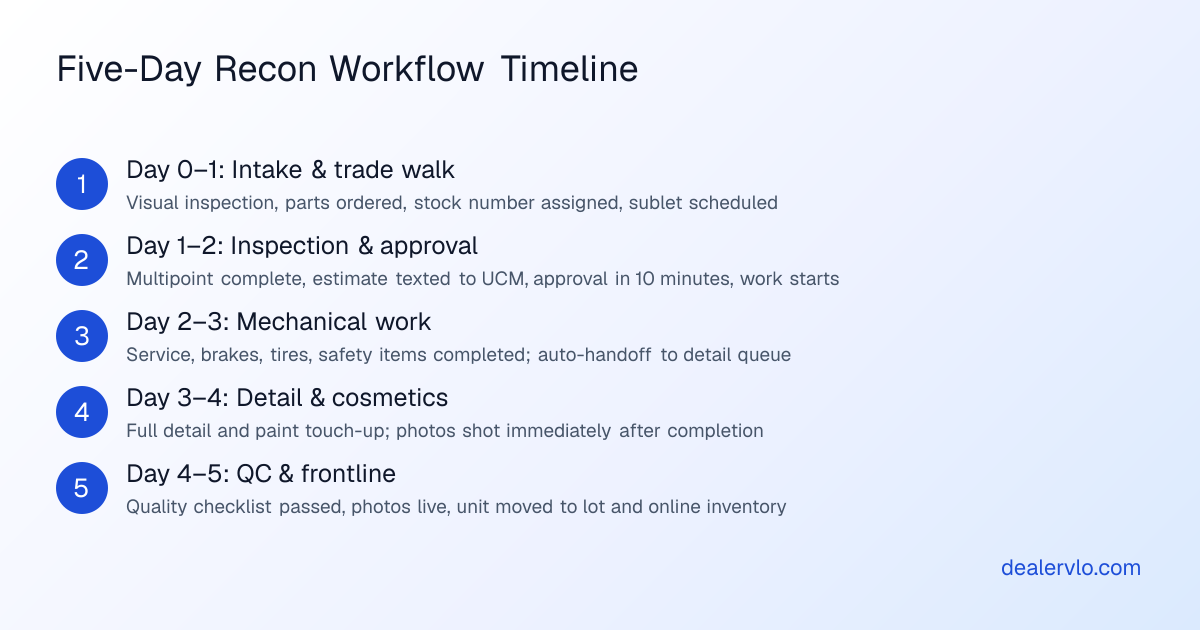
A three-to-five-day recon cycle breaks down roughly like this:
- Day 0–1: Intake, trade walk, parts ordered, sublet work scheduled
- Day 1–2: Mechanical inspection and approval (target: four hours in the bay)
- Day 2–3: Mechanical work completed (oil change, brakes, tires, safety items)
- Day 3–4: Detail and cosmetic finish (target: eight hours)
- Day 4–5: Photos, QC, and frontline
Getting to a three-day cycle means keeping service to a few hours per car and detail plus photos to about a day. That's hard, but it's doable—by load balancing work across multiple dedicated techs so no single bottleneck stalls the line.
Best practice is that mechanical plus detail combined must be two days or less. If service takes three days and detail takes two, you're already at five days before intake, approval delays, or parts hold. The only way to hit that is to pipeline the work: when mechanical finishes on a unit, detail should know automatically and have a slot ready. No one should have to walk the lot looking for the car or wonder if it's done.
One workflow trick that works: run category-based tech assignment. Instead of random dispatch, assign cars to techs by complexity:
- Express lane: sold units, safety inspections, emissions, fluids—in and out same day
- Basics: tires, brakes, routine maintenance, under four hours
- Specialty: engine, transmission, anything over four hours or requiring diagnostics
This prevents a simple oil-and-tires car from waiting behind a transmission rebuild. Your tech working the express lane can turn four cars a day; the specialty tech turns one, but that one needed the time.
Vendor coordination and sublet tracking
Most independent dealers sublet body work, glass, upholstery, and sometimes alignments or diagnostics. The problem is that once a car leaves your lot, it enters a black hole: you don't know when the vendor actually started work, when they'll finish, or whether the car is even still there. It's common for a unit to sit at a body shop for a week on a two-day repair simply because no one called to check status.
The fix is vendor portal integration or, at minimum, a shared tracking sheet with due dates and progress updates. If you use reconditioning workflow software, the vendor should receive the work order through a portal, accept it with a committed return date, and update status as work progresses. If you're doing this manually, send a text or email with the stock number, scope, and expected return date, and require the vendor to confirm receipt and commit to a timeline.
Then hold them to it. If a car is due back Thursday and it's not on your lot by 3:00 p.m., you call. Vendors will fill their schedule with whoever yells loudest, and if you don't track it, your cars sit while they handle someone else's rush job.
For common sublets (tires, glass, detail if you outsource it), establish standing pickup and drop-off times. For example: tire vendor picks up Monday and Thursday at 10:00 a.m., returns same day by 4:00 p.m. That predictability lets you plan the rest of the workflow instead of guessing when the car will reappear.
Track sublet time separately from in-house time. If a car spends three days at the body shop, that's not a recon workflow problem—it's a vendor selection or volume problem. But if a car sits on your lot for two days waiting to go to the body shop because no one scheduled the pickup, that's a workflow gap you can close.
Stock the parts you always need
You can't control backorders on specialty parts, but you can control how often you run out of the everyday ones: oil filters, wiper blades, cabin filters, brake pads for your most common models, and touch-up paint in your area's most common colors. Keep a small stock of your high-runners on the shelf and ask your supplier about standing orders with next-morning delivery. Every car that doesn't wait on a routine part is a car that doesn't lose a day.
Detail, photos, and final merchandising timing
Detail and photos are the last mile, and they're where a lot of dealers lose another two to three days because nobody coordinated the handoff. Mechanical finishes on Tuesday afternoon, but detail doesn't know until Thursday, and photos don't happen until the following Monday because the photographer only comes twice a week.
Best practice: detail sees the queue before the car arrives. When mechanical marks a unit complete in your workflow system, it automatically appears on detail's schedule for the next available slot. If detail runs an eight-hour cycle and you have two guys, you can turn two cars a day—so the system books them in order and everyone knows when their car is up.
Photos and QC should happen the same day detail finishes. If you shoot your own photos, train your detail team to do it as the final step—wipe it down, pull it into your photo area, shoot the standard set, upload, done. If you use a professional photographer, coordinate their schedule with your detail completion schedule so cars don't sit clean and pretty for four days waiting on pictures.
Quality control is the final gate. Run a checklist—safety items, cosmetic standards, cleanliness, all fluids topped, no warning lights, photos and description live in your DMS. If something fails, the task reopens with a reason code and goes back to the responsible party. Digital QC checklists (built into most recon workflow software) make this automatic and cut rework because the tech knows exactly what failed and why.
Merchandising requirements—photos, description, price—should be in place before a unit is marked frontline ready. Otherwise you're putting cars on the lot that no one can sell yet, and that doesn't help your turn rate or your gross.
Put a real dollar-a-day number on every unit sitting on your lot.
Open the Holding Cost CalculatorAccountability and visibility: every stage needs an owner and a clock
The core principle of fast recon is this: every stage needs an owner and a clock. When a car has been waiting 36 hours on approval, someone should know, and it should be obvious whose move it is. When a unit has been in mechanical for four days on a two-hour job, your workflow system should flag it and escalate.
Manual handoffs—"hey, is that car ready yet?"—are where the days disappear. Automation of the handoffs is what brings them back. When mechanical finishes, detail should know automatically. When detail finishes, photos should trigger automatically. When QC passes, the car should appear on the frontline list and in your online inventory without anyone having to remember to update three different systems.
A live status dashboard is worth the software cost. You should be able to pull up a screen and see:
- Every car in recon, with current stage and time in that stage
- What's waiting on approval, and for how long
- What's waiting on parts, and expected delivery date
- What's at a vendor, and expected return date
- What's past target timeline, flagged in red
When something goes red, you act. If a car has been waiting on UCM approval for 24 hours, you text the manager. If a vendor is two days past their committed return, you call. If a car has been in detail for three days on an eight-hour target, you find out why.
Visibility also protects quality. Digital QC checklists lock in your standards—no unit goes frontline without passing every gate. Rework shrinks, customer satisfaction rises, and the path to the lot stays clear.
14-day free trial, then $29/mo · Cancel anytime
Measurement: ADR and time to line
You can't improve what you don't measure. The two metrics that matter for recon speed are Average Days in Recon (ADR) and Time to Line (T2L).
ADR measures the time, in days or hours, from mechanical inspection to frontline ready. This is what recon actually controls—the work they touch. If your ADR is eight days and your target is five, you have a workflow problem inside your shop.
Time to Line (T2L) measures the full cycle: from acquisition (auction, trade, or purchase) to frontline ready. T2L includes intake delays, approval delays, parts delays, and sublet time. It's the total clock, and it's what affects your holding costs and turn rate.
Track both, and track them by stock number so you can drill down. If T2L is twelve days but ADR is five, your problem isn't the shop—it's intake or approval or parts ordering. If ADR is nine days and T2L is fourteen, your shop workflow is the bottleneck.
Set targets and review weekly. Post the numbers where your team can see them. When a store knows the goal is five days and they're hitting seven, they start asking the right questions: Why did this car sit for two days waiting on an oil filter? Why didn't we order tires until day four?
Workflow technology and automation
You can run a tight recon process on a whiteboard and a group text, but past about twenty units a month it gets hard to track manually. Workflow software pays for itself fast by eliminating the "where's that car?" and "who's supposed to approve this?" questions that burn hours every week.
Good recon software gives you:
- Workflow builder to map your custom process—intake, inspection, approval, mechanical, sublet, detail, photos, QC, frontline
- Task assignment and timelines so every step has an owner and a due date
- Live status dashboard showing every car, every stage, every delay
- Mobile approvals so your UCM can approve from the auction, the lot, or home
- Vendor portals with committed timelines and status updates
- Automated handoffs so detail knows the moment mechanical finishes
- Bottleneck alerts when a car or a stage goes past target time
The expensive mistake is saving a little on tools while your process leaks days — and holding cost — on every car. Some cloud-based DMS platforms include recon workflow modules; others don't, so check before you assume.
To be clear about ours: DealerVLO isn't a recon workflow board — it doesn't run stage timers, vendor portals, or approval texts. What it does is track every car's reconditioning costs line by line, roll them into that car's all-in cost and margin, and show its days on the lot, so you can see what slow recon is costing you car by car.
Even a simple shared task board (Trello, Asana, Monday) is better than nothing if it gives you visibility and accountability. The point is to make status obvious and handoffs automatic so the car keeps moving.
Common workflow gaps and how to close them
Here are the most common leaks, and the fixes:
Gap: Car sits for three days before anyone inspects it.
Fix: Daily or twice-weekly trade walk, parts ordered day zero.
Gap: Approval takes 24–48 hours.
Fix: Mobile text approvals with ten-minute SLA, or pre-approval thresholds by price/mileage.
Gap: Parts delay—ordered late, backordered, wrong part.
Fix: Order during trade walk; maintain a shelf stock of common consumables (filters, wipers, bulbs); build a two-day parts buffer into your timeline and escalate anything that goes longer.
Gap: Car finishes mechanical Tuesday, doesn't start detail until Friday.
Fix: Automated handoff from mechanical to detail queue; detail schedules in advance based on expected completion.
Gap: Sublet vendor holds the car for a week on a two-day job.
Fix: Committed return dates in writing, daily status updates, and a backup vendor when the first one misses deadlines.
Gap: Photos don't happen for three days after detail.
Fix: Shoot photos immediately after detail as part of the same workflow step, or coordinate photographer schedule with detail completion.
Gap: No one knows where a car is or what's holding it up.
Fix: Live status dashboard, every stage logged, every delay visible.
Close even a few of these gaps and you'll take days off your average cycle without spending a dollar on faster parts or more labor.
Buy cars you can recon fast
Recon speed starts at acquisition. A car that needs heavy body work, a transmission, or a backorder-prone part is a slow car before it ever reaches your lot — no workflow fixes that. When you're on the block or looking at a trade, ask whether you can get it frontline-ready in a few days with the people and vendors you have today. If not, pass, or price your offer for the longer cycle and the extra holding days. Buying cars that sell fast also means buying cars you can recon fast: clean history, common parts, and mechanical work your own shop can handle.
Putting it together: a realistic five-day timeline
Here's what a five-day recon cycle looks like in practice for a typical unit—not a wholesale flip, not a total rebuild, but a normal trade or auction buy that needs tires, brakes, detail, and the usual service work:
Day 0 (acquisition day): Trade walk at 8:00 a.m. Visual inspection flags tires and brakes. Tires ordered from your vendor, picked up same day. Stock number assigned, keys tagged, car logged into system. Initial intake photos taken.
Day 1 (inspection and approval): Tech pulls the car at 9:00 a.m., completes multipoint inspection by 10:30. Scope: tires (already ordered), front brakes, oil change, cabin filter, wiper blades, minor paint touch-up on rear bumper. Estimate texted to UCM at 10:35. Approved by 11:00. Tires delivered by 2:00 p.m. Tech starts work.
Day 2 (mechanical completion): Tech finishes brakes, tires, oil, and service work by 2:00 p.m. Marks unit complete in workflow system. Detail receives automatic notification, books the car for first slot tomorrow morning.
Day 3 (detail and paint touch-up): Car pulled into detail bay at 8:00 a.m. Full interior and exterior detail, paint touch-up on bumper, completed by 4:00 p.m. Photos shot immediately after final wipe-down, uploaded to DMS by 5:00.
Day 4 (QC and frontline): QC checklist completed at 9:00 a.m.—all safety items pass, cosmetics pass, photos and description live. Car moved to frontline, appears in online inventory same day.
Total elapsed time: four days from acquisition to frontline. You have a one-day buffer to hit your five-day target, which covers the occasional parts delay or approval hiccup.
That's the blueprint. It's not magic, and it doesn't require heroic effort—it requires a process where every step has an owner, every handoff is automatic, and every delay is visible so you can fix it before it costs you three days.
Frequently asked questions
What is a realistic recon turnaround time for an independent used car dealer?
The best-run lots get a typical trade or auction buy frontline-ready in three to five days, while plenty of lots without a defined process take a week or two. A five-day target is aggressive but achievable with good workflow design—intake and trade walk on day zero, inspection and approval within 24 hours, mechanical and detail combined in two to three days, and photos plus QC on the final day. Getting down to three days means keeping service to a few hours per car and detail plus photos to about a day, which takes dedicated people and tight load balancing.
How much does slow recon actually cost per vehicle?
Every day in recon costs you floor plan interest (or the return on your own cash), insurance, and depreciation — the exact number depends on your rates and the car, so run your own with a holding cost calculator. As a worked example: at $40 a day, cutting a twelve-day cycle to five saves 7 × $40 = $280 per car, and at twenty cars a month that's about $5,600 a month. Speed helps gross too, because the car reaches the lot younger and sells closer to your asking price.
What is the daily trade walk and why does it matter?
The daily trade walk is a quick morning inspection of every new acquisition—trades, auction buys, and purchases—done with your service manager or lead tech before the car enters formal recon. You tag keys, assign stock numbers, and do a visual check for tires, body damage, glass, and obvious mechanical needs. The goal is to spot anything that requires parts or sublet work so you can order it that day instead of discovering it three or four days later when the tech finally pulls the car in. Running the trade walk consistently — daily, or at least two to three times a week — can take days off your cycle, because parts get ordered on day zero instead of day four.
How do I get recon approvals down to ten minutes instead of two days?
Best practice is mobile text approvals. When the tech completes the inspection, your workflow system (or a simple text if you're doing it manually) sends the full scoped estimate to the used car manager's phone. The manager reviews it on the spot—at the desk, at the auction, or at home—unchecks anything unnecessary, and approves. The car is still on the lift and the tech starts work immediately. If real-time approval isn't realistic, set pre-approval spend thresholds by vehicle mileage or price bucket so common work (under $800 for low-mileage, under $1,200 for mid-mileage) proceeds without waiting, and only big-ticket items require manager sign-off.
How do I track cars that are out at vendors for sublet work?
Most independents sublet body work, glass, upholstery, or specialty repairs, and cars disappear for a week because no one tracks them. The fix is a vendor portal (if your recon software supports it) or a manual tracking sheet with stock number, scope, pickup date, committed return date, and status updates. Send the work order to the vendor in writing, require them to confirm receipt and commit to a return date, then hold them to it—if a car is due back Thursday at 3:00 and it's not on your lot, you call. For high-volume sublets like tires or glass, establish standing pickup and drop-off schedules (e.g., Monday and Thursday at 10:00 a.m., same-day return) so the workflow stays predictable.
What metrics should I track to measure recon speed?
Track Average Days in Recon (ADR) and Time to Line (T2L). ADR measures the time from mechanical inspection to frontline ready—what your recon process actually controls. T2L measures the full cycle from acquisition to frontline, including intake delays, approval delays, and sublet time. If T2L is high but ADR is low, your problem is upstream (intake, parts ordering, approvals). If ADR is high, your shop workflow or vendor coordination is the bottleneck. Track both weekly by stock number so you can drill down and fix the specific gaps that are costing you days.
Bottom line
Hitting a three-to-five-day recon turnaround time isn't about spending more or working weekends—it's about designing a workflow where every stage has an owner, every handoff is automatic, and every delay is visible before it becomes a three-day problem. Run a consistent trade walk, get approvals down to ten minutes, coordinate your vendors with committed timelines, and pipeline mechanical-to-detail-to-photos so the final steps happen on the same day. Close the gaps that leak time, measure what matters, and your average cycle will drop without adding a single tech or dollar to your recon budget. The cars you already own will turn faster, cost less to hold, and hit the lot younger—and that's money you keep every single month.
14-day free trial, then $29/mo · Cancel anytime
Before you authorize the work: see whether a repair earns back its cost plus the holding days it adds.
Open the Recon ROI Calculator