Reconditioning Bottlenecks: Why Cars Get Stuck in Your Shop (And How to Fix It)
Identify the 5 recon bottlenecks costing you days and gross—manager approval delays, parts gaps, vendor handoffs, inspection backlogs, and accountability…

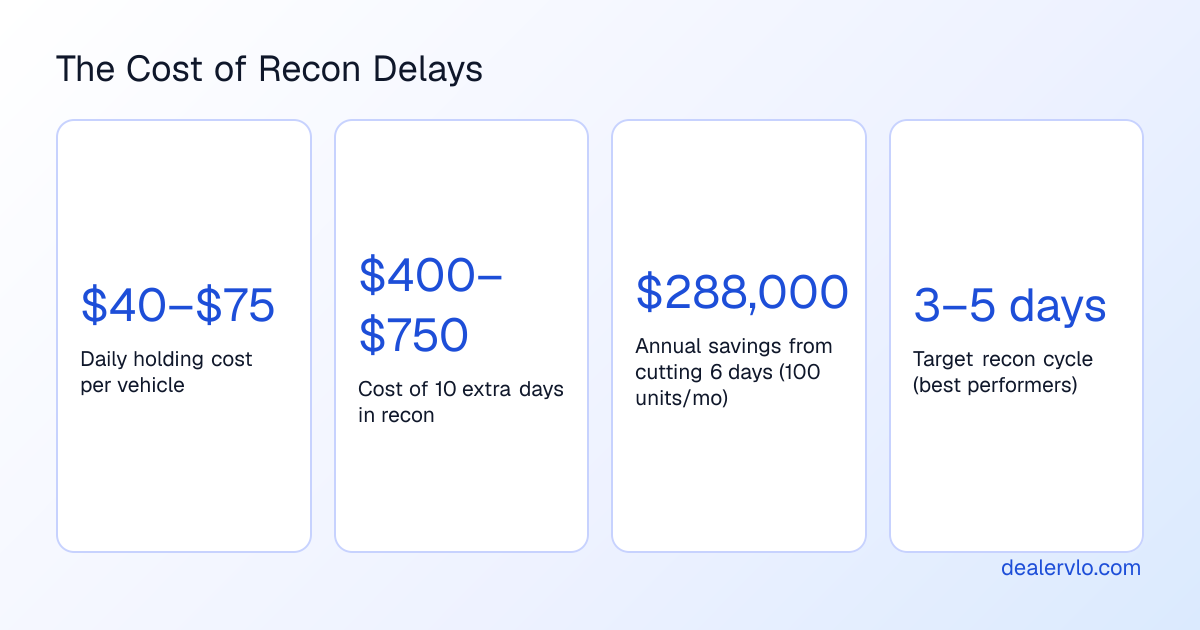
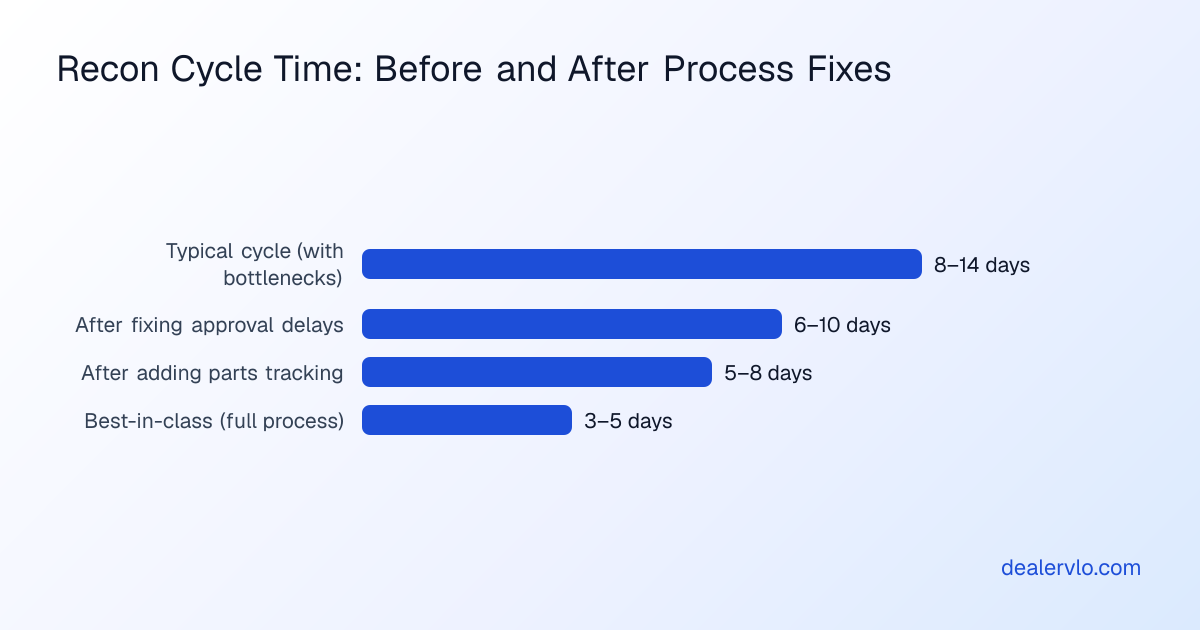
Every day a car sits in recon, it bleeds holding cost. Depending on the vehicle, that's somewhere between $40 and $75 per day before it ever reaches your lot. If your recon cycle runs eight to fourteen days—and industry data shows many stores still land in that range—you're looking at $320 to $1,050 of lost gross per unit, just from the wait.
The best-performing dealers are proving you can cut that cycle to three to five days with the right process in place. But most recon delays aren't caused by the work itself. They're caused by what happens between the work: approvals that sit in an inbox, parts orders that nobody tracks, vendor jobs that leave without a due date, inspections that don't trigger the next step, and a total lack of visibility into who owns what.
This article walks through the five most common recon bottlenecks—the exact places cars get stuck—and the process fixes that unstick them.
Compliance note: This article discusses operational process, not regulatory requirements. If your state imposes specific reconditioning disclosure obligations, confirm those with your state dealer licensing authority.
Why recon speed matters more now than it used to
Total turn time—acquisition to sale—averaged 50.2 days in 2024, a 23% increase from the year before. That's not just recon time; it's the whole clock. But recon is where you have the most control, and it's where most of the bleeding happens.
Holding cost is the accumulation of interest, insurance, advertising, and other sale expenses charged against your margin, multiplied by the number of days you own the unit. Most domestic vehicles run around $40 per day. Luxury imports and high-content trucks can hit $80. Even at the conservative end, a car that sits for fifteen days instead of five costs you an extra $400 in holding cost alone.
The math scales fast. If you're reconditioning 100 vehicles a month and you shave six days off your average cycle, you save roughly $24,000 a month—$288,000 a year—at $40 per day per car. That's not revenue. That's cost you didn't incur, which falls straight to the bottom line.
The financial case for speed is clear. The operational question is where the time actually goes. Most of it isn't wrench time. It's wait time—cars parked between steps because no one knows the next step is theirs to own.
Bottleneck 1: Manager approval delays
This is one of the quietest killers in the recon process. The inspection finishes. The estimate gets written. Then the car sits for a day or two waiting for a manager to review and approve the work—not because the manager is slow, but because the estimate is sitting in an inbox, on a clipboard in the service drive, or in a stack on a desk while that manager is tied up with a customer, a bank call, or off for the day.
The actual work might be a two-hour job. But if the approval step has no clock on it and no one owns the wait, it's not unusual for a vehicle to lose one to two full days right here. Nobody feels it because the bottleneck is invisible. The tech hasn't started yet, so there's no complaint. The car just sits.
Manager approval delays quietly push vehicles past the fifteen-day window when they command the highest prices. Every day of delay is a day you're not selling, and delays in reconditioning make price drops more likely once the car finally does hit the lot.
The fix: push approvals to mobile with a visible clock
The fix is to make approvals visible and fast. Push the estimate to a single place—a dashboard, a mobile notification, a shared screen—where the right manager can review and approve it without hunting for paper or switching systems.
Set a target approval time (two hours is reasonable for most stores) and track it. You don't need to punish anyone for missing it, but if you measure it, people start to see it. When there's a clock on the step, the step gets done.
Some stores solve this by giving service managers mobile approval access so they can sign off between customers. Others batch approvals twice a day at set times so everyone knows when decisions happen. Either works. What doesn't work is treating approval as an untracked step that happens "when the manager gets to it."
Bottleneck 2: Parts sourcing and ordering delays
Once the work is approved, parts get ordered. If everything's in stock locally, this step is fast. If you're waiting on a back-ordered sensor, a body panel from a regional warehouse, or a trim piece that has to ship from across the country, the car parks until the part shows up.
Parts delays are partly outside your control—you can't make a supplier stock something they don't have. But visibility into the delay usually is in your control, and that's where most stores lose time. A tech finds out a part is back-ordered three days after the order was placed, or discovers the wrong part arrived and now there's another two-day wait for the replacement. The car wasn't stuck because of the part. It was stuck because no one knew the part was the problem until it was too late to call an audible.
The fix: tie parts requests to the VIN and track expected arrival
Tie every parts request to the VIN and require an expected arrival date in the system. If a part is back-ordered, that should trigger an alert the same day so you can decide whether to source it elsewhere, adjust the scope, or at least set expectations with your sales team.
If you're ordering from multiple suppliers, consider consolidating to one or two so you can leverage volume, get better terms, and build a relationship that makes it easier to get answers when something goes sideways. Many auctions offer reconditioning services and parts at checkout—if you're buying there anyway, ask what they stock.
For common failure items—sensors, brake components, filters, belts—keep a small on-site inventory if your volume supports it. You'll spend a few hundred dollars up front, but you'll save days per car when you don't have to wait on a same-day delivery that shows up at 4:45 p.m.
The goal isn't to eliminate parts delays entirely. It's to know about them immediately so they don't become invisible three-day gaps.
Bottleneck 3: Vendor handoff failures
Sublet work—dent repair, glass, upholstery, paint—leaves your building without a firm due date, and it comes back when it comes back. In the meantime, the car is off your property, out of your workflow, and not moving through any checklist. If the vendor is running behind or misjudged the job, you often don't find out until you call to ask where the car is.
The communication gap is the killer. Every person involved in recon has a different role, and if there's no system that bridges those interactions, miscommunication becomes the norm. Vendor handoffs are where that breakdown is most expensive, because you lose both time and control.
Dealerships that bring more work in-house—especially cosmetic repairs—reduce dependency on external vendors and shorten turnaround times. The result is faster recon and more consistent quality. More importantly, it allows you to control costs, maintain standards, and keep cars moving on your schedule.
The fix: send vendors scoped work with due times and ask for photo proof
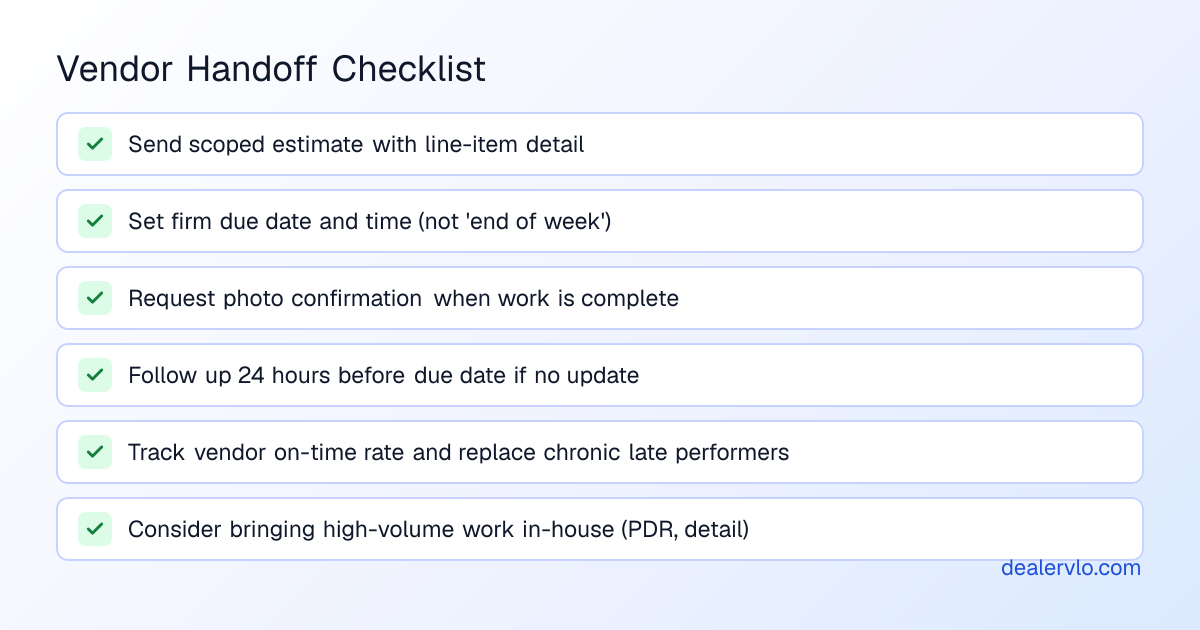
When you sublet work, send a scoped estimate with a firm due date and time, and ask for photo confirmation when the work is complete. Treat vendors like internal resources: give them clear expectations, track the timeline, and follow up before the due date if you haven't heard anything.
If a vendor consistently misses deadlines or goes dark, replace them. Speed and reliability matter more than saving $50 on a dent job when the delay costs you $200 in holding cost and pushes the car out of your selling window.
Some stores solve vendor handoff problems by bringing cosmetic work in-house. If you have the space and the volume, hiring a part-time detailer or PDR tech can eliminate a major bottleneck and give you control over quality and timing. Whether you should bring work in-house or sublet it depends on your throughput—just make sure the decision is about speed and consistency, not just cost per job.
For more on managing the broader vehicle intake process and integrating vendor work into your workflow, we've written about that separately.
Bottleneck 4: Inspection backlogs
Recon delays often start within the first few hours. A car gets taken in, it appears on a list somewhere, and then nothing happens because no task was assigned, no inspection was triggered, and no one is sure who owns the next step.
Inspection backlogs happen when intake doesn't automatically fire the next action. The car is in your system, but it's not in anyone's queue. If your workflow depends on someone remembering to pull a list at the end of the day and manually assign inspections, cars slip through—especially on busy weeks when acquisition volume spikes.
Even when inspections do happen, they don't always lead anywhere. The tech completes the inspection, logs the findings, and then the estimate sits because no one was notified that it's ready to review. The inspection step is done, but the next step doesn't know it's supposed to start.
The fix: make intake trigger inspection, and inspection trigger the estimate
The fix is to make each handoff explicit. When a car is taken into inventory, that action should automatically assign an inspection task to a specific person with a due time. When the inspection is complete, that should automatically trigger estimate creation and notify the approving manager.
You don't need expensive software to do this—you need a checklist with owners and deadlines, and you need someone checking at the end of each day to make sure nothing is sitting unassigned. A shared board or a simple task tracker works if everyone actually uses it.
The inspection itself should be consistent. Most include mechanical system checks (engine, transmission, brakes, steering, suspension), safety systems (tires, airbags, lights), a diagnostic scan, fluid analysis, frame and rust assessment, a cosmetic review, and a test drive. A standardized checklist helps your team document what needs to be done, assign responsibilities, and keep each vehicle moving.
If a department is receiving more vehicles than it's completing in a day, you have a capacity problem—staffing may need to be addressed. If vehicles aren't moving to the next department as they should, the issue is process and delegation. Either way, you can't fix what you can't see.
For guidance on what's worth fixing and what's not during recon, see our article on what not to fix in recon.
Bottleneck 5: No accountability and no process visibility
The most expensive bottleneck isn't a specific step. It's the absence of ownership. When no one knows who's responsible for moving a car to the next stage, and there's no shared view of where each car sits in the process, vehicles stall for days without anyone noticing.
Lack of visibility means you're managing recon by asking around. You don't know which cars are waiting on parts, which are at a vendor, which are waiting for approval, or which have been sitting untouched for three days. By the time you find out a car is stuck, you've already lost the time.
No accountability means no one feels the delay. If five people touch a car during recon and none of them owns the total cycle time, it's easy for everyone to assume someone else is handling it. The work gets done eventually, but "eventually" costs you $40 to $75 per day, per car.
The fix: assign an owner to every car and make status visible to everyone
Every car in recon should have a single owner who's responsible for moving it through the process. That doesn't mean they do all the work—it means they're the one person who tracks where it is, what's next, and whether it's on schedule. If a car is stuck, that owner is the one who escalates it.
Make status visible. A shared board—physical or digital—that shows every car, its current stage, who owns it, and how many days it's been in process gives your entire team the information they need to spot problems early. When everyone can see that a car has been sitting in "waiting for parts" for four days, someone asks the question before it becomes six days.
Some stores run a daily standup where the recon owner reports on every car in process: what's done, what's next, what's blocked. It takes ten minutes and it eliminates most of the "I thought you were handling that" gaps that cause delays.
The combination of clear ownership and visible status turns recon from a black box into a managed process. You'll still have delays—parts will back-order, vendors will run late—but you'll know about them the day they happen instead of the day the sales manager asks why a car isn't on the lot yet.
For a detailed look at how the fastest stores structure their entire workflow, see our article on recon speed and the 3-day workflow. If you want to benchmark your current process, our guide to recon turnaround time and workflow walks through how to measure it.
What fixing these bottlenecks actually looks like
You don't need to overhaul your entire operation overnight. Start with the bottleneck that's costing you the most time. For many stores, that's manager approval—it's invisible, it's easy to fix, and cutting a day or two there immediately improves your cycle time.
Once approvals are moving, tackle parts visibility. Make sure you know the day a part goes on backorder, not three days later. Then tighten up vendor handoffs by adding due dates and follow-up reminders.
Inspection backlogs and accountability are harder because they require process changes and buy-in from your team, but they're also the ones that stick. When everyone knows who owns each car and what the next step is, recon stops being a guess and starts being a process you can manage.
The goal isn't perfection. It's predictability. If you know a car is going to take five days in recon and it actually takes five days, you can plan your inventory, set buyer expectations, and avoid the "where's that car?" conversations that waste time and credibility.
Cutting your recon cycle from ten days to five doesn't just save you holding cost. It adds five extra days of selling time to every vehicle, and those days are the ones when prices are strongest. That's the real return: more cars ready faster, less cost per unit, and a system that doesn't depend on one person remembering to check a list.
For more on budgeting recon work and deciding what's worth spending, see our used-car reconditioning cost budget guide. If you're trying to control total cycle time from acquisition to frontline, our article on how to buy cars that sell fast covers the buying decisions that set you up for quick recon in the first place.
Once cars are ready, the next bottleneck is often getting them online. Our guide on why cars aren't showing on listing sites and how to post cars fast to Facebook Marketplace can help you eliminate the delay between recon-complete and live inventory.

Frequently asked questions
What is the biggest recon bottleneck for most independent dealers?
Manager approval delays are the most common invisible bottleneck. The work might only take two hours, but if the estimate sits in an inbox or on a clipboard while the manager is tied up, the car can lose one to two full days waiting for a signature. The fix is to push approvals to mobile with a visible clock and a target response time—two hours is reasonable for most stores. When approvals are tracked and visible, they stop being the place cars get stuck.
How much does each day in recon actually cost?
Holding cost per vehicle per day typically ranges from $40 to $75 depending on the vehicle type, with luxury imports and high-content trucks at the higher end. This is the accumulation of interest, insurance, advertising, and other sale expenses charged against your margin. A car that sits for fifteen days instead of five costs you an extra $400 to $750 in holding cost before it ever reaches the lot—and that's before any price depreciation from aging inventory.
How can I prevent parts delays from stalling recon?
Tie every parts request to the VIN and require an expected arrival date in your system. If a part is back-ordered, that should trigger an alert the same day so you can source it elsewhere or adjust the scope. Consider consolidating to one or two suppliers so you can leverage volume and get faster answers. For high-failure items like sensors and brake components, keep a small on-site inventory if your volume supports it—you'll save days per car when you don't have to wait on delivery.
Should I bring vendor work in-house or keep subletting it?
It depends on your volume and your space. Bringing cosmetic work in-house—especially PDR, detailing, or minor trim repair—gives you control over speed, quality, and cost, and eliminates the communication gaps that cause vendor handoff delays. If you're reconditioning fifty or more cars a month and you have the space, hiring a part-time tech can pay for itself in reduced cycle time. If your volume is lower, focus on managing vendors better: send scoped work with firm due dates and ask for photo confirmation when complete.
How do I know where my recon process is actually stuck?
You need visibility into every car's current stage, how long it's been there, and who owns the next step. A shared board—physical or digital—that shows vehicle status, days in process, and assigned owner lets you spot bottlenecks in real time instead of discovering them three days later. Many stores run a daily standup where the recon owner reports on every car in process: what's done, what's next, what's blocked. When the whole team can see where cars are sitting, someone asks the question before it becomes a week-long delay.
What's a realistic recon cycle time target for a small independent lot?
Top-performing dealers are hitting three to five days from intake to frontline-ready with the right process and visibility. If you're currently running eight to fourteen days, cutting that to five or six is a realistic first goal and will save you substantial holding cost per unit. The key is making handoffs explicit so each step triggers the next one automatically—intake triggers inspection, inspection triggers estimate, approval triggers parts ordering. Speed comes from eliminating the wait between steps, not from rushing the work itself.
Before you authorize the work: see whether a repair earns back its cost plus the holding days it adds.
Open the Recon ROI Calculator