Facebook Marketplace is still free lead flow — we just made posting painless
Facebook Marketplace is one of the last free lead sources for a small lot. Why it's worth posting to — and how DealerVLO makes each car take about two minutes.
Ask most small-lot dealers about Facebook Marketplace and you get a shrug. They know it works — half the walk-ins mention they saw a car on it — but actually posting to it is the chore nobody wants. Save the photos off your phone, open Facebook, re-type the year, make, model, mileage, color, and transmission into every field, write a description, do it again for the next car. So the cars sit unposted, and a free lead source goes to waste.
That's the exact problem we just went after. This post is two things: the honest case for why Marketplace still belongs in your mix even though everything else costs money, and what we changed so posting a car there takes about two minutes instead of ten.
Why Marketplace still earns its spot
Every other place your cars show up — the paid marketplaces, the lead providers — charges you, one way or another. Marketplace doesn't. It's one of the last channels where you can put a car in front of a large local audience for free, and the people who reach out are usually closer to buying than a cold web-form lead, because they messaged you about that car.
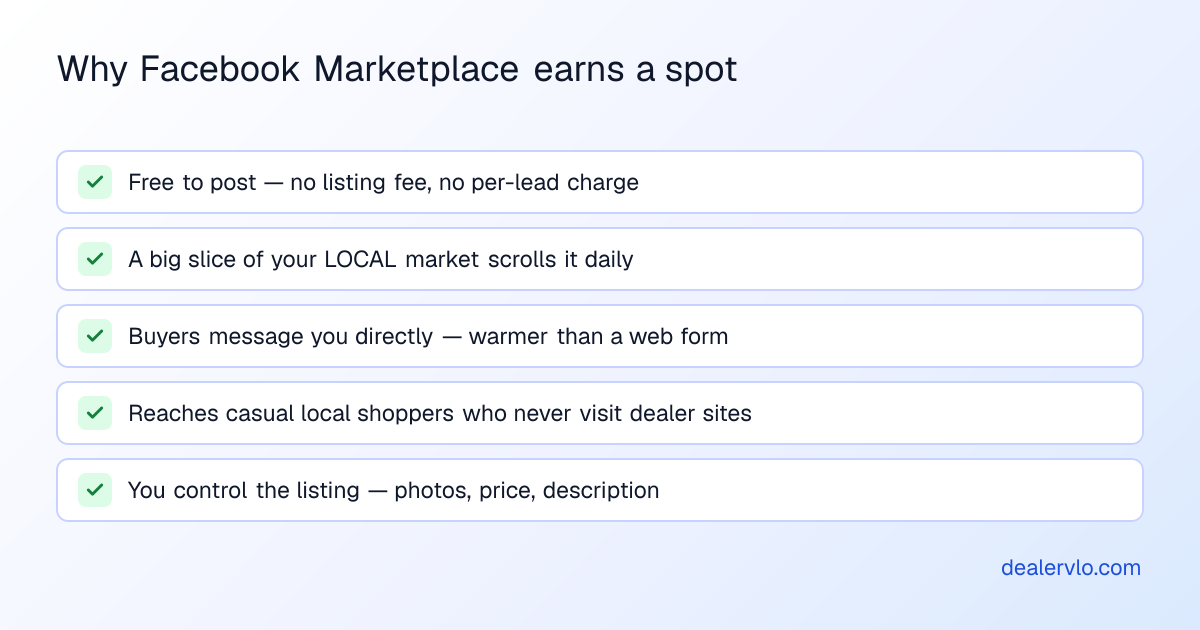
The other thing it does that your website can't: it reaches the casual buyer. Plenty of local people who'd never think to search "[used cars near me]" and land on a dealer site are scrolling Marketplace on the couch anyway. You're not competing for their attention there — you're just in the place they already look. (For the full picture of where your cars should live, the car-listing-sites rundown covers the paid channels too, and the dealer's Marketplace guide walks through Facebook's current rules and the paid catalog path.)
The catch has always been the labor
Here's the honest reason most dealers under-use it: posting by hand is a slog. For one car you're saving a dozen photos to your device, uploading them, then hand-typing every spec into Facebook's form and writing something in the description box. Multiply that by a lot of thirty cars and it's an afternoon nobody has. So it gets skipped, or done for the two newest units and never again.
The information to post a clean listing already lives in your inventory system. It was just trapped there — you were the copy machine moving it into Facebook by hand. That's the part that shouldn't exist.
Turn your ad spend into a cost per car sold and a real ROI — and see how many units the spend has to produce just to break even.
Open the Marketing ROI CalculatorWhat we changed
Open any car in DealerVLO and hit Post to marketplace, and the window now hands you everything a listing needs, already formatted:
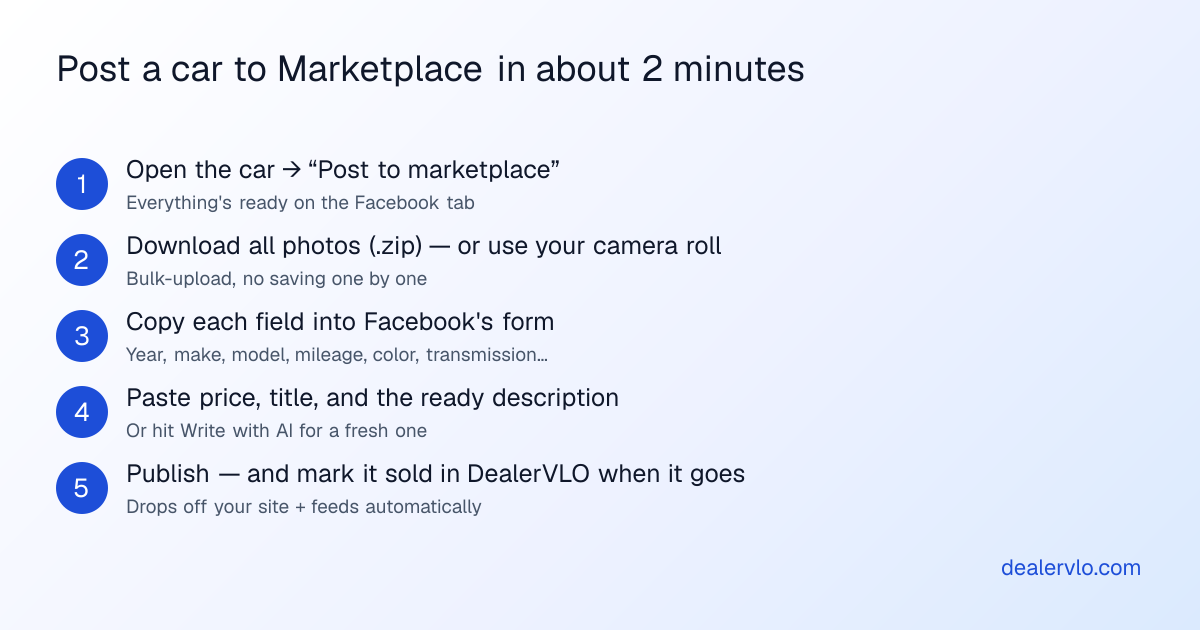
Three things do the heavy lifting. First, one click downloads all the car's photos as a single zip — unzip it and upload the whole set at once instead of saving them one at a time (and if you shot the car on your phone, they're already in your camera roll, so you skip even that). Second, every field Facebook's Sell → Vehicle form asks for is laid out as a tap-to-copy checklist — year, make, model, trim, mileage, body style, color, fuel, transmission — so nothing gets left blank or typed from memory. Third, the description is written for you, with the specs, key features, your phone number, and location already in it, and a Write with AI button that generates a fresh, plain-spoken one on demand if you want it sharper.
The result is what you'd expect: a professional listing in about two minutes, and you'll actually post the whole lot instead of the two newest cars. The step-by-step guide walks the exact flow.
Make the listing actually convert
Fast posting only helps if the listing is good. The bar on Marketplace isn't high, but a thin listing — three blurry photos and "runs great" — gets scrolled past, and a complete one that looks like a real dealer posted it gets the message.
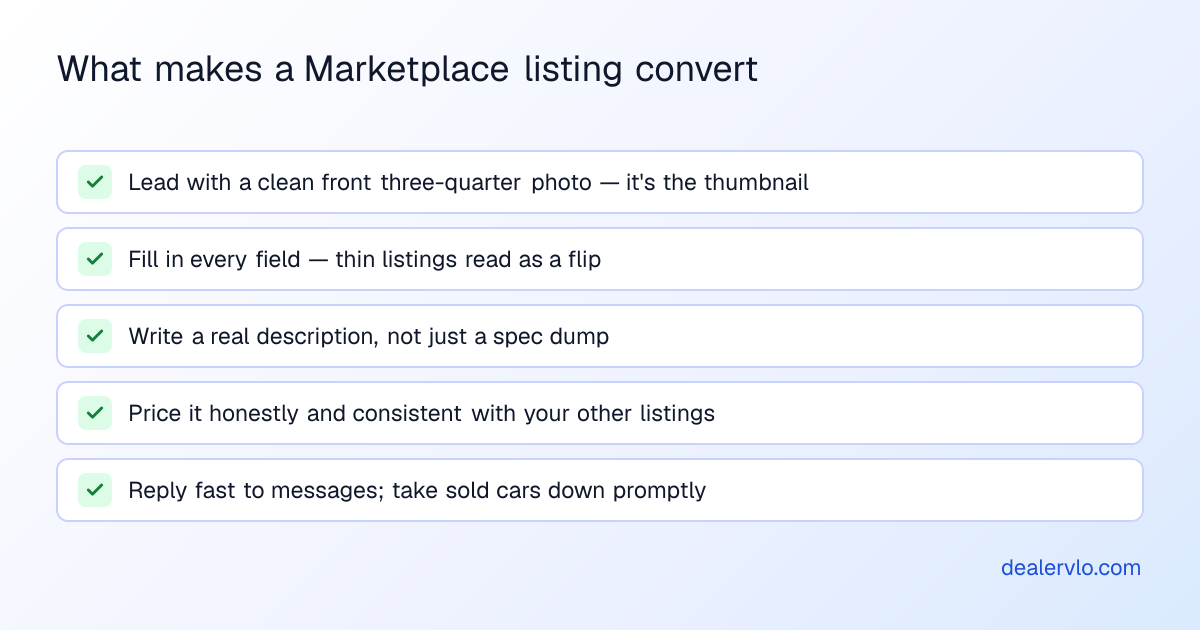
The photo is doing more work than anything else — it's the thumbnail that decides whether a scroller taps at all, so lead with a clean front three-quarter shot (how to shoot a car so it sells if your photos are the weak link). Fill in every field. Write a real description instead of a spec dump (what a good listing description actually does). And when the messages come in, answer them fast — Marketplace buyers move on quickly, and turning that first message into an appointment is where the sale actually starts.
The honest part: Facebook's rules move
Two things to keep straight. Marketplace's rules for dealers have shifted more than once, and Facebook limits how many listings you can post and how fast — so post steadily rather than dumping your whole lot in an hour, and keep every listing accurate to a car that's physically on your lot. Manual posting, within those limits, is the dependable free path.
DealerVLO also generates an automated Marketplace catalog feed you can connect in Settings → Feeds if you'd rather not post by hand — but because Facebook's dealer-catalog rules keep changing, treat that as a supplement to manual posting, not a replacement for it. And when a car sells, mark it sold in DealerVLO so it drops off your website and your other feeds; the Marketplace post is the one you still take down yourself.
Frequently asked questions
Is Facebook Marketplace worth it for a used-car dealer?
For a small lot, yes — it's one of the last places to reach a lot of local buyers for free, and the messages tend to be warmer than a cold web lead. It won't replace your paid channels, but as a free source that reaches casual local shoppers, it earns its spot. The labor of posting was the only real downside, and that's the part worth fixing.
How long does it take to post a car with DealerVLO?
About two minutes: open the car, click Post to marketplace, download the photos as one zip (or use your camera roll), copy each field into Facebook, and paste the ready price, title, and description. No re-typing specs, no saving photos one by one.
Manual posting or an automated feed?
Manual is the reliable free path — post steadily within Facebook's limits. The automated catalog feed in Settings is a supplement, since Facebook's dealer-catalog rules keep shifting.
How do I keep listings professional?
Lead with a clean exterior thumbnail, fill in every field, write a real description (or have AI write it), and price it honestly. Complete listings out-pull thin ones every time.
What happens when the car sells?
Mark it sold in DealerVLO and it drops off your site and feeds automatically. Then take the Marketplace post down, since you created that one by hand.
Bottom line
Facebook Marketplace is free lead flow you're probably leaving on the table, and the only real reason is that posting by hand is tedious. The information to post a great listing already lives in your inventory — it just needed to stop requiring you to be the copy machine. Now it's a couple of clicks: grab the photos, copy the fields, paste the description, done.
That's the whole idea behind DealerVLO — your inventory entered once, then working everywhere it can, from your own website to the marketplaces to a Marketplace post you can put up in two minutes. It's $29/month flat, unlimited users, with a free 14-day trial that a card starts, no charge until day 14. Get your cars in front of the local buyers already scrolling for them.