Where to list your cars for leads — and how to be on every site at once
The car listing sites that actually get an independent lot leads in 2026 — CarGurus, Facebook Marketplace, Autotrader, Cars.com — and how to be on all of them from one feed.
Every dealer eventually asks the same question a different way: where do I put my cars so the phone rings? The honest answer isn't a single site. Buyers don't shop one marketplace and stop — they cross-shop, bouncing from CarGurus to Autotrader to a Facebook tab, comparing the same three cars across all of them. If your unit is only on one, you're invisible on the other two exactly when they're deciding.
So the real move isn't picking the best site. It's being on all the high-intent ones at once — and doing it without turning your afternoons into data entry. This is the map: which sites earn their place for an independent lot, why being everywhere beats being anywhere, and how one feed gets you there.
Where used-car shoppers actually are in 2026
For a small lot, five channels do the heavy lifting. Rank them by where high-intent buyers actually start, not by which vendor pitched you hardest:
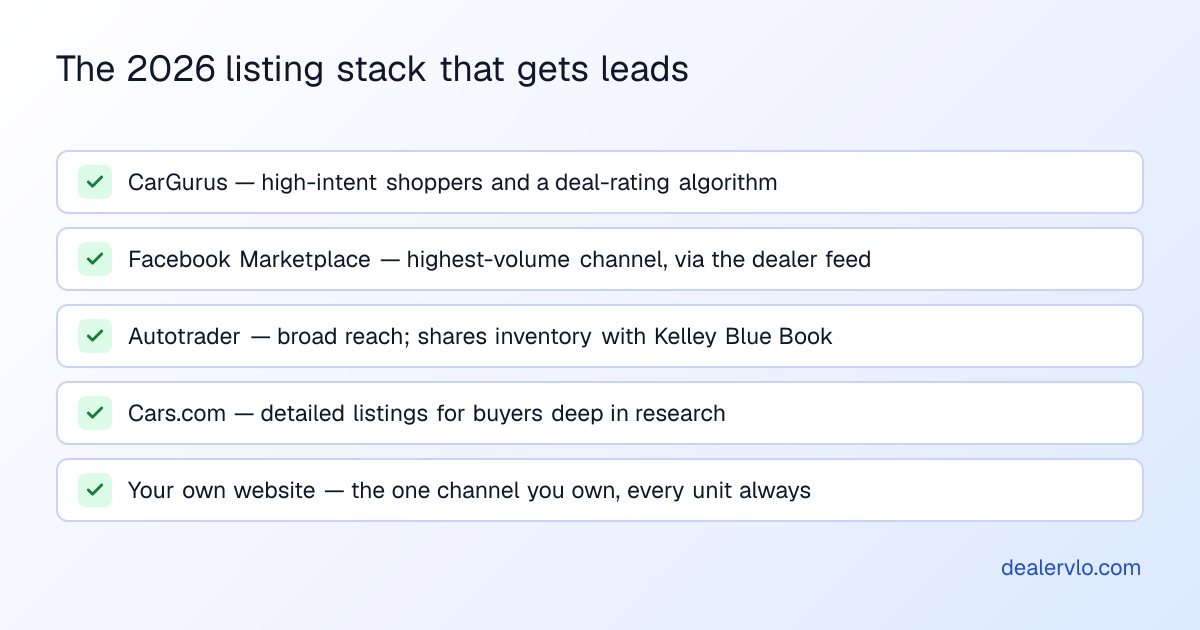
CarGurus bills itself as the most-visited automotive shopping site in the US, and for lead quality it lives up to the reputation — its deal-rating badges pull in buyers who've already done their homework on price. Facebook Marketplace is still the highest-volume channel for a lot like mine, but since 2023 dealer inventory only surfaces through an approved feed, not a business- page post — I covered that path in detail in the Marketplace guide. Autotrader shares inventory with Kelley Blue Book (both Cox properties), so one listing there reaches two of the names buyers trust most. Cars.com skews toward shoppers deep in research, comparing trims and history.
And then the one everyone underrates: your own website. Every other channel is rented land — the platform sets the rules, changes the fees, and can delist you on a policy whim. Your site is the only place your whole inventory is always listed, on your terms, and it's what your Google Business Profile and an AI assistant both point people to. If you're weighing which of these to pay for, the companion piece on what listing actually costs — including the free stack is the money lens; this post is the reach lens.
The real problem isn't which site — it's being on all of them
Once you accept that you need presence on four or five sites, a second, quieter problem shows up: keeping them all straight. This is where most lots quietly lose money and hours.
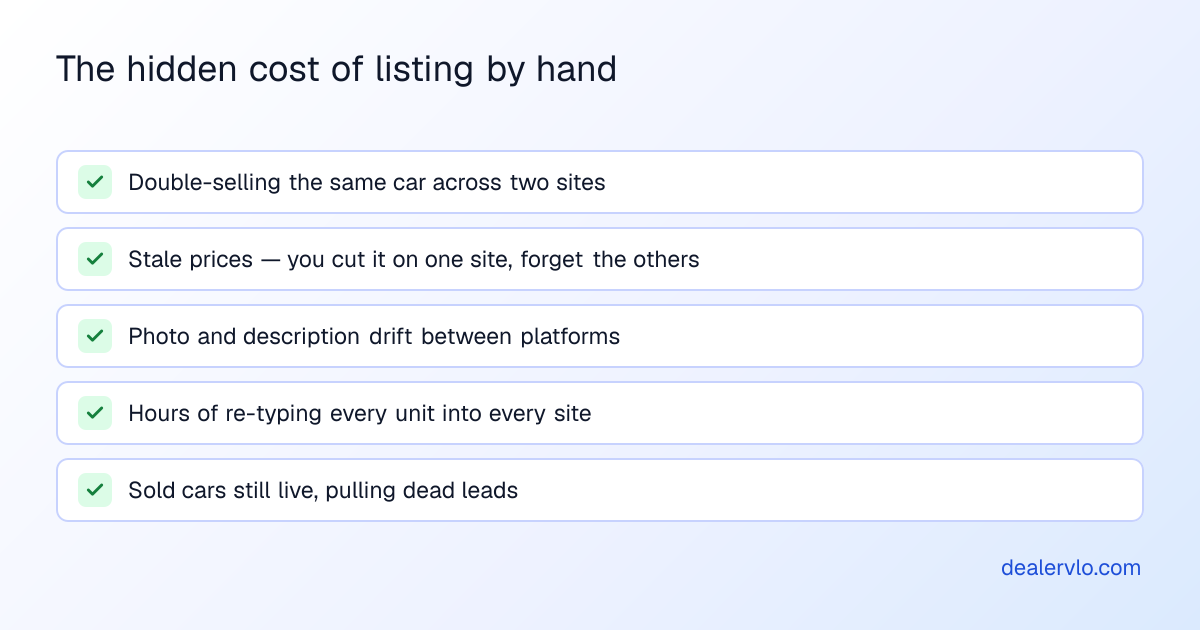
You drop the price on a slow unit on CarGurus, then forget Cars.com, so a buyer calls quoting the old higher number and now you're negotiating against your own listing. You sell a car off its Marketplace lead, but it's still live on Autotrader for three days pulling calls you can't fill — which wastes the buyer's time and yours. Two people put a deposit on the same truck because it read "available" in two places at once. None of this is a marketing problem. It's a sync problem, and doing it by hand across five sites, every week, is where the wheels come off.
The tell that you've got it: how long does it take you to change one car's price everywhere? If the answer is "I'd have to log into four sites," you're not really on four sites — you're on four slowly-diverging copies of your inventory.
Turn your ad spend into a cost per car sold and a real ROI — and see how many units the spend has to produce just to break even.
Open the Marketing ROI CalculatorSyndication: one feed to every marketplace
The fix is inventory syndication — a fancy word for a simple idea. Your cars live in one system as the single source of truth. From there, one feed formats each unit and pushes it out to every marketplace you've turned on, and keeps them in lockstep as things change. Enter the car once; it shows up everywhere. Change it once; it changes everywhere. Sell it; it disappears everywhere.
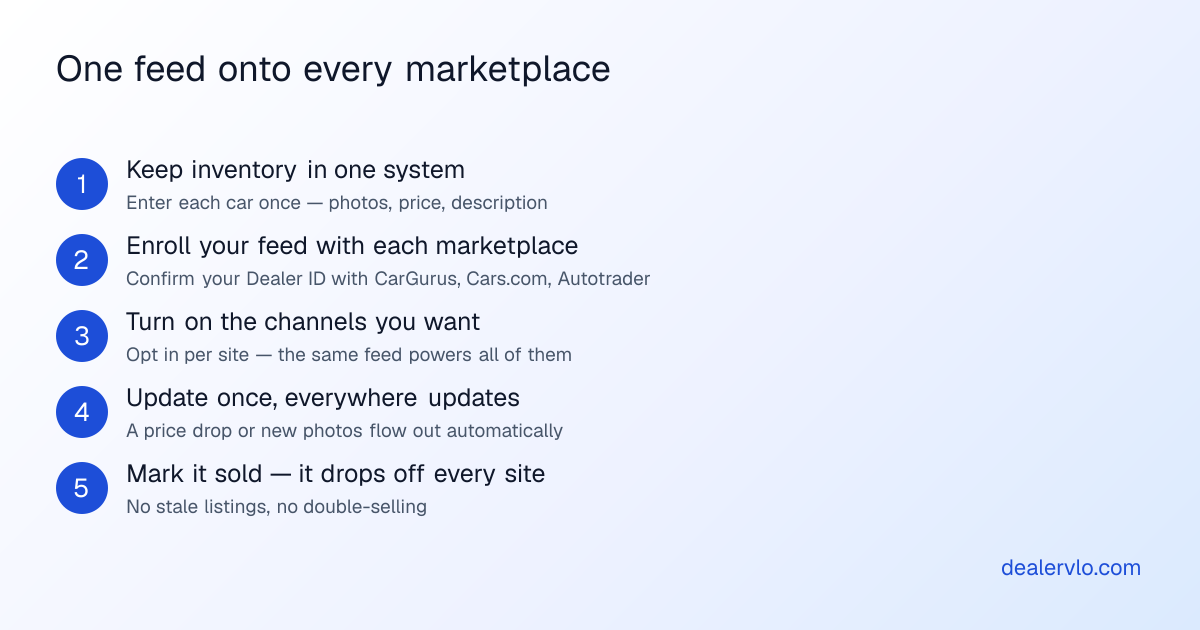
There's one honest bit of setup: each marketplace has to accept your feed. You (or your software) enroll as a feed provider with CarGurus, Cars.com, and Autotrader, and they hand you a Dealer ID that ties the feed to your account — a one-time step per platform, usually a short email to their feed team or your rep. After that it runs itself. And to be clear about what syndication does and doesn't do: it kills the work — the retyping, the stale prices, the sold-car cleanup — not the platforms' own subscription fees. Autotrader still bills you like Autotrader. What changes is that you stop paying for reach twice: once in dollars and again in hours.
One photo set and one description feeds everything
Here's the multiplier most dealers miss: if your inventory is centralized, you only have to do the good work once, too. Shoot the unit properly, one time, write one honest, well-built description, and that same set of photos and copy flows to every channel. No re-shooting for Cars.com, no thinner description on the site because you were tired of typing.
That's also why listing quality and listing reach aren't separate projects. A great listing on one site is a rounding error; a great listing syndicated to five is a distribution system. The lots that turn inventory fast aren't the ones posting more — they're the ones whose one good listing is everywhere the buyer looks, which is the whole game behind a healthy inventory turn rate.
Judge every channel by cost per car sold
More reach is only worth it if it sells cars, and every platform will happily report you a flattering lead number. The number that pays rent is cars sold per channel against what the channel costs — ask every buyer where they found the car, count sold units per channel monthly, and divide the cost by the sales. I walked through that ninety-day scorecard in the free-vs-paid listing breakdown and the wider marketing cost-per-car-sold math, so I won't re-teach it here — just don't skip it. Syndication makes this measurement possible, because your listings are finally consistent enough across sites to compare fairly. And once the leads come in, turning them into appointments fast is what separates a busy inbox from a sold car.
Frequently asked questions
What are the best sites for a dealer to list used cars in 2026?
For lead volume: CarGurus, Facebook Marketplace (via the dealer feed), Autotrader, Cars.com, and your own website. CarGurus and Marketplace usually drive the most contacts for a small lot; Autotrader and Cars.com add research-stage reach. The mix that actually pays is decided by cost per car sold in your market, not by lead counts.
How do dealers get inventory on multiple sites at once?
Inventory syndication — one system holds your cars, and a single feed publishes each unit to every marketplace you've enrolled, keeping them in sync. You enter the car once instead of retyping it into five sites, and it drops off everywhere when it sells.
What is inventory syndication?
Publishing one source of inventory to many destinations automatically. The system formats and sends your feed to each site and updates them together — killing stale prices, duplicate listings, and sold cars that linger live.
Does DealerVLO post my cars to CarGurus, Autotrader, and Cars.com?
Yes — one feed syndicates to CarGurus, Cars.com, and Autotrader, plus a Facebook Marketplace feed and your own website. Each channel is opt-in; you enroll DealerVLO as your feed provider with the platform first to get your Dealer ID, then it runs automatically.
Do I still pay the marketplaces if I use DealerVLO?
Yes. DealerVLO removes the work, not the platforms' subscription fees. Those sites still bill you on their own terms — syndication just means you're paying for reach without also paying in hours.
Bottom line
Being on the best car listing site doesn't matter much when your buyer is cross-shopping four of them. Presence everywhere the high-intent shopper looks — CarGurus, Marketplace, Autotrader, Cars.com, and the site you own — is the real advantage, and the thing standing between most lots and that is the sheer tedium of keeping five listings in sync by hand.
That tedium is exactly what DealerVLO takes off your plate: enter a car once and it flows to your own website and out through one feed to CarGurus, Cars.com, Autotrader, and Facebook Marketplace — photos, price, and description staying current on their own, and dropping off every channel the moment you mark it sold. One record, everywhere your buyers are, for $29/month flat with unlimited users — a free 14-day trial that a card starts, no charge until day 14. You still deal with each marketplace for their own account and fees; you just stop doing it five times over.