What is a vehicle inventory feed — and what makes yours good
A plain-English guide to vehicle inventory feeds for used-car dealers: what's in one, why data quality decides your lead quality, feed formats and update frequency, and how to tell a good feed from a broken one.
Every dealer relies on inventory feeds whether they know the word or not. The moment your cars appear on CarGurus, Autotrader, or Cars.com without you typing them in one by one, a feed did that. It's the plumbing underneath modern car listings — invisible when it works, and the quiet reason your leads dry up when it doesn't.
Worth understanding, then, even if you never touch the file itself. Because the quality of that feed is the quality of your listings, which is the quality of your leads. Here's what a vehicle inventory feed actually is, what's in one, and how to tell whether yours is helping you or holding you back.
What a vehicle inventory feed is
A vehicle inventory feed is a structured, machine-readable file of your current inventory — every available car, described in a format a marketplace can read — that gets delivered to each channel on a schedule. Think of it as your lot, translated into a spreadsheet the size of your inventory, updated as things change, and handed to CarGurus, Autotrader, Cars.com, Facebook, and your own website so each can build listings from it.
The key thing: it replaces a person posting cars with a system publishing them. Instead of you entering the same Silverado into five sites, one feed carries it to all five and keeps them in sync. That's the difference between listing being a data-entry job and a systems job — the whole premise of inventory syndication.
What's inside one
Per car, a feed carries the facts a shopper and a platform both need:
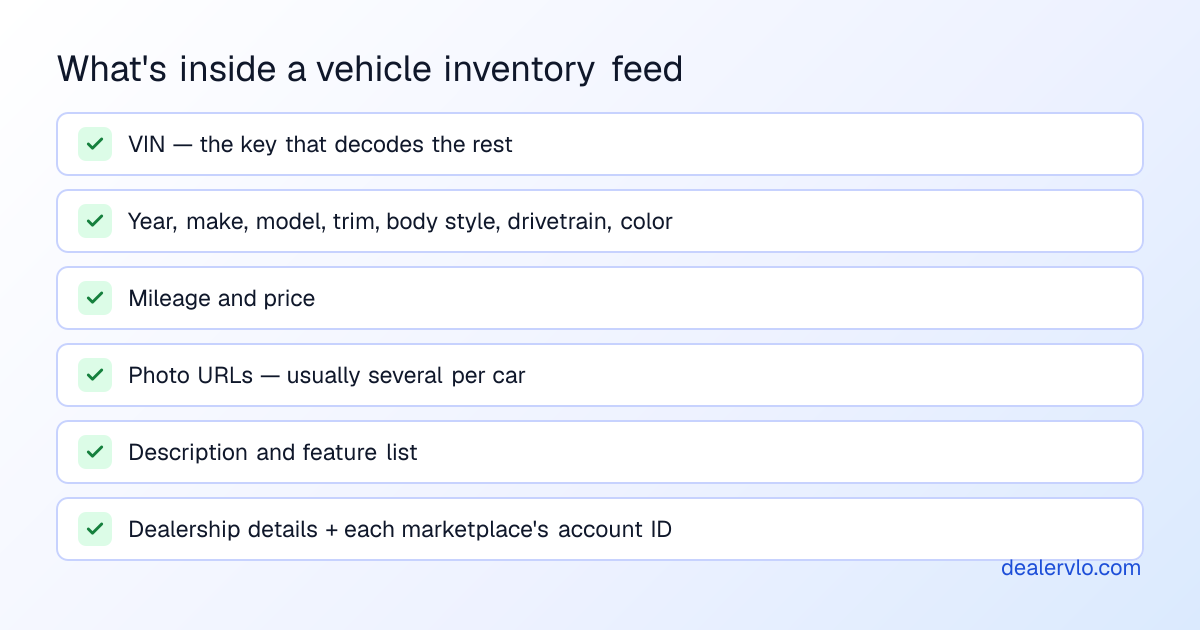
The VIN is the anchor — decode it and most of the spec fields fill themselves, which is why a clean feed usually starts with a clean VIN. In DealerVLO, a VIN scan at intake populates the year, make, model, trim, and specs the moment a car is entered, so the feed is built on decoded data instead of whatever someone typed in a hurry. Photos and a real price do the rest of the heavy lifting — a car missing either one is technically in the feed but effectively invisible, which is the number-one reason cars don't show up.
Turn your ad spend into a cost per car sold and a real ROI — and see how many units the spend has to produce just to break even.
Open the Marketing ROI CalculatorFormat and frequency (the parts you don't have to love)
Feeds are usually CSV or XML, delivered to each marketplace on a schedule — often over SFTP, sometimes via an API. Every platform wants a slightly different set of columns in a slightly different shape, which is exactly why hand-building feeds is miserable and why dealers let software emit the right format per channel from one source. You almost never touch the file; what matters is that the data behind it is complete.
Frequency matters more than dealers think. A feed that refreshes once a day is up to a day stale — a car you sold this morning can keep pulling calls until tonight's cycle, and a price cut won't reach shoppers until the next refresh. Closer to real-time is better, because your listings should never be far behind your actual lot. When your inventory has one source of truth, freshness is automatic: you change the car once and every channel gets the change on its next pull.
Good feed, broken feed
Same inventory, wildly different results — it all comes down to the data. This is the checklist I'd run against any feed, mine or a vendor's:
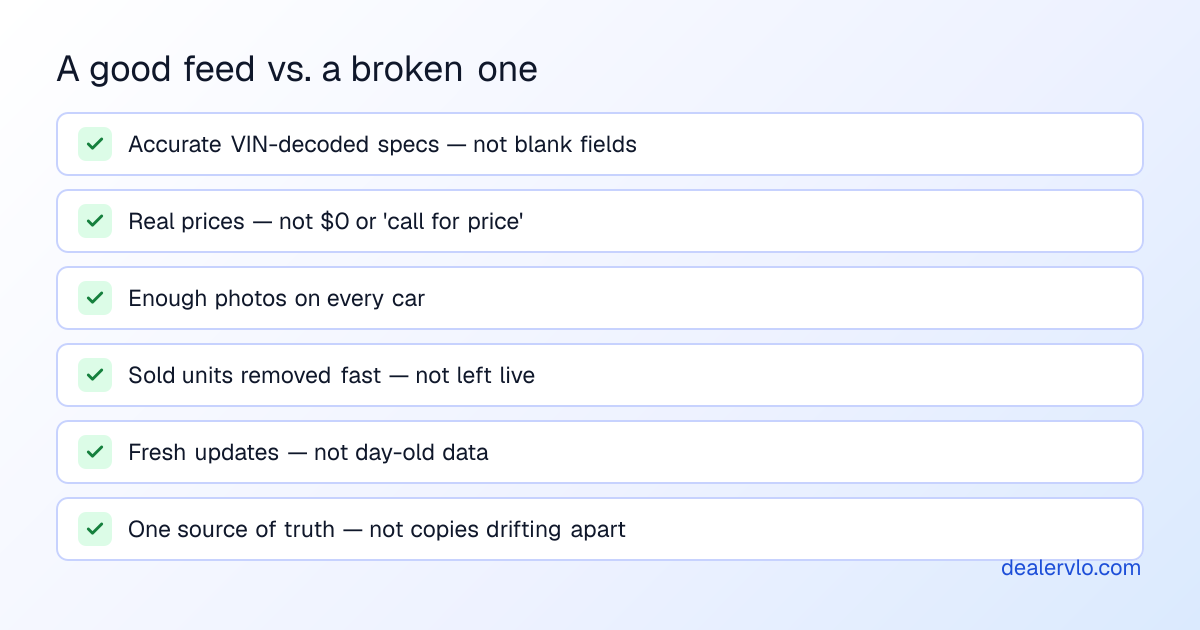
Notice that every failure mode on the "broken" side is a data problem, and almost all of them come from the same root: inventory maintained in more than one place. Blank specs, stale prices, sold cars left live, contradictory listings — those are what happens when there's no single source of truth and humans are keeping copies in sync by hand. Fix the root and the whole column clears.
From one record to everywhere
Here's what a healthy feed pipeline looks like end to end — and why, once it's set up, listing stops being something you do and becomes something that happens:
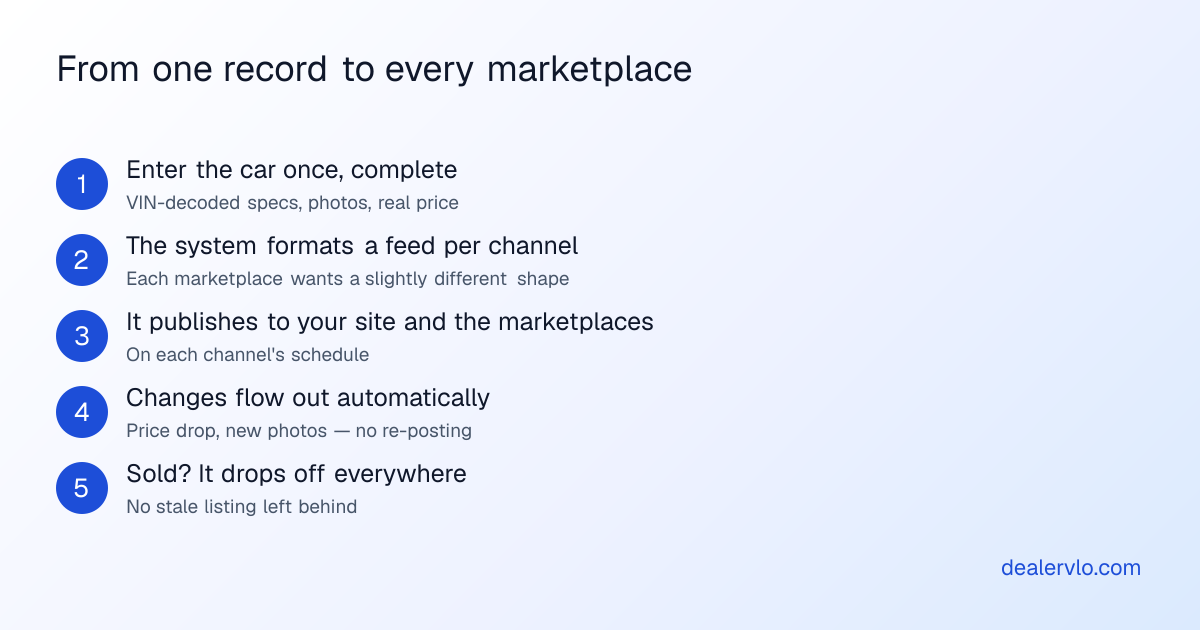
That's the model DealerVLO runs on: enter a car once, VIN-decoded and complete, and it becomes your website listing plus one feed out to CarGurus, Cars.com, and Autotrader, staying current on its own and dropping off every channel the moment you mark it sold. You still enroll with each marketplace for their own account and fees — the feed just means you're never the one formatting files or chasing stale listings. And once your feed is clean and consistent, you can finally measure which channel actually sells cars, because you're comparing real listings instead of drifting copies.
Frequently asked questions
What is a vehicle inventory feed?
A structured, machine-readable file of your current inventory — every available car with its VIN, price, specs, and photos — sent to each marketplace and your website on a schedule, so your cars get listed without you typing them into every site.
What information is in a car inventory feed?
Per car: VIN, year/make/model/trim, mileage, specs, price, photos, description, and features. Per dealership: your contact details and the account IDs each marketplace uses to match the feed to you.
What format is a vehicle inventory feed?
Usually CSV or XML, delivered on a schedule (often over SFTP, sometimes API). Each platform wants a slightly different layout, which is why software formats it per channel from one source.
How often should it update?
Daily at minimum, ideally closer to real-time — a stale feed keeps sold cars live and delays price changes from reaching shoppers.
What makes a feed good or bad?
Accuracy, completeness, and freshness: VIN-decoded specs, real prices, enough photos, sold cars pulled fast, and one source of truth. Blank fields, stale prices, and duplicate listings are the marks of a feed maintained by hand in several places.
Bottom line
A vehicle inventory feed is just your lot, translated into data and delivered on a schedule — but that translation is where your listings live or die. Clean, complete, VIN-decoded data with real prices and photos, refreshed often and drawn from one source of truth, produces listings that get found and leads that close. Blank, stale, hand-maintained data produces cars that are technically listed and practically invisible.
You don't have to become a feed engineer to get the good version — you have to keep your inventory in one place, complete, and let the system handle the rest. That's what DealerVLO does: one VIN-decoded record per car, published to your site and syndicated out to the major marketplaces from a single source, for $29/month flat with unlimited users and a free 14-day trial that a card starts, no charge until day 14. Get the data right once, and every channel gets it right for you.