Facebook Marketplace Auto Posters for Car Dealers: What's Safe and What Puts Your Account at Risk
How Marketplace auto-posters for car dealers work, what Meta's own terms say about automation, which claims are vendor folklore, and safer ways to post.
Part of the Listings, photos & merchandising guide: Where to list your cars for leads — and how to be on every site at once
Switching from another DMS? Compare DealerVLO to DealerCenter, Frazer, or Lot Wizard.
Search "Facebook Marketplace auto poster for car dealers" and nearly every result is written by a company selling one. Each promises the same thing: install an extension, pick your cars, and your whole lot shows up on Marketplace while you sleep. Most of them also promise it's safe, often with a count of dealers who have "never been banned."
This post is the version with no tool to sell. It covers how these auto-posters actually work, what Meta's own terms and policies say (quoted, with links), which of the scary "rules" are vendor folklore, and the posting setups that don't bet your lot's best free lead source on one personal profile. For the bigger picture of what Meta allows dealers at all, start with how to sell cars on Facebook Marketplace as a dealer.
Why there's no official auto poster anymore
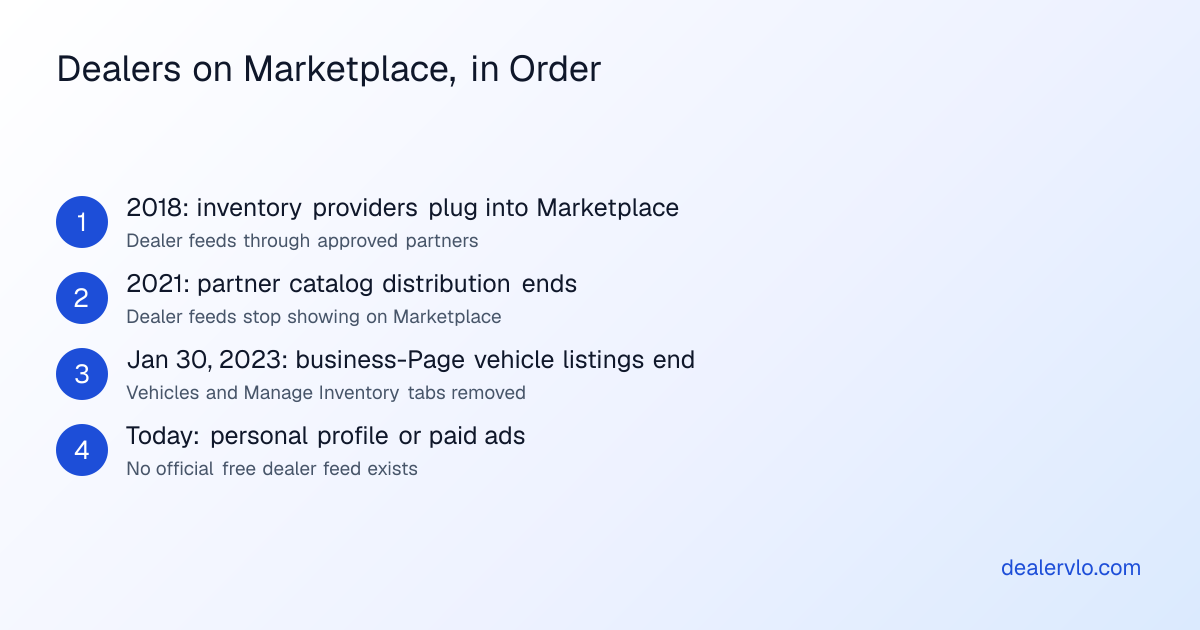
There used to be a sanctioned way to automate this. In 2018, providers like Dealers United and Carsforsale.com joined the list of inventory providers integrated with Marketplace. Your inventory went into a feed, the feed went to Facebook, and cars showed up. That's the setup most dealers still picture when they hear "auto-post."
It's gone. In 2021 Meta discontinued inventory partners' catalog distribution on Marketplace, and on January 30, 2023 it ended vehicle listings created from business Pages. CBT News covered the change as Pages losing their "Vehicles" and "Manage Inventory" tabs. Meta's notice about it, reposted on DealerRefresh, said free person-to-person vehicle listings would stay. Under other ways to reach buyers, it listed creating Marketplace listings from your personal profile.
So the only free path left runs through a person's own account, one listing at a time. Every auto-poster on the market exists to automate that one path.
How Marketplace auto-posters for car dealers actually work
The tools differ in price and polish, but the mechanism is the same. Here's what three vendors say on their own sites (checked October 19, 2026):
| Tool | How it posts, per the vendor | Listed price |
|---|---|---|
| AutoLister Pro | Chrome extension, from your own profile | $99/mo per salesperson; dealerships "from $799/mo" |
| AutoPosting Pro | Chrome extension, "the Facebook account you're already logged into" | $29.90/mo after a $9.90 first month; Dealership $499/mo |
| Marketplace QuickPost | Extension that "runs locally in your browser" | From $39/mo for 30 vehicles, or $4 per vehicle |
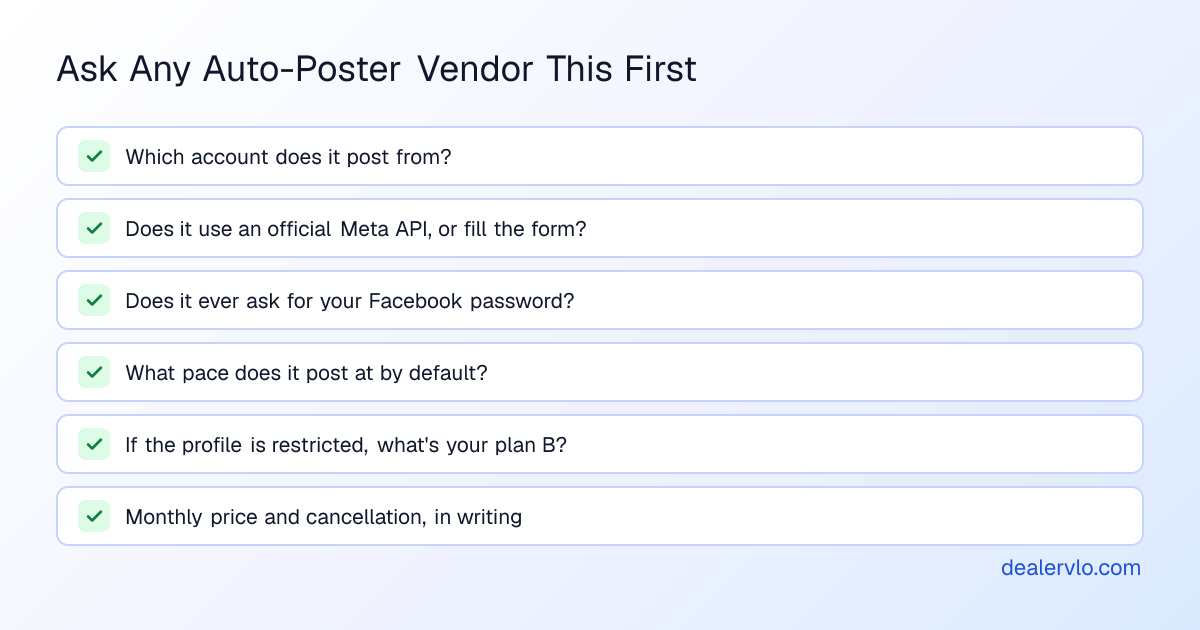
None of the vendors we checked says it posts through an official Meta API for Marketplace vehicles. They work by filling in Marketplace's listing form inside your browser, under your login, faster than you would. That matters for one reason: the account doing the posting is a real person's personal profile. If Meta restricts it, the tool vendor loses nothing. You lose that profile's Marketplace access, and possibly more of the account.
What Meta's own terms say about automation
Here's what Meta actually publishes, so you can weigh it yourself instead of trusting a vendor's summary:
- Automated access. Facebook's Terms say you may not "access or collect data from our Products using automated means (without our prior permission)." Meta's automated data collection terms add that its Platform APIs "are the only allowable means to access data programmatically" without prior written permission.
- One account, personal use. The same Terms say to "create only one account (your own) and use it for personal purposes."
- Spam. Meta's spam policy targets actions taken "either manually or automatically, at very high frequencies," and says lower-frequency accounts can be restricted too when there are other signals, like repetitive content.
- Marketplace itself. The Commerce Policies say Marketplace "is intended for consumer-to-consumer sales," and that enforcement can include removing listings or suspending access to commerce features.
Be precise about what that adds up to. Meta has no published rule that says "auto-posting tools are banned." The Terms' automation language is written about accessing and collecting data, not posting. But an auto-poster that posts your whole lot from one profile, with the same description template on every car, is pushing that profile toward the exact signals the spam policy names: high frequency and repetitive content. That's the honest risk. It's a judgment call about your account, not a settled rule either way.
Some vendors acknowledge this themselves. AutoPosting Pro's site says restriction "can happen with any tool, and by hand too," and defaults to a slow pace: one car every few minutes, 20 a day unless you change it.
Vendor folklore vs. what Meta publishes
The posts that rank for this topic are full of very specific rules. When we traced them, they came from tool vendors and agencies, not from Meta:
- "10 listings a day" or "5 new listings and 20 total per month." Meta doesn't publish a listing cap for US sellers in its Commerce Policies or help pages. Different vendors quote different numbers.
- "Zero bans" or "99.9% safe." These are marketing numbers. One vendor's count of dealers with "zero bans reported" changed between two reads of its page. No vendor can count the bans its customers never report.
- "Extensions are instantly detected." This one gets repeated in dealer forums, but we found no published Meta statement that it detects specific extensions. It's a reasonable worry, not a documented fact.
- Specific ban lengths ("7 to 30 days"). Not in Meta's policies. Meta's help center says it warns you when your access is at risk and that you can request a review.
None of that makes auto-posters safe. It means the risk is unquantified, and anyone selling you a precise number is guessing.
What actually puts a dealer's Marketplace access at risk
Set the tools aside for a second. Going by what Meta publishes, here's what draws enforcement on any account, auto-posted or not:
- Volume and pace. Dozens of listings in a burst from one profile is the "very high frequency" pattern the spam policy names. A lot that posts every unit on Monday morning looks very different from a person posting a few cars a day.
- Repetitive content. The same paragraph, the same phone number line and the same emoji block on 40 cars is the "repetitive content" signal. Write each listing for the car in front of you.
- Accounts that aren't one real person's. The Terms require your own account under the name you use in everyday life. A shared "dealership" personal profile that three salespeople log into breaks that before any tool gets involved.
- Inaccurate listings. A wrong price, a car that's already sold, or a "$1,000" price that's really a down payment gets reported by shoppers. Keep listings honest and take sold cars down promptly.
DealerVLO is built around that. It doesn't post to Marketplace for you: there's no official feed to post through, and the only other way is acting inside your personal account. Instead, each car in your DealerVLO inventory has a Post to marketplace kit with every photo in one download, each field Facebook asks for ready to copy, and a written description with an optional AI rewrite, so each listing reads like it was written for that car. Posting by hand that way takes a couple of minutes a car, at a pace that looks like a person, because it is one. Our step-by-step posting guide walks the whole flow.
14-day free trial, then $29/mo · Cancel anytime
Safer ways to get your cars in front of Facebook shoppers
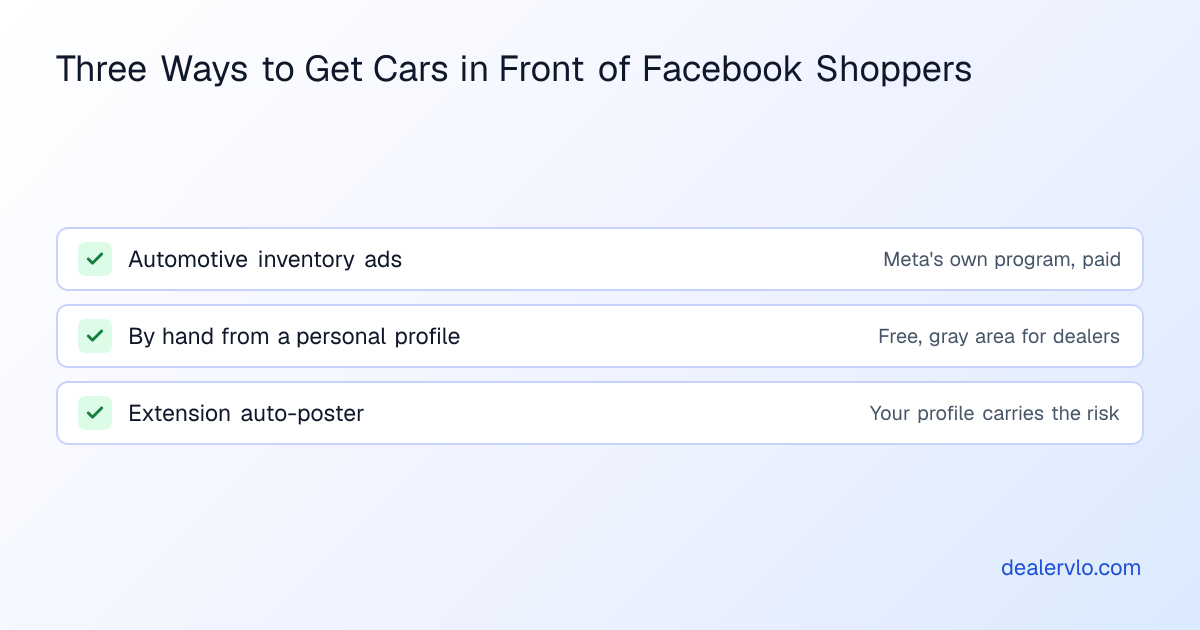
1. Paid automotive inventory ads (Meta's own program). Meta's automotive inventory ads turn a vehicle catalog into ads for each car across Facebook and Instagram. This is the one automated, sanctioned way to keep your whole lot in front of Facebook shoppers: the catalog updates itself from a feed, and nothing runs through anyone's personal profile. You pay for the reach. DealerVLO generates the vehicle catalog feed in Meta's format from your inventory, at a URL you paste into Commerce Manager as a scheduled feed, so prices, photos and sold cars stay current. It doesn't buy or manage the ads; that's your Meta ad account and your budget.
2. A real person posting by hand, at a normal pace. Free, and the path Meta itself pointed sellers to when it ended business-Page listings. It's still a gray area for a dealership, since Marketplace is meant for consumer-to-consumer sales, so keep each person on their own account, keep listings accurate, and don't post the whole lot at once.
3. Channels that don't depend on Facebook at all. Your own website and the listing sites keep working if a profile gets restricted tomorrow. In DealerVLO, your inventory publishes to your included dealer website automatically, and the same cars go to CarGurus, Cars.com and Autotrader through daily listing feeds once you enroll with each site. Leads from your website's forms land in one lead inbox with their source, so you can see what your site produces next to what Marketplace does. If a shopper's next stop after Marketplace is your website, it's worth checking that page holds up on a phone:
Paste one car page: see its mobile speed against Google's published lines, and whether shoppers can find and reach you.
Open the Dealer Website CheckIf you're paying for an auto-poster, run the real numbers on it: monthly fee in, cars sold from Marketplace out. Do the same for paid Facebook ads. The free Marketing ROI Calculator turns a monthly spend into a cost per car sold for any channel, and our post on what dealership marketing costs per car sold shows how to set it up.
If you still want to use an auto-poster
It's your account and your call. Plenty of small lots weigh the hours saved against the risk and decide to try one. If you do:
- Use it on a real person's own profile, never a made-up or shared one.
- Turn the pace down. Fewer cars a day, spread out, beats a lot dump.
- Never give a tool your Facebook password. QuickPost, for one, markets that it never asks for your login; that's the right standard.
- Vary the descriptions instead of one template for every car.
- Have a plan B for the day the profile is restricted: a second channel already running, so Marketplace going quiet doesn't mean your phone does.
- Get the price and cancellation terms in writing, and compare them against cars actually sold from Marketplace, not views or messages.
14-day free trial, then $29/mo · Cancel anytime
Frequently asked questions
Is there an official Facebook Marketplace auto poster for car dealers? No. Meta stopped distributing dealer inventory partners' catalogs on Marketplace in 2021 and ended vehicle listings from business Pages on January 30, 2023. The auto-posters sold to dealers today are browser extensions or apps that fill in Marketplace's listing form from a person's own logged-in profile. None of the ones we checked says it uses an official Meta API for posting vehicles.
Do Facebook Marketplace auto posters get you banned? Meta doesn't publish a rule that names auto-posting tools, so nobody can tell you a specific tool gets you banned. What Meta does publish: its Terms forbid accessing or collecting data by automated means without permission, and its spam policy targets actions taken manually or automatically at very high frequencies or with repetitive content. An auto-poster pushes you toward exactly those signals, and the account at risk is the personal profile the tool posts from.
How many cars can a dealer post on Facebook Marketplace per day? Meta doesn't publish a daily, weekly or monthly listing cap for US sellers. Figures like 10 a day or 5 new listings a month come from tool vendors and agencies, not Meta's policies. What Meta's spam policy does say is that very high posting frequency and repetitive content are what it acts on.
Can a car dealer still post cars on Facebook Marketplace? Not from a business Page since January 30, 2023. Meta's own notice about that change pointed sellers to listing from a personal profile, and paid automotive inventory ads can still show cars across Facebook. Meta's Commerce Policies also say Marketplace is intended for consumer-to-consumer sales, so a dealership's staff posting lot inventory from personal profiles is a gray area rather than a program built for dealers.
What's the safest way to get dealer inventory in front of Marketplace shoppers? The paid route is Meta's automotive inventory ads, built from a vehicle catalog feed in your own ad account. The free route is a real person posting each car by hand from their own profile, at a normal pace, with accurate listings. Either way, don't make Marketplace your only channel: your own website and the listing sites don't depend on one personal account staying in good standing.
Are auto-poster vendors' "zero bans" claims reliable? Treat them as marketing. One vendor's "zero bans reported" dealer count changed between two reads of the same page, and none of these numbers are audited. A vendor can't see bans its customers never report, and the account that gets restricted is yours, not theirs.
Bottom line
There's no official Facebook Marketplace auto poster for car dealers anymore. Every tool sold under that name automates posting from a person's own profile, and Meta's published rules on automation and spam make that profile the thing at risk. The vendors' precise "safe limits" and ban counts aren't Meta's numbers. If you use Marketplace, post like a person, keep every listing accurate, and make sure your website and listing sites are carrying the lot whether Facebook cooperates or not.
DealerVLO gives you the Marketplace kit for every car, the Meta catalog feed for paid ads, your own dealer website and the CarGurus, Cars.com and Autotrader feeds, all for $29 a month. Start your 14-day free trial and get your lot posted everywhere it should be.