Free car listing sites for dealers: what's actually free in 2026
Free car listing sites for dealers, checked against each site's own rules: what's free, what's $5, what caps you at one car, and what bans dealers outright.
Part of the Listings, photos & merchandising guide: Where to list your cars for leads — and how to be on every site at once
Switching from another DMS? Compare DealerVLO to DealerCenter, Frazer, or Lot Wizard.
Listing fees are one of the quietest line items in this business — a few hundred here for a platform subscription, a premium tier there, and suddenly marketing is your third-biggest expense behind inventory and rent. Before any of that, it's worth knowing exactly what you can do for free, because in 2026 the free stack is genuinely good.
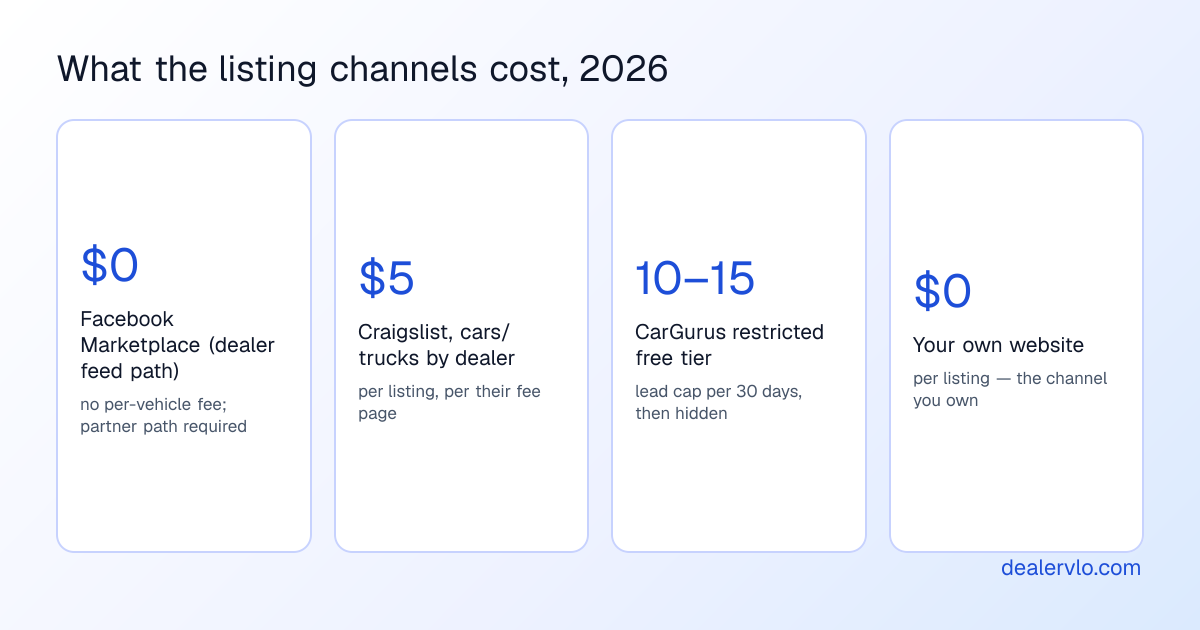
This is the map: every channel where an independent dealer can put inventory in front of buyers for nothing (or next to nothing), what each one honestly costs in money or catch, and how to judge them all with one number. Most "free car listing sites" lists are written for people selling their own car. Several of those sites cap dealers at one car or don't allow them at all, so every row below is checked against the site's own rules. For the deepest free channel, I'll point you to the full Marketplace guide — this post is the tour; that one's the manual.
Free car listing sites for dealers at a glance
| Channel | Cost to a dealer | The catch |
|---|---|---|
| Your own website | $0 per listing | You need the site first |
| Facebook Marketplace | $0 | Personal profile only, a gray area for dealers |
| Google Business Profile | $0 | Posts, not listings; you have to post weekly |
| CarGurus Restricted | $0 | Monthly lead cap, 6 photos per car |
| Craigslist | $5 per post | Relist when the post expires |
| OfferUp | 1 free car a month | More than that is paid |
| Nextdoor | Not allowed | Business sellers can't use For Sale |
| Google vehicle listings | Paid only | Free Listings don't support vehicles |
| Autotrader, Cars.com | Paid | Priced by quote |
14-day free trial, then $29/mo · Cancel anytime
Facebook Marketplace — free, with one big asterisk
Still the highest-volume free channel for a small lot, and the one that keeps earning its place on lots like mine. The asterisk: since January 30, 2023, Meta doesn't allow vehicle listings from business Pages at all, and the dealer partner feeds that used to put inventory into Marketplace ended back in 2021. What's left for free is listing each car from a personal profile — which is how a lot of small lots do it, but Meta's Commerce Policies say Marketplace is "intended for consumer-to-consumer sales," and Meta has never explicitly approved dealer staff posting lot inventory that way.
So "free" here means "free, one car at a time, on Meta's tolerance" — a labor question and a risk question, not a money question. The Marketplace guide covers what Meta actually allows, the paid Automotive Inventory Ads product, and the posting "rules" you'll read online that Meta never published.
Your own website — the free channel you actually own
Every other channel on this list is rented land: the platform sets the rules, changes the fees, and can delist you at will (see: every Marketplace policy change ever). Your site is the one place your whole inventory is always listed, free, on your terms — and it's what your Google Business Profile sends people to, and what an AI assistant can cite when someone asks it to recommend a dealer.
The catch is the setup cost, not the listing cost — I broke down what dealer websites actually charge separately. Once it exists, listing there should be automatic: if putting a car on your own site takes more effort than posting it to Marketplace, something's backwards.
Google Business Profile — free, and nobody uses it
Not a listings platform in the classic sense, but a free surface where a fresh-arrival post with a real photo shows up on the exact search — your dealership's name, "used car dealer near me" — where buyers are already deciding. It takes fifteen minutes a week and most of your competitors' profiles are abandoned. The full setup and routine is its own post.
CarGurus' free tier — real, but read the cap
CarGurus runs a restricted free listings program, and the operative word is restricted: the program caps how many leads free-tier dealers get in each 30-day period — CarGurus doesn't publish the number, so ask your rep — and once you hit the cap, your cars drop out of search results until the next period. Its Restricted Listings page also limits each car to six photos. The terms have changed more than once over the years (it was suspended entirely for a stretch), so treat the details as confirm-before-you-count-on-it.
The honest read: for a low-volume lot, a handful of free leads a month from high-intent CarGurus shoppers is a genuinely good deal. For a lot doing real volume, the cap means the free tier is a taste of the paid product — which is exactly what it's designed to be.
14-day free trial, then $29/mo · Cancel anytime
Craigslist — $5, and worth five dollars
Craigslist charges $5 per cars/trucks by-dealer listing in the US, per its own posting-fees page. Not free, but it rounds to free: one extra buyer conversation on an aging unit repays the fee many times over. Craigslist buyers skew cash, local, and decisive — a good match for the cheap-commuter end of the lot, and a cheap test on anything that's aging past your markdown line.
Two practicalities: relist when the post expires (the fee is per post), and reuse the photos and description you already wrote — which goes for every channel here. Shoot the unit once, properly, write one honest description, and syndicate that everywhere.
OfferUp — one free car a month
OfferUp shows up on every consumer "free places to sell your car" list, and for a private seller that's fair. For a dealer it's a trial, not a channel. OfferUp's free listing limits give each account one free listing a month in Cars & Trucks. After that you buy single listings or a subscription, and OfferUp points dealers who want to post a lot of vehicles to its Verified Dealer program. The same page warns that opening extra accounts or posting in the wrong category to dodge the limit breaks its rules.
Use the free one on the unit that fits OfferUp's mostly local, mobile buyers, and judge whatever you pay after that with the same cost-per-car-sold math as everything else here.
The "free" sites that don't work for dealers
Three names come up constantly and don't belong in a dealer's free stack:
- Nextdoor. Its For Sale and Free guidelines list "listing items that you are selling for a business" as not allowed. Selling your own personal car there is fine; listing lot inventory isn't.
- Google. There is no free way to put vehicles in Google's shopping results. Google's vehicle ads policies say Free Listings are not supported for vehicle sales. Vehicles run only as paid Vehicle Ads from a Merchant Center vehicle feed. Your free Google surface is the Business Profile above. If you do decide to pay for it, DealerVLO generates that Merchant Center vehicle feed for you; I wrote up what Google vehicle ads take to set up.
- Search aggregators. AutoTempest is a search engine across other listing sites, so there's nothing to post there. You show up by being on the sites it searches.
The paid tier, for completeness
Autotrader, Cars.com, and paid CarGurus are subscription products priced by quote, and this post won't pretend to know your quote. The only universal advice: a paid platform is neither good nor bad in general — it either beats your free stack's cost per car sold in your market, or it doesn't. Which brings us to the only judging system you need.
If you do add one, the work shouldn't double. DealerVLO sends your inventory to CarGurus, Cars.com and Autotrader from the same record that feeds your website, once you enroll with each platform. Their subscription fees still apply; what goes away is retyping every car and pulling sold units by hand.
One number decides everything: cost per car sold
Leads are a flattering metric — every platform will happily report you a big number. The number that pays rent is cars sold per channel, against what the channel costs:
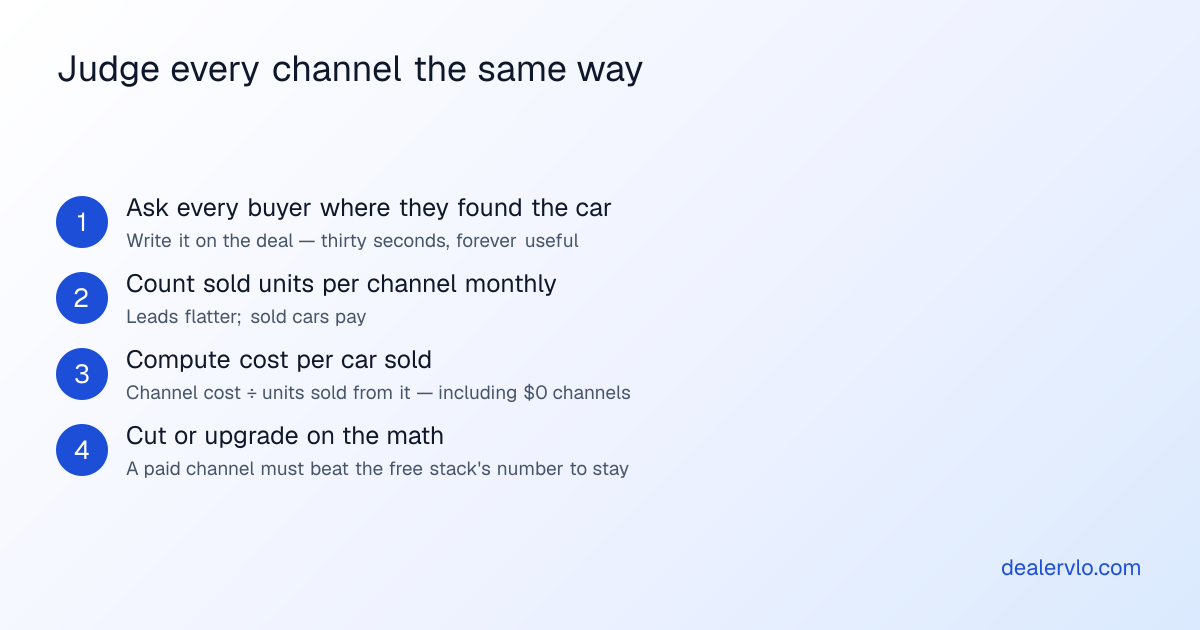
Run that for ninety days and the free-versus-paid debate answers itself with your own data — a $0 channel selling two cars a month beats a $1,000 channel selling three, and you'll know instead of guessing.
Turn your ad spend into a cost per car sold and a real ROI — and see how many units the spend has to produce just to break even.
Open the Marketing ROI CalculatorFrequently asked questions
Where can a dealer list used cars for free in 2026?
Marketplace (from a personal profile — a gray area for dealers), your own website, Google Business Profile posts, CarGurus' capped free tier, and $5-per-post Craigslist. OfferUp gives one free car listing a month. The paid majors are quote-priced subscriptions.
Does Google list cars for free?
No. Google's Merchant Center rules don't support Free Listings for vehicle sales; vehicles run only as paid Vehicle Ads. Your free Google surface is the Business Profile.
Can dealers list cars free on OfferUp or Nextdoor?
OfferUp allows one free Cars & Trucks listing a month, and points high-volume dealers to its Verified Dealer program. Nextdoor doesn't allow business sellers in For Sale at all.
How much does Craigslist charge dealers?
$5 per cars/trucks by-dealer listing in the US, per its posting-fees page — one-time, per post.
Is CarGurus free for dealers?
There's a restricted free tier with a lead cap per 30 days (CarGurus doesn't publish the number) — hit the cap and your cars leave search until the next period. Terms have changed before; confirm current ones.
Can dealers still list free on Facebook Marketplace?
Only from a personal profile, and it's a gray area: business-Page vehicle listings ended in January 2023 and the dealer partner feeds in 2021. Meta's dealer product today is paid ads.
Do free channels replace paid listings?
For many small lots, mostly yes. Decide per-channel with cost per car sold — a paid platform has to beat the free stack's number to earn its subscription.
Bottom line
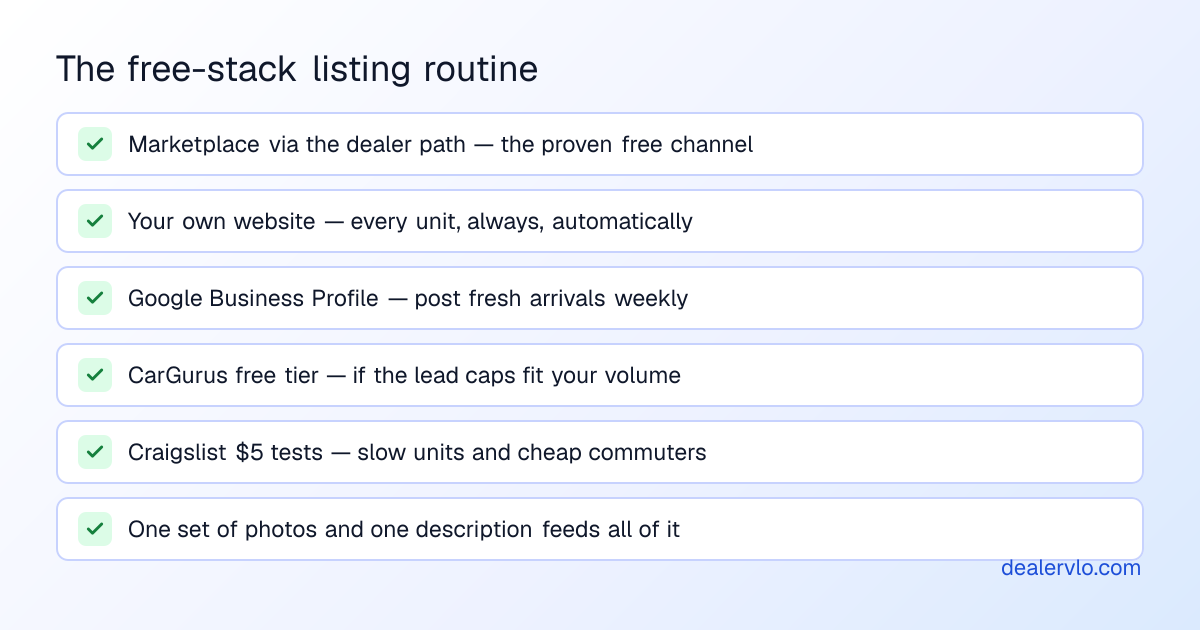
The 2026 free stack — Marketplace listings, your own site, a live Google profile, the CarGurus free tier where it fits, and $5 Craigslist tests — is a real distribution system, not a consolation prize. Work it with one set of photos and one description per unit, track where buyers actually come from, and let cost-per-car-sold decide what deserves money.
The tedious part is doing that per unit, every week — which is the part DealerVLO automates: your inventory flows to your own website the moment a car is entered, and each unit turns into a ready-to-post Marketplace listing without retyping. One record, every channel, $29/month flat — with a free 14-day trial, no charge until day 14.
14-day free trial, then $29/mo · Cancel anytime