Dealer website cost: what providers actually charge in 2026
Real published prices for used-car dealer websites in 2026 — $29 to $99+/month, who charges what, quote-only vendors flagged, and the questions to ask first.
Part of the Marketing, leads & your website guide: Used Car Dealer Marketing: What a Small Lot Should Do First — and What to Skip
Switching from another DMS? Compare DealerVLO to DealerCenter, Frazer, or Lot Wizard.
Every dealer knows the lot needs a website. What nobody can seem to find out — without sitting through three demos — is what one actually costs. Half the providers in this category publish a price; the other half want your phone number first.
So here are the published numbers as of 2026, checked against each vendor's own pages the way I did for the DMS pricing comparison: real prices where they exist, "quote-only" where they don't, and no invented figures to fill the gaps. Plus the part that matters more than the sticker — what a dealer website has to do, and the questions that protect you from the price you didn't see coming.
14-day free trial, then $29/mo · Cancel anytime
The published prices
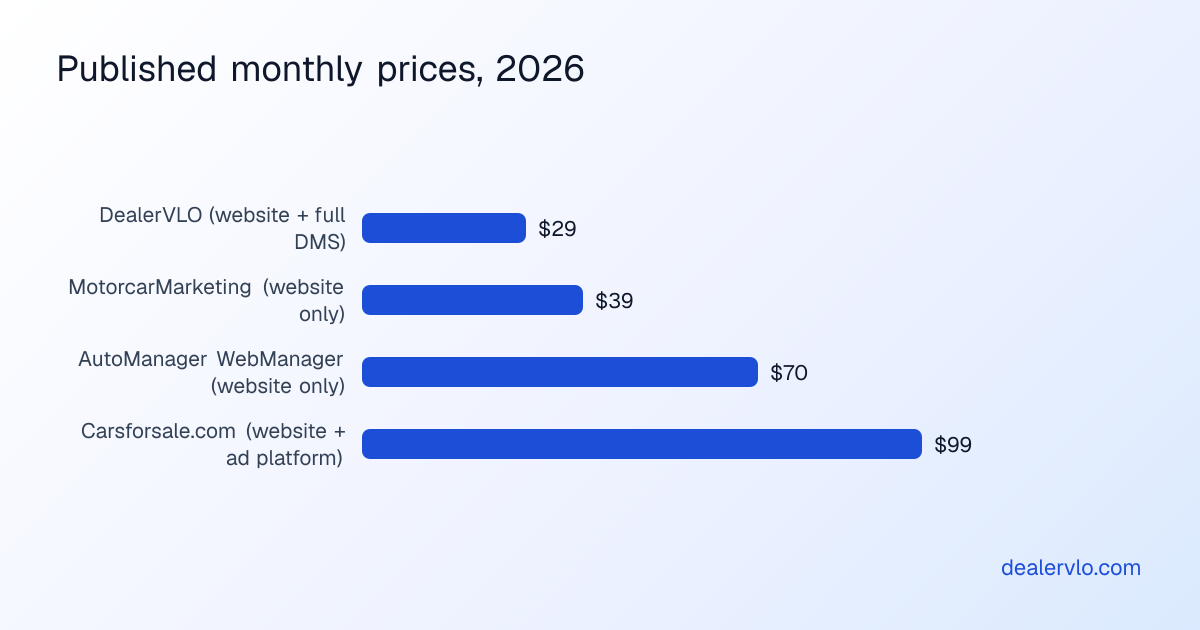
MotorcarMarketing — $39/month, website only. Advertises unlimited listings and photos, no setup fee, no contract, and a three-year price guarantee, with exports to the major marketplaces. The budget pick if a standalone site is genuinely all you need.
AutoManager WebManager — $70/month, website only. The website arm of the long-running AutoManager suite; its pricing page also lists a DMS-plus-website package at $144/month. Deep feature list — marketplace exports, Facebook posting, video generation.
Carsforsale.com — $99/month, website plus their advertising platform. The pitch is the bundle: a dealer site plus placement on their consumer shopping platform and a stack of tools. If their marketplace pulls in your area, the bundle math can work; the website alone isn't why you'd pay it.
DealerCenter Premium Website — $99/month, as a module. It's listed alongside DealerCenter's $99/month DMS (the Premium Pro Website is $125/month), so a lot running both pays $198/month at list — and like the rest of DealerCenter's module pricing, the total depends on what you stack. Price the full stack, not the module.
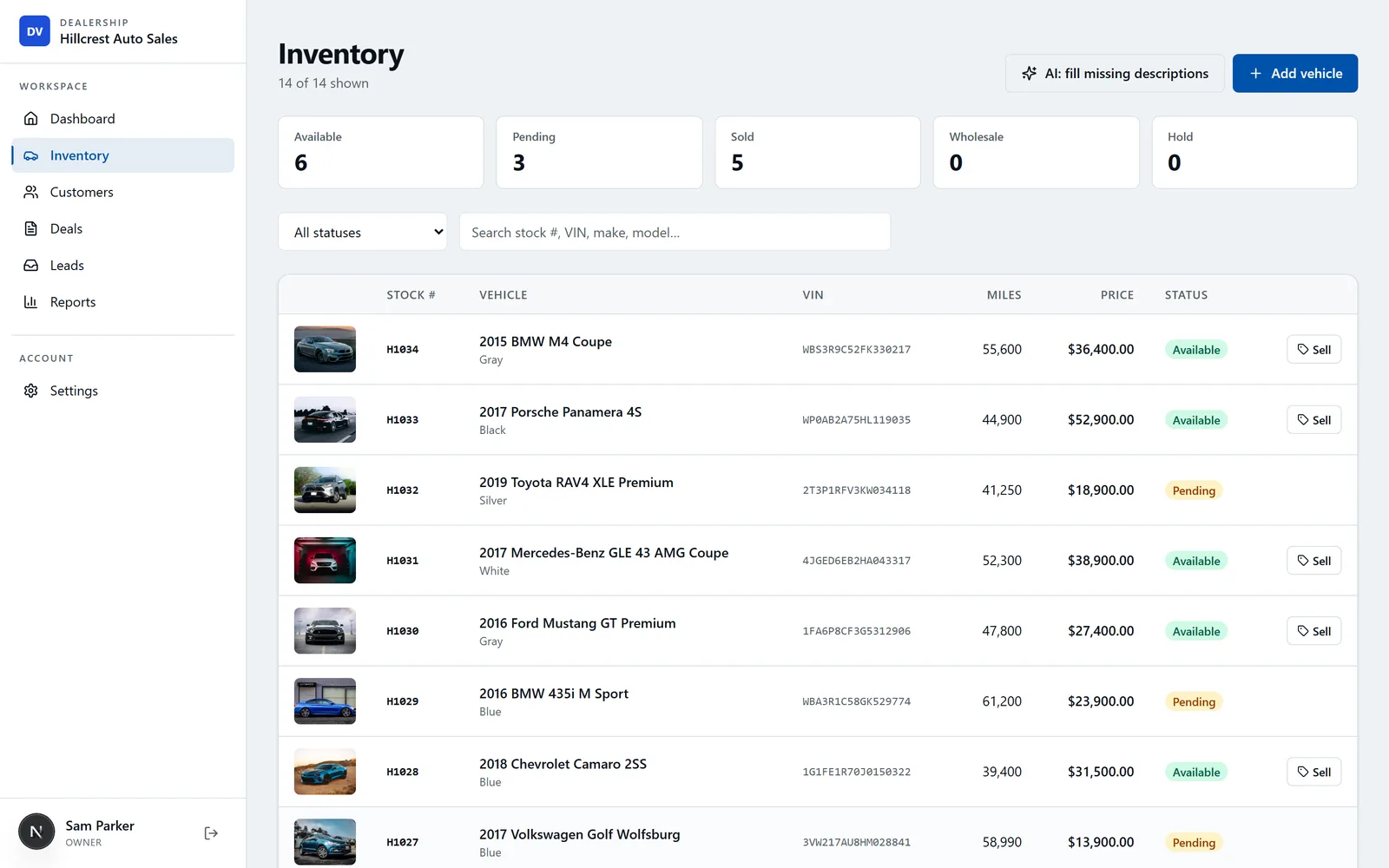
DealerVLO — $29/month, website included with the whole DMS. Full disclosure, this one's mine, so weigh accordingly: the dealer website isn't a product we sell separately — it's included in the flat plan with inventory, the deal jacket, and the paperwork. Your inventory syncs to your own domain in real time because the website and the DMS are the same system. Don't take the description's word for it — browse the live demo store (sample inventory, real product). The trade-off is the same one from the DMS list: we're the newest name here.
The quote-only tier
Dealer Car Search doesn't publish pricing. It's a popular product with a big footprint — and dealer reviews of quote-only vendors in this category recur on one theme: the number you start at isn't the number you end at, because features arrive as up-sells. That's exactly what the in-writing questions below are for.
The franchise-grade platforms (Dealer.com, Dealer Inspire and kin) are quote-only and built — and priced — for franchise stores. If you're running a 25-car independent lot, you're not their customer, and that's fine; neither is their invoice.
Why not just Squarespace?
Fair question — generic builders run roughly $20–50 a month and look great. The problem isn't looks, it's inventory. A dealer site is really an inventory application wearing a website: every unit needs its own page, photos, and price; everything has to update the moment a car arrives or sells; and the same data should flow out to marketplaces without retyping.
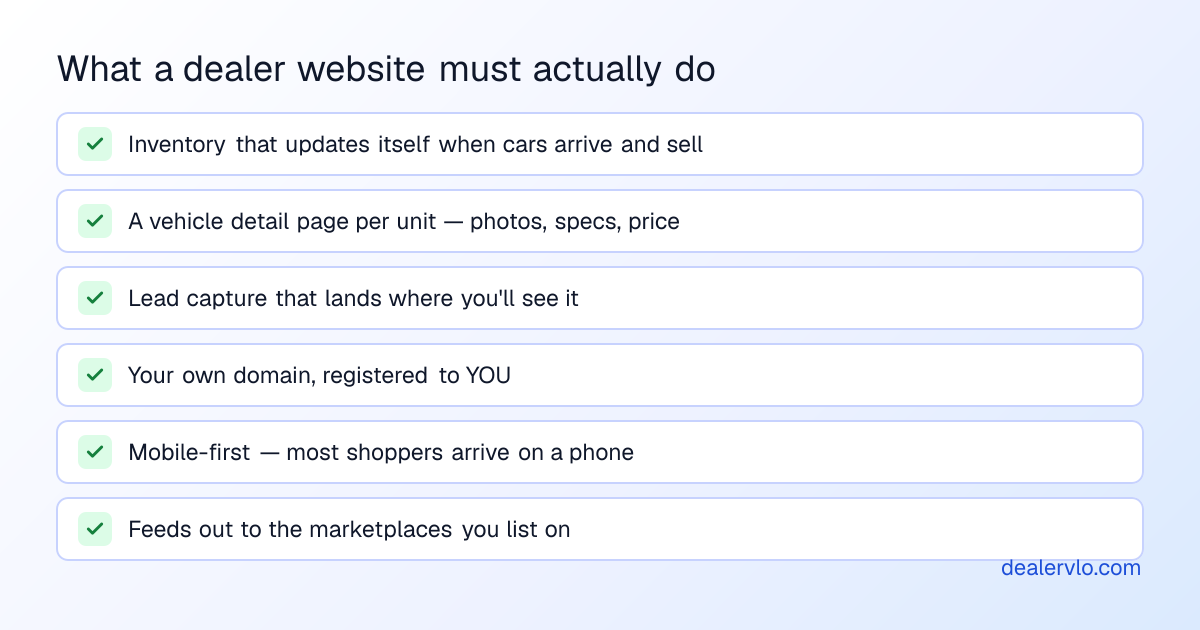
On a generic builder, every one of those checkmarks is a manual job — which means the "cheap" site quietly costs you an hour of clerical work per car. The dealer-specific products exist because that hour is worth more than the price difference.
How to shop the quote-only vendors
If a published-price product fits, the comparison is easy. When you do call a quote-only vendor, four questions protect you:
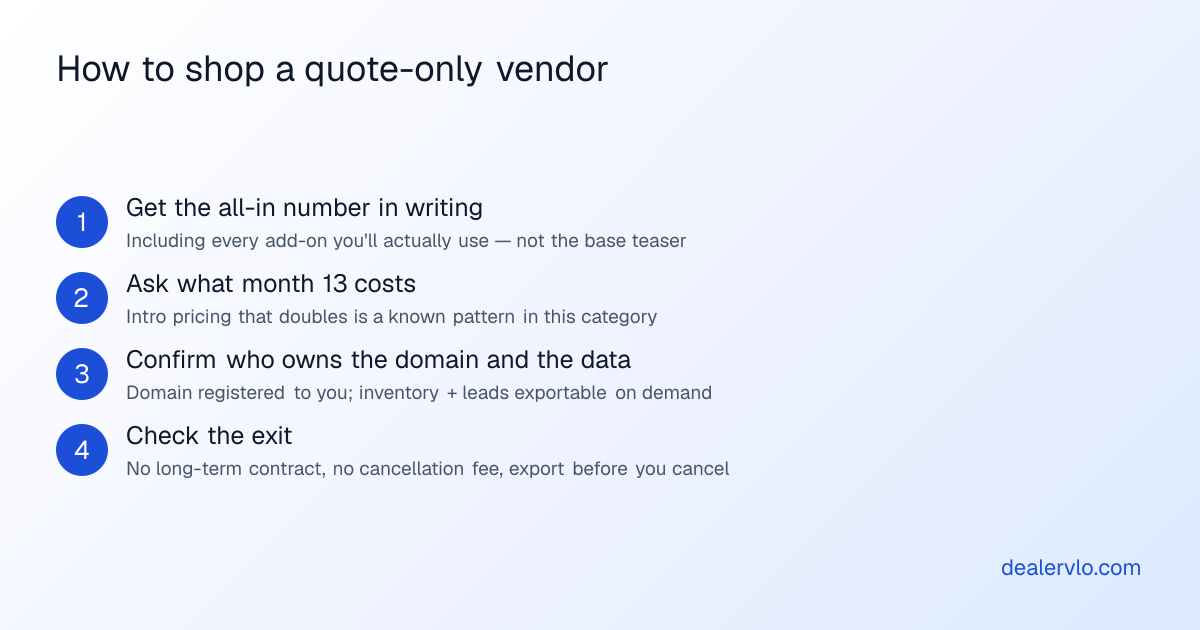
The domain question deserves the emphasis. A website provider that registers your dealership's domain in its name owns your exit: leave, and you're starting your local search presence — your Google Business Profile points at that domain, remember — from zero. Domain in your name, data exportable on demand, no long-term contract. Those three clauses cost nothing to ask for and everything to skip.
14-day free trial, then $29/mo · Cancel anytime
The website is the asset; the marketplaces are the audience
One framing note, because it changes how much website you should buy: your site and your marketplace listings do different jobs. Marketplace traffic — Facebook, the big listing platforms — is rented audience on someone else's land. The website is the thing you own: it's where your Google profile sends people, what the AI assistants can cite when someone asks for a dealer recommendation, and the only sales channel no platform can reprice on you. That's the real reason it's worth $29–99 a month — not as a brochure, but as the owned end of your marketing.
Frequently asked questions
How much does a dealer website cost per month?
Published 2026 prices run $39 (MotorcarMarketing) to $70 (AutoManager WebManager) to $99 (Carsforsale.com, bundled with its ad platform; DealerCenter's $99 Premium Website module, listed alongside its $99 DMS). Several vendors are quote-only. DealerVLO includes the website in its $29/month flat DMS plan.
Can I just use Squarespace or Wix?
You can, but a dealer site is an inventory application — VDPs, photo sync, marketplace feeds. On a generic builder all of that is manual, so the cheap sticker buys you a recurring data-entry job.
What should a dealer website include?
Self-updating inventory, a detail page per unit, lead capture, your own domain, mobile-first design, and marketplace feeds. No automatic inventory sync = brochure, not dealer website.
Why is so much pricing quote-only?
Usually because it's negotiable, varies by store, or grows with add-ons. Shop it with the all-in number in writing and the month-13 question.
Who should own the domain?
You. Always. Plus data export on demand and no long-term contract — that's the exit door.
Bottom line
The published market says a real dealer website costs $39–99 a month standalone, more when it's a module on a bigger bill, and unknown-until-you-call at the quote-only shops. Whatever you pick, buy the checklist — self-updating inventory, your domain, your data — not the demo.
Or skip the separate bill entirely: DealerVLO's plan is $29/month flat for the DMS, the paperwork, and the website on your own domain — one system, so the inventory you manage is the inventory your site shows. The 14-day trial is free — no charge until day 14.
14-day free trial, then $29/mo · Cancel anytime
Paste one car page: see its mobile speed against Google's published lines, and whether shoppers can find and reach you.
Open the Dealer Website Check