How to Get Your Dealership Recommended by ChatGPT (Before Your Competitor Does)
Car buyers now ask ChatGPT which dealer to visit. How AI assistants pick, and five levers a small lot controls: entity data, schema, reviews, Q&A, and presence.
Part of the Marketing, leads & your website guide: Used Car Dealer Marketing: What a Small Lot Should Do First — and What to Skip
Switching from another DMS? Compare DealerVLO to DealerCenter, Frazer, or Lot Wizard.
Your next customer may ask a chatbot which lot to visit
A buyer used to type "used trucks near me" into Google and scroll. Now a growing share of them open ChatGPT or Perplexity and ask a different kind of question: "I need a reliable used truck under $25k near Lowell — where should I go?" And the assistant doesn't return ten blue links. It names two or three dealers.
Either you're on that short list or you don't exist for that buyer. The good news, if you run a small independent lot: the things that get a dealership named are not ad budgets. They're data hygiene, reviews, and answering questions in public — work you control, most of it free. This is the practical version of how it works and what to do, in the order I'd do it.
14-day free trial, then $29/mo · Cancel anytime
How the AI actually picks (it's evidence, not ads)
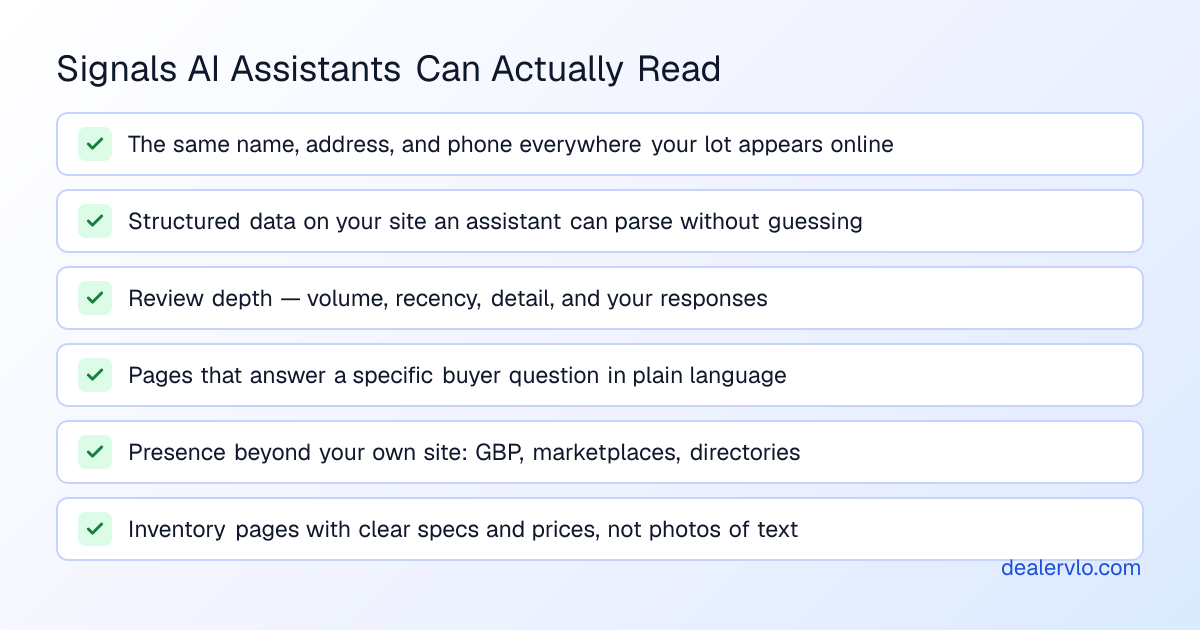
Nobody outside the AI labs knows the exact recipe, and anyone claiming they do is selling something. But the observable pattern is consistent: assistants recommend businesses they can verify and describe from public data. When an assistant names a dealer, it's drawing on what it can read — your website's content and structure, your business listings, your reviews and how you respond to them, and mentions of your lot across the wider web.
Which means the question isn't "how do I trick the AI" — it's "how easy is it for a machine to confirm who I am, what I sell, and whether people trust me?" A lot with one thin website, three reviews, and a phone number that differs between Google and Facebook is hard to cite. An assistant asked to stake a recommendation will pick the dealer whose evidence is clean.
Lever 1: Make your business data boringly consistent
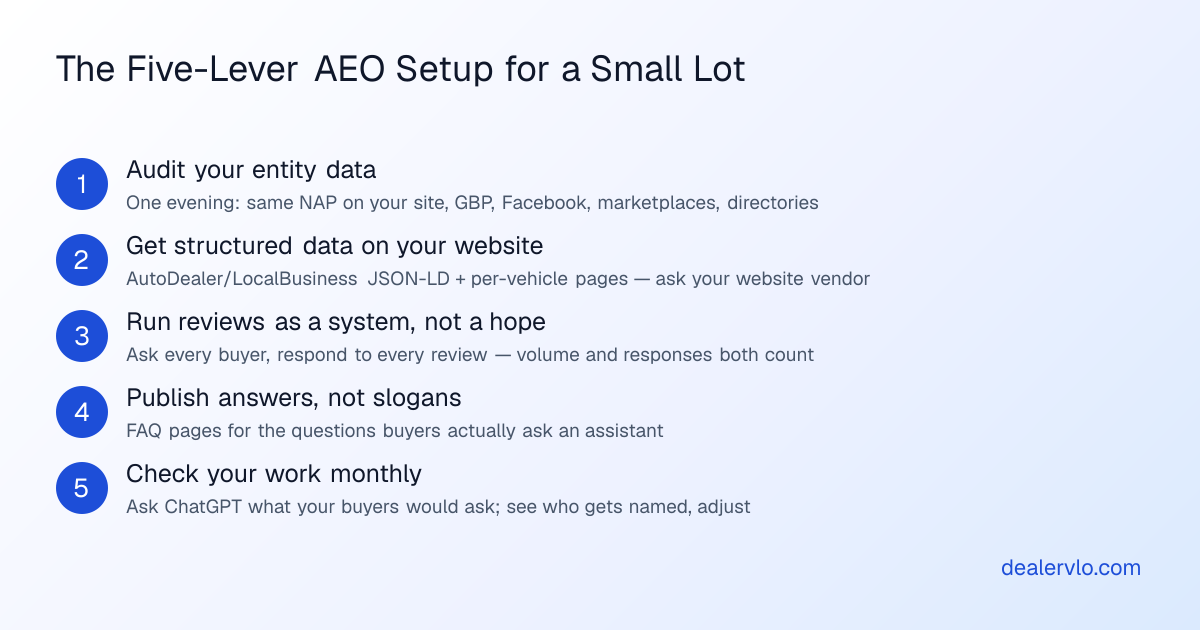
Start with the least glamorous fix, because it's the foundation: your name, address, and phone number should be identical everywhere your dealership appears — your website, Google Business Profile, Facebook, the marketplaces you list on, and the directories you forgot you're in. Same for hours and the exact business name (pick one: "Simon's Auto Sales" or "Simons Auto Sales LLC" — not both).
To a human these look like trivia. To a machine deciding whether two mentions are the same business, they're the whole ballgame — inconsistent data reads as uncertainty, and uncertainty doesn't get recommended. One evening with a spreadsheet fixes most of it.
Lever 2: Put structured data on your website
Assistants lean on structured data — machine-readable JSON-LD markup that states plainly: this is an auto dealer, here's the name, address, hours, and here's what's for sale. A site with proper AutoDealer/LocalBusiness markup, per-vehicle pages with clear specs and prices, and marked-up FAQs hands the machine its answer. A site that's photos and a phone number makes the machine guess — and machines don't recommend guesses.
You don't need to write code; you need to ask one question of whoever runs your website: "What structured data does my site publish?" If the answer is a blank stare, that's your gap. (This is also built into how DealerVLO's dealer websites work — every vehicle you add becomes a clean, crawlable page with real specs from the VIN decode, and your business details stay consistent because they come from one system.)
Turn your ad spend into a cost per car sold and a real ROI — and see how many units the spend has to produce just to break even.
Open the Marketing ROI CalculatorLever 3: Reviews are the trust signal machines can read
When an assistant vouches for a dealer, review data is the closest thing it has to public proof of trust — volume, recency, what customers actually wrote, and whether the dealer responds. A lot with hundreds of detailed reviews and thoughtful responses gives the machine a rich, citable story. A lot with nine reviews and no replies gives it nothing to work with.
You can't buy this one; you build it as a system: ask every buyer at delivery, make it effortless, and respond to every review — including the angry ones you shouldn't answer raw. The full playbook is in how to get Google reviews without breaking the rules, and it pays twice now: once with humans reading your profile, again with every AI that scans it.
14-day free trial, then $29/mo · Cancel anytime
Lever 4: Publish answers, not slogans
Assistants assemble answers from pages that answer things. "Family owned since 1998, where deals are made!" gives a machine nothing. "Do you take trade-ins with a loan balance?" answered in three honest sentences gives it exactly the shape it's looking for.
So write the questions your buyers actually ask — financing with imperfect credit, what's inspected before sale, trade-in process, out-of-state purchases — and answer each plainly on your site. This is the same move that wins local search and the same honesty that makes listings convert; AI search just raises the payoff on it. One well-answered page beats ten pages of adjectives.
Lever 5: Exist in more than one place
Assistants cross-reference. A dealership that appears only on its own website is a single uncorroborated claim; one that shows up consistently on Google Business Profile, Facebook Marketplace, CarGurus, and a couple of local directories is a corroborated fact. You don't need to be everywhere — you need the places you are to agree with each other, and you need more than one of them.
The monthly check that ties it together: open ChatGPT and Perplexity and ask them what your buyer would ask — "best used car dealer near [your town]", "where to buy a used truck under $25k in [your area]". See who gets named and what the assistant says about you. That's your scoreboard, free, once a month.
What NOT to spend on
This corner of marketing is young, which means the grifters arrived first. Keep your money in your pocket on all of the following:
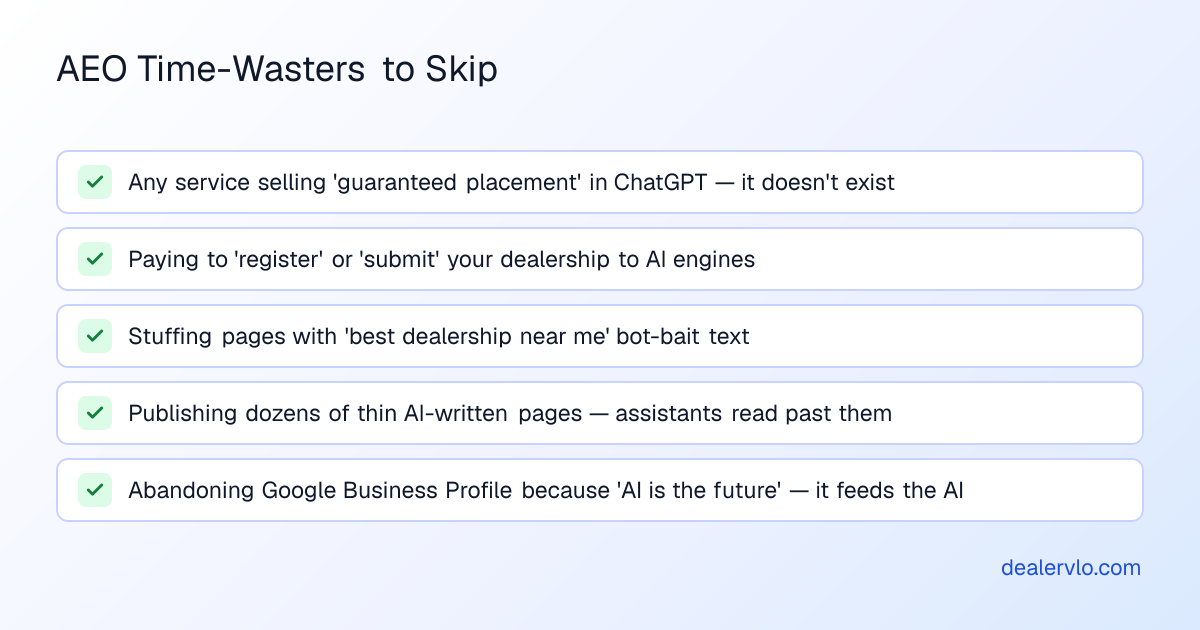
There is no paid placement in ChatGPT's recommendations and no submission portal — anyone guaranteeing you a spot is lying about how this works. Bot-bait keyword stuffing reads worse to a language model than to a human. Mass-publishing thin AI-written pages doesn't build the evidence trail; it dilutes it. And don't let anyone talk you out of Google fundamentals — the assistants read the same ecosystem Google indexes, so your GBP and reviews feed both machines at once.
The honest timeline
None of this is overnight. Assistants refresh their picture of the world on their own schedule, and review depth compounds monthly, not daily. The realistic arc: fix the data and structure once (a weekend of work plus one conversation with your website vendor), run the review system forever, and expect movement over weeks and months. The dealers who start now are building a lead that gets harder to close every month — because this game rewards accumulated evidence, and evidence takes time the competitor who starts next year can't compress.
Frequently asked questions
How does ChatGPT decide which dealerships to recommend?
AI assistants build their answer from the public data they can read and trust: your business details as they appear consistently across the web, structured data on your website, review volume and content, and how clearly your site answers the specific question the buyer asked. There's no ranking auction behind it — the assistant is pattern-matching on evidence. Dealers with clean, consistent, well-structured public data are simply easier to cite than dealers whose information is thin or contradictory.
Can I pay to get my dealership recommended by ChatGPT?
No. There is no ad placement, no submission form, and no service that can "register" you with ChatGPT, Gemini, or Perplexity. Anyone selling guaranteed AI placement is selling something that doesn't exist. What you can do is make your dealership the easiest one for an AI to verify and describe — which is unglamorous data-and-reviews work you mostly control for free.
Does local SEO help my dealership show up in AI search?
Heavily. The same signals that win Google's local results — a complete Google Business Profile, consistent name/address/phone everywhere, real reviews, pages that answer specific questions — are the raw material AI assistants read. If you've done local SEO properly, you've built most of the AEO foundation already; AI search raises the payoff on the same work rather than demanding brand-new work.
What structured data does a dealership website need?
At minimum, machine-readable business details (the AutoDealer/LocalBusiness type in JSON-LD): name, address, phone, hours, and what you sell — plus per-vehicle pages with clear specs and prices, and FAQ content marked up so an assistant can lift the exact answer. If your website vendor can't tell you what structured data your site publishes, that's a real question to ask them this week.
How long does it take to show up in AI recommendations?
Expect weeks to months, not days — assistants refresh from search indexes and data providers on their own schedules, and review depth builds gradually. The practical approach: fix your data and schema once, run your review process continuously, and check monthly by asking the assistants the questions your buyers would ask and seeing who they name.
Bottom line
AI assistants recommend the dealership that's easiest to verify: consistent data, structured pages, deep reviews, plain answers, corroborated presence. Every one of those levers is in a small dealer's hands, most of them free, and they're the same fundamentals that win Google — with the payoff now doubled because two kinds of machines are reading them.
If the website lever is the one you're missing, that's the part DealerVLO handles by default: every unit becomes a real, crawlable page with honest specs, and your business data stays consistent because it lives in one system. Fix the foundation once, and both Google and the chatbots find the same trustworthy lot — yours. For the rest of what AI can do on your lot, start with the working guide.
14-day free trial, then $29/mo · Cancel anytime