The Two-Channel Marketing Stack for a Sub-10-Car-a-Month Lot
A minimum-viable marketing stack for small used car lots: manual Marketplace posts plus in-house Google Vehicle Ads on a tight budget.
Part of the Marketing, leads & your website guide: Used Car Dealer Marketing: What a Small Lot Should Do First — and What to Skip
Switching from another DMS? Compare DealerVLO to DealerCenter, Frazer, or Lot Wizard, or see what DealerVLO's car dealer management software includes.
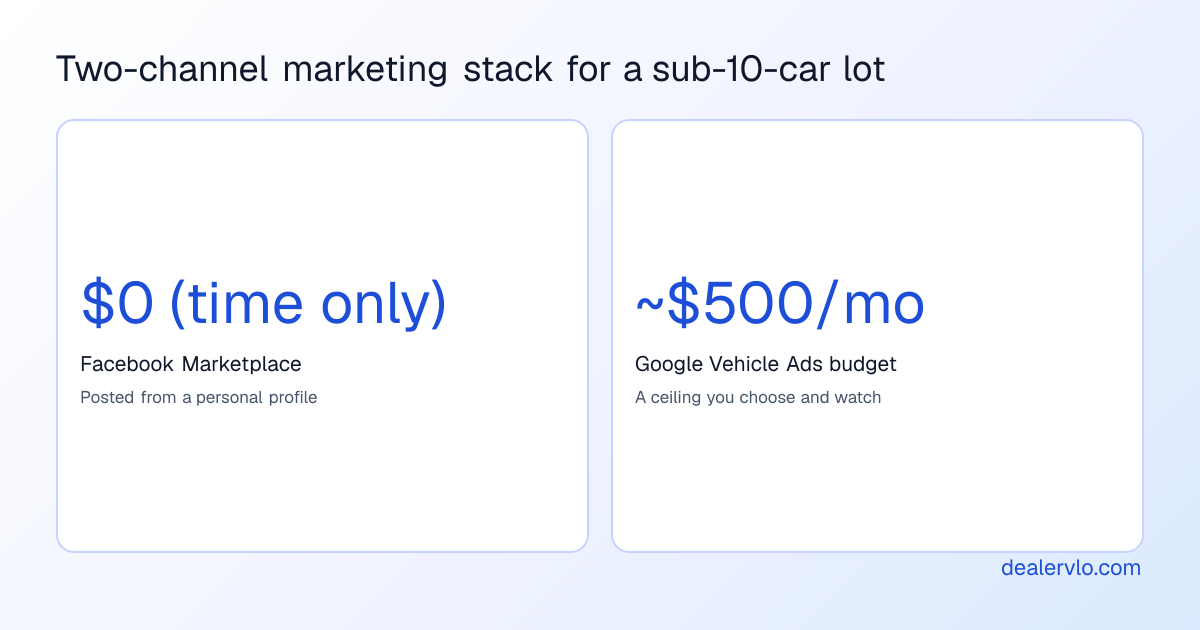
If you're moving fewer than 10 cars a month with one or two people doing everything — buying, recon, answering leads, printing paperwork — you don't need a marketing department. You need two channels that work without eating your week: Facebook Marketplace, posted by hand from a personal profile, and Google Vehicle Ads run in-house through Performance Max. That's the whole stack. Everything else (radio, a third-party agency, a bigger listing-site package) is a volume-stage upgrade, not a starting point.
This isn't a general budget framework — it's a specific answer to "what do I actually turn on this month" when there's no marketing budget line in your head, just whatever's left after floor plan and insurance.
14-day free trial, then $29/mo · Cancel anytime
Why just two channels
A lot moving 25-30 cars a month with a sales staff can justify running radio, PPC, a third-party agency, and paid social all at once — that's a volume business with volume money. A sub-10-car lot is a different business. You don't have the deal flow to spread spend thin across six channels and still feel it, and you don't have the headcount to manage six channels anyway.
Marketplace and Google Vehicle Ads earn the two slots for one reason each. Marketplace is free — it costs you time, not money, and personal-profile posting is still allowed even after Meta restricted the free business-Page channel. Google Vehicle Ads put your actual inventory, with photos and prices, in front of people actively searching for a car like yours, and you can run it yourself without hiring an agency.
| Channel | Cost | Who posts | Control |
|---|---|---|---|
| Facebook Marketplace | Free (time only) | Personal profile, one car at a time | Full — you write it, you post it |
| Google Vehicle Ads (PMax) | Your ad budget, billed by Google | You, in your own Google Ads account | Feed-driven, some automation |
| Listing sites (CarGurus, Cars.com, etc.) | Per-site fees, set by each site | Automated feed | Low — you can't control placement |
| Agency-run multi-channel | A monthly retainer on top of your ad spend | Third party | Low — you're paying to not manage it |
Channel 1: Facebook Marketplace, posted from a personal profile
Here's the structural fact that shapes this whole channel: since January 2023, Meta no longer lets a business Page create free vehicle listings on Marketplace. Free listings are now posted by hand from a personal profile, one car at a time, not from the dealership Page. Paid ads run through a Page or ad account are unaffected; it's specifically the free listing mechanic that moved to a person.
For a one- or two-person lot this isn't really a downside — it's just how the workflow has to run. Whoever is the "face" of the lot (you, or your one salesperson) posts each car from their own profile: good photos, an honest description, the price. There's no workaround that lets the business Page do this for free, and no legitimate shortcut that gets cars back onto Marketplace through an automated feed — Meta ended dealer partner feeds in 2021, before it cut off Page listings, and nothing in any DMS changes that; feeding Marketplace automatically simply isn't something any vendor can offer anymore.
What DealerVLO does for this step: each vehicle's page has a "Post to marketplace" kit that pulls all the car's photos into one download, lines up the specs so you can copy them straight into the listing, and gives you a written description with an optional AI rewrite — so the manual part is faster, even though the posting itself still has to be a human clicking through their own profile. You're not saving the step, you're saving the ten minutes of re-typing specs you already have in your inventory. On a computer, DealerVLO's Chrome extension skips the copying too: Post to Facebook opens Marketplace's form with that car filled in, and you still check it and click Publish (here's how that compares to an auto-poster).
A few practical notes worth keeping in mind on Marketplace specifics: there's a lot of blogger folklore out there about exact photo counts, mileage minimums, and "warm-up posting" rules supposedly required to avoid getting flagged. None of that traces back to an actual Meta policy page, so treat it as unverified — post real photos of the actual car, write an accurate description, and don't worry about hitting a magic number of pictures.
Channel 2: Google Vehicle Ads, run in-house through Performance Max
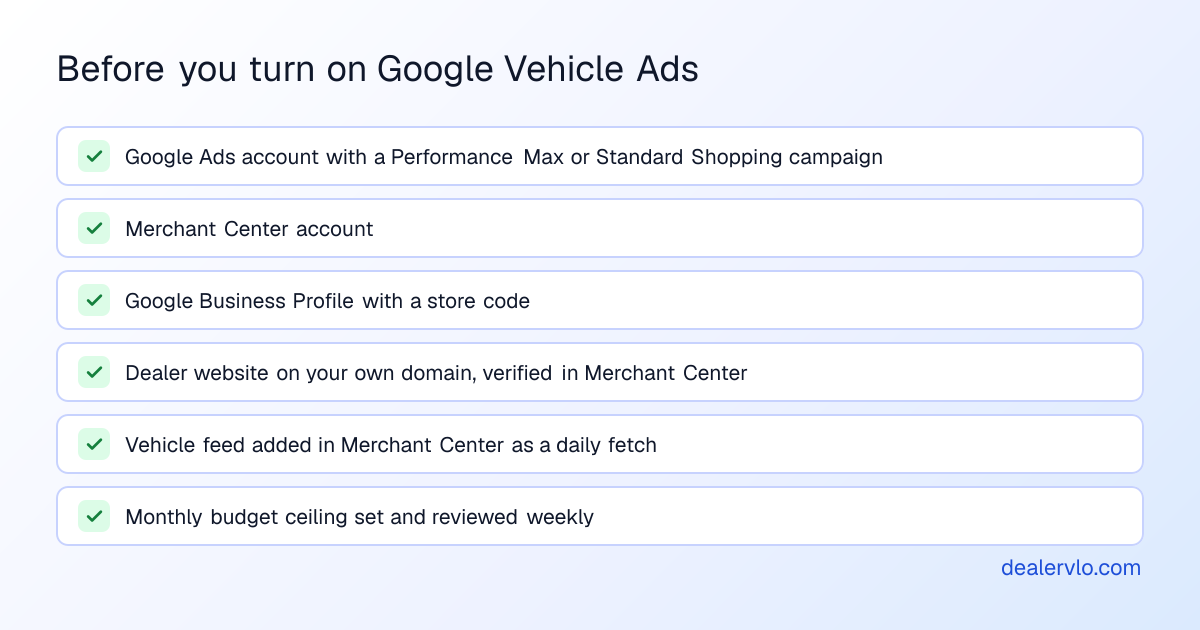
Google Vehicle Ads is a specific paid format: it shows an image of your actual vehicle — make, model, price, mileage, your dealership name — to someone actively searching on Google. To use it you need your own Google Ads account running a Performance Max or Standard Shopping campaign (billed by Google), a Google Merchant Center account, a Google Business Profile with a store code, and your dealer website on your own domain, verified and claimed in Merchant Center. Merchant Center then pulls a vehicle feed with each car's details: VIN, price, mileage, specs, photos and a link to the car.
That's more setup steps than Marketplace, but none of them require an agency. A one- or two-person lot can work through this themselves, and once it's live, it mostly runs on the feed you keep current.
One habit worth having before you turn this on: Performance Max makes a lot of placement and creative decisions on its own, and Google changes those options often. Check in your own account where your ads are showing and what creative Google is generating before you raise the budget, rather than assuming.
You set the budget yourself. A number like $500 a month is a ceiling you choose, and it's a reasonable place for a sub-10-car lot to start precisely because it's small enough that a mistake doesn't wreck the month. Performance Max can spend fast, so start small, watch it, and scale only once you understand what it's doing. Google Ads is built in a way that makes it very possible to keep raising your spend without much friction, so set the number and watch it rather than letting the campaign set it for you.
14-day free trial, then $29/mo · Cancel anytime
Feeding both channels from one clean inventory record
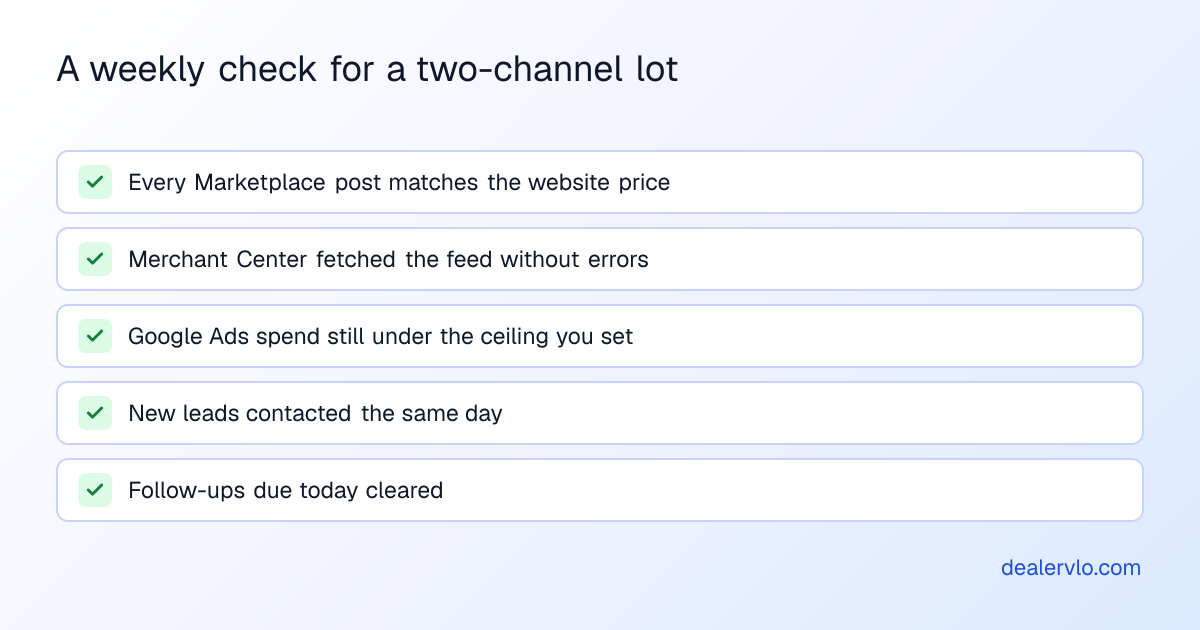
The one thing both channels share is that they're only as good as the vehicle data behind them. A Google Vehicle Ads feed needs accurate make, model, price, mileage, color and photos. A Marketplace post needs the same facts typed out by hand. If your price on Marketplace doesn't match your price on your website, or your mileage is stale because nobody updated it after a test-drive odometer check, you lose trust with a shopper who cross-checks — and they will.
This is one of the places DealerVLO earns its keep without doing the marketing for you: every car's record holds VIN, stock number, photos, and price in one place, and photo enhance (a White, Dark, or Showroom backdrop, with the car cut out and never regenerated) is included in the plan if your photos need cleaning up before they go anywhere public. The website and the automated listing feeds to CarGurus, Cars.com, Autotrader and Carfax.com all read that same price off the car's record, so if you fix a number in one place it's consistent across those channels. For Google Vehicle Ads, DealerVLO gives you a vehicle ads feed under Settings → List my cars on other sites: a feed URL you add in Merchant Center as a daily scheduled fetch, carrying each available car's VIN, price, mileage, specs, photos and link from that same record. DealerVLO supplies the feed; the Google Ads campaign and its budget stay in your own account. It doesn't post to Marketplace for you (nothing legitimately can, since that requires a personal profile), but it keeps the data you're copying from accurate and current.
Turn your ad spend into a cost per car sold and a real ROI — and see how many units the spend has to produce just to break even.
Open the Marketing ROI CalculatorWhat "working" looks like for two channels
With only two channels and a lead inbox, you don't need channel-attribution software — you need a place to actually look at whether leads are coming in and whether you're following up. DealerVLO's lead inbox records each lead's source (the dealer website's forms, or Phone/Walk-in/Facebook/Listing site/Other when you add one by hand), gives each lead a status from New through Converted, and sends you one daily email of what's due for follow-up. It won't total your cost per lead by channel or compute an ROI percentage for you — that math is yours to do, and the honest version of it depends on numbers (click costs, conversion rates) that change by market and by month, so don't trust a blanket industry figure for it.
What you can watch, cheaply, every week: are Marketplace leads actually coming in, and are Google Vehicle Ads leads landing on your Financing page or a vehicle inquiry form? The dashboard's "Needs attention" list flags leads awaiting contact and follow-ups due, so with two channels and low volume you can actually clear that list daily instead of letting it pile up — which is the main practical advantage of running lean instead of running six channels you can't watch closely.
When to add a third channel
Two channels is a floor, not a ceiling. The signal to add a third isn't a calendar date, it's volume: once you're reliably clearing more cars a month and the owner can't personally answer every lead and post every Marketplace listing anymore, that's when a listing-site subscription, a Facebook Pixel on your website, or paid social catalog ads start to pencil out. Before then, spending money to "diversify" a channel mix you can't even keep up with manually is just spending money.
If you do add listing sites later, remember each one runs its own fee schedule and its own enrollment process. DealerVLO's feeds to CarGurus, Cars.com, Autotrader and Carfax.com are included at no extra charge from DealerVLO's side, but you still pay and manage your own account with each site, and each feed goes out three times a day — new cars, price changes and sold cars reach those sites with the next daily send, not instantly. Your own dealer website updates much faster than that. That's a fine trade for a small lot: one less thing to babysit, in exchange for not controlling placement or exact timing on third-party sites.
14-day free trial, then $29/mo · Cancel anytime
For a broader look at where a small lot's marketing dollars generally go — not just these two channels — the used car dealer marketing budget breakdown and the general marketing guide for small lots cover the bigger picture. If you're trying to figure out whether your spend is paying off at all, measuring cost per car sold walks through that math without inventing a benchmark number for you. And if your website itself needs a check before you send paid traffic to it, run it through the free dealer website check tool first — a slow or broken vehicle page wastes every dollar you spend getting someone to it.
If you're weighing whether your current website setup can even support a Google feed and clean listings, how independent lots pick a website provider and the step-by-step website setup guide are worth a read before you start building campaigns on top of a shaky foundation. And if you're curious whether your site is even visible to AI search tools shoppers increasingly use, the AI crawler blocking guide is a five-minute check.
Frequently asked questions
Can I still post cars for free on Facebook Marketplace as a dealer?
Yes, but only from a personal profile, not your dealership's business Page. Meta stopped letting business Pages create free vehicle listings in January 2023; the free person-to-person listing mechanic still exists, but it has to be created by an individual, so a small lot's owner or salesperson posts each car from their own account.
What's a realistic monthly budget for Google Vehicle Ads on a small lot?
You set the budget yourself in Google Ads. A number like $500 a month is a reasonable, controllable starting ceiling for a sub-10-car lot — set it yourself and watch the campaign closely, since Performance Max can spend aggressively if you let it run unmonitored.
Do I need an agency to run Google Vehicle Ads?
No — a one- or two-person lot can set this up directly: a Google Ads account, a Merchant Center account, a Google Business Profile with a store code, your website verified in Merchant Center, and a vehicle feed Merchant Center fetches daily. It takes more setup steps than Marketplace, but none of them require outside help once your inventory data is accurate.
Why can't my inventory feed post to Facebook Marketplace automatically?
Meta ended dealer partner feeds to Marketplace in 2021, before it restricted business-Page listings in January 2023, and that hasn't changed. No vendor, including DealerVLO, can legitimately push listings there automatically — it has to be a person posting from their own profile. DealerVLO's Chrome extension can fill in the listing form for one car, but that person still reviews it and clicks Publish.
How do I know if my two-channel marketing is actually working?
Track whether leads are coming in and whether you're following up on them, since that's the practical signal at low volume — a precise cost-per-lead or ROI percentage by channel depends on numbers (click costs, local conversion rates) that vary too much to benchmark generically. Watching your lead inbox daily and clearing follow-ups matters more than chasing a channel-level ROI number at this scale.
Should I add listing sites like CarGurus or Cars.com before or after this two-channel stack?
Add them once volume outgrows what one or two people can manually manage. Before that point, the per-site fees and feed management often cost more attention than the extra leads are worth for a lot this size.
Bottom line
A sub-10-car lot doesn't need six marketing channels, an agency retainer, or a monitoring dashboard with a dozen metrics on it — it needs Marketplace posted consistently from a personal profile and a Google Vehicle Ads campaign run carefully on a budget you set and watch. Get those two working, keep your inventory data clean behind both of them, and add a third channel only once volume forces your hand. Run your next listing through DealerVLO so the specs behind your Marketplace posts and your website stay accurate.
14-day free trial, then $29/mo · Cancel anytime