How Used Car Dealers Can Actually Use AI on the Lot (Without Getting Burned)
How independent used-car dealers use AI in 2026: listings, lead replies, pricing research, review responses, working ChatGPT prompts, and what never to hand it.
Part of the Marketing, leads & your website guide: Used Car Dealer Marketing: What a Small Lot Should Do First — and What to Skip
Switching from another DMS? Compare DealerVLO to DealerCenter, Frazer, or Lot Wizard.
Every vendor says "AI" now. Here's what it actually does for a lot.
Open your inbox and half the vendor pitches have AI in the subject line. AI pricing, AI chat, AI photos, AI everything — most of it priced like it's magic. Meanwhile you're running a 10-to-50-car lot where you're also the buyer, the finance department, and the person writing every listing at 9 PM.
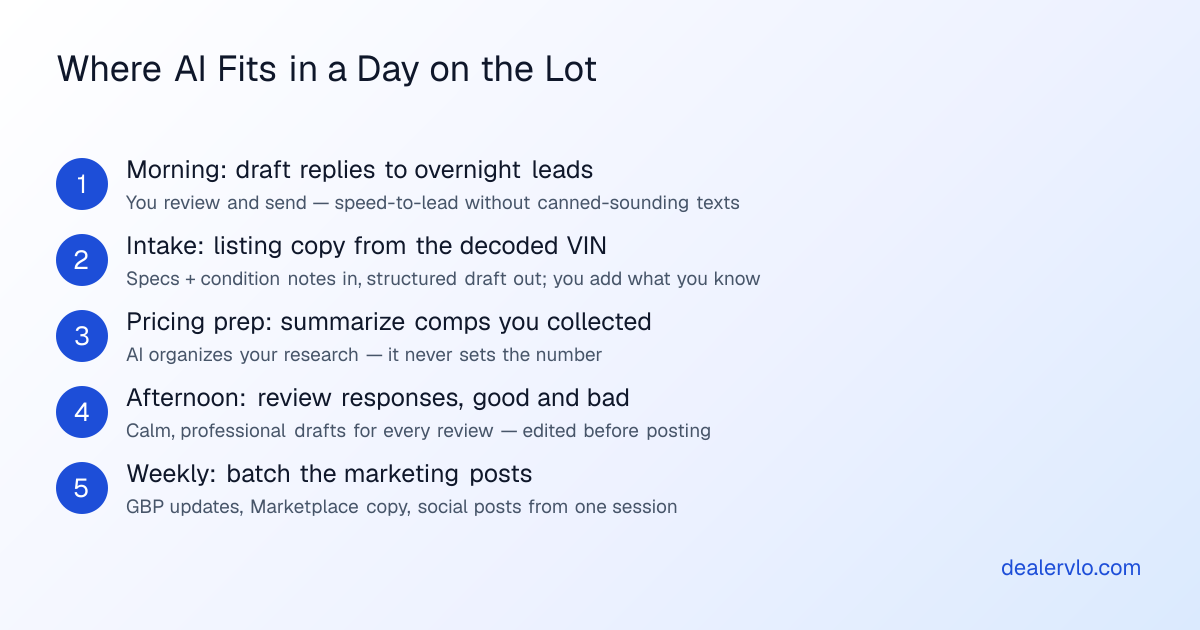
I run my own lot, and I use AI most days. Not the way the pitches describe it — the way a small operator actually can: as a fast, tireless drafting assistant for the writing chores that eat your week, while every decision that touches money, law, or a customer stays yours. This is the working version of that: what AI genuinely does well on a used-car lot, the prompts that earn their keep, and the short list of things you should never let it touch.
14-day free trial, then $29/mo · Cancel anytime
The one rule: AI drafts, you decide
Everything that works about AI on a lot comes down to one split. Language models are excellent at drafting — producing clean, structured text from facts you give them, instantly, in any tone. They are unreliable at deciding — they don't know your market, they don't know the car, and when they don't know something they make it up with total confidence.
So the working rule is: hand AI the drafting, keep the deciding. A listing draft, a follow-up text, a review reply — all drafting, all fair game. A price, a compliance answer, a promise to a customer — all deciding, all yours. Every use below is just that rule applied to a different corner of the operation.
Writing listings that don't sound like everyone else's
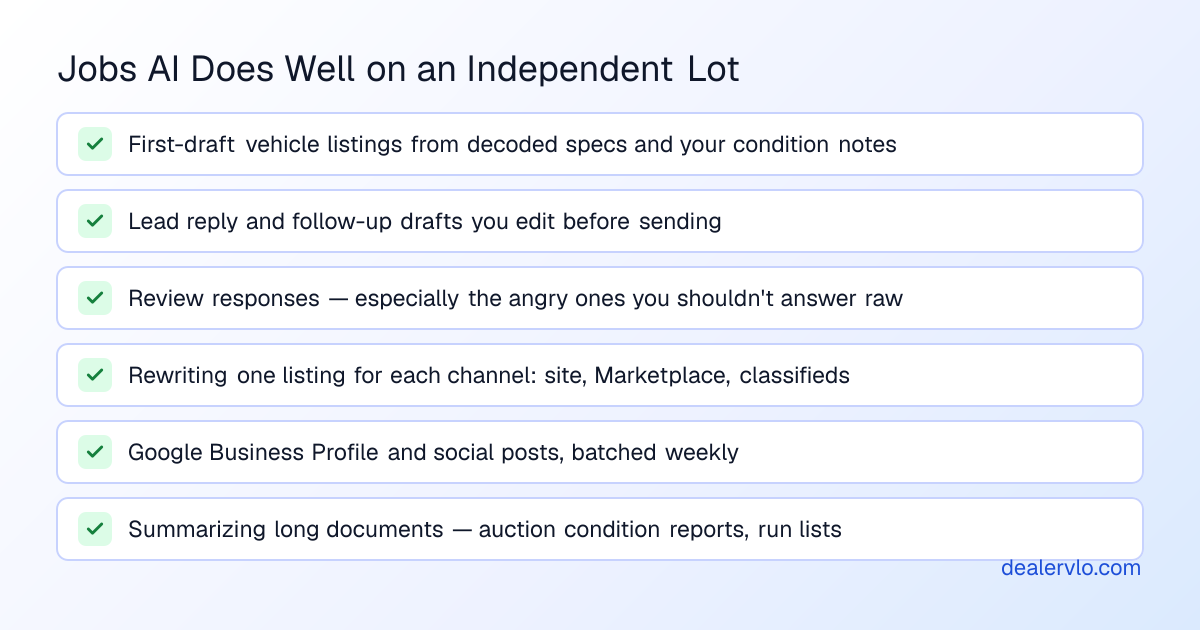
This is the highest-value use on most lots, because listing copy is pure drafting. The workflow that works: decode the VIN so the facts are right, jot three or four honest condition notes ("new tires in recon, one respray on the rear quarter, non-smoker, second owner"), tell the AI who the likely buyer is, and ask for a draft. What used to take me twenty minutes of staring at a blank description box takes about five — most of it editing, which is where your knowledge of the actual car goes in.
The machine's draft gets the structure and the specs right. Your edit adds the things only you know: how it drove, what you fixed, why you bought this one at the lane. That combination — accurate specs, honest condition, one specific detail a template would never include — is exactly what makes a listing that sells instead of one that scrolls past.
Two cautions. Never let AI invent equipment — if it says "panoramic roof" and the car has a plain sunroof, you now have an accuracy problem on a public listing. Feed it the decoded specs; don't let it guess. And rewrite, don't copy-paste, across channels: ask for a tighter version for Marketplace and a shorter one for classifieds, so you're not posting identical copy everywhere.
Decode any VIN free — year, make, model, trim, engine — straight from NHTSA.
Open the VIN DecoderAnswering leads faster — without sounding like a bot
Speed-to-lead decides more deals than most dealers admit, and converting an online lead into an appointment is mostly about answering fast with something that doesn't read like a canned template. AI splits that difference: it drafts a specific, human-sounding reply in seconds — you read it, fix anything off, and send.
The practical setup is simple. When a lead comes in on a specific unit, paste the inquiry and the car's basics into your assistant and ask for a short reply that answers the actual question, offers two appointment windows, and doesn't oversell. Same for the day-three follow-up nobody enjoys writing. The messages stay yours — you read every one before it goes out — but the blank-screen time disappears, and the lead hears back while they're still shopping.
What I don't recommend: fully automated AI chat that answers customers with no human review. The failure mode isn't hypothetical — an unreviewed bot will eventually promise financing terms, misstate equipment, or answer a legal question wrong, in writing, to a customer. Draft-and-review gets you the speed without handing a stranger the keys.
Pricing and appraisal: research assistant, never the appraiser
Here's where the honesty matters. AI does not know what your market is doing this week. Models are trained on old data, and a chatbot will state a "current market value" with complete confidence and no current information. Letting it set a price is letting it guess with your money.
What it's genuinely good at is organizing the research you collect. Paste in the comps you pulled — asking prices, mileage, days on market from your own comp work — and have it structure the comparison, flag the outliers, and pressure-test your reasoning ("what would make this unit worth less than these comps?"). Same on the buy side: summarize an auction condition report into a two-line risk read before you bid at the lane, or turn your scribbled walk-around notes into a clean appraisal write-up. The number stays yours. The paperwork around the number gets faster.
That's the exact line DealerVLO's price suggestion is built on. Instead of a chatbot guessing a value from old training data, it looks up current listings near you, shows you the real ones it found, and hands you an asking-price range — not a single black-box number. The comps come to you; the decision still doesn't.
Reviews, reputation, and the reply you shouldn't write angry
Every dealer eventually gets the review that makes your blood pressure spike. That's precisely the message you shouldn't write yourself in the moment — and precisely what AI drafts well. Paste the review in, ask for a calm, professional response that acknowledges the specific complaint without admitting fault you don't own, then edit and post. For the good reviews, batch ten thank-you replies in five minutes instead of leaving them hanging for a month.
Responding to every review — quickly, specifically, professionally — is one of the cheapest trust signals an independent lot can send, and it feeds the same engine as getting more Google reviews in the first place. AI removes the main reason it doesn't happen: nobody has time to write them.
14-day free trial, then $29/mo · Cancel anytime
Marketing content on a schedule you'll actually keep
The marketing that works for independent lots — showing up in local searches, fresh Google Business Profile posts, consistent Marketplace listings — dies on consistency, not ideas. AI fixes the consistency problem. One session a week: feed it this week's fresh inventory and anything happening on the lot, and have it draft the GBP post, three social posts, and the Marketplace copy variants. Edit, schedule, done.
The voice caution applies double here: out of the box, AI writes like a press release. Tell it to write like a dealer talking to neighbors, show it an example of your voice, and cut every sentence that sounds like a brochure. The goal is your lot sounding like your lot, faster — not sounding like every other AI-written page.
Five prompts that earn their keep
Prompts aren't magic, but specific beats vague every time. These five patterns cover most of what I actually use — swap in your details:
- Listing draft: "Write a used-car listing for a [year make model trim], [mileage] miles. Decoded specs: [paste]. Condition notes: [your honest notes]. Likely buyer: [commuter / family / work truck]. Honest, specific, no hype, no equipment not listed in the specs. 150 words."
- Lead reply: "A customer asked: '[paste inquiry]' about our [unit]. Draft a short, friendly reply that answers their exact question, offers Tuesday evening or Saturday morning to come see it, and doesn't pressure them."
- Review response: "Draft a calm, professional response to this review of my dealership: '[paste]'. Acknowledge the specific issue, don't admit fault, invite them to contact me directly, keep it under 80 words."
- Comp organizer: "Here are comps I pulled for a [unit]: [paste prices, miles, days listed]. Organize into a table, flag outliers, and list three questions I should answer before pricing mine against these."
- Condition-report read: "Summarize this auction condition report in five bullets: biggest mechanical risks, cosmetic issues, and anything that affects retail-readiness. [paste]"
Notice what none of these do: none ask the AI for a fact it would have to invent. Every prompt hands it your information and asks for structure, speed, or tone. That's the pattern.
What NOT to let AI touch
This list is short and non-negotiable, because the failure mode on each one lands on your license, your money, or your reputation:
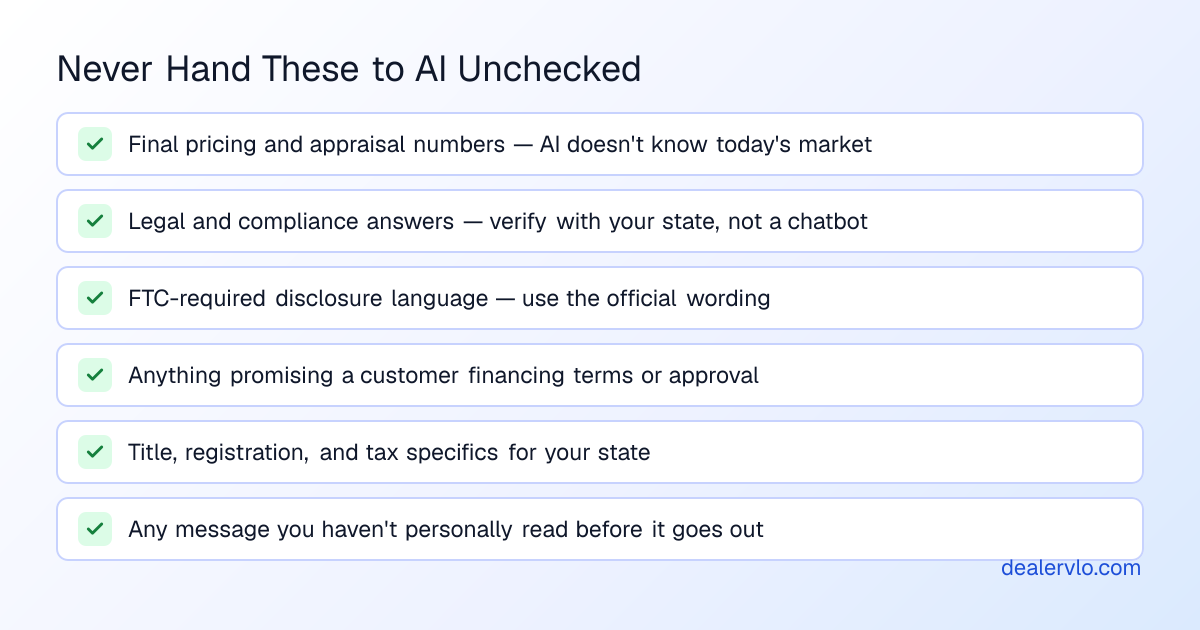
Final pricing. The model doesn't know this week's market. It will give you a number anyway. That's the problem.
Compliance and legal answers. Ask an AI about your state's title deadline or the Buyers Guide requirements and you'll get a confident answer that may be wrong in ways you can't see. Wrong statute, stale deadline, invented form name — all common. Your regulator, your attorney, and your dealer association are sources; a chatbot is not.
Disclosure language. The FTC Buyers Guide, odometer disclosure, and your state's required wording exist as official text. Use the official text. There is no upside to a paraphrase.
Financing conversations. Never let an automated anything discuss terms, rates, or approval odds with a customer. That's regulated territory and judgment territory at once.
Anything you haven't read. The rule that catches everything else: no AI-drafted word reaches a customer, a listing, or a legal document without a human — you — reading it first. AI failures aren't loud; they're a plausible wrong sentence in paragraph three. The read-through is the whole safety system.
The stack that makes this work: AI drafts, your DMS executes
Here's the part most AI-for-dealers articles skip: a drafting assistant is only half the workflow. The other half is the system of record that feeds it accurate facts and executes the result — decoding the VIN so the listing draft starts from real specs, syncing the finished listing to your website and feeds, tracking the lead the reply goes to, and generating the compliance documents from official templates instead of anyone's paraphrase.
That's the division of labor on my lot: AI handles the drafting, and DealerVLO handles the deterministic work — VIN decode auto-fills the inventory record, listings flow to the website and marketplaces, leads land in one inbox, and the deal jacket produces the federal documents from the actual required text. The machine that guesses never touches the parts that can't be guessed. If your current setup is a spreadsheet and a legal pad, fixing that layer first will do more than any prompt — and it's $29 a month, not enterprise-AI money.
Frequently asked questions
What is the best AI tool for a used car dealership?
For most independent lots, a general assistant like ChatGPT, Claude, or Gemini covers the highest-value work — drafting listings, lead replies, review responses, and marketing posts — for free or a small monthly subscription. Specialized automotive AI tools exist for chat, pricing, and photo enhancement, but start with a general assistant and a good process before paying for anything dedicated. The tool matters less than the habit: draft with AI, edit with your own knowledge of the car.
Can AI write my car listings for me?
AI writes a strong first draft — feed it the decoded VIN specs, your condition notes, and who the likely buyer is, and it produces clean, structured copy in seconds. What it can't do is know the car. You still add what you saw on the test drive, what you fixed in recon, and what makes this unit different from the three others like it in your market. Draft with the machine, finish with the dealer.
How much does AI cost for a small dealership?
The general assistants run free to roughly twenty to thirty dollars a month per seat — a rounding error next to a floor-plan bill. Dedicated automotive AI products (chat widgets, pricing tools, photo backgrounds) are priced like software subscriptions and vary widely, so treat each one like any vendor decision: know the job it does, and check whether a general assistant plus ten minutes of process gets you most of the way for free.
Will AI replace car salespeople?
Not on an independent lot. The parts of the job AI handles are the writing chores around the sale — listings, follow-up drafts, review replies — not the sale itself. Appraising a trade, reading a customer on the test drive, and closing at the desk are judgment and trust work. Dealers who use AI well get those hours back to spend on exactly that.
Is it safe to use AI for compliance or legal questions?
No — treat AI answers on legal and compliance topics as unverified. Language models confidently produce wrong statutes, wrong deadlines, and wrong disclosure language, and a wrong compliance answer on a car deal has real consequences. Get compliance requirements from your state regulator, your attorney, or your dealer association, and let AI help with everything around them — never be the source of them.
Bottom line
AI won't buy better cars for you, and it won't close a deal. What it will do — today, for free or close to it — is give you back the hours you spend writing: listings, lead replies, review responses, marketing posts. Hand it the drafting, feed it real facts, read everything before it ships, and keep every decision that touches money, law, or a customer in your hands.
And put a real system of record under it, so the machine that drafts is always working from accurate data and the paperwork comes from official text instead of anyone's best guess. That's the whole play: AI for the words, a modern DMS for the facts, you for the judgment.
14-day free trial, then $29/mo · Cancel anytime
Punch in cost, recon, holding days, and sale price to see your true net gross and margin.
Open the Profit Margin Calculator