Buy Here Pay Here Digital Marketing: A Tax-Season Playbook (and What You Can't Say in Ads)
Buy here pay here digital marketing for tax season: get found locally, advertise financing within Truth in Lending rules, and handle ad platform limits.
Part of the Marketing, leads & your website guide: Used Car Dealer Marketing: What a Small Lot Should Do First — and What to Skip
Switching from another DMS? Compare DealerVLO to DealerCenter, Frazer, or Lot Wizard.
Buy here pay here digital marketing comes down to three things: be easy to find when a credit-challenged buyer searches on their phone, explain your financing honestly, and be ready before tax refunds land in mid-to-late February. The trap is that "easy financing" is regulated speech. Put a down payment or a weekly payment in an ad and federal Truth in Lending rules kick in, and Facebook and Google both restrict how financing ads can be targeted.
This post is the playbook: what to fix now, what to say and not say in ads, how the ad platforms treat financing offers, and a calendar that has you ready for the refund wave. It isn't legal advice. Have your attorney look at your ad copy before you run it.
14-day free trial, then $29/mo · Cancel anytime
Why BHPH marketing is different
A BHPH shopper usually isn't asking "which car?" first. They're asking "will I get approved, and what will it cost me a week?" They often shop on a phone, and they've usually been turned down somewhere else.
That changes what your marketing has to do:
- Answer the approval question without promising approval.
- Talk about payments without tripping disclosure rules you haven't met.
- Show real cars at real prices, because a payment means nothing without the car.
- Be fast. A buyer with a refund in the bank is shopping several lots that week.
And most of the year's business lands in a few weeks. The IRS can't issue refunds that include the Earned Income Tax Credit or Additional Child Tax Credit before mid-February, and that hold covers the entire refund. When it lifts, the money arrives at once. The full timing is in used-car sales seasonality, and how to size the down payments that come with it is in BHPH tax-season down payments.
Step 1: Get found when they search "buy here pay here near me"
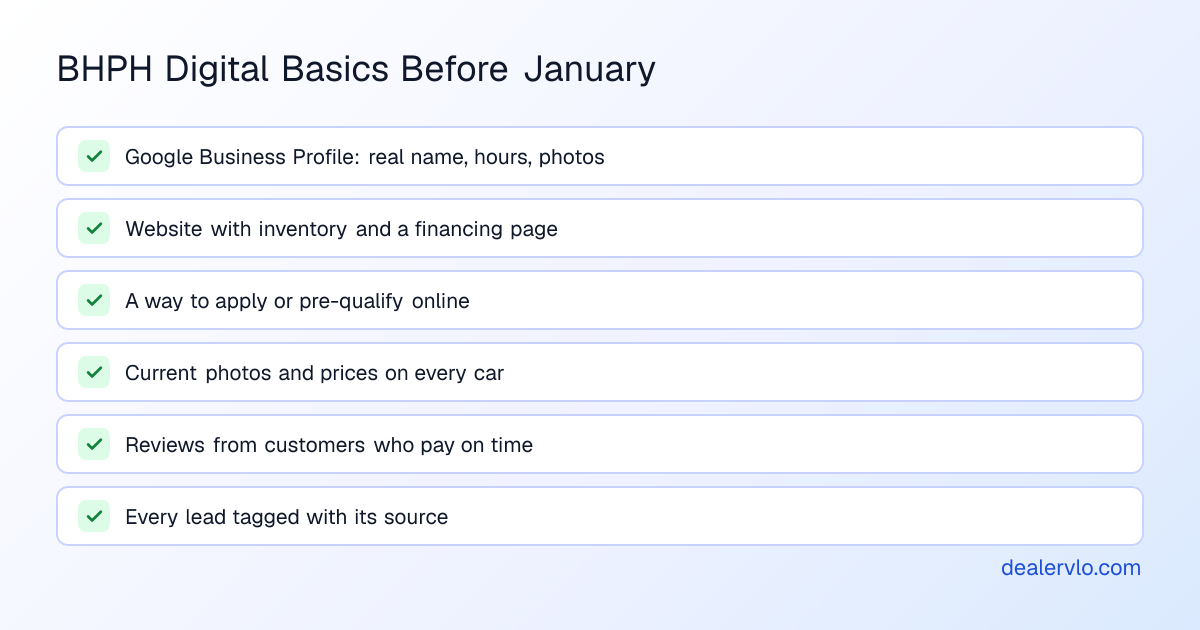
Google Business Profile first. It's the free listing that shows up on Google Maps and local results, and it's where a phone search lands. Fill in your hours, photos of the lot and the cars, and your website. One rule catches a lot of BHPH lots: Google's guidelines say the profile name must reflect your real-world business name, and adding keywords or taglines can get the profile suspended. If "Buy Here Pay Here" isn't on your sign, don't add it to the name; say it in your description and on your website. The Google Business Profile guide walks through the setup, and how to get Google reviews covers the part that moves you up the map.
A website that answers the approval question. It needs your inventory with photos and prices, a page that explains plainly how your financing works, and a way to apply or pre-qualify without calling.
DealerVLO includes a dealer website, and your inventory posts to it automatically. You can turn on a Financing page, and on it either a short pre-qualification form or a full online credit application. The application deliberately doesn't collect a Social Security number online; you get that in person or by phone before you pull credit. Applications are encrypted and only owners, admins, and finance managers can open them. Every priced car page also shows a monthly payment estimator, clearly labeled as an estimate, with a button to your Financing page for that car.
14-day free trial, then $29/mo · Cancel anytime
Step 2: Advertise financing within the Truth in Lending rules
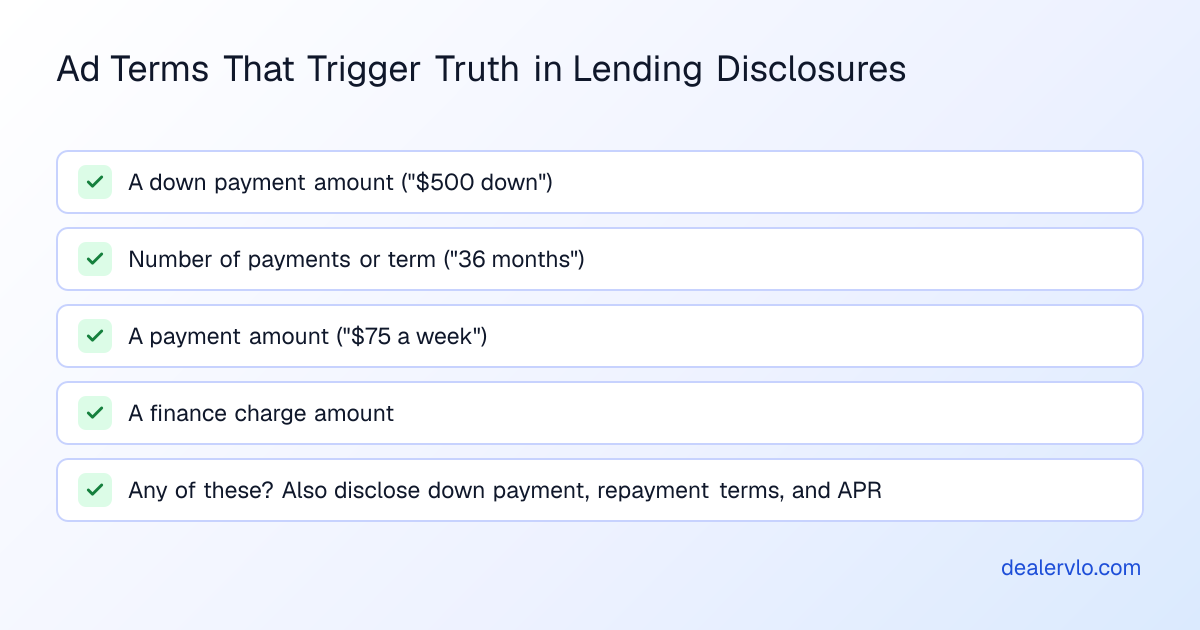
This is where BHPH ads get dealers in trouble. Under Regulation Z, the federal Truth in Lending rules, certain words in a credit ad are triggering terms (Regulation Z's advertising rule):
- the amount or percentage of a down payment
- the number of payments or the period of repayment
- the amount of any payment
- the amount of any finance charge
Use any of them and the ad must also disclose the down payment, the terms of repayment, and the annual percentage rate, using that term. So "$500 down, $75 a week" in a Facebook post is a triggering ad, and it needs the full disclosures.
The official commentary gives examples of phrases that don't trigger: "pay weekly," "monthly payment terms arranged," "take years to repay," and "no downpayment" when that's true (CFPB commentary). It also warns that a trigger can be implied: "80 percent financing available" signals a 20% down payment.
A few more rules worth keeping:
- Don't promise what you can't deliver to every applicant. If you can't approve everyone, don't say you will.
- Make sure any APR you advertise is the real one. The CFPB took action against a BHPH dealer, Herbies Auto Sales, for advertising a misleadingly low 9.99% APR while leaving required costs out of the finance charge.
- Keep the fine print honest. A disclaimer that contradicts the headline doesn't fix the headline.
Step 3: Facebook, with the financing-ad rules
Facebook is where a lot of BHPH buyers browse, and there are two very different ways to be there.
Free: Marketplace and your Page. Meta ended dealer feeds into Marketplace, so free listings are posted by hand, one car at a time. DealerVLO's "Post to marketplace" kit gives you every photo as one download, each field ready to copy, and a written description with an optional AI rewrite, so a listing takes a few minutes. The Facebook Marketplace guide covers what works there.
Paid: ads that mention financing. Meta requires advertisers in the US running financial products and services ads to use a Special Ad Category, and that limits your targeting:
- No targeting by ZIP code, and you can't exclude locations. City targeting widens to about a 15-mile radius in the US.
- The age range must include 18 to 65, and all genders must be included.
- Lookalike audiences aren't available; Meta offers its adjusted "special ad audiences" instead.
Meta's financial ad rules also say loan ads must not ask for personal or financial information like bank account details in the ad itself. Send people to the application on your own website instead.
For inventory ads, DealerVLO provides a Facebook vehicle catalog feed in Meta's format for automotive inventory ads. You set up and pay for the ads in your own Meta ad account.
Step 4: Google ads for financing and inventory
Google applies the same kind of limits. In the US and Canada, its personalized advertising policy doesn't allow credit ads to target or exclude people by age, gender, parental status, marital status, or ZIP code. Use city, state, or radius targeting.
To show actual cars in Google's vehicle ads, you need a Google Ads account, a Google Business Profile, and an inventory feed in Google Merchant Center. DealerVLO supplies that vehicle ads feed (each available car's VIN, price, mileage, photos, and link), and you run and pay for the campaign in your own Google Ads account. There are no free vehicle listings on Google; cars appear through paid vehicle ads.
Turn your ad spend into a cost per car sold and a real ROI — and see how many units the spend has to produce just to break even.
Open the Marketing ROI CalculatorStep 5: A tax-season marketing calendar
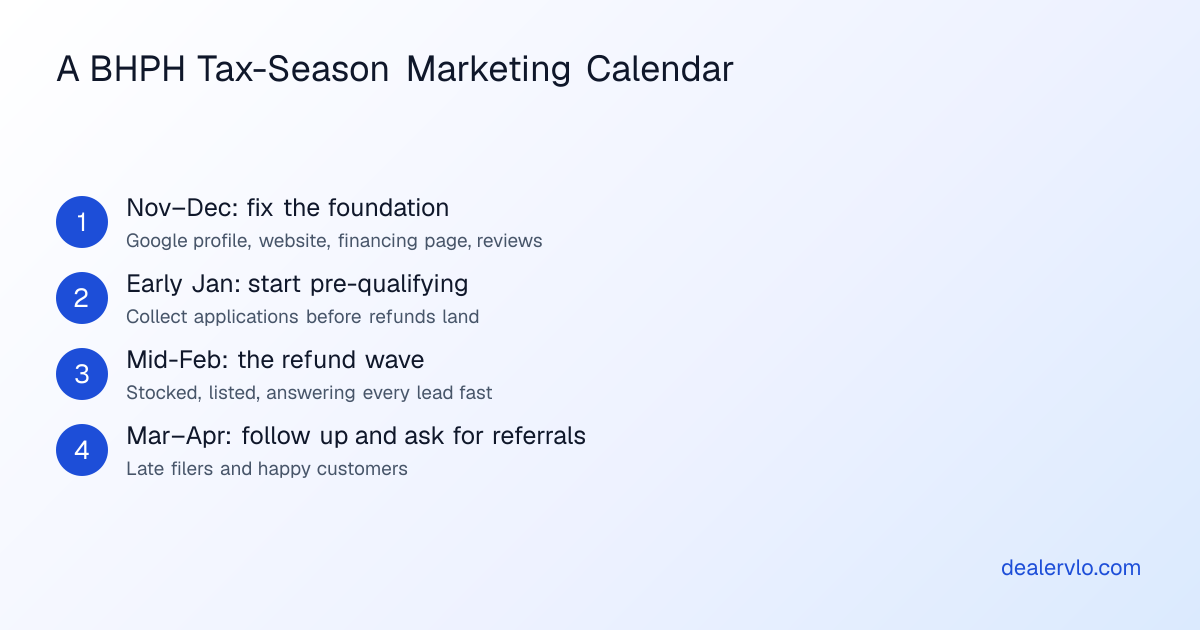
November–December: fix the foundation. Google profile, website, Financing page, current photos and prices, and reviews. None of it works if you start in February.
Early January: start pre-qualifying. Shoppers are planning what to do with their refund before it arrives. Invite them to apply now so you can answer the approval question before they walk in. Keep the wording within the rules in Step 2.
Mid-February: the refund wave. Be stocked, listed, and answering leads fast. The lots that win this week are the ones that bought and reconditioned in December and January.
March–April: follow up. Late filers and slower refunds keep the season going. Follow up on every application that didn't close, and ask your best customers for referrals.
Step 6: Answer fast, and know what's working
A BHPH lead goes cold fast. When a lead comes in through a DealerVLO dealer website, DealerVLO emails your dealership address, and if the buyer gave an email, it sends them an automatic confirmation. Every lead lands in a lead inbox with its source recorded, so you can see whether Marketplace, your website, or a paid campaign is producing deals. DealerVLO doesn't text or call customers; that part is you and your phone.
Then measure. Divide what you spent on each channel by the cars it actually sold. The cost per car sold guide shows the math, and the calculator above does it for you.

Step 7: Your paying customers are your best marketing
The cheapest BHPH lead is a referral from someone who's paying on time and likes how they've been treated. That relationship runs through collections: clear payment schedules, reminders, and treating people decently when a payment is late. Keeping BHPH accounts current covers the cadence, and repeat and referral business covers how to ask.
DealerVLO tracks buy-here-pay-here payments with a collections view, and lots carrying notes get a collections panel on the dashboard with payments due today and past-due accounts. A customer who's been treated well on the back end is the one who leaves the review and sends a cousin.
14-day free trial, then $29/mo · Cancel anytime
Frequently asked questions
How do you market a buy here pay here dealership?
Start with the basics a credit-challenged shopper checks on their phone: a Google Business Profile with your real name, hours, photos and reviews, and a website that shows your inventory and explains how your financing works, with a way to apply or pre-qualify. Then add Facebook Marketplace and paid ads, answer every lead fast, and track which source each sale came from. Time it so everything is ready before tax refunds arrive in mid-to-late February.
What can't you say in a buy here pay here ad?
If an ad states a down payment amount, the number of payments or the loan term, a payment amount, or a finance charge, the federal Truth in Lending rules (Regulation Z) require it to also disclose the down payment, the terms of repayment, and the annual percentage rate. General phrases like "pay weekly" or "monthly payment terms arranged" don't trigger those disclosures. Don't promise anything you can't deliver for every applicant, and have your attorney review your ad copy.
Do Facebook ads work for buy here pay here?
They can, but financing ads have to run in Meta's Special Ad Category for financial products and services. That means no ZIP code targeting, an age range that includes 18 to 65, all genders, no lookalike audiences, and city targeting that automatically widens to about a 15-mile radius in the US. Free Marketplace listings, posted by hand, are a separate channel without those targeting rules.
When should a BHPH lot start tax-season marketing?
Get the foundation ready in November and December, start pre-qualification messaging in January, and be fully stocked and answering leads fast by mid-February. By law the IRS can't issue refunds that include the Earned Income Tax Credit or Additional Child Tax Credit before mid-February, so refund money arrives in a wave right after that.
Should I put "Buy Here Pay Here" in my Google Business Profile name?
Only if it's part of your real business name as it appears on your sign. Google's guidelines say the profile name must reflect your real-world business name, and adding keywords or taglines that aren't part of it can get the profile suspended. Use your categories, description, and website to say you offer in-house financing.
Can Google ads target by ZIP code for financing offers?
No. In the United States and Canada, Google's personalized advertising policy doesn't allow credit-related ads to target or exclude people by age, gender, parental status, marital status, or ZIP code. Use city, state, or radius targeting instead.
Bottom line
BHPH digital marketing isn't about clever ads. It's about being findable, honest about how your financing works, and ready before the refund wave. Fix your Google profile and website now, keep payment talk inside the Truth in Lending rules, respect the platform limits on financing ads, and answer every lead fast in February.
If you want your website, Financing page, credit application, leads, and BHPH notes in one place, start a free 14-day DealerVLO trial.
14-day free trial, then $29/mo · Cancel anytime
Structure an in-house note — payment, total interest, and what it collects per month — for any weekly, bi-weekly, or monthly term.
Open the BHPH Payment Calculator