Keeping BHPH Accounts Current: A Payment Follow-Up Cadence for In-House Financing
A practical follow-up cadence for a buy-here-pay-here lot: catch a slipping account early, decide when to re-set a schedule vs. hold firm, and keep buyers paying.
Part of the BHPH, financing & F&I guide: How to Run a Buy Here Pay Here Dealership: The Whole Loop, From Approval to Payoff
Switching from another DMS? Compare DealerVLO to DealerCenter, Frazer, or Lot Wizard.
Run a buy-here-pay-here lot and you're not just the dealer — you're the bank. The gross is on the lot the day you sell the car, but the profit shows up one payment at a time over the next year or two. Which means the single number that decides whether your lot makes money isn't what you sold this month. It's how much of what you're owed actually comes in.
So the skill that matters most in BHPH isn't closing — it's keeping accounts current, and catching a slipping one early enough to do something about it. This is a follow-up cadence for exactly that: how to reach out, when to bend and when to hold firm, and how to read the signs a note is going bad before it does. One note up front: this isn't legal advice. The rules for ending a loan and any required notices vary by state — for that side, talk to a lawyer.
14-day free trial, then $29/mo · Cancel anytime
Keeping accounts current is the whole game
A retail dealer who sells a car and misses on the paperwork loses a little time. A BHPH dealer who sells a car to a buyer who stops paying loses the car, the gross, and the money he financed — and he's carrying that hole while he's still trying to collect. The economics only work if the payments come in, which is why the back half of a BHPH deal deserves as much attention as the front.
It matters more right now than it did a couple of years ago. Subprime and buy-here-pay-here past-due rates have climbed to multi-year highs, according to the Federal Reserve — meaning more of your customers are stretched thinner than they were when you approved them. That's not a reason to panic; it's a reason to be disciplined about follow-up, because the lots that stay boring and consistent about it are the ones that keep their money.
The follow-up cadence
The goal of follow-up isn't to be aggressive. It's to be early, predictable, and low-drama — so that paying you is a habit, and a real problem surfaces while it's still small.
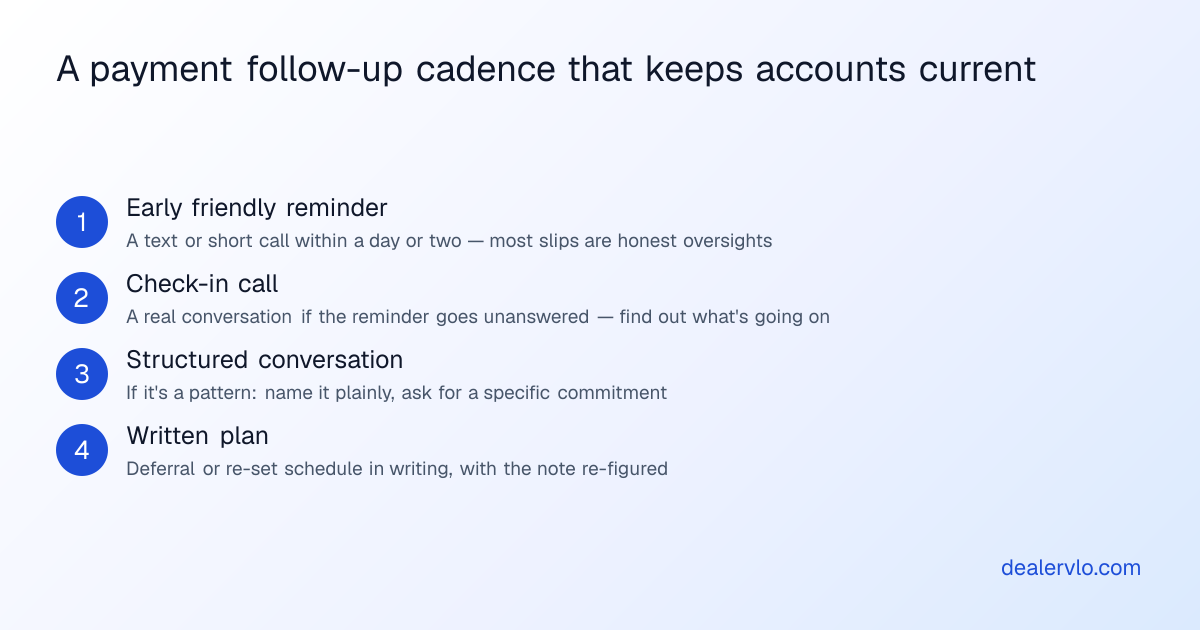
It starts before anything goes wrong: a light reminder around the due date keeps paying top-of-mind. When a payment slips, reach out within a day or two, gently — a text or a short call. Most misses at this stage are honest: a payday that moved, a card that expired, a life thing. Catching them early, before the customer has quietly decided to avoid you, is most of the battle.
If the reminder goes unanswered, that's your cue for a real check-in call — not a warning, a conversation. What's going on? Is this a one-week problem or a this-job-ended problem? You're gathering information as much as asking for money. And if the same account keeps slipping, you move to a structured conversation: name the pattern plainly, and ask for a specific commitment — a date, an amount — instead of another vague "soon."
When to bend, and when to hold firm
Not every past-due account is the same problem, and treating them the same is how you either lose a good customer or keep feeding a bad note.
Bend when the trouble is temporary and the customer is talking to you. A buyer who lost a week of work, is answering the phone, and has been reliable until now is worth a one-time deferral or a re-set schedule — keeping a paying customer paying is almost always worth more than forcing the deal to blow up. Hold firm when the pattern is chronic, the promises keep breaking, or the customer has gone dark. The tell isn't the missed payment; it's whether they're engaging.
When you do re-set a schedule, put it in writing and re-figure the note so both sides are working off the same new number — the payment, the remaining term, what it now collects per month. Guessing at the new math is how a "help" turns into a second argument.
Structure an in-house note — payment, total interest, and what it collects per month — for any weekly, bi-weekly, or monthly term.
Open the BHPH Payment CalculatorApproving the right buyer up front is what makes all of this rarer — a payment the customer's income actually supports is the single best thing you can do to keep an account current. That's a front-end job; see BHPH underwriting: who to approve. And when a customer wants to catch up or pay ahead, quoting it cleanly matters — how to calculate a BHPH payoff walks through it.
14-day free trial, then $29/mo · Cancel anytime
Reading the signs early
You don't react to one late payment from an otherwise-reliable buyer — that's noise. You react to the pattern, and the pattern shows up in a stack of small signals.
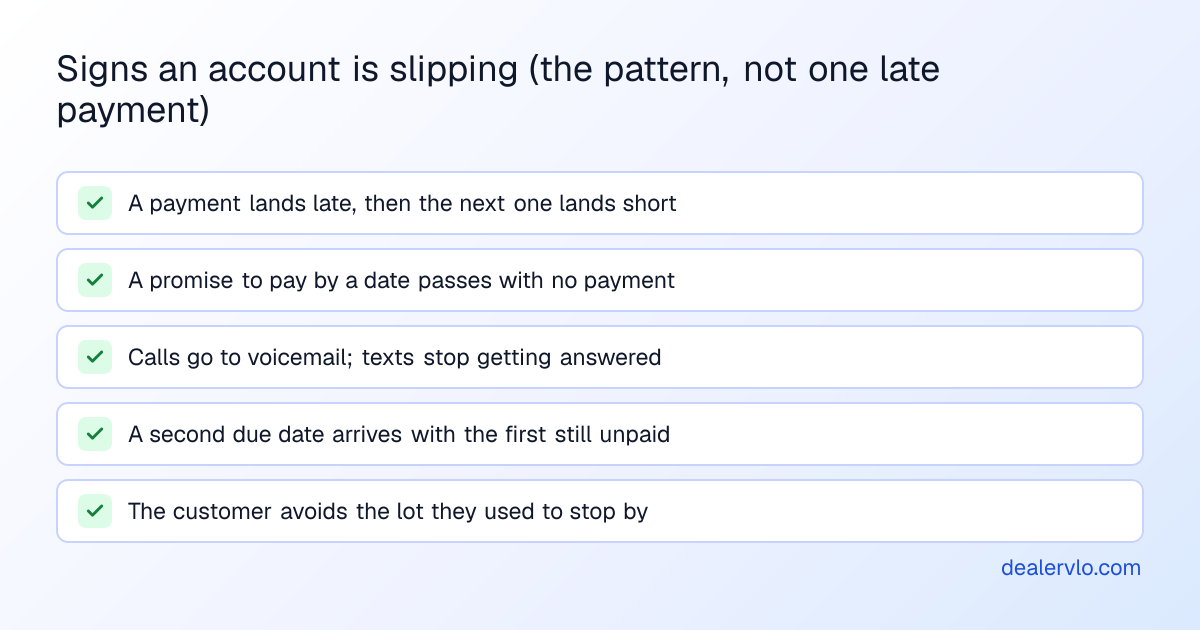
When two or three of those land on the same account, that's the moment for the direct conversation — not three weeks later. The whole advantage of a consistent cadence and good notes is that you see the pattern forming instead of discovering it after it's too far gone. This is also where a light, consistent reminder rhythm earns its keep: the habits that keep accounts current are cheaper than any recovery.
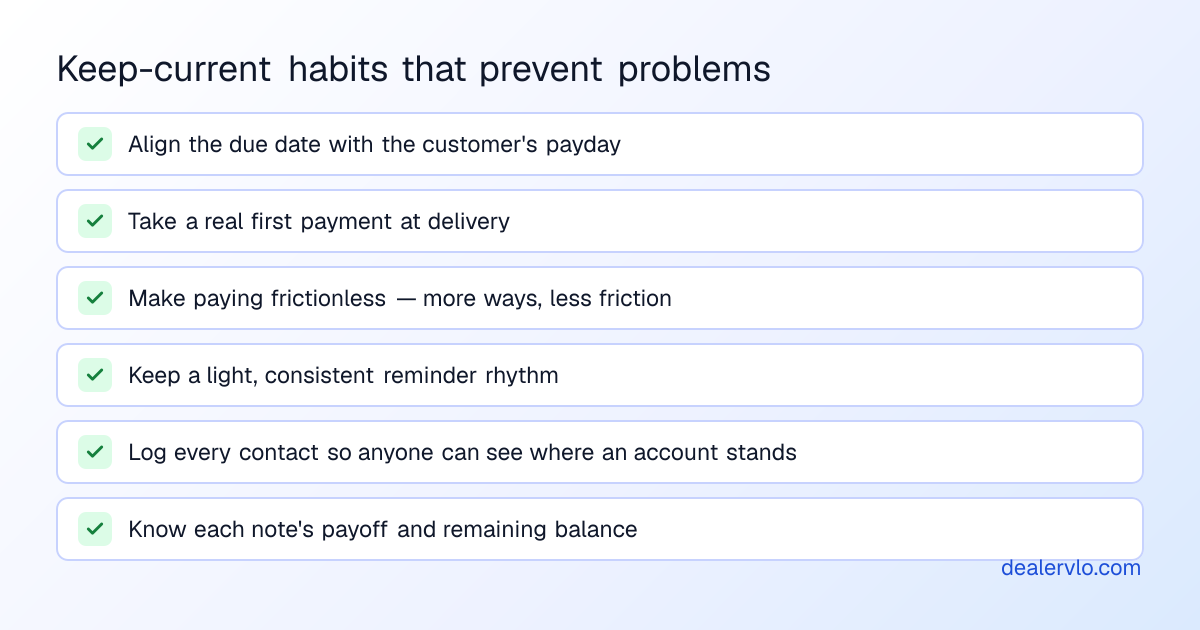
A lot of what looks like a follow-up problem is really an underwriting or setup problem that showed up later — the payment was too big, the due date fought the customer's payday, or the first payment never really happened. Fix those at the front, and the back half gets a lot quieter. (Down-payment discipline is part of that; BHPH and tax season covers the seasonal side.)
The line you don't cross alone
Everything above is operations — talking to customers, re-setting schedules, keeping habits tight. There's a separate world of rules that governs what happens if a note truly goes bad: ending the loan, recovering the vehicle, and any notices that requires. Those steps and their timing vary by state, and getting them wrong is expensive. Don't improvise that part — set your process with a lawyer for your state, and stick to it.
Frequently asked questions
How soon should a BHPH lot follow up on a missed payment? Early and lightly — a friendly reminder within a day or two of a missed due date catches most slips before they harden, since many are honest oversights. Waiting until an account is well past due to make first contact is the mistake.
When should I offer a payment deferral or re-set the schedule? When the problem is temporary and the customer is communicating — a reliable buyer who hit a real emergency and is answering the phone. Hold firm when the pattern is chronic or they've gone dark. Put any change in writing and re-figure the note.
What are the signs a BHPH note is going bad? The pattern: a payment that lands late then short, broken promises to pay, calls going to voicemail, and a second due date arriving with the first unpaid. One late payment is noise; several signals stacking is the signal.
How do I keep BHPH customers paying in the first place? Set the deal up to pay — align the due date with payday, take a real first payment at delivery, make paying easy, approve realistically, and keep a consistent reminder rhythm. Most back-end problems are front-end problems.
Does DealerVLO help manage BHPH payments? Yes — it structures the note, generates the schedule, and tracks every payment against the balance, so who's current and who's behind is visible without a spreadsheet, with payment and payoff calculators for re-figuring a note.
Bottom line
In BHPH, the money is made on the back half of the deal, so the follow-up cadence isn't clerical — it's the business. Be early, predictable, and low-drama; bend for temporary problems and hold firm on chronic ones; and read the pattern early enough to act. Approve well at the front, keep the habits tight, and most accounts stay current on their own.
If you want the payment side handled in one place — the note structured, the schedule generated, and every payment tracked against the balance so a slipping account is obvious — that's what DealerVLO does for in-house-financed lots. Start a free trial and set up a real note on your own numbers.
14-day free trial, then $29/mo · Cancel anytime